

Key Takeaways
ZoomInfo: Best for mid-market and enterprise teams that need verified data, intent signals, and AI research in one platform.
Apollo: Best all-in-one prospecting and outreach platform for SMB sales teams.
LinkedIn Sales Navigator: Best for social selling and account research inside the world's largest professional network.
Cognism: Best for EMEA and regulated industries that need phone-verified, GDPR-compliant data.
Lusha: Best lightweight prospecting tool for individual reps and small teams.
Clay: Best for technical GTM operators building custom enrichment workflows.
6sense: Best for marketing-led ABM and predictive intent.
Seamless.ai: Best for real-time contact discovery and fresh data.
UpLead: Best accuracy-first pick for SMB teams that want transparent pricing.
B2B prospect research used to mean an afternoon of cross-referencing LinkedIn, company websites, and a half-empty CRM before sending a cold email that probably wouldn't get a reply.
In 2026, that work has been compressed. The right tool surfaces in-market accounts, verified contacts, and the context a rep needs to start a real conversation in minutes, not hours. The wrong tool wastes a sales team's most expensive resource: their time.
This guide compares the 9 best B2B prospect research tools for 2026. For each, you'll see what it does well, where it falls short, real pricing, and who it fits, so you can match a tool to your sales motion, team size, and data needs.
What are B2B prospect research tools?
B2B prospect research tools are platforms that help sales and marketing teams identify, verify, and prioritize the companies and people most likely to buy.
They combine firmographic data, verified contact information, technographics, and intent signals to help teams research accounts faster. Many now also use AI to turn that data into account briefs and recommended next steps.
The category splits into a few types:
Data platforms focus on accurate contact and company data at scale.
All-in-one platforms bundle prospecting data with outreach and sequencing.
Social tools prospect inside a professional network using self-reported profiles.
Orchestration tools chain multiple data providers and AI together into custom workflows.
Intent platforms identify which accounts are in-market before they raise their hand.
Most teams use more than one. The question isn't which single tool wins, but which combination fits how you sell.
The 9 best B2B prospect research tools for 2026
Tool | Data strength | Intent data | Starting price |
ZoomInfo | 500M+ contacts, verified, intent + context graph | Yes (Guided Intent) | Consumption-based |
Apollo | 230M+ contacts, crowdsourced | Yes (Bombora) | Free or $49/seat/mo |
LinkedIn Sales Navigator | 1B+ member network | Partial | Core / Advanced tiers |
Cognism | Phone-verified Diamond Data, GDPR | Yes | From $14,000/yr |
Lusha | Verified emails and phones | Add-on | Free or $37.45/mo |
Clay | 150+ provider waterfall + AI | Via providers | Free or $167/mo |
6sense | Predictive buying-stage models | Yes (core) | Free or custom |
Seamless.ai | Live search engine for leads | Add-on | Free or custom |
UpLead | Verified data, real-time checks | Paid tiers | Free trial or $99/mo |
1. ZoomInfo
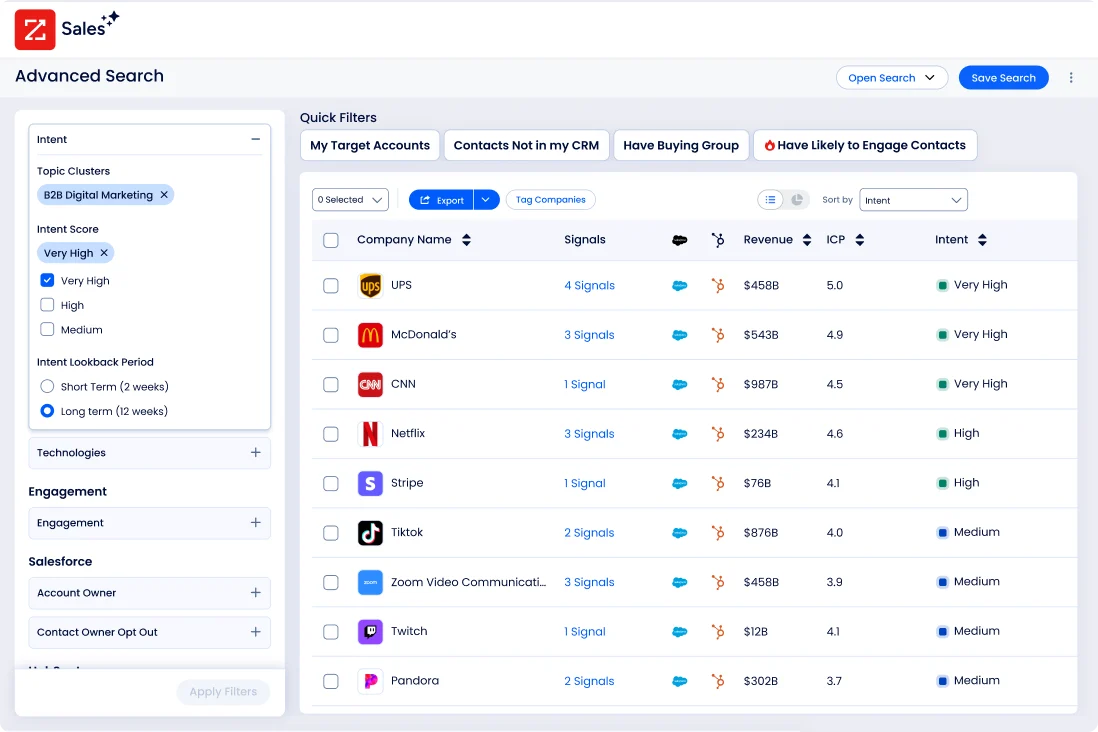
ZoomInfo is the most comprehensive B2B data platform for prospect research, built on verified contact and company data plus buyer intent signals. It answers the three questions every rep starts with: who to target, when to reach out, and what to say.
The database covers 500M+ contacts and 100M+ companies, with 135M+ verified phone numbers, 200M+ verified business emails, and up to 95% accuracy on first-party data. Where most intent vendors deliver signals without verified contacts, ZoomInfo combines both in one platform, so you can find an in-market account and reach the right person in the same workflow.
What separates ZoomInfo's research from a static database is the GTM Context Graph, the layer that connects its data with your CRM and conversation history to surface why an account is worth pursuing, not just that it exists. You can run that research inside Claude and ChatGPT through ZoomInfo's MCP server, without exporting a CSV.
Inside ZoomInfo's own workflow, ZoomInfo Copilot brings that intelligence into the rep's daily workflow within GTM Workspace, surfacing in-market accounts, drafting outreach, and recommending next steps automatically.
Key features:
Contact and company search across 300+ attributes, with department org charts, direct dials, and verified emails
Buyer intent from 210M IP-to-organization pairings, plus guided intent, which surfaces topics historically correlated with your own closed deals rather than manual keyword selection
WebSights website visitor tracking that resolves anonymous traffic to companies and buying teams
Technographic data on 30M+ companies across 30,000+ technologies
Job-change alerts, saved searches with automated alerts, and one-click CRM export
MCP and API access to run research inside Claude, ChatGPT, or custom agents
Pricing: Consumption-based. Cost is tied to what you use (exports, API calls, enrichment) rather than rigid per-seat licensing.
ZoomInfo Lite is permanently free with 10 monthly export credits. A 7-day trial of paid plans is also available.
What our customers say:
After running a vendor analysis on a test prospect list, Outreach found ZoomInfo returned the most accurate contact data and direct dials. Within three weeks, the team improved connect rates 7x, cut connect time by 67%, and reached target contacts 5x faster.
"ZoomInfo's direct dials were the best. The team was able to reach decision makers much faster due to having accurate direct dial phone numbers right at their fingertips." — Mark Kosoglow, VP Sales, Outreach
Read the Outreach case study →
2. Apollo
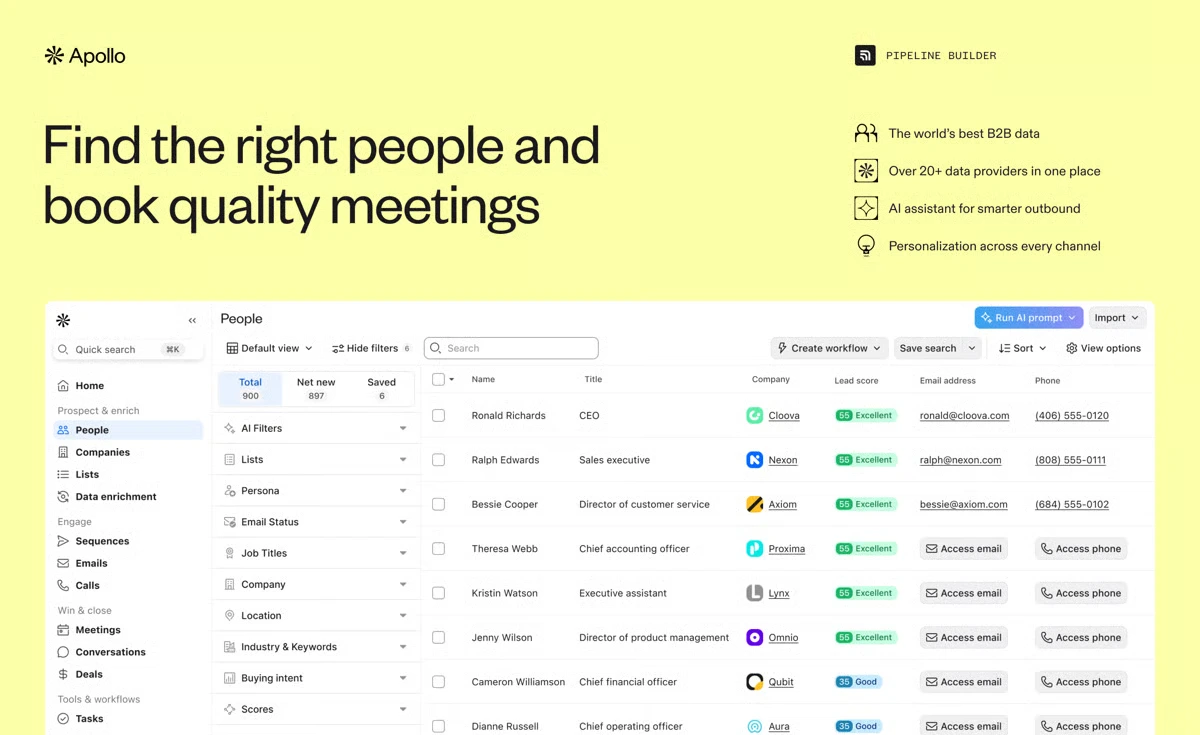
Apollo is an all-in-one platform that bundles a B2B contact database, multi-channel sequencing, a built-in dialer, and email deliverability tooling into one subscription. For small teams that want to prospect and run outreach without paying for two separate tools, it's a fast, affordable starting point.
The platform publishes 230M+ verified B2B contacts, with a claimed 97% email accuracy rate on verified records, 150M contacts refreshed monthly, and 5.3M new contacts added each month.
Apollo's data model combines crowdsourced contributions from 2M+ data contributors with public web crawling and third-party providers, which helps keep pricing accessible but can lead to inconsistent accuracy across some segments, particularly direct dials and non-US regions.
Key features:
Contact and company search across 230M+ verified contacts with 65+ filters
Built-in multi-channel sequences, dialer, and meeting scheduler
Chrome extension for LinkedIn and web prospecting
Intent data via Bombora and LeadSift
Pricing (annual billing):
Plan | Price | Credits per seat/year |
Free | $0 | 900 (granted monthly) |
Basic | $49/seat/month | 30,000 |
Professional | $79/seat/month | 48,000 |
Organization | $119/seat/month (3-seat min) | 72,000 |
Credits cover emails (1 credit) and phone numbers (8 credits). API access requires the Organization plan.
Customer reviews:
“The best thing I like about Apollo.io is that it is easy to find accurate leads and reach out to them in the correct approach. The filters are really useful and save a lot of time for follow-ups.” - Raju S., G2
“I dislike that Apollo.io can sometimes have outdated or inaccurate contact data. The platform can also feel a little overwhelming at first, and some features may take time to learn.” - verified G2 user
See how Apollo compares to ZoomInfo.
3. LinkedIn Sales Navigator
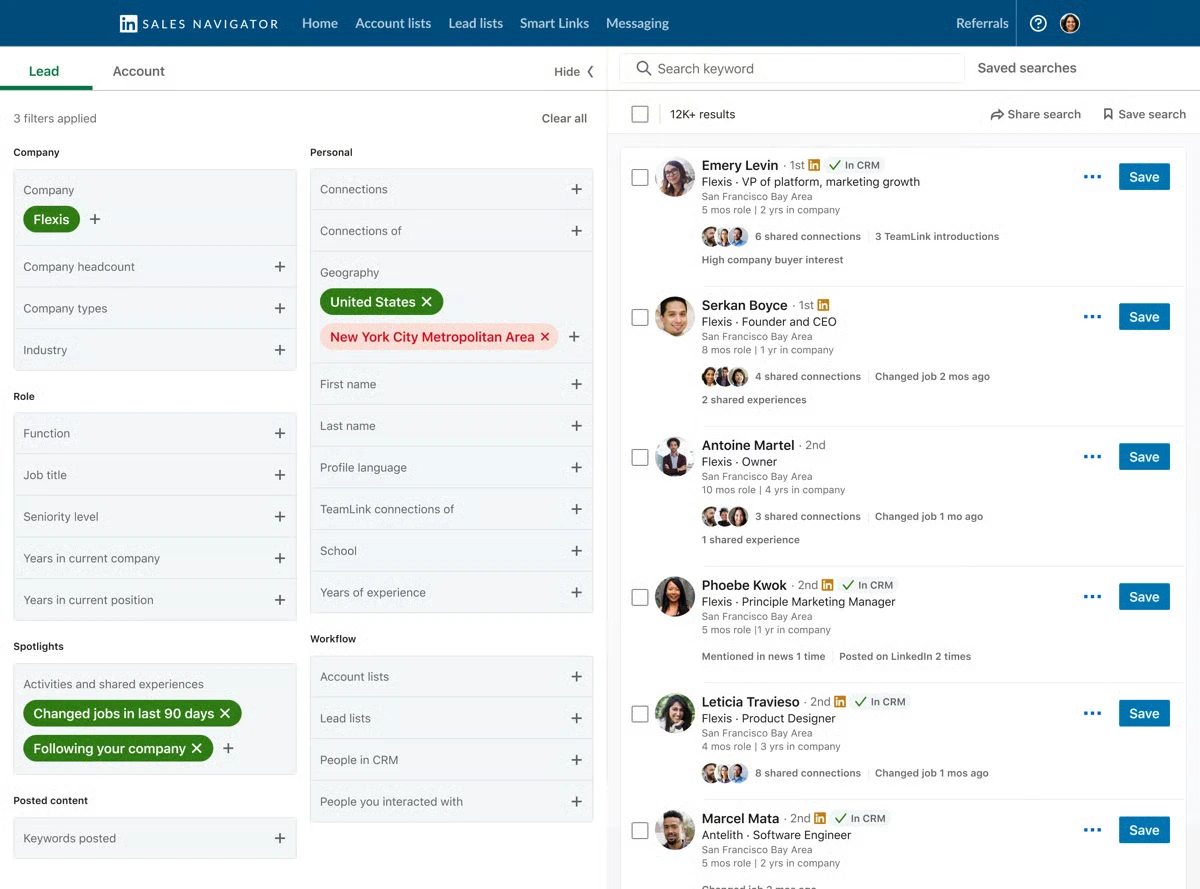
Sales Navigator is LinkedIn's prospecting tool, built on top of the platform's 1B+ member network. It filters by company, role, industry, seniority, and engagement signals like job changes and posts.
For prospect research, its strength is fresh, self-reported professional data: people update their own LinkedIn profiles, so titles and job moves are often more current than any third-party database.
It works best as a complement to a data platform rather than a standalone source. Sales Navigator gives you the person and the context, but not their direct dial or personal email, only InMail. Most teams pair it with a data tool that supplies verified contact details.
Key features:
50+ advanced search filters across LinkedIn member and company data
Account IQ and Lead IQ for AI-powered account and lead insights
50 InMail messages per month across all tiers
Real-time alerts on job changes, promotions, and posts
CRM sync with Salesforce, HubSpot, Microsoft Dynamics, and others
Pricing: Three tiers: Core (individual sellers), Advanced (sales teams, 2+ seats), and Advanced Plus (teams using integrated CRM, 10+ seats). LinkedIn doesn't publish per-seat pricing on its comparison page; check current rates directly.
A free trial is available.
Customer reviews:
“I like LinkedIn Sales Navigator for its ease of use and how it's my go-to source for information. I appreciate the updates on what's happening with target companies, the ability to save leads and accounts, and account mapping.” - Tim K., G2
“It takes a bit of getting used to, and the price isn’t cheap by any means. To really get value out of it, you need to stay on top of using your messaging credits and consistently following up.” - Matthew W., G2
See how LinkedIn Sales Navigator compares to ZoomInfo.
4. Cognism
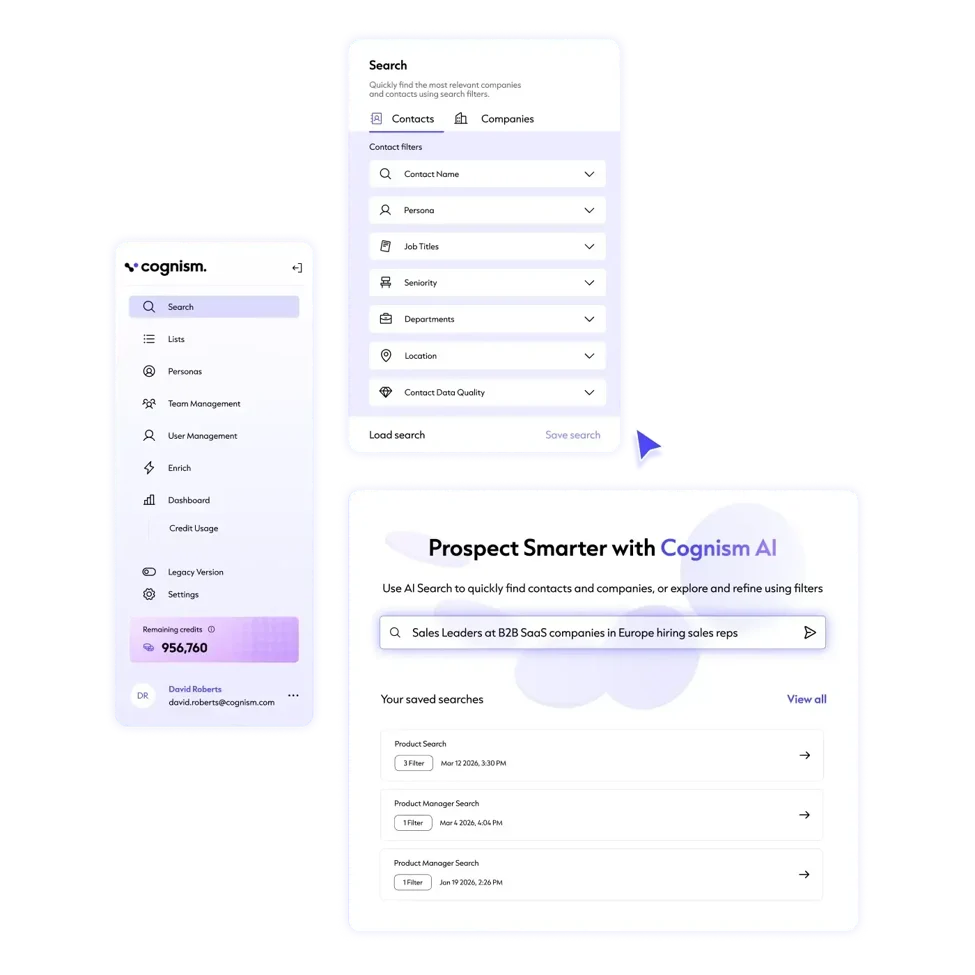
Cognism is a B2B sales intelligence platform built around compliance-first, phone-verified data, with particular strength in the UK and EMEA. Its flagship differentiator is Diamond Data, mobile numbers manually verified by human callers, which deliver higher connect rates for European prospects than algorithmically validated data.
For teams selling into regulated markets or across European borders, the compliance posture is the draw. Cognism screens against do-not-call lists across multiple countries and maintains GDPR and CCPA compliance built into the data layer. Coverage and accuracy are strongest in EMEA and taper outside Europe, so it's less of a fit for purely North American motions.
Key features:
Phone-verified Diamond Data mobile numbers with on-demand verification
Firmographic, technographic, and signal-based list building
Contextual signals including hiring, funding, M&A, and job changes
AI company research, persona builder, and AI search
GDPR and CCPA compliance with multi-country DNC screening
CRM enrichment and Data-as-a-Service add-ons
Pricing:
Plan | Price | Includes |
Standard | From $14,000/year | Core prospecting, 5 seats |
Pro | From $18,750/year | Advanced workflows, premium mobile data, intent, 5 seats |
Credits are used to reveal, enrich, or export contacts. No charge for viewing previously revealed contacts. CRM Enrichment and Data-as-a-Service are available as add-ons.
Customer reviews:
I really like how easily I can find new prospects and organize my accounts and lists with Cognism. It's also very easy to set up, which was a big plus for me. - Chara E., G2
The biggest downside is the price and the credit system for Diamond Data. While the verified numbers are great, you really have to be stingy with how you use them because the 'Diamond' credits run out fast if you're doing high-volume outreach - Syed F., G2
5. Lusha
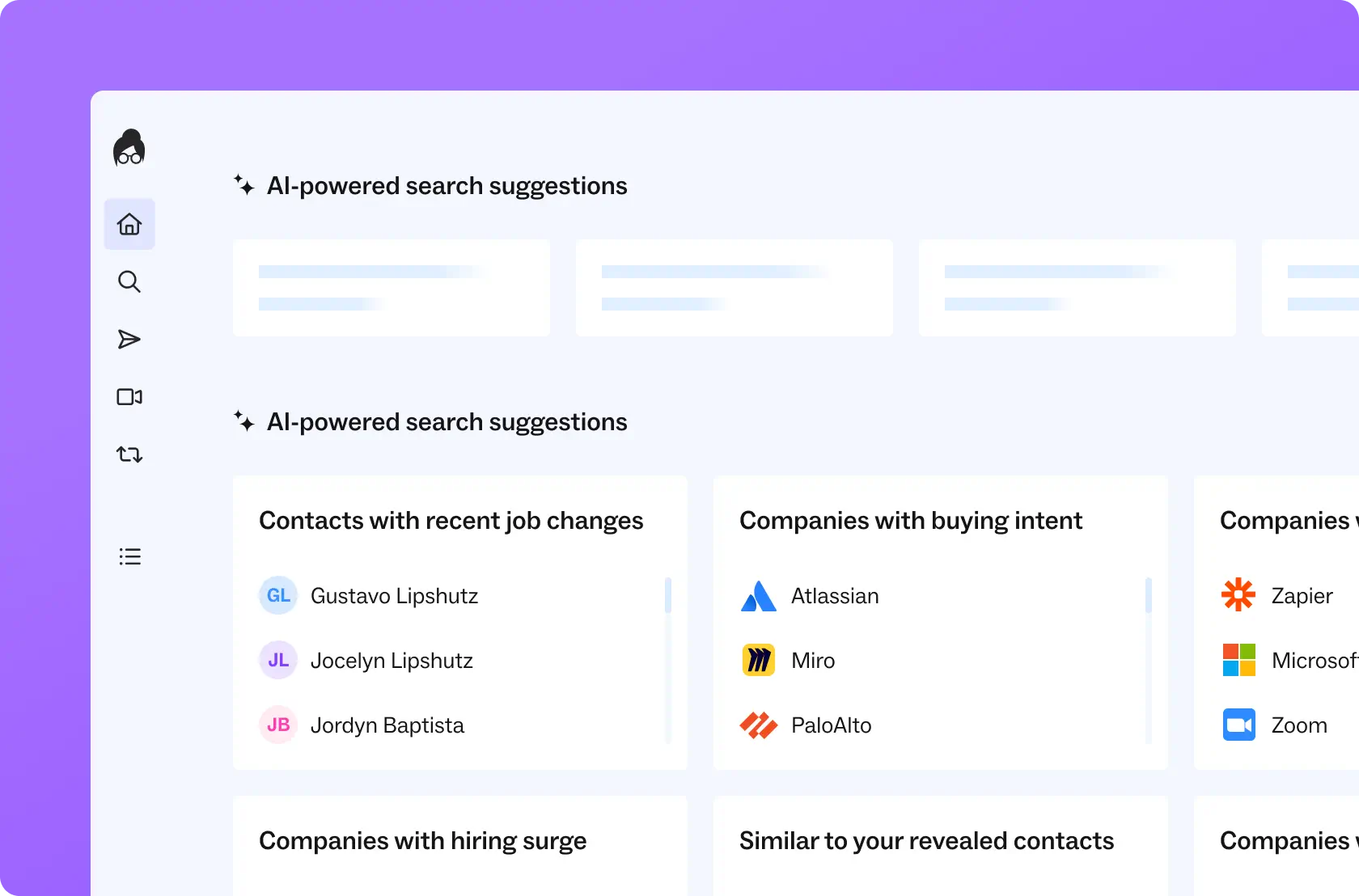
Lusha is a lightweight prospecting tool built around a clean browser extension that works directly on LinkedIn and company websites. Its focus is verified emails and phone numbers with a minimal interface, which makes it a practical pick for individual reps and small teams who want quick contact lookups without a steep learning curve.
Lusha emphasizes data accuracy and compliance certifications (GDPR, CCPA, SOC 2, ISO 27701) over breadth of features. It has fewer native signal and orchestration layers than enterprise platforms, but for teams whose main need is reliable contact data inside their existing workflow, that simplicity is the point.
Key features:
Verified emails and phone numbers via Chrome extension
Contact and company lookalikes for list expansion
Buying intent topics (5 on paid tiers, more on Scale)
API, webhooks, and MCP support on higher tiers
Bulk enrichment and CRM export
Compliance certifications built in
Pricing:
Plan | Price | Credits/year | Seats |
Free | $0 | 480 (40/mo) | 1 |
Starter | $37.45/month | 4,800 | 1 |
Pro | $52.45/month | 7,200 | 2 |
Premium | $299.95/month | 40,800 | 5 |
Scale | Custom | Custom | Custom |
Phone numbers cost 5 credits each; emails cost 1. Higher tiers add API access, SSO, and unlimited intent results.
Customer reviews:
“I can use it for free. It connects with LinkedIn which makes it easy to access while on their website.” - verified G2 user
“Users consistently report a few major pain points with Lusha, primarily centered around inaccurate or outdated contact data, a restrictive credit-based pricing model, and privacy concerns.” - Vedant G., G2
See how Lusha and ZoomInfo compare.
6. Clay
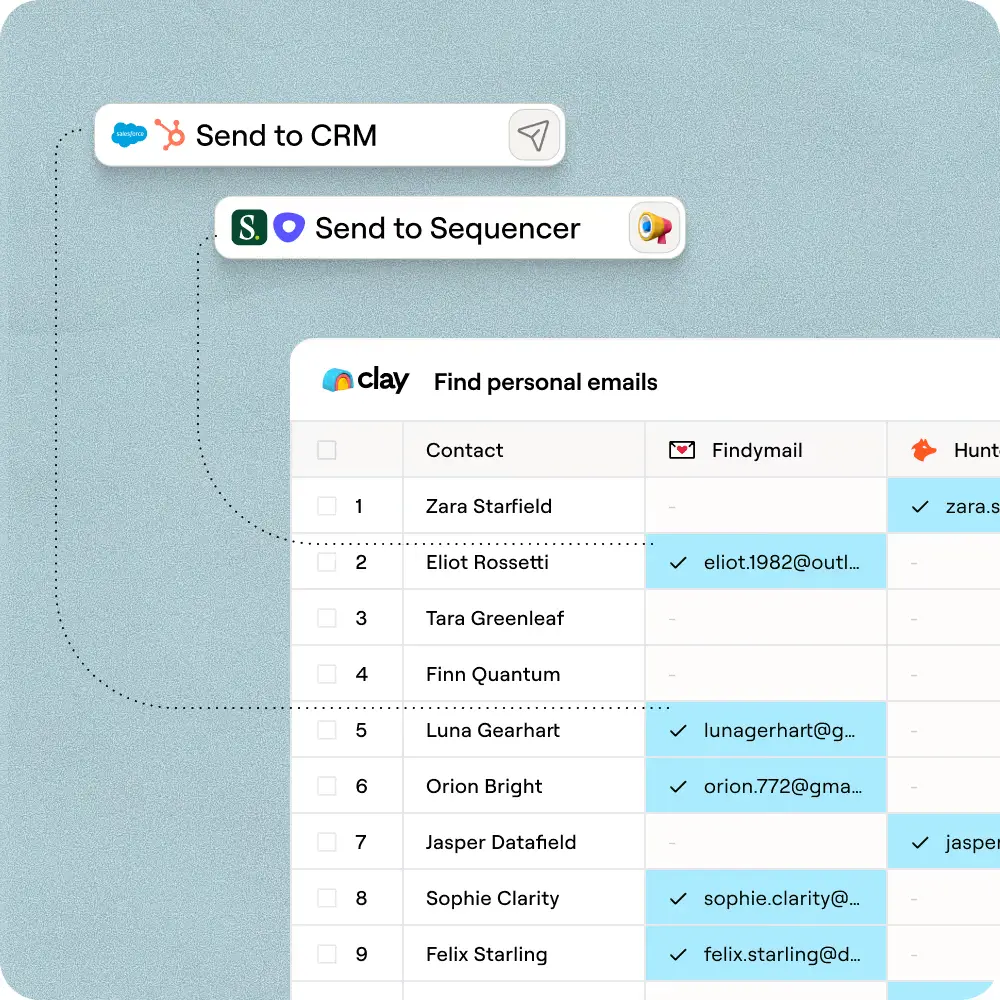
Clay is a data orchestration and enrichment platform for technical GTM operators.
Rather than relying on a single data source, it queries 150+ providers in a waterfall, runs AI research agents through Claygent, and pushes the output into any CRM or sequencer. For teams that want granular control over enrichment and have the resources to build and maintain the workflows, it covers a wide range of use cases.
The flexibility comes with a learning curve. Clay runs cohort training and certification programs, which reflect the configuration burden it places on whoever owns it. Pricing also runs on two separate currencies (Actions for platform work, Data Credits for the data itself), so costs can compound at scale. Clay fits custom research, experimental enrichment combinations, and bespoke lead-gen workflows where the right provider mix isn't obvious.
Key features:
150+ data provider integrations in one workflow canvas
Claygent AI agent for web research and custom data extraction
Waterfall enrichment with provider fallback logic
Signal tracking for job changes, funding, hiring, and news
API and webhook output to CRM and sequencers
Native sequencer and ad-audience sync
Pricing:
Plan | Price | Actions/year | Data Credits/year |
Free | $0 | 6,000 | 1,200 |
Launch | $167/month | 180,000 | 30,000 |
Growth | $446/month | 480,000 | 72,000 |
Enterprise | Custom | Custom | Custom |
Actions and Data Credits are separate currencies and don't roll over between periods. A 14-day trial is available.
Customer reviews:
“It's really super helpful for enriching and qualifying the leads and then scoring the leads, sending them to the automation tool. It's really handy when it comes to outbound workflow.” - Krishna S., G2
“I feel there can be more integrations, like more AI. Maybe something like having tools built in Clay, similar to Zapier or any other, would be amazing, so we don't have to rely on external tools for integrations.” - Anwesh S., G2
7. 6sense
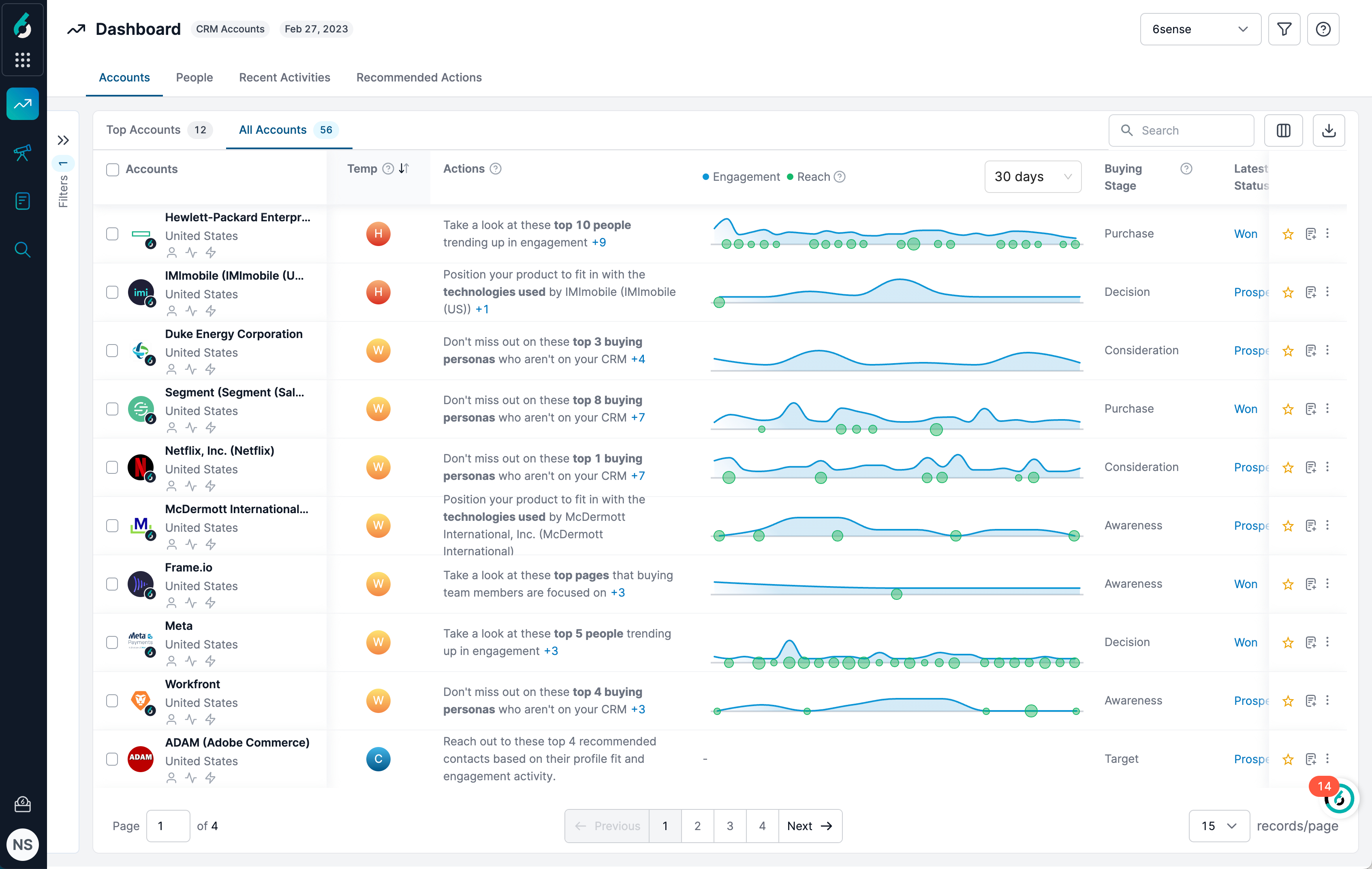
6sense is an intent and predictive platform built on the premise that most of the B2B buyer journey happens before a prospect talks to a seller.
Its Signalverse ingests over a trillion buying signals daily and classifies accounts into buying stages using predictive models trained on each customer's own win/loss data. For marketing-led ABM programs, that account identification is the core value.
Where 6sense shows limits is contact-level execution. Reviewers flag data quality gaps at the contact level, and intent signals only drive revenue when sales can reach the people behind them. Implementations also take time and dedicated administration. 6sense is strongest as the account-identification layer in an ABM stack, often paired with a verified contact data source for execution.
Key features:
Predictive buying-stage classification scored across the funnel
Company and people search with List Builder and Persona Map
Technographics, psychographics, and third-party intent
Web visitor identification and job postings
Sales Copilot with AI account summaries and recommended actions
CRM, SEP, and web app integrations
Pricing: Free tier includes 50 data credits per month with company and people search, sales alerts, List Builder, and Chrome extension. Paid tiers (Sales Intelligence with data credits and/or predictive AI) are custom-quoted.
Intent data, predictive scoring, and CRM integrations are excluded from the free tier. Advertising costs are separate from platform fees.
Customer reviews:
“I like the fact that 6sense Sales Intelligence gives alerts when organizations are ready to be reached out to, so we don't waste any time. We can see immediately their buyer intent and their buying stage, which we can then use in a timely fashion.” - David G., G2
“While 6sense Sales Intelligence does provide us with beneficial insights, the learning curve has been fairly steep, and the platform can feel complex to navigate and use.” - Ethan M., G2
8. Seamless.AI
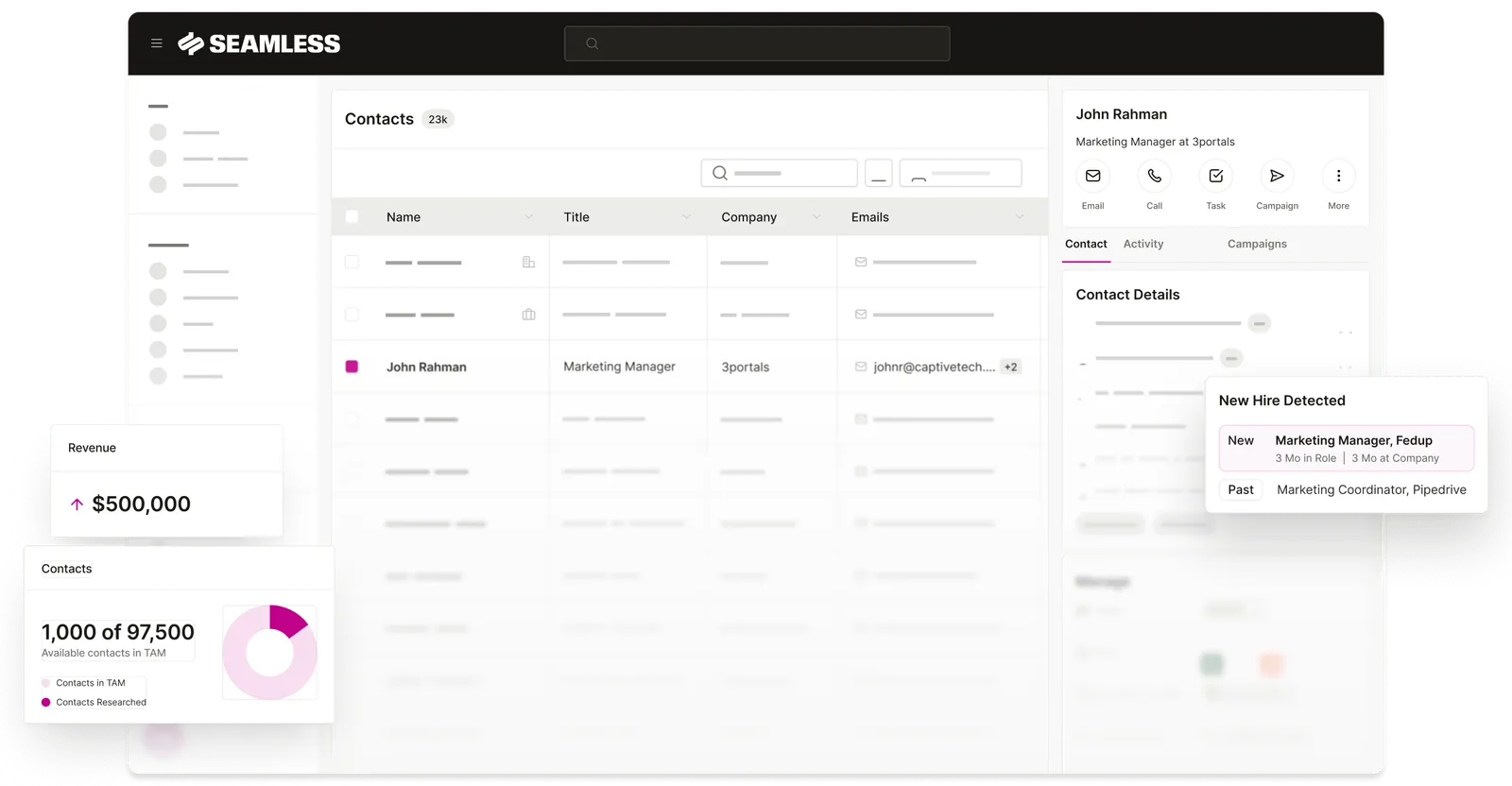
Seamless.AI is a real-time search engine for B2B contact data.
Rather than serving from a static database, it searches the web live to find emails, cell phones, and direct dials at the moment you query, which it positions as a way to reduce data decay. For teams that prioritize fresh contact discovery and want prospecting plus basic outreach in one tool, it's a budget-friendly option.
Reviewers consistently praise the search and filtering but flag email accuracy and aggressive upselling as the main drawbacks. Several core capabilities (data enrichment, buyer intent, autopilot, API) are add-ons rather than included, so the real cost depends on what you bolt on.
Key features:
Real-time search engine for emails, cell phones, and direct dials
Chrome extension for prospecting on LinkedIn and the web
Pitch Intelligence and AI writing assistance
Connect for built-in emailing, calling, and tasks
Job-changes filter to keep contact data current
Add-ons for data enrichment, buyer intent, autopilot, and API
Pricing: Free tier includes 1 user and 50 credits. Pro (per user, annual credit packages, unlimited exports) and Enterprise (unlimited users, custom packages) are contact-sales only.
Several capabilities, including buyer intent and data enrichment, are paid add-ons rather than included in base plans.
Customer reviews:
“I like that Seamless quickly finds accurate emails and direct dials, with intuitive filters, CRM integrations, and a Chrome extension that make building and capturing high‑quality B2B lead lists fast and efficient.” - Hardik L., G2
“Intent signals aren't always precise, and contact data (like most platforms similar to this) is not always complete or up to date.” - Todd L., G2
9. UpLead
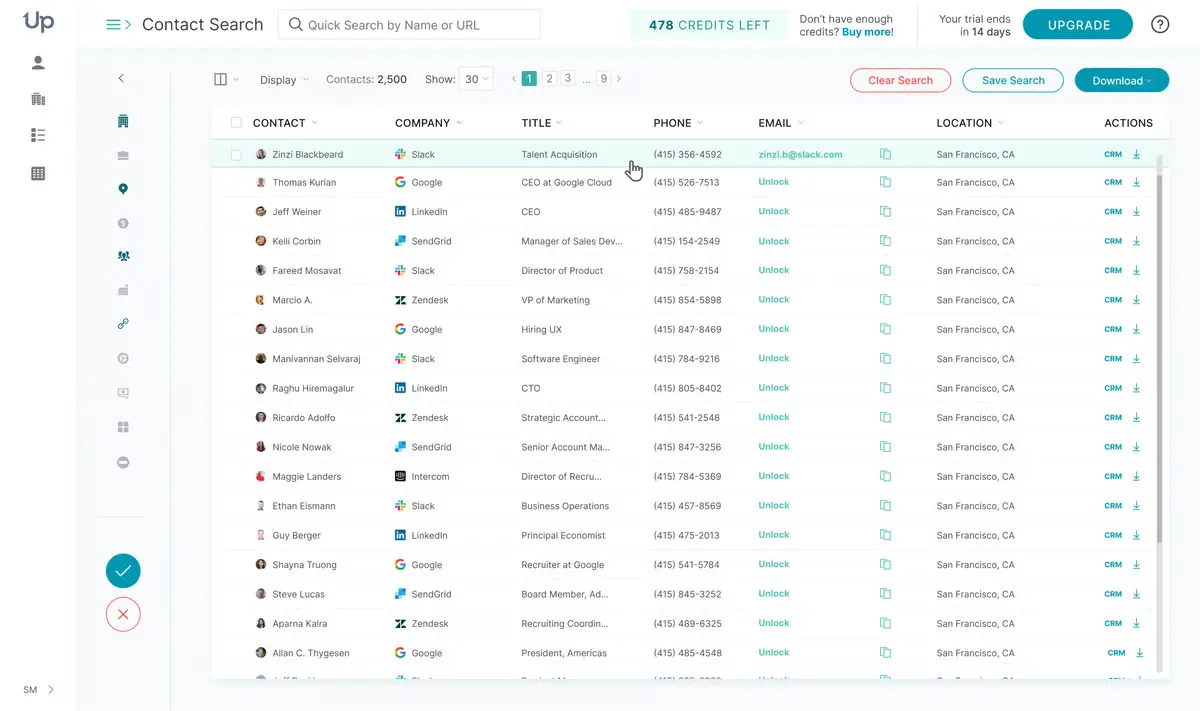
UpLead is an accuracy-focused data platform aimed at SMB teams. Its differentiator is real-time email verification at the point of export, which it backs with a high-accuracy guarantee, and transparent published pricing, an exception in a category where most providers gate quotes behind sales calls.
For teams that found enterprise platforms too expensive or larger databases too unreliable, UpLead's pitch is clean data at a predictable price. The trade-off is a smaller database and lighter feature set than the enterprise platforms, with buyer intent and full API access reserved for the top tier.
Key features:
Verified emails and mobile direct dials with real-time checks
Technographics and data enrichment on higher tiers
Buyer intent data and competitor intelligence on Professional
Advanced search filters and suppression list uploads
Chrome extension and bi-directional CRM sync
Integrations with major CRMs plus 1,500+ apps via Zapier
Pricing:
Plan | Price | Credits |
Free Trial | $0 / 7 days | 5 |
Essentials | $99/month | 170 |
Plus | $199/month | 400 |
Professional | Custom (annual) | Custom |
One credit unlocks one contact. Buyer intent, full API access, and bi-directional CRM sync are reserved for the Professional plan.
Customer reviews:
“I like UpLead because it's easy to use and accurate. The initial setup was very easy, which made getting started a breeze.” - Whitney A., G2
“When searching for contacts that have common names it can be hard to find the right one. The lead list can only reveal 100 at a time.” - Rich B., G2
How to choose a prospect research tool
The best tool is the one that fits your data needs, sales motion, and team size. Four factors separate a good fit from a wasted subscription.
Data accuracy and coverage
Accuracy is the foundation everything else runs on.
A database of 500M contacts is worthless if a third of the records bounce. Look at verification method (human-verified beats algorithm-only), refresh frequency, and accuracy guarantees.
Match coverage to your market: North American depth, EMEA compliance, or global reach are different strengths, and few tools lead in all three.
Intent and trigger signals
Firmographic fit tells you who to target. Intent tells you when. The strongest tools pair both, so you reach in-market accounts with verified contacts in one workflow rather than buying signals from one vendor and contacts from another.
Check whether intent is included or an add-on, how often it refreshes, and whether it's account-level or contact-level.
Filtering and segmentation depth
Research is only as good as your ability to narrow the field.
Strong filtering across industry, size, technographics, seniority, and signals lets you build precise lists instead of broad ones. Tools with shallow filters force you to do the segmentation work manually after export.
Workflow and CRM integrations
A tool that doesn't sync to your CRM creates manual work and stale data. Prioritize native, bidirectional integrations over Zapier-based connections, which add latency and failure points.
The best tools push research directly into the systems your team already works in, including, increasingly, the AI assistants reps use for daily research.
Get better prospect research with ZoomInfo
Most prospect research tools give you data. ZoomInfo gives you data plus the context to act on it. The platform combines verified contacts, company intelligence, and intent signals with the GTM Context Graph, the layer that connects what's happening across an account to what you should do next.
500M+ contacts and 100M+ companies, verified at up to 95% accuracy on first-party data
135M+ verified phone numbers and 200M+ verified business emails
Guided Intent that surfaces the topics tied to your own closed-won deals
WebSights visitor tracking, technographics, and org charts in one platform
MCP and API access to run research inside Claude, ChatGPT, and custom agents
Your team doesn't need another tab in the stack. They need better data inside the workflow they already use.
Talk to our team to see how ZoomInfo powers your prospect research.
FAQs
What's the difference between prospect research tools and a CRM?
A CRM manages relationships you already have. Prospect research tools find and verify new accounts and contacts before they enter the CRM. Most teams feed research data into the CRM, where the relationship takes over.
How much do prospect research tools cost?
Pricing ranges from around $37 per month for lightweight SMB tools to five-figure annual contracts for enterprise platforms. The right comparison isn't price per contact, it's cost per qualified opportunity sourced.
Are free prospect research tools worth it?
Free tiers are useful for testing data quality before you commit. They're capped on credits and features, but they're the best way to evaluate accuracy against your own target list before paying.
What's the best prospect research tool for small teams?
Apollo is the strongest all-in-one for small teams that want prospecting and outreach in one tool. Teams that prioritize data accuracy over breadth tend to move to ZoomInfo as their ICP and pipeline goals get more defined.
