
LinkedIn is where B2B buyers research vendors, follow peers, and quietly build shortlists, which is exactly why it is the most competitive lead generation channel in B2B. Winning on it in 2026 takes more than connection requests and templated DMs.
This guide covers what actually generates pipeline on LinkedIn now: the organic, paid, and outbound plays that work, and the mistakes that waste budget. It also shows how to turn LinkedIn activity into booked meetings by reaching buyers on the channels where they actually reply.
What Is LinkedIn Lead Generation
LinkedIn lead generation is the practice of using LinkedIn to identify decision-makers who fit your ideal customer profile, earn their attention, and convert them into qualified leads your sales team can work. It spans three motions that reinforce each other: organic content and social selling that pull buyers toward you, paid ads and Lead Gen Forms that capture demand at scale, and outbound prospecting that reaches specific accounts directly.
What makes LinkedIn different from cold email or cold calling is visibility. Before a prospect replies, they can see your profile, your mutual connections, and your credibility, which creates a warmer path to a conversation. That same visibility raises the bar: a weak profile or a generic pitch gets ignored faster here than anywhere else.
The channel is crowded for a reason. LinkedIn hosts more than 65M decision-makers, and they use it to evaluate vendors before they ever fill out a form. The opportunity is real, but so is the noise, which is why a clear strategy matters more than raw activity.
Is LinkedIn Right for Your ICP? A Quick Reality Check
Before you invest in a LinkedIn motion, confirm your buyers are actually there. This is the step most guides skip, and it saves you weeks of effort pointed at the wrong channel.
Run this diagnostic before committing budget:
Does your ICP keep an active LinkedIn profile, not just a dormant one?
Are your target titles the kind that post, comment, and read on the platform?
Does your average deal size justify the time that relationship-based outreach takes?
Is LinkedIn a primary professional network in your buyers' industry?
If you answered no to two or more, LinkedIn may not be your highest-leverage channel. Construction, manufacturing, field services, and many traditional SMB buyers are rarely active on it, and practitioners in communities like r/b2bmarketing are blunt about this: a motion built around a platform your buyers ignore will underperform no matter how well you execute. Knowing this upfront tells you whether LinkedIn is your main play or a support channel to a phone and email motion.
The 10 LinkedIn Lead Generation Strategies That Work in 2026
The plays below move from building demand to capturing it to converting it. Most teams run several at once, but the sequence matters: targeting and positioning come before outreach, and measurement runs underneath all of it.
1. Turn Your Profile and Content Into an Inbound Engine
Your profile is a landing page, so treat it like one. Lead your headline with the problem you solve, not your title, and use your About section and Featured links to point at a resource or a booking link. Then post content that earns attention: perspective, frameworks, and lessons from real work, not product announcements.
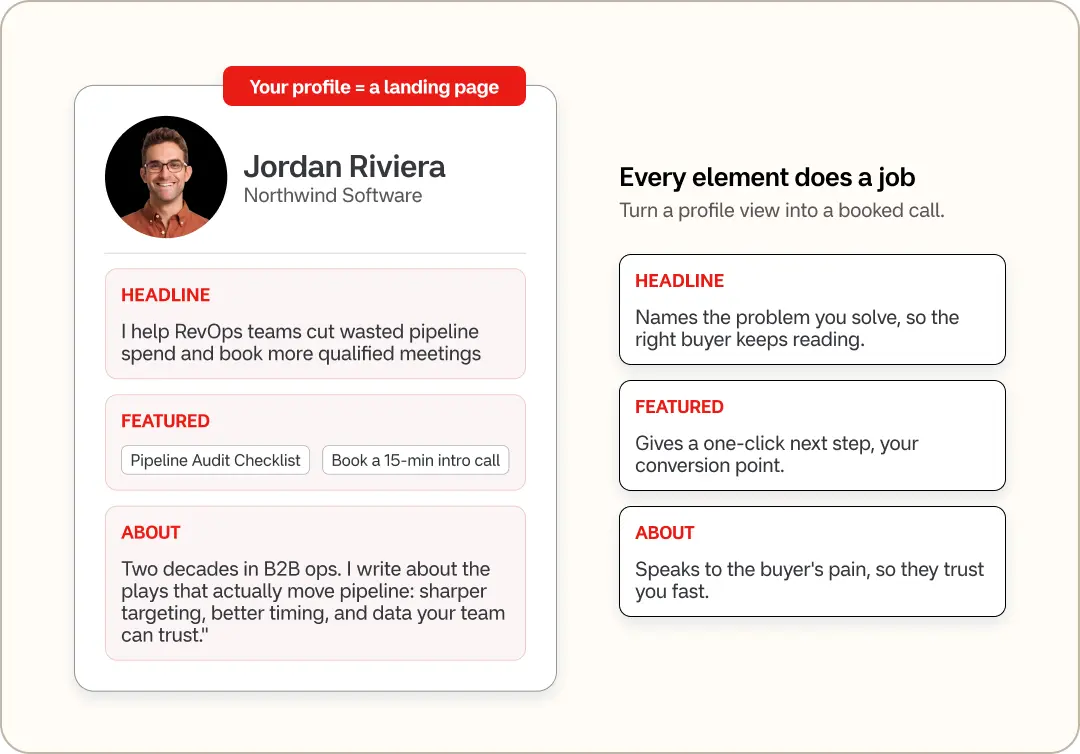
Be honest about how organic has changed. Practitioners report that pure organic posting is harder than it was two years ago, and that the posts which move pipeline sell a point of view rather than a product. AI-generated "personalization" is called out fast, so authenticity is the edge. Treat content as a compounding warm-up that makes your later outreach land, and pair it with inbound lead generation motions on your own site.
2. Build a Precise Target List With Sales Navigator and Boolean Search
Precision beats volume. Start from a named target account list rather than searching for individuals at random, then map the buying committee inside each account. Sales Navigator filters and Boolean operators (AND, OR, NOT, and quotation marks for exact titles) let you narrow to the exact roles and seniorities you want.
An example Boolean string for finding senior marketing buyers while excluding noise:
("marketing director" OR "VP marketing") AND ("B2B" OR "SaaS") NOT "intern"
Save your best searches so new matches surface automatically. The limitation to plan around: Sales Navigator shows you who to target, but it does not give you their email or direct dial, which is where a data provider comes in later.
3. Layer Intent Signals and Trigger Events to Time Outreach
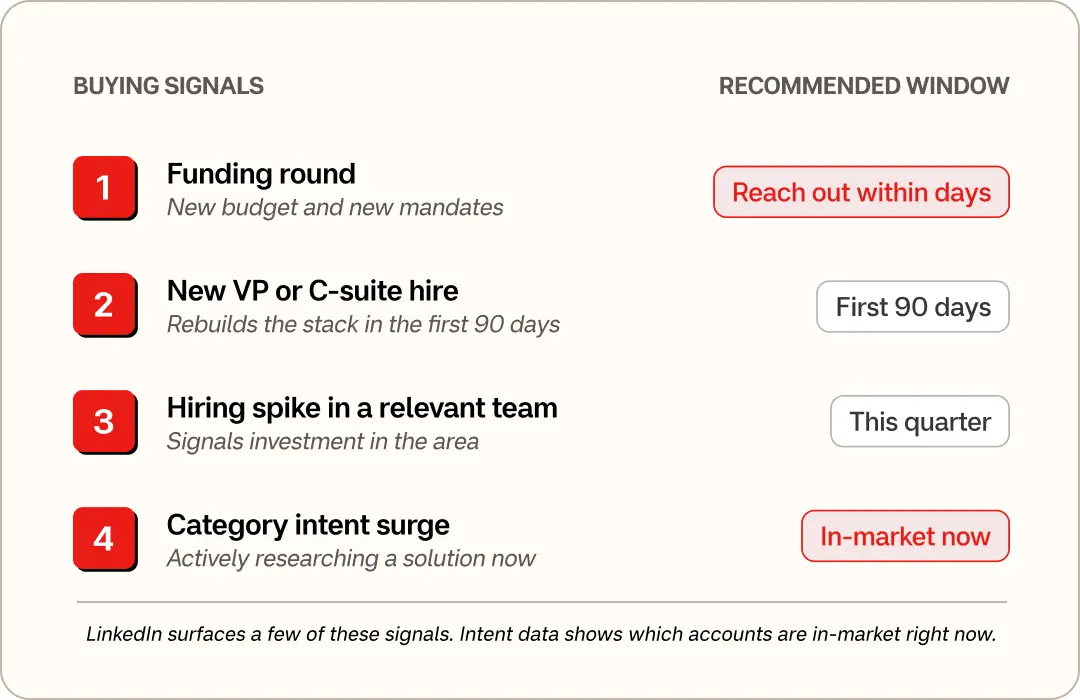
Timing is the highest-leverage variable in LinkedIn outreach. The same message lands or flops depending on when it arrives. Rank your outreach by trigger events, with the strongest at the top:
A funding round, which brings new budget and mandates, so reach out within days.
A new VP or C-suite hire, who typically rebuilds the stack in their first 90 days.
Sustained hiring in a relevant department, which signals investment.
Executive posts about a specific challenge you solve, which tell you what is top of mind.
LinkedIn surfaces some of these, but it cannot tell you which accounts are actively researching your category right now. That is buyer intent data, and it is the difference between guessing and knowing. Pairing trigger events with intent signals means you spend time on accounts already in a buying window instead of the whole list.
4. Personalize Outreach That References Something Real
You have 300 characters in a connection request, so spend them on the prospect, not your pitch. Reference a specific post, a mutual connection, or a company event, and state why you are connecting without selling. Save the ask for after they accept.
For the full message frameworks, cadence, and templates, see our guide to LinkedIn prospecting and outreach. The principle that matters most: personalization means referencing something true, and merge-field "Hi {{FirstName}}" personalization fools no one. Copy only lands when the targeting behind it is right, so accurate data and signals do more for reply rates than clever wording.
5. Multi-Thread the Buying Committee
Single-contact outreach is a single point of failure. When your one contact goes quiet, the deal stalls. B2B decisions run through a buying committee, so connect with three to five stakeholders across the account and tailor your angle to each role.
This is where stakeholder mapping pays off: an org chart shows you who the economic buyer, the champion, and the technical evaluator are, so you reach the whole group rather than hoping one person carries the deal internally. Warm intros through mutual connections lift response rates several times over cold outreach, according to practitioners who run this motion.
Reaching the whole committee only works if you can contact each person. ZoomInfo pairs buying-group and org-chart data with a verified direct dial and email for every stakeholder, which is how the sales engagement platform Outreach lifted its connect rate 7x.

"What's most compelling is the emotional boost that a rep gets when they pick up the phone and they know they have a chance."
6. Run LinkedIn Ads and Lead Gen Forms
Paid is now a core part of most LinkedIn lead generation programs, not an afterthought, because organic reach alone rarely fills a pipeline. LinkedIn's targeting lets you reach buyers by job function, seniority, industry, and skills, and you can upload your account-based marketing lists as matched audiences to serve ads straight to your target accounts.
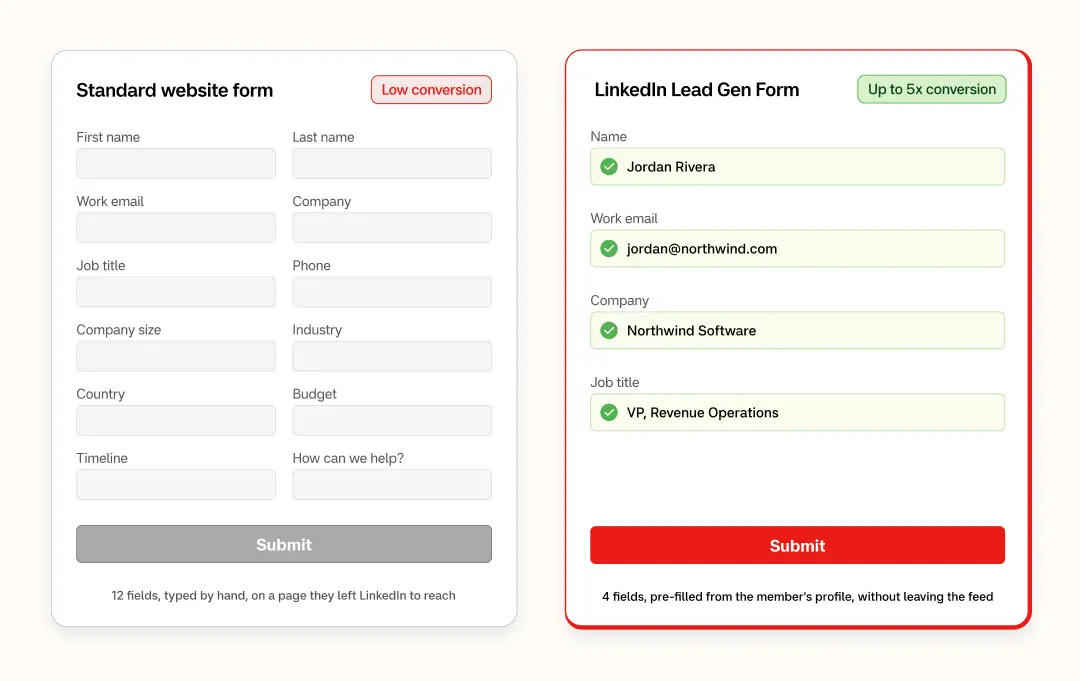
Use Lead Gen Forms rather than sending clicks to a landing page. They pre-fill with the member's profile data, which removes friction and, per LinkedIn, can convert up to five times better than off-platform forms. A few rules that hold up:
Keep forms to three or four fields, since every extra field costs conversions.
Match the form's promise to the ad so the experience is seamless.
Sync submissions to your CRM and route them for instant follow-up, because speed to lead decides who wins.
The catch with any form fill is data quality, so enrich each submission with a verified email, direct dial, and firmographics before it hits the routing queue.
7. Retarget the Buyers Who Already Know You
Most leads need several touches before they convert, so retargeting keeps you in front of people who already engaged. Install the LinkedIn Insight Tag, then segment audiences by intent: pricing-page visitors on a short window, content readers on a medium one, and light visitors on a longer one, each with messaging matched to their stage.
Build exclusion audiences for current customers and active opportunities so budget goes only to prospects who still need nurturing. Retargeting is also where organic and paid compound, since people who saw your content are far more likely to act on the ad.
8. Use LinkedIn Events and Lead Magnets to Capture Demand
A gated resource or a short event turns attention into contact information. Practitioners running monthly LinkedIn events report hundreds of registrations and dozens of genuinely relevant leads per session, because attendees can register in one click and reps can invite their networks at scale.
The same logic applies to lead magnets: a data-backed report, a calculator, or a practical framework gives buyers a reason to hand over their details. Promote it through personal and company posts, boost the posts that perform, and route every signup into a webinar and event lead generation follow-up flow. The 95-5 rule is why this matters: at any given time, only about 5% of your market is in-market, so capturing the other 95% now, with something useful, builds the pipeline you close next quarter.
9. Move Qualified Leads Off-Platform to Close Them
This is the strategy most guides underplay, and it is the one that separates activity from pipeline. LinkedIn is a research and relationship channel. It is rarely where deals close. Reps who run this well use LinkedIn to understand the org chart and recent activity, then reach out through verified email and phone where reply rates are higher and the conversation is not buried in a crowded LinkedIn inbox.
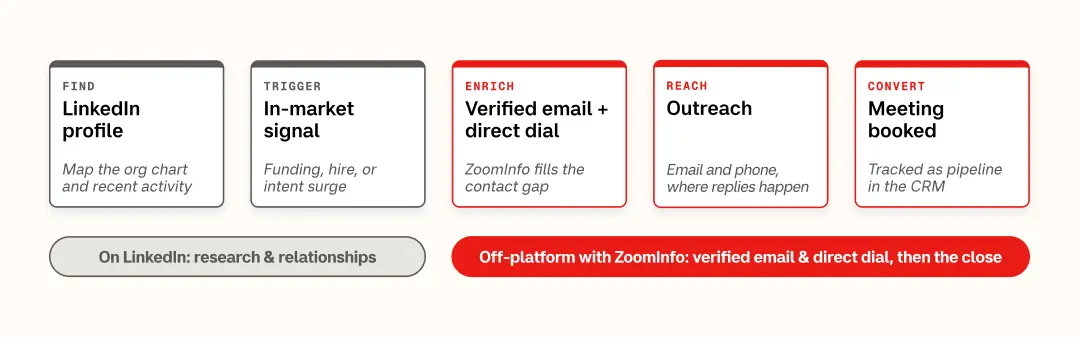
The blocker is that LinkedIn stops at the profile. It does not give you a work email or a direct dial, and the numbers listed on company sites are often wrong. A data provider closes that gap by enriching a LinkedIn profile with a verified email, direct dial, and firmographics, then pushing it to your CRM. That is what turns LinkedIn from a place to browse into a lead generation engine, and it is why most serious teams run Sales Navigator alongside a data platform rather than on its own.
10. Measure Replies and Meetings, Not Vanity Accepts
Connection acceptance rate tells you your profile is credible. It does not tell you anything about pipeline. Track the metrics that predict revenue:
Reply rate, which tells you the message was compelling enough to answer.
Meeting conversion rate, the share of conversations that become booked calls.
Pipeline sourced, the revenue opportunities you can attribute to LinkedIn in your CRM.
Benchmark these weekly against your other channels. Well-targeted LinkedIn outreach can beat cold email on reply rate, but only when the underlying data and signals are accurate. When a prospect stalls after three or four LinkedIn touches, move them into a multichannel sales cadence that adds email and phone rather than sending a fifth DM.
How ZoomInfo Strengthens LinkedIn Lead Generation
LinkedIn gives you access to decision-makers. What it cannot give you is confidence that the contact details behind those profiles are accurate, clarity on which accounts are actually in-market, or the bandwidth to act on signals at scale. Those three gaps are where most LinkedIn motions break down, and they map to what ZoomInfo, the all-in-one AI GTM Platform, is built to do.
The platform stacks three layers:
A verified data foundation of 500M+ contacts, 120M+ direct dials, and 200M+ business emails, continuously reverified, so the contact you pull from a LinkedIn profile is accurate when you use it, not just when it was collected.
The GTM Context Graph, an intelligence layer that processes 1.5B+ data points a day to fuse intent, CRM, and behavioral signals, so you see which accounts are researching your category and why they are surfacing now.
Universal access that delivers that intelligence wherever your team works, in a seller workspace, a RevOps studio, or through an API and MCP interface for teams building their own AI prospecting workflows.
For LinkedIn specifically, that plays out in three ways:
Its browser extension reveals a verified email and direct dial on a LinkedIn profile, so you can move the connection into email and phone outreach.
Its intent signals close the gap LinkedIn cannot, showing who is in-market.
Its AI agents research accounts and draft outreach so a lean team can act on signals without it becoming a second job, while reps still send the LinkedIn messages themselves.
Seismic attributed 39% of active pipeline to ZoomInfo signals while saving 11.5 hours per rep each week. And it is free to start with consumption credits based on usage, so teams can prove the motion before they commit.
Common LinkedIn Lead Generation Mistakes
Even good teams lose pipeline to a few avoidable errors. Watch for these:
Pitching in the connection request, which signals you care about your quota, not their problem.
Relying on LinkedIn alone, which misses buyers who are not active there and leaves pipeline on the table.
Over-automating connection requests and InMails, which reads as spam and risks account restrictions.
Treating merge fields as personalization, which prospects see through instantly.
Measuring accepts instead of replies and meetings, which flatters activity and hides whether anything is working.
Turning LinkedIn Into Pipeline With ZoomInfo
LinkedIn is the best place in B2B to find decision-makers and build credibility before you reach out. It is rarely where you close. The teams that generate real pipeline treat it as the front end of a system: precise targeting, well-timed outreach based on real signals, and a fast move to verified email and phone to actually start the conversation.
That is the gap ZoomInfo fills, verified contact data so your outreach reaches people, intent signals so you act when accounts are in-market, and workflow so a small team can run all of it. See how ZoomInfo turns LinkedIn activity into booked meetings.
See how ZoomInfo powers your LinkedIn lead generation motion. Book a demo.
Frequently Asked Questions
What LinkedIn lead generation strategies actually work in 2026?
The ones that work combine tight targeting, timing, and a move off-platform. Practitioners consistently point to value-first organic content that sells a perspective rather than a product, warm introductions through mutual connections, LinkedIn events and lead magnets to capture the 95% of buyers not yet in-market, and paid ads with Lead Gen Forms for scale. What consistently wastes time is high-volume generic DMs, AI-generated "personalization," and treating LinkedIn as a closing channel instead of a research channel. The through-line: use LinkedIn to find and warm up buyers, then reach them on verified email and phone to book the meeting.
Is LinkedIn good for lead generation?
For most B2B teams, yes, because decision-makers research vendors there and the targeting is unmatched. The exception is ICPs that are not active on the platform, such as many construction, manufacturing, and traditional SMB buyers. Run the ICP diagnostic first: if your buyers do not post, comment, or read on LinkedIn, it is a support channel at best, and phone and email should lead.
Are LinkedIn Lead Gen Forms free?
The forms themselves are a native feature of LinkedIn's paid ad products, so you pay for the ad campaign, not the form. They pre-fill with the member's profile data, which removes friction and, per LinkedIn, can convert up to five times better than sending prospects to an external landing page. Keep them to three or four fields and sync submissions to your CRM for fast follow-up.
How many LinkedIn connection requests can you send per day?
LinkedIn limits requests to curb spam, and the safe volume varies by account health and history, but most accounts can send several dozen a week without issues. Sending too many too fast, especially with low acceptance rates, gets accounts flagged. Prioritize a smaller number of well-targeted, personalized requests over volume.
How do you generate leads on LinkedIn for free?
Optimize your profile to lead with the problem you solve, post value-first content consistently, engage genuinely on your prospects' posts before reaching out, and use LinkedIn's native search to build a precise list. Free tactics build awareness and warm relationships over time. To convert that attention into reachable pipeline you will eventually need verified contact data to move conversations to email and phone, which is where a data platform adds leverage.
What is the difference between LinkedIn lead generation and LinkedIn prospecting?
Prospecting is one part of the wider motion: an individual rep finding and reaching out to specific people. LinkedIn lead generation is the full system that attracts, captures, qualifies, and converts leads across organic content, paid ads, and outbound, spanning both marketing and sales. Prospecting fills the top of the funnel one rep at a time; lead generation is the program that makes the whole channel produce pipeline.
