
Your CRM has thousands of contact records. But how many of those records have a phone number that actually connects to the right person today?
For most B2B sales teams, the answer is fewer than they think. Contacts change jobs, numbers go stale, and fields get left blank at import. The result is a dial list that looks full but performs like it is half empty. Phone number enrichment fixes that by appending verified direct dials and mobile numbers to your existing records at scale, so reps spend time in conversations instead of hunting for contact details.
This page covers how enrichment works, where it moves the needle for revenue teams, and which tools do it best.
What Is Phone Number Enrichment
Phone number enrichment is the process of appending verified phone numbers to contact records that are missing them, outdated, or only carry a generic switchboard line. It matches your existing records against third-party verified databases and writes the results back into your CRM or sales engagement platform automatically, without anyone having to manually trigger it.
Unlike a one-time data import, enrichment is continuous. It runs when new leads enter your system, when records hit a staleness threshold, and on scheduled cadences to catch decay before it hits your outreach.
Enrichment tools can append three types of phone numbers, and they are not equally valuable for outbound:
Direct dials connect straight to a contact's desk or office line, bypassing the switchboard entirely. Highest value for B2B sales.
Mobile numbers reach contacts on personal or company-issued cell phones and typically have the highest connect rates of any number type. They come with stricter compliance requirements under TCPA and GDPR, so consent management matters.
Switchboard and main line numbers route to a company's front desk or automated directory. Easy to source, hard to convert. Some providers pad their total coverage figures with these, which is worth pressing on when you evaluate.
The quality of what a tool appends matters as much as the volume it claims. A database of 200M phone numbers is only as useful as the share of those numbers that actually reach the right person.
How Phone Number Enrichment Works
When enrichment is set up properly, it runs inside your existing systems without anyone triggering it. Here is how the core mechanics work.
Single-Source Enrichment
The simplest model: one provider, one pass.
You submit a contact record, it gets matched against that provider's database, and whatever number they have comes back. It works, but your fill rate is capped by that one provider's coverage. Contacts they have no data on stay empty.
Waterfall Enrichment
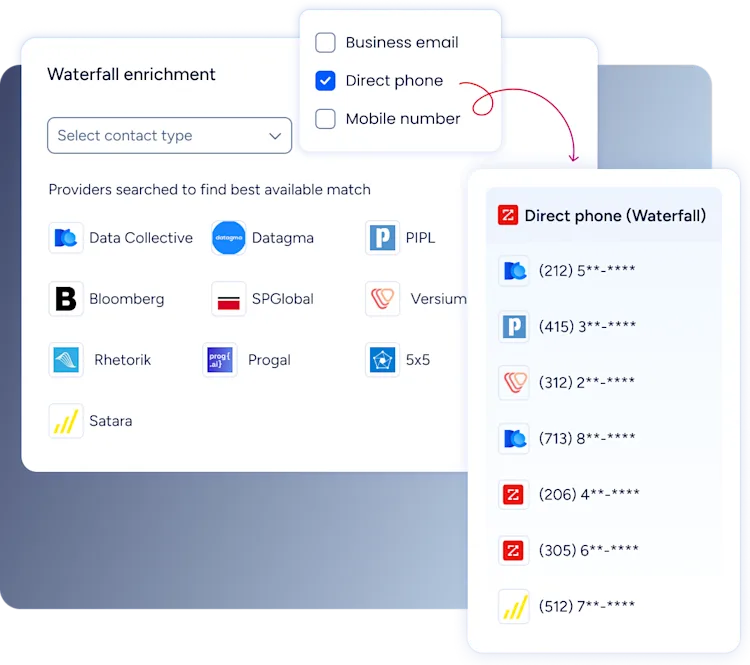
The higher-coverage approach. Instead of relying on one provider, unmatched records cascade through multiple sources in sequence until a match is found or every option is exhausted.
For teams running large-scale outbound across different industries and geographies, waterfall is the standard because coverage gaps vary significantly by vendor.
Verification and Confidence Scoring
Appending a number is only half the job. Before a number reaches your CRM, good platforms run it through a series of checks:
Format validation to confirm the number follows the correct pattern for its country and region
Line-type detection to distinguish mobile from landline from VoIP
Carrier lookups to flag numbers that have been ported or disconnected
Reachability checks to confirm the number is active
Each number gets a confidence score based on how many checks it passes and how recently the data was verified. Ops teams use those scores to route dials: high-confidence numbers go into priority sequences, lower-confidence ones get re-verified or deprioritized.
CRM Automation
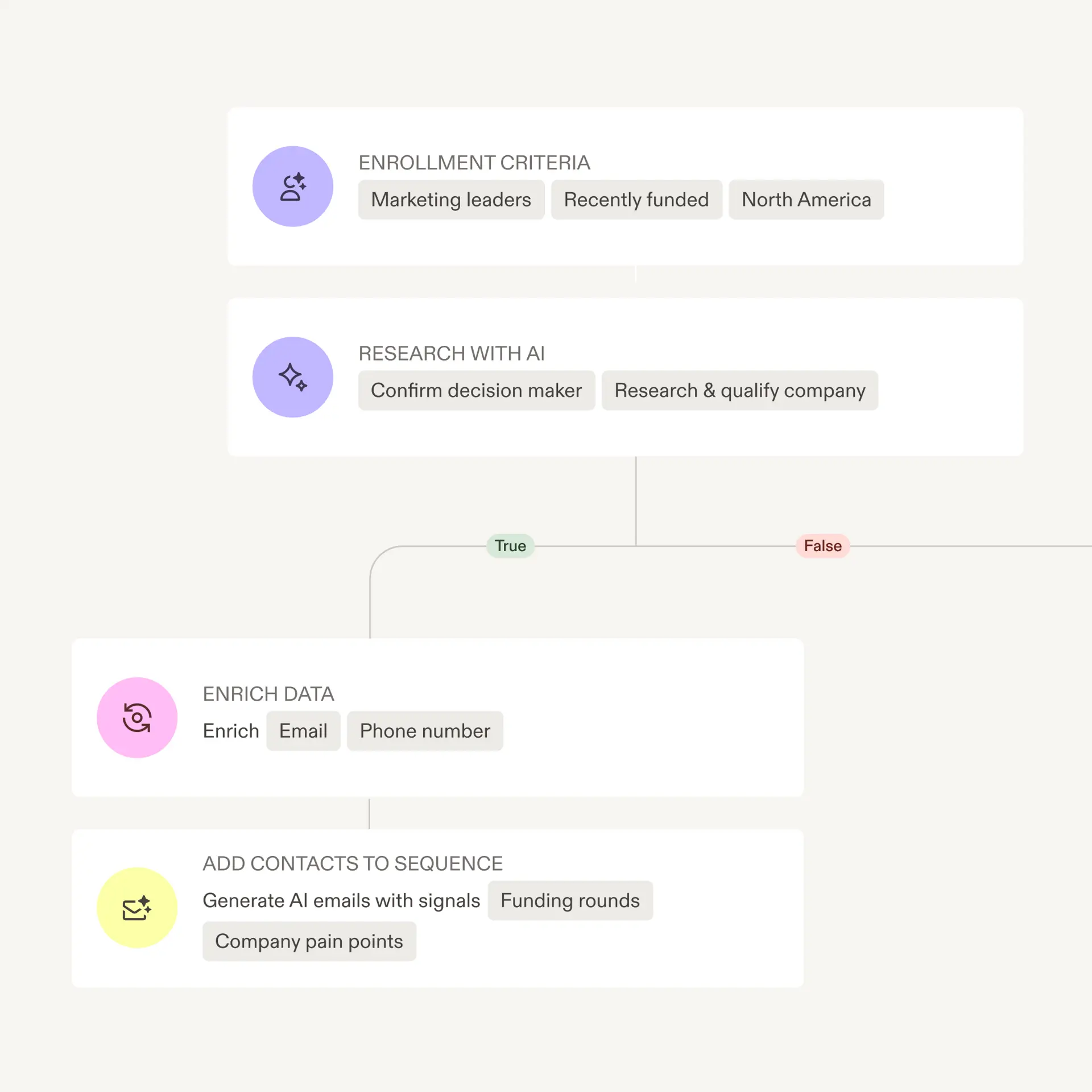
CRM automation is what turns enrichment from a project into a process. Native integrations with Salesforce and HubSpot push enriched numbers directly into contact records, trigger-based workflows fire when a new lead enters the system, and scheduled batch enrichment keeps existing records current on a rolling cadence.
Where Phone Number Enrichment Has the Most Impact
Enrichment is not a data hygiene initiative. It is a revenue operations lever, and the teams that see the biggest returns are the ones who plug it into their highest-leverage workflows.
Outbound Prospecting
SDR and BDR teams live by connect rates, and connect rates live or die on the quality of the number in front of the rep. Enriching a target account list with verified direct dials before loading it into a sales engagement sequence means reps start every session with numbers they can trust. Common gaps enrichment fills include:
Purchased lists where phone fields are incomplete or missing entirely
Event lead captures that only collected name, email, and company
Inbound form submissions where prospects did not provide a number
Inbound Lead Follow-Up
Speed-to-call on high-intent inbound leads is one of the highest-leverage plays in B2B sales, and it depends entirely on having a verified number at the moment the lead arrives.
When a prospect submits a form with a name and email but no phone number, real-time enrichment appends a direct dial before the record even reaches your rep. That window closes fast, and enrichment is what keeps it open.
Account-Based Marketing
ABM programs coordinate outreach across channels at the account level, but the motion stalls at the point of follow-up if sales is missing direct contact data. Enriching ABM contact lists ensures reps have verified direct dials for the right people at each target account, so the handoff from marketing engagement to sales conversation actually lands.
5 Best Phone Number Enrichment Tools
Buyers searching for enrichment tools are typically in evaluation mode. Here is a comparison of the leading platforms, followed by a closer look at each.
Tool | Direct Dial Coverage | Mobile Numbers | Waterfall Enrichment | CRM Integration | Best For |
ZoomInfo | 120M+ direct dials | Yes | Yes, 25+ providers via GTM Studio | Salesforce, HubSpot, native | Enterprise teams needing depth and accuracy |
Apollo | 275M+ contacts | Yes | No | Salesforce, HubSpot | SMB and mid-market outbound |
Adapt | 200M+ contacts | Yes | No | Salesforce, HubSpot | Teams needing broad B2B coverage |
Kaspr | EU-focused coverage | Yes | No | Salesforce, HubSpot, Pipedrive | European outbound teams |
Lusha | 300M+ direct dials | Yes | No | Salesforce, HubSpot, Pipedrive | SDR teams needing phone-first prospecting |
ZoomInfo
ZoomInfo is built for revenue teams that need verified direct dial coverage at scale. Its database includes 135M+ verified phone numbers, with 120M+ being direct dials rather than switchboard lines. That ratio is the meaningful differentiator from providers who inflate coverage figures with generic main lines that rarely convert.
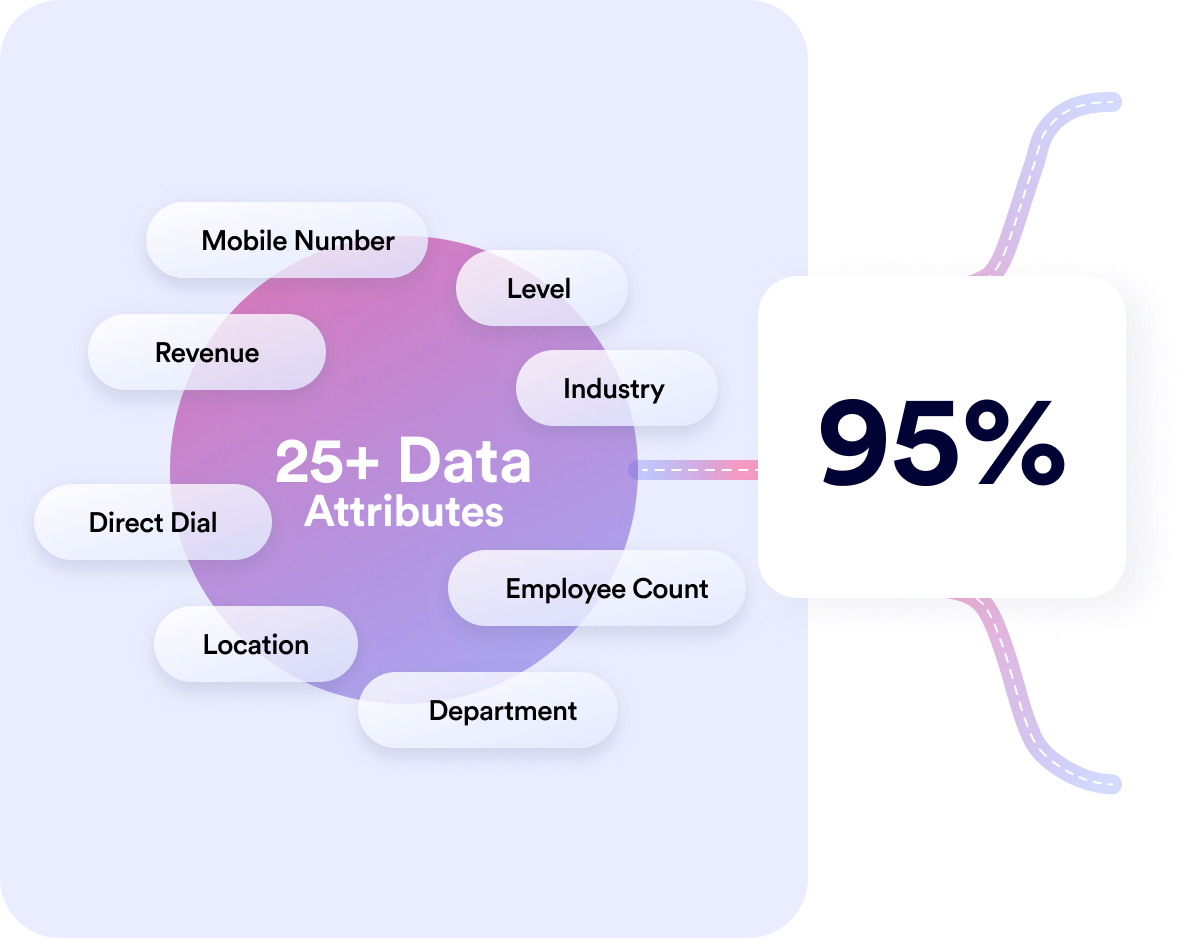
The platform processes and verifies 1.5B+ data points daily, supported by 300+ human researchers who catch edge cases that automated checks miss. On first-party data, ZoomInfo delivers up to 95% accuracy.
What separates ZoomInfo from point solutions is the intelligence layer around the phone data. Enriched records connect to firmographic details, technographic signals, and real-time buying intent data through ZoomInfo's GTM Context Graph, so reps know not just who to call but who to prioritize first. For teams that need maximum fill rates, GTM Studio offers waterfall enrichment across 25+ providers from a single platform, without building and maintaining separate integrations for each vendor.
Key features:
120M+ verified direct dials with confidence scoring on every number
Waterfall enrichment across 25+ providers via GTM Studio
Real-time buying intent data layered onto enriched records
Native Salesforce and HubSpot integrations with trigger-based automation
300+ human researchers supplementing automated verification
Pricing: Consumption-based. Cost is tied to what you use (exports, API calls, enrichment) rather than rigid per-seat licensing. Free trial available.
Apollo
Apollo is a strong option for SMB and mid-market teams running high-volume outbound. Its database covers 275M+ contacts with phone and email in one platform, making it a broad prospecting tool rather than a dedicated enrichment platform. Phone data quality is solid for its price point, though direct-dial coverage thins out at the enterprise level and for contacts outside US tech and SaaS.
Apollo does not offer waterfall enrichment, so fill rates are capped by what its own database holds for a given contact.
Key features:
275M+ contact database with phone and email combined
Built-in sales engagement sequences alongside enrichment
Chrome extension for enriching contacts directly from LinkedIn
Salesforce and HubSpot integration with automated sync
Free plan available for teams evaluating before committing
Pricing: Free plan available. Basic at $49/user/month, Professional at $79/user/month, Organization at $119/user/month (billed annually).
See how Apollo compares to ZoomInfo
Adapt
Adapt is a broad B2B contact database with 200M+ contacts, suited to teams that need wide coverage across industries and geographies. Phone enrichment is part of its core offering, though the platform is more commonly used for list building and prospecting than for automated CRM enrichment workflows running in the background.
It works well for teams that need to build net-new contact lists quickly with phone numbers included at export. Teams that need trigger-based enrichment firing automatically inside their CRM will find it limited on that front.
Key features:
200M+ contact records with phone numbers included
Advanced filtering by industry, company size, job title, and geography
Chrome extension for enriching contacts while browsing LinkedIn
CSV export and CRM sync for Salesforce and HubSpot
Team collaboration features for shared list building
Pricing: Free plan available. Starter at $49/month, Basic at $99/month, custom plans available.
Kaspr
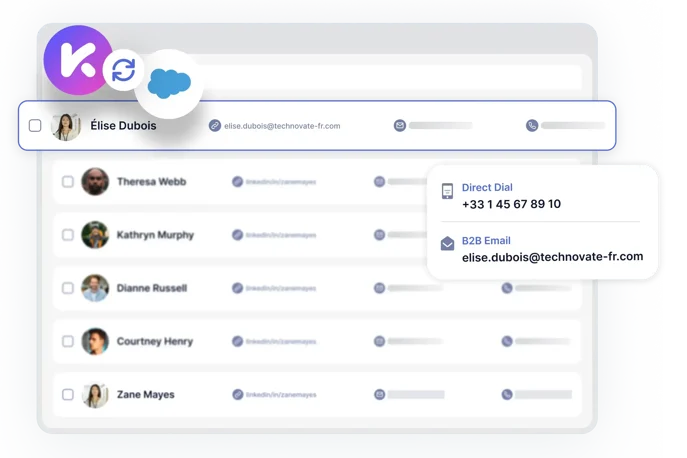
Kaspr is a phone-first enrichment tool with particular strength in European contact data, where GDPR compliance is a baseline requirement. It is built primarily for individual SDRs and small sales teams who need to pull verified phone numbers quickly from LinkedIn profiles, making it a prospecting workflow tool rather than an enterprise enrichment platform.
Coverage is strongest in Western Europe, particularly France, the UK, and the DACH region. For teams selling into North America, fill rates drop noticeably. Kaspr fits European-focused outbound teams that need a lightweight, LinkedIn-native solution with compliance controls built in from the start.
Key features:
LinkedIn Chrome extension that surfaces phone numbers and emails directly on profiles
GDPR-compliant data sourcing with transparency on data origins
Strong direct dial and mobile coverage for European contacts
Integrations with Salesforce, HubSpot, and Pipedrive
Team workspace for sharing enriched contacts across an SDR team
Pricing: Free plan available. Starter at €45/user/month, Business at €79/user/month (billed annually).
Lusha
Lusha is a phone-first sales intelligence platform widely used by SDR teams for direct dial and mobile coverage. Its database includes 300M+ direct dials and 152M+ verified emails across 30M+ company profiles, with phone accuracy reported at 86% and email accuracy at 98%. It positions itself on ethically sourced, compliant data (GDPR, CCPA, SOC 2 Type II, ISO 27701), making it a credible option for teams with stricter procurement requirements.
Lusha works best as a lightweight prospecting and enrichment tool layered into existing workflows, particularly via its Chrome extension on LinkedIn. For revenue teams running large-scale automated enrichment across millions of records, coverage and intent depth thin out compared to enterprise platforms.
Key features:
300M+ direct dials with 86% phone accuracy
Chrome extension that surfaces verified contacts on LinkedIn and company sites
Native integrations with Salesforce, HubSpot, and Pipedrive
CSV bulk enrichment and API access on higher plans
Buying intent signals and job change alerts on Premium and above
Pricing: Free plan available (40 credits/month). Starter at $37.45/user/month, Pro at $52.45/user/month, Premium at $299.95/month (5 seats), Scale custom. Phone numbers cost 5 credits each. Billed yearly.
See how Lusha compares to ZoomInfo.
Why Phone Data Degrades and What It Costs You
B2B contact data decays at roughly 25% to 30% per year, driven by job changes, promotions, and company moves. For a database of 50,000 contacts, that is between 12,000 and 15,000 records becoming unreliable over twelve months. A CRM enriched eighteen months ago and left untouched has a meaningful share of its dial list quietly working against reps.
The problem compounds because it is invisible until it has already done damage:
Connect rates decline while rep activity metrics still look healthy in reporting
Pipeline targets start slipping without a clear cause to point to
Reps lose trust in the CRM and maintain their own contact lists outside the system, which kills visibility for ops and leadership
The fix is automated enrichment at ingestion for new records and scheduled re-enrichment on a rolling cadence for existing ones, running in the background without anyone having to trigger it.
Get Verified Phone Numbers Into Your CRM
Accurate phone data is the foundation of an outbound motion that generates pipeline rather than just activity. Without verified direct dials, reps waste time on dead numbers, connect rates decline, and the CRM loses credibility with the people using it every day.
ZoomInfo gives revenue teams the phone number coverage, verification accuracy, and CRM automation to make enrichment a continuous process. With 120M+ direct dials, waterfall enrichment across 25+ providers, and native integrations with Salesforce and HubSpot, it is built for teams that cannot afford gaps in their dial lists.
Talk to our team and see what verified phone data does for your connect rates.
Frequently Asked Questions
What is the difference between phone number enrichment and verification?
Enrichment appends new phone numbers to records that are missing them. Verification checks whether numbers you already have are still valid and reachable. Revenue teams need both: enrichment to fill gaps and verification to confirm accuracy before a calling campaign goes live.
How often should you re-enrich your CRM?
Quarterly at minimum. High-velocity sales teams benefit from monthly or continuous enrichment, where automated workflows refresh records as they hit staleness thresholds. The faster your target market churns, the more frequently you need to run it.
What types of numbers can enrichment tools append?
Direct dials, mobile numbers, and company switchboard numbers. Direct dials and mobiles are the most valuable for outbound because they bypass gatekeepers. When evaluating a provider, always ask specifically about direct dial coverage rather than total phone number volume, since those figures can differ significantly.
Does phone number enrichment work for international contacts?
It depends on the provider. ZoomInfo and Apollo have strong North American coverage with reasonable international depth. Kaspr is the strongest option for European contacts. For teams selling across multiple regions, waterfall enrichment across multiple providers is the most reliable way to maximize fill rates.
Do you need a parallel dialer to get value from phone enrichment?
No, but the two work well together. Enrichment makes sure the numbers in your CRM are accurate; a parallel dialer lets reps work through those numbers faster by dialing multiple lines at once. Without verified data, a parallel dialer just burns through bad numbers quickly. With it, reps get more conversations per hour without sacrificing list quality.
