
AI assistants can write a passable cold email in seconds. The harder question is whether the person it's addressed to still works at the company, and whether the company still exists in the form the model thinks it does. The deeper problem is whether anything the AI said about either of them is true.
This is the grounding problem. In B2B go-to-market, it's the difference between AI that scales your team and AI that quietly damages your pipeline.
This guide covers what AI grounding is, how it works, why ungrounded AI fails in GTM, and the kind of B2B data grounded AI requires.
What Is AI Grounding?
AI grounding is the process of connecting a large language model's outputs to verified, real-world data so its responses reflect what's actually true about your market today.
An ungrounded AI generates answers from what it learned during training. That training data is frozen at a point in time, and it was never specific to your business. A grounded AI pulls in trusted external sources at the moment of the query and reasons over those.
The distinction matters because LLMs are fluent without being correct. They can produce confident-sounding output about a company that no longer exists, a contact who left two years ago, or a market that's shifted since the model was trained. Grounding closes that gap. It tells the model what's actually true right now and forces the reasoning to start from there.
In practice, grounding means three things: live data access at query time, verified and auditable sources, and contextual relevance to the task. Without all three, you don't have grounded AI. You have an AI that sounds grounded.
How AI Grounding Works
Grounding is the goal. Four common techniques get teams there, each suited to different data types and use cases.
Retrieval-Augmented Generation (RAG)
The system converts the query into a vector representation, searches a pre-indexed document store for semantically similar content, and injects the retrieved chunks into the model's prompt alongside the query.
Best for: knowledge-heavy domains like internal documentation, support content, policy lookups
Weak point: anything that changes faster than the retrieval index can keep up
Knowledge Graphs
Knowledge graphs structure information as entities and the explicit relationships between them. When a question requires precise traversal ("who reports to the VP of Sales at this account"), a graph returns a structured answer without depending on fuzzy text matching.
Best for: org charts, corporate hierarchies, product catalogs, anything where relationships between entities carry meaning
Weak point: unstructured or free-text content where relationships aren't pre-mapped
Prompt Engineering and Context Windows
Prompt engineering is the simplest form of grounding. You hand the model the facts it needs directly in the prompt.
This works for focused, one-off tasks. At scale it breaks down because every model has a token limit, and filling it with irrelevant context degrades performance. Precision beats volume.
Tool Use and API-Based Grounding
Tool use lets the model call external functions during generation. The AI decides what data it needs at runtime, calls an API or database, and incorporates the result. This is the approach behind MCP, which gives AI agents native access to live, verified data sources in real time. To run complete plays on that data, Agent Teams coordinates specialist agents through GTM.AI or GTM Studio. For data that changes daily (intent signals, job changes, funding events), tool-based grounding outperforms static retrieval.
Across all four techniques, grounding is the goal and RAG is the most common way to achieve it. Fine-tuning is sometimes confused with grounding but solves a different problem. It changes how a model sounds, not what it knows.
Why Ungrounded AI Fails in B2B GTM
In a consumer context, an AI hallucination is annoying. In B2B GTM, it costs deals.
ZoomInfo's 2025 State of AI in Sales and Marketing survey found that 80% of non-users cited accuracy concerns as a reason they haven't adopted AI tools, and 42% of users said they were dissatisfied with the AI tools they did use. They pointed to data quality, security, and hallucinations as the core issues.
These aren't abstract worries. They're the reality of running AI on top of B2B data that hasn't been verified.
Tell an ungrounded AI agent to research an account and it returns a summary anyone could find on Google. It might describe the company's industry correctly, then invent a CFO who left in 2023. The failure modes compound across the GTM stack:
GTM workflow | What goes wrong without grounding |
Prospecting | Outdated contact data wastes rep time and burns sender reputation |
Account research | AI confidently invents details, leaving reps unprepared on calls |
Stale firmographics rank the wrong accounts as high-fit | |
AI-drafted outreach | Personalization lands against information that's no longer true |
Pipeline forecasting | Missing real signals (job changes, funding, hiring patterns) leads to misreading what's happening |
The AI isn't reasoning over the world your reps are actually selling into. It's reasoning over a snapshot of the world that's already gone.
This is why generic "GPT on my CRM" experiments fail. They have data without context. No understanding of why things happened, no patterns across deals, no causal chain connecting signals to outcomes.
What AI Grounding Requires
For AI to be useful across go-to-market workflows, it needs access to three dimensions of B2B data simultaneously.
Dimension | What it covers | Examples |
Identity data | Who buyers are and how to reach them | Names, titles, verified emails, direct dials, departments, seniority |
Company context | Attributes that drive segmentation and ICP matching | Industry, employee count, revenue, technographics, funding stage |
Dynamic signals | What the account is doing right now | Intent surges, hiring patterns, funding events, leadership changes, tech stack movement |
An AI grounded in all three is reasoning over the real account. An AI grounded in one or two is filling gaps with assumptions, which is where hallucinations live.
And B2B data, unlike most other content AI gets grounded in, doesn't sit still. 70% of B2B contact data decays every year. Identity, firmographics, signals, and engagement history live in different systems with no shared view. Keeping tens of thousands of accounts verified and current requires infrastructure most teams can't build in-house. Stale, fragmented data at B2B scale is why most AI grounding efforts in GTM fail.
How ZoomInfo Grounds AI at B2B Scale
The GTM Context Graph is built to solve the grounding problem at B2B scale. It rests on four layers, each one dependent on the one below it.
Grounding data. The verified foundation: 500M+ contacts, 100M+ companies, 200M+ verified business emails, 135M+ verified phone numbers, and technographics across 30,000+ tracked technologies. Up to 95% accuracy on first-party data, refreshed against 1.5B+ data points processed daily. This is the underlying B2B data foundation every grounded workflow draws from.
Unification. Verified data alone isn't enough. Records have to be resolved across systems. Entity resolution and semantic normalization turn fragmented data from CRM, marketing automation, and conversation intelligence into one canonical view of every account, contact, and relationship.
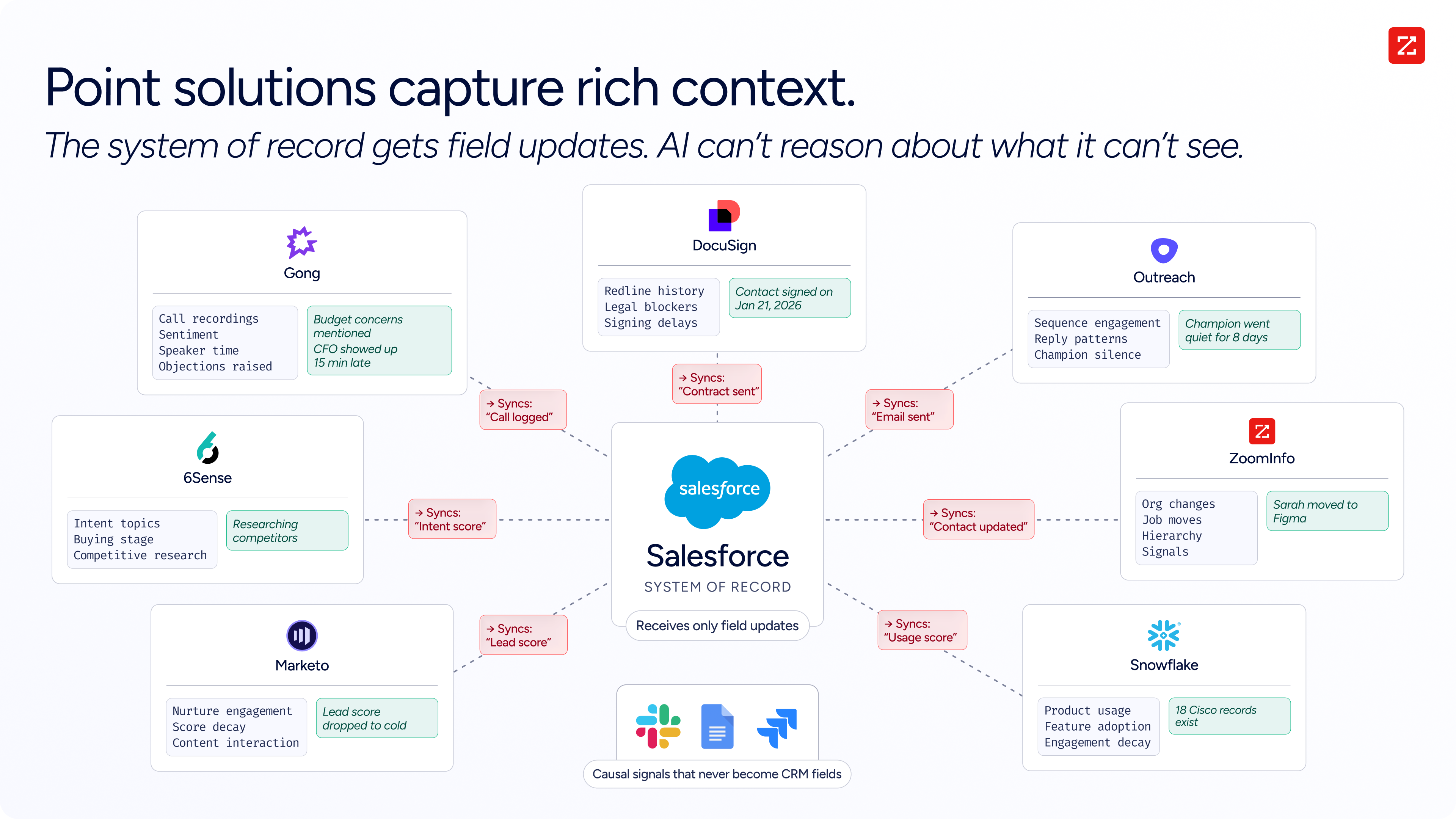
The context graph. The connected intelligence layer. The GTM Context Graph fuses verified data with a customer's first-party CRM, conversation, and engagement history into one connected view. On top of that state, it captures causality — which signals preceded which deal movements, and which buying committees form around which accounts.
Surface area. A grounding layer locked inside one application can't ground the AI agents your team is actually using. The same intelligence reaches GTM Workspace for sellers, GTM Studio for marketers, RevOps, and GTM engineers—where Agent Teams runs complete GTM plays end to end—and APIs and ZoomInfo MCP for any third-party AI agent. That covers Claude, ChatGPT, Microsoft Copilot, and any MCP-compatible client.
This is the architecture behind GTM.AI. Verified data at the bottom, unification above it, the context graph on top, and universal access carrying it into every tool. Agent Teams draws on this architecture to run coordinated plays, with specialist agents sharing context and acting within the controls admins set. Skip any layer and the outputs degrade.
Start Grounding Your AI in Verified Data
Context is what bottlenecks AI in production. Upgrading the model alone won't fix that.
Every failure mode in this guide traces back to the same gap: a model reasoning over data that's stale, incomplete, or disconnected from what's actually true. Closing that gap is what the GTM Context Graph is built for.
Connect AI to verified B2B data through ZoomInfo MCP. For complete plays that act on that data, Agent Teams runs end-to-end motions in GTM Studio or headless through GTM.AI.
AI Grounding FAQ
Is AI Grounding the Same as RAG?
No. Grounding is the goal of producing AI outputs that reflect verified reality. RAG is one technique for getting there, specifically by retrieving relevant documents and injecting them into the prompt at query time. You can also ground AI through APIs, MCP servers, knowledge graphs, or direct integrations. Grounding describes the outcome; RAG describes one method.
Does Fine-Tuning Solve the Grounding Problem?
Not directly. Fine-tuning changes how a model sounds and what domain vocabulary it understands. It doesn't connect the model to current, verified data. A fine-tuned sales AI still hallucinates about contacts and accounts if it doesn't have access to a live grounding layer.
Can AI Grounding Eliminate Hallucinations Entirely?
No. Grounding significantly reduces hallucinations by constraining the model to verified sources. Models can still misinterpret retrieved context or generate responses that go beyond what the source supports. Citation enforcement and human review remain important safeguards.
How Do I Know if My AI Is Grounded?
Three questions tell you most of what you need to know. Is the data it's reasoning over current as of today, or from the model's training cutoff? Can you trace any specific output back to a verifiable source? When the underlying data changes, does the AI's output change accordingly? If all three answers are yes, the AI is grounded. If any are no, it's guessing.
Can I Ground AI Using Just My CRM?
Partially. Your CRM grounds the AI in what your team has captured about an account. It doesn't ground the AI in what's true about the account outside your CRM, which is most of what matters. Identity data decays, firmographics shift, and signals happen in the world beyond your funnel. Grounding AI in CRM alone is grounding it in a partial, often outdated view. Pairing it with CRM data enrichment keeps the grounding layer current.
