
A B2B data API turns a third-party data provider into infrastructure. Your CRM, warehouse, internal tools, and AI agents query verified company and contact data on demand, with no manual exports or static lists in the middle.
The shift matters more in 2026 than it did two years ago. CRM data decay is a known structural problem, and AI and ML workflows now depend on verified external data the same way revenue teams have for years. Dirty data inside an agentic system produces bad outcomes at machine speed.
This guide covers how B2B data APIs work, how to evaluate one, and when buying makes more sense than building.
What Is a B2B Data API?
A B2B data API is a programmatic interface to a B2B data provider's database of companies and contacts. Authenticated clients send requests and receive structured responses across firmographic, contact, technographic, intent, and engagement data. It is the same data that powers a vendor's user-facing products, delivered as raw infrastructure for any system that needs to consume it.
The category sits in the data-as-a-service (DaaS) layer of a modern revenue stack, underneath:
The CRM (Salesforce, HubSpot, Microsoft Dynamics)
The marketing automation platform (Marketo, HubSpot, Eloqua)
The data warehouse (Snowflake, Databricks, BigQuery, Redshift)
AI and ML systems and custom internal tools
Agentic workflows running in Claude, ChatGPT, Cursor, and similar AI environments
What distinguishes a B2B data API from adjacent categories is the asset behind the endpoint. A CRM API exposes your own records. A web scraper returns whatever is publicly visible at request time. A B2B data API returns verified, refreshed records from a provider that has invested in a dedicated collection and verification pipeline. The contract is freshness and accuracy on data the consumer does not have to source themselves.
Intelligence APIs vs Integration APIs
Not every API that touches B2B data does the same job, and the distinction matters during procurement. Intelligence APIs are the data source. They supply verified business information (contacts, firmographics, technographics, intent signals) that your systems can query for new records or enrichment. Integration APIs move data between systems, connecting your CRM to your marketing automation platform, syncing records between databases, transporting data without generating it.
| Intelligence API | Integration API |
Purpose | Supply verified B2B data | Move data between systems |
Example | Query for all VP-level contacts at a target account | Sync enriched records from your data warehouse to Salesforce |
Output | New or enriched records | Transferred records |
Key buyer | RevOps, Data Engineering, Sales Ops | IT, Platform Ops |
Most teams need both. If you're evaluating B2B data providers, you're shopping for an intelligence API first. The integration layer comes second.
How B2B Data APIs Work
Enterprise-grade B2B data APIs run on a two-stage pattern. Search first, then enrich. Search returns matched record IDs based on filter criteria (industry, headcount, tech stack, geography, job title, seniority). Enrichment takes those IDs and unlocks the full data payload, including business emails, direct dials, employment history, hierarchy, and technographics. The split exists because search is cheap to run while enrichment consumes credits, so verifying record fit before paying to pull full records is the credit-efficient path.
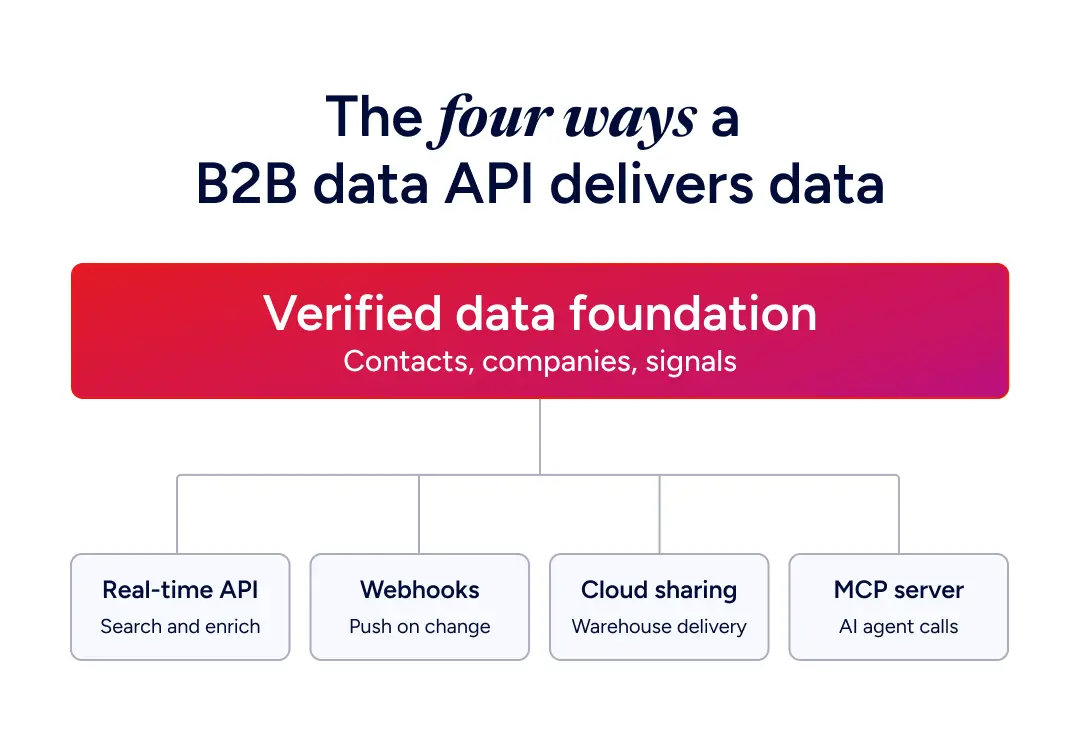
Four delivery patterns dominate:
Real-time API calls. Stateless requests against the provider's database, used for form enrichment, lead routing, and ad-hoc lookups. Latency typically lands under 500ms.
Webhook subscriptions. The provider pushes record updates to your endpoint as the underlying data changes. Useful when millions of records need continuous refresh rather than scheduled re-pulls.
Cloud data sharing. Pre-packaged datasets delivered into Snowflake, Databricks, AWS, Google Cloud, or Azure via native marketplace integrations. Less integration code to maintain, and updates flow automatically.
MCP servers. The Model Context Protocol, released by Anthropic as an open standard in late 2024, lets AI agents call external tools natively inside a conversation. For teams building agentic workflows, MCP is becoming a peer to REST APIs as an access mechanism for verified B2B data.
Common B2B Data API Use Cases
Production deployments cluster around a small number of recurring patterns. The right architecture, refresh cadence, and credit model depend on which of these dominate your workload.
CRM and warehouse hygiene. Standardize, deduplicate, and continuously refresh records across major CRMs and data warehouses. Eliminates the manual data ops work that typically runs to days per ops person per week.
Total addressable market modeling. Query firmographic, technographic, and intent attributes to size addressable markets for strategic planning, territory design, and capacity allocation. Verified data replaces guesswork in board-level numbers.
Buyer propensity scoring. Feed external B2B data into internal scoring models. Verified third-party signals consistently outperform models trained only on internal data because they capture market activity the CRM never sees.
Real-time form enrichment. Enrich web form submissions at the moment of capture. Better routing, better scoring, and a faster path from inbound to first touch.
Lead-to-account matching and routing. Account-based routing logic that fires the moment a record changes, matching inbound leads to existing accounts and assigning ownership in milliseconds.
AI and ML model training. Verified external data as input to internal prediction models for churn, expansion, intent classification, and propensity.
Master data management. A single source of truth for company and contact data across CRM, marketing automation, warehouse, and custom apps. Resolves the cross-system attribution problem that destroys reporting.
Agentic GTM workflows. AI agents running in Claude, ChatGPT, Cursor, and similar environments call the data API via MCP. Sellers and marketers run prospecting and research without leaving the AI tool they already work in.
The right deployment usually combines two or three of these patterns rather than one. A team running a propensity model in Snowflake will also want real-time form enrichment at the inbound layer and webhook-driven hygiene to keep the warehouse clean. Architecture decisions should follow the workload mix, not the other way around.
What to Look for in a B2B Data API
Vendor pitches will emphasize different criteria depending on where they are strong, so treat the six below as table stakes rather than differentiators.
Data scale
The number of companies, contacts, verified phone numbers, and verified business emails in the provider's database. Scale matters because lookup failure rates compound. Every missing record is a downstream system that has to fall back to manual lookup or a secondary vendor.
What to ask:
How many companies and contacts are in the database, broken down by region?
What percentage of contacts have a direct dial vs only a corporate switchboard number?
How is international coverage structured (EMEA, APAC, LATAM)?
Sub-categories matter as much as headline totals. A provider with 100M contacts globally may have thin coverage in Germany or Japan, which is a problem if those are growth territories. Ask for record counts inside your top three geographies before signing.
Verification and accuracy
Self-reported accuracy is unreliable. Ask for the full verification methodology (ML scanning, human researchers, contributory community data, third-party signal triangulation), and request a sample test against your own seed list before signing. First-party verified accuracy of 90% or higher is the realistic enterprise bar.
The credible providers run a multi-source verification pipeline rather than relying on one signal:
ML models that detect contact changes across public web sources
Human research teams that verify high-value records by hand
Contributory networks where existing customers' data feeds back into verification
Third-party signal triangulation against job change platforms, news sources, and filings
Ask for accuracy numbers broken down by field (email vs phone vs job title) rather than as a single composite percentage. Phone accuracy is typically lower than email accuracy across the category, and headline numbers can hide that.
Refresh frequency
Static B2B data ages fast. Bounced emails, wrong direct dials, departed contacts. Continuous refresh, with millions of records updated daily, materially outperforms quarterly snapshots in any system that touches active prospecting or routing logic.
Look for two specifics:
How frequently the underlying database updates (daily is the bar, weekly or quarterly is a downgrade)
How updates propagate to your downstream systems (webhook push vs scheduled API re-pull vs manual re-export)
The second matters more than the first for most teams. A provider with daily database updates but no webhook delivery still leaves your CRM stale until the next batch job runs.
Delivery flexibility
REST APIs are necessary but no longer sufficient. Look for webhooks for continuous updates, cloud marketplace listings (Snowflake, AWS, Databricks, Google Cloud) for warehouse delivery, and MCP support for agentic workflows. The wider the surface area, the fewer custom pipelines your team maintains.
A modern stack typically needs three surfaces:
Real-time API for inbound enrichment, lead routing, and ad-hoc lookups
Cloud or warehouse delivery for analytical workloads, propensity models, and TAM analysis
MCP or agent surface for AI clients that pull data inside conversations
Vendors that cover only one of these force you to pipe data manually between systems. Vendors that cover all three let you pick the right pattern for each workload without re-platforming when needs change.
Compliance
GDPR, CCPA, CPRA, and the expanding US state-level privacy regime have turned compliance into a procurement gate at most enterprises. Look for a first-class Compliance API for opt-out management, SOC 2 Type II certification, and ISO 27701 and ISO 27001 attestations as baseline requirements.
Specifically, your security and legal teams will want answers on:
How the provider sources contact data and obtains lawful basis under GDPR
Whether opt-out and erasure requests can be queried programmatically (Compliance API) rather than handled by support tickets
Data residency options for EU customers
Sub-processor lists and how downstream data flow is governed
The shorthand is simple. If the provider can't answer these questions in a single procurement call, the operational burden of compliance falls on your team.
Pricing model
Per-record consumption pricing is standard in the category. Clarify upfront which calls count as billable, how long enriched records remain in the credit window (12 months is the verified-provider norm), whether bulk endpoints carry separate pricing, and how usage caps and overages work.
A few questions that surface hidden costs:
Are search calls free, or do they consume credits?
Once a record is enriched, do refreshes within the credit window cost additional credits?
Are webhook updates billable, or included in the base subscription?
What happens when you hit the usage cap, and whether overages are charged or capped hard?
Consumption-based pricing is fair, but the unit economics vary enormously between vendors. Two providers quoting "one credit per enriched record" can have a 3x cost difference once you account for refresh policies and which calls are billable.
Build vs Buy: When Does a B2B Data API Earn Its Place?
Most enterprise teams considering a B2B data API have some version of an internal data effort already running. A few engineers maintaining scrapers, a manual export process from LinkedIn Sales Navigator, a contractor refreshing key accounts quarterly. The build-vs-buy question is really a question of whether internal effort is a better use of engineering time than vendor consumption fees.
Three signals that the buy decision has crossed the threshold:
Engineering hours on data maintenance exceed engineering hours on product work. When a team is spending more than 20% of capacity keeping scrapers alive, debugging deduplication logic, or resolving entity matching across systems, internal cost has overtaken vendor cost on a fully loaded basis.
The downstream systems consuming the data have multiplied. A single CRM consuming internal data is manageable. Five systems (CRM, MAP, warehouse, ML pipeline, AI agent surface) consuming the same data with different freshness expectations is a maintenance burden that vendor APIs solve at the source.
Compliance exposure has grown. Scraping or buying lists from unverified sources is a legal risk that scales with company size. Enterprise procurement teams are increasingly unwilling to sign off on data sources without documented lawful basis and opt-out mechanisms.
The build case still holds in narrow scenarios, like highly specialized verticals where no vendor covers the relevant entities, internal R&D models that need raw signal data rather than verified records, or teams where the data work is the product. Outside those, the operational case for buying is hard to argue against.
A common middle path is hybrid. Use a vendor API for the 80% of data needs that match standard B2B firmographics, and build internally for the narrow verticals or proprietary signals that vendors don't cover well. Most enterprise data teams settle into this pattern within 12 to 18 months of their first vendor contract.
How ZoomInfo Delivers B2B Data as Infrastructure
ZoomInfo's data foundation covers 500M+ contacts and 100M+ companies, refreshed against 1.5B+ data points daily. It's the same dataset behind ZoomInfo's user-facing products, delivered as raw infrastructure for any team building inside their own systems.
Four delivery surfaces cover the patterns above:
Enterprise API for real-time search, enrich, and AI-layer endpoints. Consumption is one credit per enriched record, with 12 months of refresh coverage included.
MCP server for native tool calls inside Claude, ChatGPT, and other AI clients. Setup is a three-step OAuth flow with no integration code on the consumer side.
Data Cubes for cloud delivery into Snowflake, Databricks, AWS, Google Cloud, and Azure via native marketplace integrations.
Webhook subscriptions for continuous record refresh when scheduled re-pulls aren't fast enough.
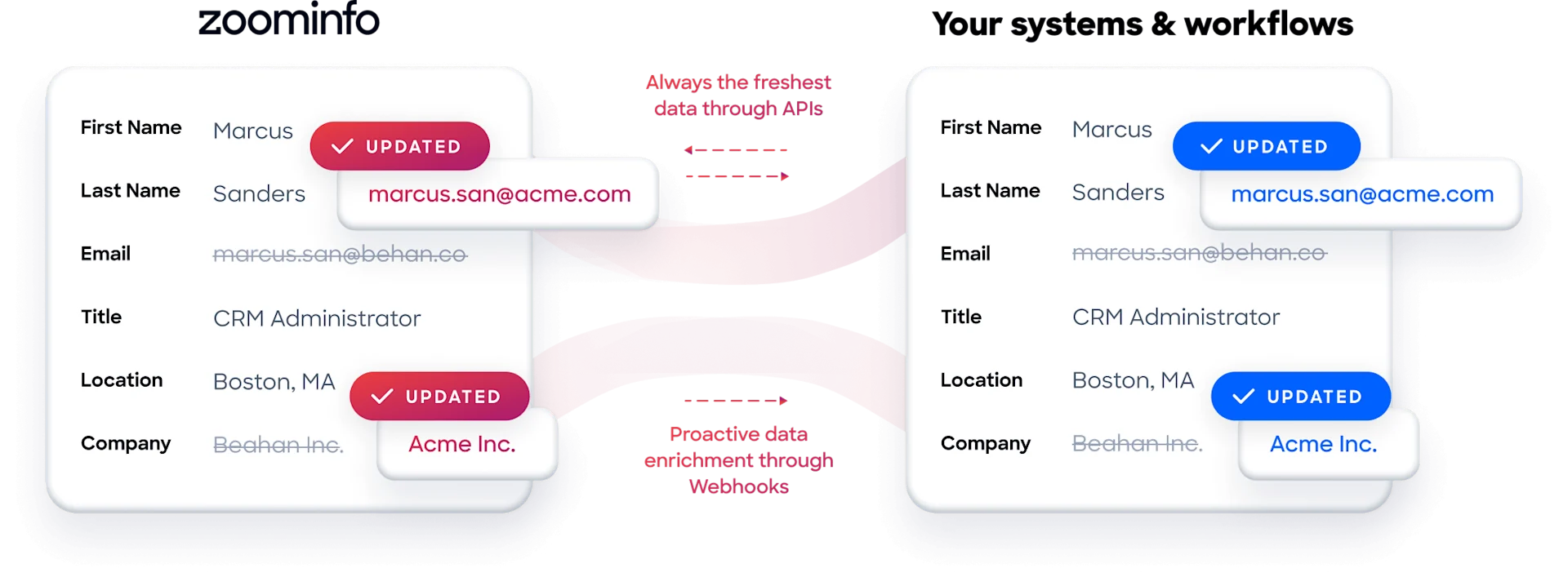
All four surfaces sit under GTM AI, ZoomInfo's distribution layer for agentic workflows. The same authentication and credit model powers REST calls, MCP invocations, and pre-built agent skills (account research, build list, buying committee, enrich contact), so teams can move between traditional API integration and agentic patterns without re-platforming.
The clearest validation of the underlying data is that Snowflake's own data science team runs production workloads on it. Their internal Account Propensity System, built on ZoomInfo data feeds, drove 25% higher customer engagement and 2x new customer conversion. Capital One uses the same data into Snowflake to cover 32M businesses and 100M+ US locations.
On compliance, ZoomInfo holds ISO 27701, ISO 27001, SOC 2 Type II, and TRUSTe GDPR certifications, with opt-out status queryable directly through the API. Pricing is consumption-based across all surfaces, and existing SalesOS or Copilot customers can extend into API and agentic workflows without a separate procurement cycle.
Build B2B Data Into Your Stack
The teams getting the most out of a B2B data API are the ones who treat it as infrastructure. One verified data foundation feeds every system that needs current company and contact records, from the CRM to the warehouse to the AI agent surface.
Book time with our team to walk through ZoomInfo's Enterprise API and MCP server for your stack.
Frequently Asked Questions
Is a B2B data API the same as a contact data API or an enrichment API?
Contact data APIs and enrichment APIs are subsets of a full B2B data API. A complete B2B data API covers contacts, companies, firmographics, technographics, intent signals, news, and engagement data in one surface. Some vendors specialize in only one slice, and the broader the surface, the fewer separate integrations your team has to maintain.
How is a B2B data API different from an MCP server?
A REST API exposes endpoints that your code calls directly. An MCP server exposes the same underlying data as tools that AI assistants can call inside a conversation, with no integration code required for each new agent or use case. Modern B2B data providers offer both, and the underlying data is the same.
What does a B2B data API typically cost?
Pricing is consumption-based, with credits charged per record pulled or enriched. The variables that drive the bill are record volume, refresh frequency, whether bulk endpoints are in use, and whether agentic AI tools such as account research are part of the workload. Enterprise contracts typically include a credit allowance with overages priced separately.
Can a B2B data API replace my CRM data?
No. A B2B data API enriches and refreshes the records in your CRM, but it does not replace the CRM itself. The CRM remains the system of record for accounts and deals. The API ensures the data inside that system stays verified and current.
What about compliance with GDPR, CCPA, and other privacy laws?
The provider should support a Compliance API or equivalent opt-out endpoint, hold SOC 2 Type II at minimum, and ideally carry ISO 27701 (privacy management) and ISO 27001 (information security) certifications. ZoomInfo holds all three, plus TRUSTe GDPR.
