
Key Takeaways
A GTM system turns data and signals into coordinated action across sales, marketing, and customer success. It's the difference between owning tools and operating as one motion.
Most B2B teams have a GTM tech stack, not a system. The tools exist, but they rarely share state, signals, or context, so the highest-intent moments fall through the cracks.
GTM systems fail for predictable reasons: fragmented data, captured-but-unactioned signals, disconnected outbound, CRM hygiene treated as a project, and AI layered on top of broken data.
The shift from stack to system is structural, not technological. You don't fix it by adding tools. You fix it by wiring the ones you already have around verified data and clear signal logic.
Modern buyers research, evaluate, and shortlist vendors before sales enters the conversation. A working GTM system meets them at the signal, not at the form fill.
Walk into any B2B revenue org and you'll find the same setup: a CRM, a marketing automation platform, an enrichment vendor, an intent provider, a few AI assistants bolted on top.
By tool count, every team looks like they have a go-to-market (GTM) system. By pipeline actually generated by those tools working together, the number is much lower.
The pressure has changed too. Gartner found 67% of B2B buyers now prefer to buy without talking to a rep. By the time your AE shows up, the shortlist is already set.
This guide breaks down what a real GTM system looks like, the six components behind it, and how to build one that actually drives revenue growth.
What is a GTM system?
A GTM system is the connected layer of data, intelligence, and workflows that runs your go-to-market motion end to end. Unlike a GTM strategy (the plan) or a GTM stack (the tools), a system is what happens when those tools share state, react to signals, and execute coordinated motion automatically.
Think of it as the operating system for revenue. The CRM stores the record of what happened, the sales engagement platform sends the message, and the marketing automation platform fires the campaign. A GTM system sits above all of that, connecting the tools, feeding them with verified data and real-time buying signals, and telling the team what to do next.
A working GTM system gives you three things at once:
A unified data foundation that combines first-party CRM data, third-party intelligence, intent signals, and conversation data into a single, trusted view.
Continuous intelligence that surfaces accounts, contacts, and moments worth acting on, ranked by likelihood to convert.
Coordinated execution that pushes those signals into the workflows of sales reps, marketers, and CSMs without forcing them to switch tools.
If any of the three is missing, you don't have a GTM system. You have a stack of tools that report to the same finance team, and the difference between the two is what separates teams hitting pipeline from teams reorganizing it every quarter.
Pro Tip: Here's a useful test. Pick any signal that should drive revenue: a target account hires a new CRO, an enterprise lead visits your pricing page three times, a renewal account goes silent. Can your system act on it within an hour without anyone manually noticing? If the answer involves Slack pings, CSV exports, or "I'll forward this to the AE," your stack isn't a system yet.
GTM System vs GTM Stack: What's the Difference?
Stacks and systems get owned by different people, optimized for different outcomes, and fail in different ways. A team can have a strong stack and still miss pipeline. Here's how they compare:
| GTM Stack | GTM System |
What it is | A collection of tools (CRM systems, engagement, enrichment, intent, analytics) | The connected layer that unifies data, intelligence, and execution across those tools |
Primary unit | Software licenses | Signals and workflows |
Owned by | Procurement + RevOps | Revenue leadership |
Optimized for | Coverage of functional needs | Outcomes (pipeline, win rate, retention) |
Common failure mode | Tool sprawl, data silos, contradicting records | Bad data feeding good workflows |
Best for | Listing what you have | Running how you sell |
The Core Components of a GTM System
A working GTM system has six components. Skip any one of them and the others lose their edge.
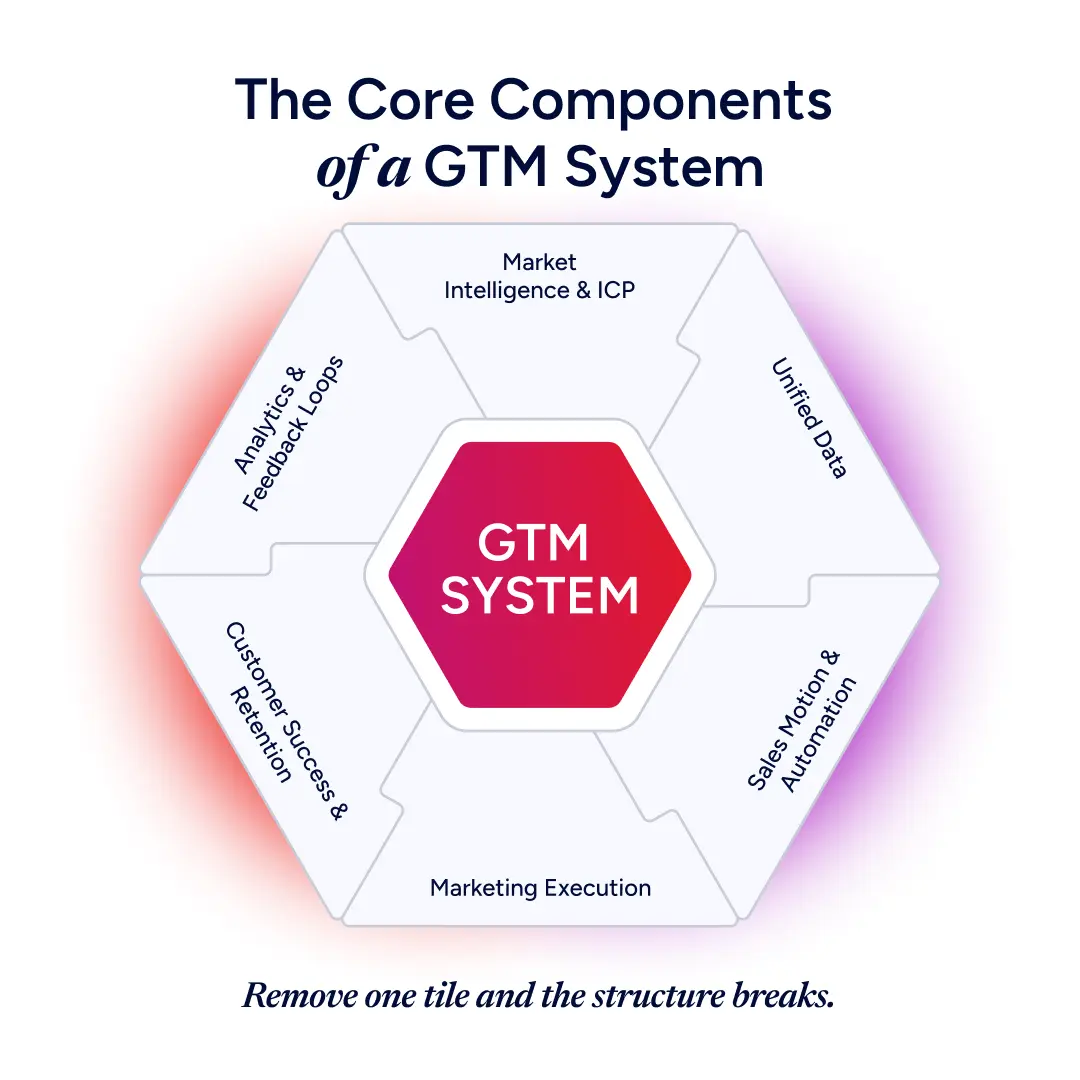
Market intelligence & ICP definition
Everything starts with knowing who you sell to and why. A GTM system uses firmographic, technographic, and behavioral data to define an ideal customer profile sharp enough to filter your total target market down to accounts you can win. Without a tight ICP, every downstream signal is noise.
Strong ICP definition pulls from:
Firmographics (industry, size, geography, revenue)
Technographics (tools already in their stack)
Behavioral data (web visits, content consumption, research patterns)
Outcome data (which segments closed fastest at highest ACV in the last 12 months)
Unified data management
Data is the foundation of every GTM system, and if it cracks, everything above it suffers.
This component covers contact and account records, intent signals, conversation data, enrichment, deduplication, and continuous verification. It also covers ownership: who's accountable for keeping records clean and who decides what counts as the source of truth.
Pro Tip: Audit your CRM before you invest in another AI tool. If 30% of your contact records are stale, no AI agent built on top of them will deliver pipeline. AI is only as useful as the data feeding it.
Sales motion & automation
This is the execution layer for sellers. It covers sequences, dialers, task management, account routing, and the workflows that turn a buying signal into a call, an email, or a meeting.
The goal is to reduce the distance between insight and action so reps spend less time hunting for context and more time selling. Strong sales enablement makes that possible at scale.
Reps shouldn't have to think about what to automate first. The sales automation layer should make that obvious, and it's the part of the GTM playbook most directly tied to pipeline velocity.
Marketing execution & demand generation
This layer covers campaigns, ABM plays, paid media activation, and audience building.
A GTM system makes sure sales and marketing teams work from the same target lists, the same definition of intent, and the same view of which accounts matter this week. That alignment is what stops marketing from celebrating MQLs that sales never works.
Customer success & retention
A GTM system doesn't stop at closed-won.
CSMs need the same signals sellers do, including expansion intent, competitor research, and the risk patterns that predict churn. The same intelligence that drives acquisition should feed retention and expansion, which is where customer success becomes a revenue function rather than a support one.
Analytics, reporting & feedback loops
The system has to learn from its own outputs: win rates by segment, sequence performance, message resonance, signal accuracy, time to first touch, and deal velocity.
The right analytics tools turn this feedback loop into the layer that keeps the GTM system improving instead of running on autopilot. Plenty of teams stop here because it's the hardest layer to build and the easiest to ignore.
Why Most GTM Systems Fail
Plenty of teams set out to build a GTM system and end up with a half-wired stack. Five failure modes explain almost all of it:
Data fragmentation. Companies run an estimated 2,000 data silos across their stack. Sales, marketing, and CS each see a different version of the same account. Reps stop trusting the system the first time it contradicts itself, and trust is hard to rebuild.
Signals captured but not actioned. Intent and engagement data piles up. Nobody routes it. The signal expires while reps cold-call accounts that aren't in market, and by the time it surfaces in a report, the buying committee has already shortlisted three competitors.
Outbound disconnected from lifecycle. SDRs sequence contacts who replied to marketing last week or are mid-deal with an AE. The outreach lands as noise, and the brand pays for it. This is why sales and marketing alignment sits at the center of every working GTM motion.
CRM hygiene treated as a project, not a system. Quarterly cleanups can't outrun daily decay. Without continuous enrichment wired into revenue operations, the foundation is broken again the day after you fix it.
AI bolted on top of broken data. AI doesn't fix bad data. It scales it. Speed without verified inputs just produces wrong answers faster, and the cost shows up in pipeline three quarters later.
The common thread is ownership. Every failure above traces back to a connection nobody was accountable for. Buying another tool puts more weight on the same broken seams.
How to Build a GTM System: A 5-Step Framework
Building a GTM system is sequential. Skip a step and the output stops compounding.
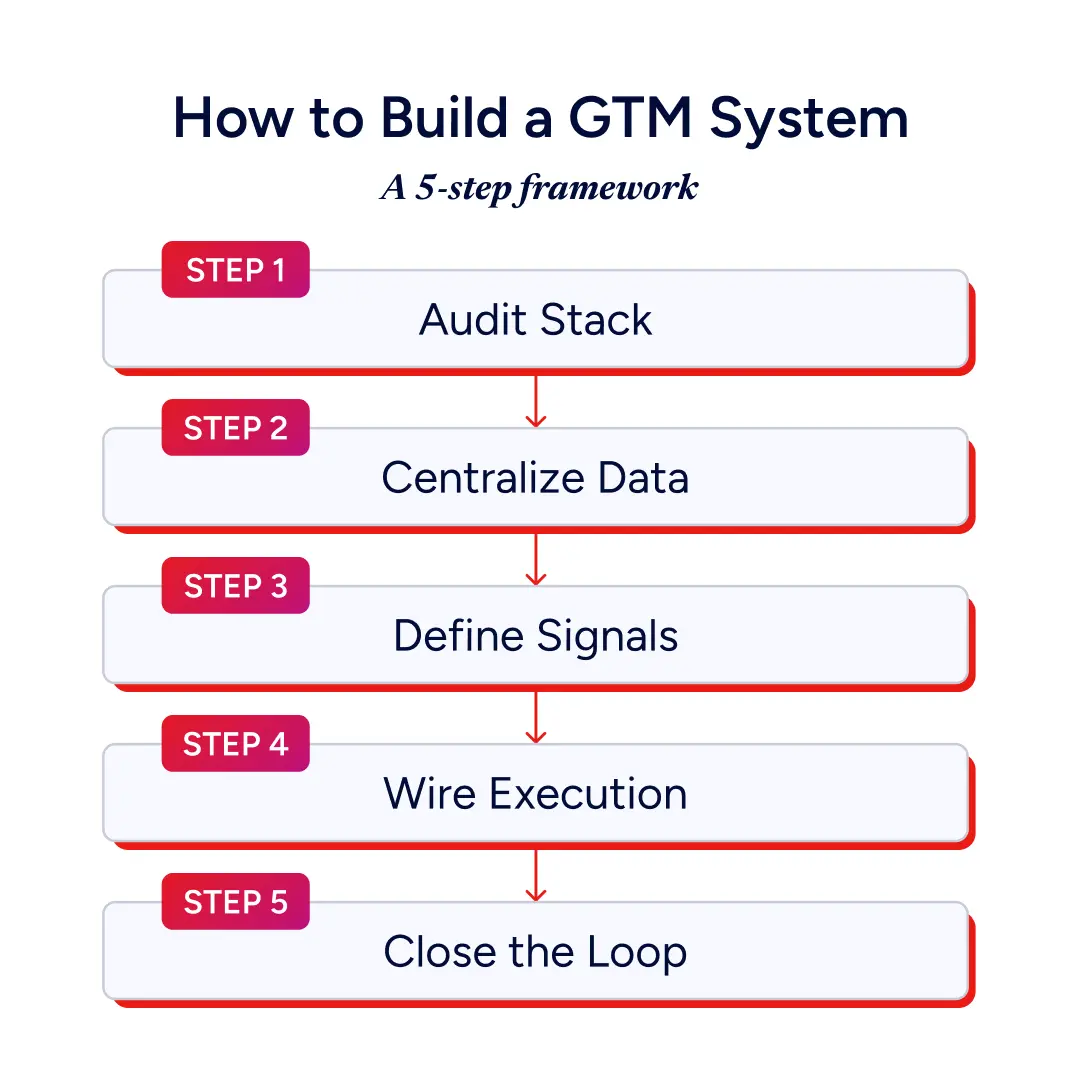
1. Audit your existing stack
Start with what you already own. Map every tool in your GTM stack against the six components above and document three things for each: what it does, what data it produces, and what data it consumes.
Two patterns show up almost every time. A handful of tools nobody uses, and two or three places where the same data gets entered manually because nothing passes it cleanly between systems.
The output is a stack diagram with gaps and overlaps marked. That tells you where to consolidate, integrate, and add. A reference list of GTM tools by category helps benchmark what should sit in each layer.
2. Centralize your data foundation
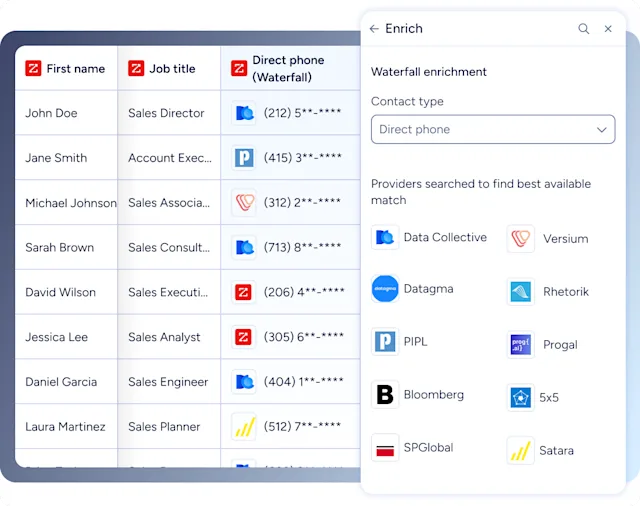
Pick a system of record (almost always the CRM) and decide what counts as the source of truth for every other piece of data: contacts, accounts, intent, conversations, enrichment. Then build the pipes that keep it clean: continuous verification, deduplication rules, ownership for each field, and a written policy on what overrides what when records conflict.
This is also where you decide how to handle third-party data. ZoomInfo's GTM Studio combines first-party CRM records with verified B2B contact, company, and intent data. Its waterfall enrichment queries multiple vendors in parallel and returns the highest-confidence record, not the first match.
3. Define the signals that matter
Signals are anything that tells you an account or contact is worth your attention right now. Common signals include:
Buying intent (third-party research behavior)
Funding announcements
Job changes tied to key buyer personas
Hiring patterns in a relevant function
Technographic changes (adding or removing competitor tools)
Engagement signals (web visits, email opens, content downloads)
Account expansion signals (new use cases inside existing customers)
The mistake most teams make is treating every signal as equally important. Score them against what correlates with closed-won deals in your historical data. Those are the signals your system should prioritize. Everything else is background noise.
Go deeper: Our free ebook Signal-Based Selling: How to Leverage 4 Key Buying Signals breaks down how to put four specific buying signals into action.
4. Wire execution to signals
A signal that nobody acts on isn't really a signal. The execution layer is where your GTM operations team decides what happens when a signal fires: who gets notified, what they do, which tool they do it in, and within what SLA.
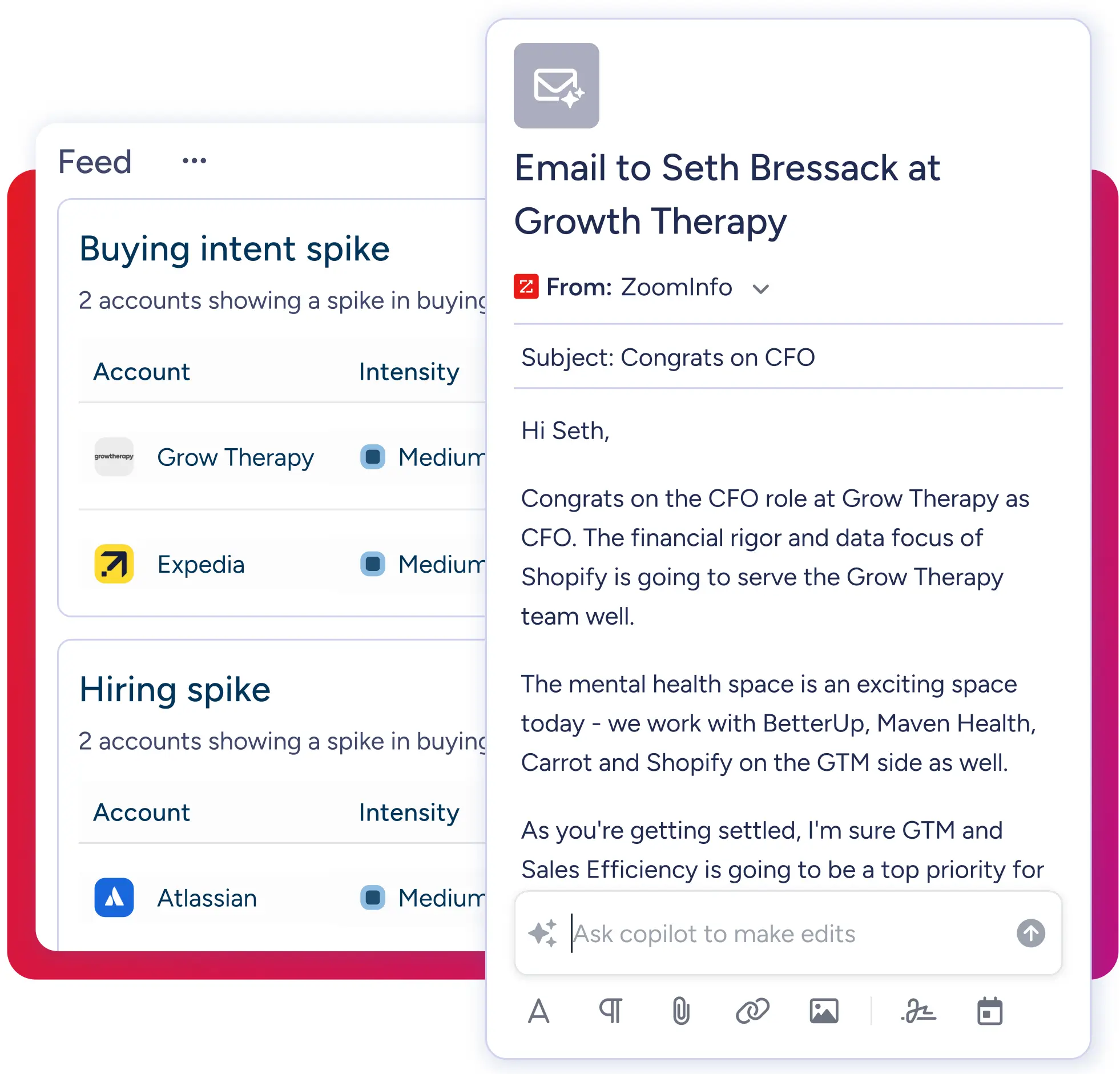
The strongest GTM systems automate the routing entirely, so a funding announcement at a target account triggers a play that adds the account to a sequence, pings the AE in their workflow, and tees up a personalized first touch grounded in the funding context.
ZoomInfo's GTM Workspace handles this layer. It surfaces up to 1,000 ranked signals per seller per day across 15+ signal types, turns each one into a next action (the brief, the outreach, the play to run), and pushes updates back to the CRM automatically so the system stays current without manual entry.
5. Close the loop with measurement
Wire reporting into the system from day one. The metrics that matter:
Signal-to-action time
Signal accuracy (whether the signal predicted what actually happened)
Pipeline sourced from signals
Win rate by signal type
Sales cycle by signal type
Net revenue retention from signal-driven expansion plays
Review monthly. Cut what isn't working, and double down on what is. A GTM system that doesn't get sharper every quarter is slowly turning back into a stack.
GTM System Examples in Practice
The easiest way to understand what a GTM system does is to walk through a few plays. Each example below follows the same structure: Signal → Action → Outcome.
Example 1: In-market account
Signal: A target account spikes in third-party research for terms related to your category, and a VP of RevOps starts visiting your pricing page.
Action: The GTM system flags the account in the AE's workspace, generates a one-page brief that pulls in the buying committee, recent funding, and tech stack, and drafts a personalized first email referencing what the VP has been researching.
Outcome: The AE reaches the account before competitors do, with context that would have taken two hours to assemble manually.
Example 2: Expansion signal
Signal: An existing customer hires three new engineering managers in a quarter and starts evaluating a product category you serve.
Action: The system notifies the CSM and the account's AE, surfaces the new hires and their reporting line, and proposes an expansion play tied to the hiring pattern.
Outcome: Expansion conversations start before the customer issues an RFP, and NRR climbs without adding new logos.
Example 3: Churn risk
Signal: A customer's product usage drops 40% in 30 days and their main champion updates their LinkedIn title.
Action: The system flags the account as high churn risk, triggers an executive escalation play, and routes a save offer through the CSM with full context on what changed.
Outcome: The save conversation happens weeks before the renewal, while there's still time to repair the relationship.
How AI is Changing GTM Systems in 2026
AI has moved from a feature inside individual GTM engineering tools to the layer that connects them. Three shifts matter most.
AI adoption is outpacing impact
McKinsey's state of AI 2025 found that 62% of organizations are at least experimenting with AI agents.
The high performers, the ones seeing real returns, are nearly three times more likely than peers to have fundamentally redesigned their workflows. Adoption without workflow redesign produces motion without margin.
ZoomInfo's state of AI in sales & marketing 2025 shows the same split: individual contributors are heavy daily users, but senior leaders remain skeptical until AI starts delivering business outcomes beyond productivity wins.
GTM data isn't AI-ready
AI use in GTM has grown nearly 900% since 2022, but only 19% of companies believe their data is ready for AI, according to ZoomInfo's 2025 go-to-market intelligence report.
The same research shows companies report under 5% revenue lift from an average $20M annual AI investment. Agents and automations inherit the data underneath them. If that data is stale, fragmented, or unverified, AI accelerates the failure rather than the result.
Agents are reshaping how tools get chosen
Gartner named multiagent systems a top strategic technology trend for 2026, describing them as collections of AI agents that work together to automate complex business processes.
In a GTM context, that means a prospecting agent, a research agent, and a personalization agent coordinating on a single account, instead of three tools a human has to stitch together. GTM engineers, the operators building these stacks, increasingly discover and wire up tools by asking Claude or ChatGPT rather than Googling.
This is what GTM AI is built for. It's ZoomInfo's distribution layer for the agentic era. Verified data, skills, and pre-built plays live in a marketplace and MCP surface, discoverable both to GTM engineers and to the AI agents working on their behalf. It meets operators and agents where they already are.
Build Your GTM System Around Verified Intelligence
Workflows are the easy part of a GTM system. The hard part is keeping the contact, account, and intent data feeding those workflows accurate, fresh, and complete at scale. That's where systems break down.
ZoomInfo is the intelligence layer for B2B GTM:
500M+ verified professional profiles
100M+ company records
Real-time buying intent across millions of topics
Conversation intelligence and signal data feeding into your CRM, SEP, and MAP
AI workflows that turn signals into next actions inside the tools reps already use
Talk to our team about turning your GTM stack into a system.
FAQs
How does GTM work?
A go-to-market motion is how a company finds, wins, and retains customers. It aligns sales, marketing, and customer success around a shared ideal customer profile and the actions that move deals forward. The GTM system makes that motion repeatable, measurable, and executable as part of a broader go-to-market strategy.
Is a GTM system the same as a CRM?
No. A CRM is a system of record that stores what already happened, including contacts, opportunities, activities, and deal stages. A GTM system is a system of action that tells the team what should happen next and why, by combining CRM data with external signals, intent, and AI-driven recommendations. The CRM is one component of the GTM system, but not the whole thing.
Do small teams need a GTM system?
Yes, in principle. Small teams need fewer tools, but they need the same connective tissue. The difference is scale. A five-person sales team can run a lightweight GTM system using a CRM, a verified data source, and a sales engagement tool. The underlying principles (unified data, defined signals, wired execution, and continuous measurement) are the same ones a 500-person revenue org needs.
What's the difference between a GTM system and a GTM operating system (OS)?
The terms get used interchangeably. "GTM operating system" tends to emphasize the orchestration layer, meaning the workflows, automations, and routing rules. "GTM system" tends to emphasize the full stack of data, intelligence, and execution. Functionally, both describe the same thing: the connected infrastructure that runs your go-to-market motion.
What are the best GTM systems for B2B SaaS?
It depends on motion, size, and existing stack. Most strong B2B SaaS systems combine a verified intelligence layer (ZoomInfo), a CRM (Salesforce or HubSpot), a sales engagement platform (Outreach or Salesloft), and a conversation intelligence layer (Chorus or Gong). The intelligence layer holds it together. Every other tool is only as effective as the data feeding it.
