
AI sales agent platforms research accounts, act on buying signals, qualify buyers and update the CRM with little manual work. Some sell one agent for one job, like the AI SDR tools built for prospecting, some build agents into a CRM or sales engagement platform, and a few coordinate teams of agents across the whole revenue cycle.
We compared eight AI sales agent software platforms on data, orchestration, revenue-cycle coverage, stack fit, governance and cost. ZoomInfo leads for complete plays on verified data, Agentforce and HubSpot Breeze fit teams that want agents inside their CRM, and Relevance AI fits teams that build their own.
AI Sales Agent Platforms at a Glance
Here’s how the eight platforms compare on platform type, where their agents work in the revenue cycle, starting price and G2 rating.
Platform | Type | Where agents work in the revenue cycle | Starting price | G2 rating |
ZoomInfo | Orchestration platform | Pipeline generation, inbound, deal execution, handoff, renewal and win-back | Free to start with consumption credits based on usage | 4.5/5 (GTM Workspace) |
Salesforce Agentforce | CRM-native agents | Inbound nurture, prospecting, coaching and custom agents in Salesforce | Flex Credits, or add-ons from $125/user/month | 4.3/5 |
HubSpot Breeze | CRM-native agents | Prospecting and customer service in HubSpot | $1 per lead recommended for outreach (Prospecting Agent) | 4.3/5 (Agent Hub) |
Gong | Revenue AI platform | Deal execution, forecasting, coaching and custom agents | Custom | 4.7/5 |
Salesloft | Revenue orchestration | Cadences, conversations, deals and forecasting | Custom | 4.5/5 |
Outreach | Agentic AI platform | Prospecting, deals, meeting prep and coaching | Custom | 4.3/5 |
Qualified | Inbound agent | Website conversion and inbound email | Custom | 4.9/5 |
Relevance AI | Agent builder | Any workflow you design | Free plan, Enterprise custom | 4.3/5 |
What Is an AI Sales Agent Platform?
An AI sales agent platform is software that runs sales tasks without a person triggering each step. An AI sales assistant suggests the next email for a rep to send. An agent researches the account, writes the message, takes the action and records it in the CRM. Our guide to AI sales agents covers how agents work and the main types in more depth.
The word “platform” matters. A single agent handles one job, such as booking meetings from inbound chat. A platform runs agents across several jobs and shares context between them, so the research gathered during prospecting is still there when the deal reaches negotiation. That shared context separates platforms that run whole plays from AI sales automation tools that handle one step.
The Six Types of AI Sales Agent Platforms
AI sales agent platforms fall into six types, defined by how much of the revenue cycle their agents cover and where those agents run. Knowing the type tells you what a platform can take off your team’s plate before you compare features.
Orchestration platforms coordinate teams of specialist agents across the revenue cycle, from the first signal to a finished CRM record. ZoomInfo Agent Teams is built this way, and the approach builds on the ideas behind revenue action orchestration tools.
CRM-native agents live inside your system of record. Salesforce Agentforce and HubSpot Breeze work on the data already in the CRM, so CRM data quality shapes what they can do.
Revenue AI and engagement platforms add agents to the tools reps already use for sequences, calls, deals and forecasts. Gong, Salesloft and Outreach sit here, and our comparison of sales engagement platforms covers the wider category.
Inbound agents convert website visitors and inbound leads. Qualified’s Piper is the best-known example.
Outbound AI SDRs such as 11x and Artisan focus on prospecting and first touches. We compare them separately in our roundup of AI SDR platforms for outbound sales.
Agent builders let you design your own agents for any workflow. Relevance AI is the agent builder on this list, and our guide on how to build an AI sales agent walks through the approach.
How We Evaluated These Platforms
We assessed each platform against six criteria, using vendor documentation, pricing pages and G2 reviews:
Data. Do agents work from verified contacts, company data and buying signals, or only from what already sits in your CRM?
Orchestration. Can agents share context and hand work to each other, or does each one run alone?
Coverage across the cycle. Do agents work beyond prospecting, in inbound, deal execution, handoff and expansion?
Where agents act. Do they act natively in your CRM, inbox, Slack and sales engagement tools, or only inside the vendor’s own app?
Governance. Can you monitor what agents do, control who builds and runs them and see the cost before work starts? Our guide to governing AI agents at scale covers what to look for.
Cost model. Is pricing per seat, per outcome or by consumption, and can you forecast it?
1. ZoomInfo
G2 rating: 4.5/5 for GTM Workspace (9,185 reviews)
ZoomInfo is an all-in-one AI GTM Platform built on three layers. Its own data sits at the foundation, with 500M contacts and 100M companies, including 135M+ verified phone numbers, 120M+ direct dials and 200M+ verified business emails, kept current by 300+ human researchers with up to 95% accuracy on first-party data. The GTM Context Graph adds the intelligence, processing 1.5B+ data points daily and fusing that data with your CRM records, calls, emails and behavioral signals. Universal Access puts both into the tools each team uses, from GTM Workspace for sellers to GTM Studio for RevOps and marketing. It’s the foundation 37 of the top 40 AI companies use to run GTM.
For AI sales agents, the key piece is Agent Teams, which runs inside GTM Studio. You give the Agent Team an outcome, such as converting an inbound lead or opening a target account, and specialist agents carry the play across every step, sharing context while a supervisor agent checks each one against your rules. A job change, form fill, intent spike or CRM event opens or resumes the play, so the work picks up from where the account stands today. Teams start from 50+ ready-made agents and templates, customize a play in plain language or code, and can be live in a day.
Teams building their own agents can reach the same data and context headless through GTM.AI’s API, CLI and MCP.
Key features:
Agent Teams templates for Outbound Prospecting, Inbound Lead Activation, Closed/Won Account Handoff and Meeting Insights & CRM Update, plus 50+ ready-made agents
Verified contacts, direct dials and buying-group data across 500M contacts and 100M companies
Intent, technographic, hiring and job-change signals that open or resume plays
GTM Context Graph reasoning across CRM, conversation and behavioral data
Native actions in Salesforce, HubSpot, Slack, Gmail, Salesloft and Outreach, with every step written back to the CRM
Monitoring, admin dashboards, role-based access and a credit estimate before each play runs
Pros:
Runs whole plays across the revenue cycle, from pipeline generation to renewal and win-back
Agents work from verified data, so actions reach the right people
Works inside the CRM and sales engagement tools teams already use
Part of GTM Studio with no new SKU or contract
Cons:
Agent Teams is newer than ZoomInfo’s core platform, so it has a shorter track record
Consumption credits need scoping against your real volume
Built for mid-market and enterprise teams more than solo founders
What users say on G2: A software engineer says GTM Workspace’s “CRM integration feels very smooth and helps automate workflows,” adding that the contact data was “very dependable, especially direct dials and email addresses.” A small-business user would like ZoomInfo’s “MCP and API endpoints” to “open up a little further” for teams running their own agent harness.
Best for: Mid-market and enterprise revenue teams that want agents to run complete plays across the cycle on verified data.
Pricing: Free to start with consumption credits based on usage.

"The AI chatbot that's given all that context has helped us craft very specific account- and persona-based messages. And people have responded to them right away."
2. Salesforce Agentforce
G2 rating: 4.3/5 (1,697 reviews)
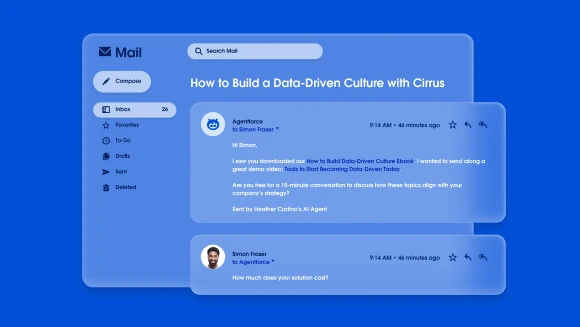
Salesforce Agentforce is Salesforce’s platform for building and running AI agents on CRM data. For sales, it includes an SDR agent that nurtures inbound leads around the clock, answers questions and books meetings for reps, a Sales Coach agent for role-play and feedback, and the Agentforce Prospecting Agent. Teams can also build custom agents for their own workflows.
ZoomInfo data powers the Agentforce Prospecting Agent, so mutual customers get verified contact, company, intent and Scoops data inside Agentforce by default through GTM.AI. Salesforce also completed its acquisition of Qualified on April 1, 2026, and is folding Qualified’s agentic marketing capabilities into Agentforce.
Key features:
SDR agent for inbound lead nurture and meeting booking
Prospecting Agent with ZoomInfo data for account and contact research
Sales Coach agent for role-play and call feedback
Agent builder for custom workflows
Native access to Salesforce data, permissions and automation
Pros:
Agents run inside the system teams already use as their source of truth
Agents inherit Salesforce’s data model and permissions
Broad agent library across sales, service and marketing
Considerations:
Designed for teams that run on Salesforce
Flex Credit usage needs forecasting against agent volume
Agent output depends on the quality of the CRM data underneath
What users say on G2: A mid-market business systems analyst says Agentforce “has reduced overall workload time and turnaround time.” A data science VP notes that per-conversation and per-action pricing “can quickly add up, especially at high interaction volumes.”
Best for: Sales organizations standardized on Salesforce that want agents inside their CRM.
Pricing: Sold through Salesforce on Flex Credits, at $500 per 100,000 credits with a standard agent action using 20 credits, or as Agentforce add-ons for Sales from $125 per user per month.
To see how verified data reaches the agent, read how the Salesforce Agentforce Prospecting Agent runs on ZoomInfo.
3. HubSpot Breeze
G2 rating: 4.3/5 for HubSpot Agent Hub (32 reviews)
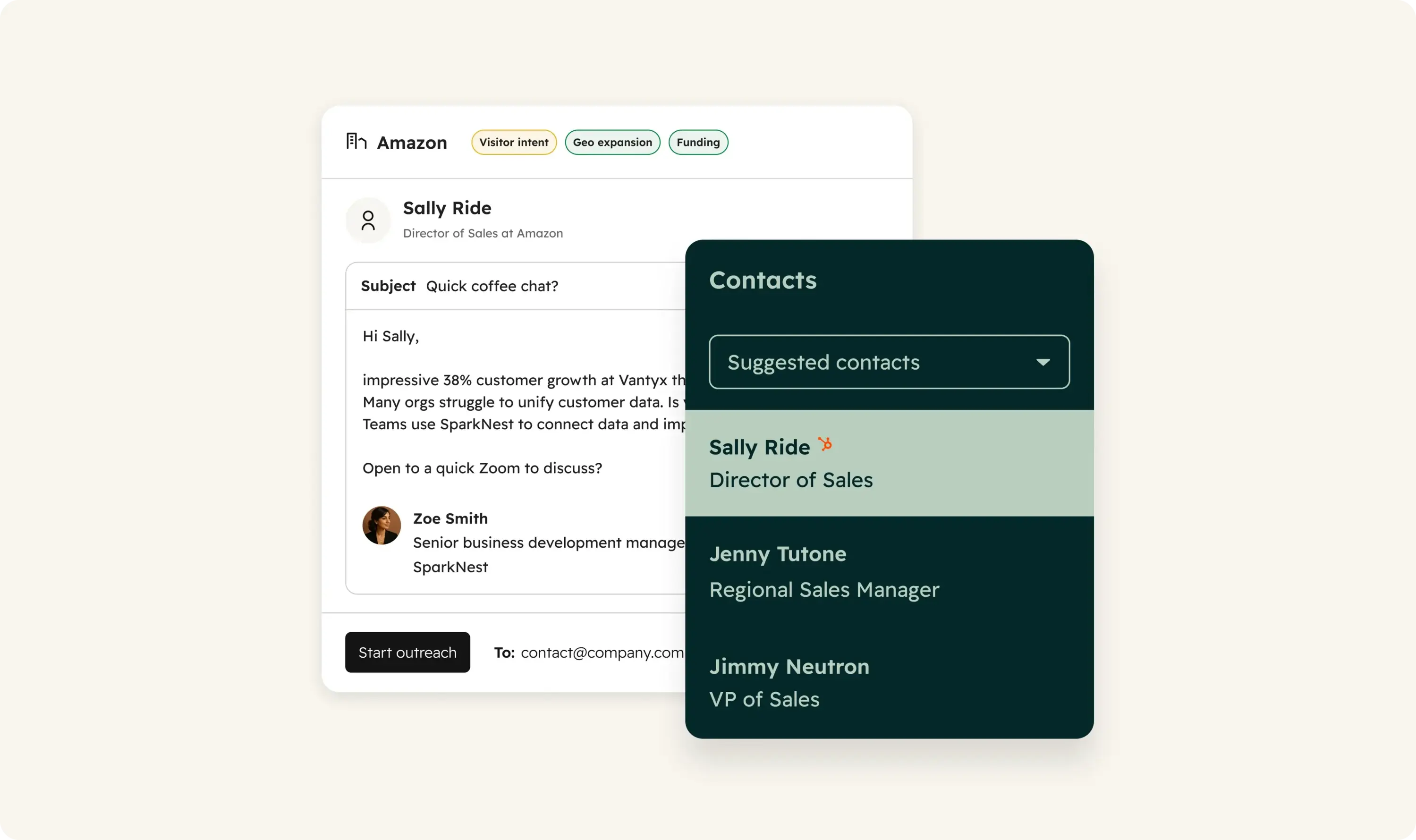
Breeze is HubSpot’s AI layer, with agents built into the HubSpot CRM. For sales, the Breeze Prospecting Agent researches leads, decides which ones are worth outreach and drafts personalized messages, while the Customer Agent resolves service conversations. Both are available on Pro and Enterprise plans with a 28-day free trial, and teams manage them, along with any custom agents they build, in HubSpot Agent Hub.
On April 14, 2026, HubSpot moved both agents to outcome-based pricing, so teams pay when the agent completes the task. ZoomInfo also powers the Breeze Prospecting Agent, bringing external contact data and buying signals into the agent alongside HubSpot’s own records.
Key features:
Prospecting Agent for lead research, prioritization and outreach drafts
Customer Agent for resolving service conversations
Outcome-based pricing billed in HubSpot Credits
Native use of HubSpot CRM data, workflows and reporting
Pros:
No extra vendor for teams already on HubSpot
Outcome-based pricing ties cost to completed work
Quick to switch on for HubSpot users
Considerations:
Designed for teams that run on HubSpot
Two sales-relevant agents today, focused on prospecting and service
Full Sales Hub features require paid seats
What users say on G2: One small-business reviewer likes that “the agent builder in HubSpot is guided by the AI itself,” prompting users through each guideline, action and connection. Another notes that “credit consumption for heavy AI tasks can add up over time.”
Best for: HubSpot-native sales and marketing teams that want agents without adding another tool.
Pricing: The Prospecting Agent costs $1 per lead recommended for outreach (100 HubSpot Credits), and the Customer Agent costs $0.50 per resolved conversation (50 HubSpot Credits).
For the data side of the integration, see how ZoomInfo powers the Breeze Prospecting Agent.
4. Gong
G2 rating: 4.7/5 (6,770 reviews)
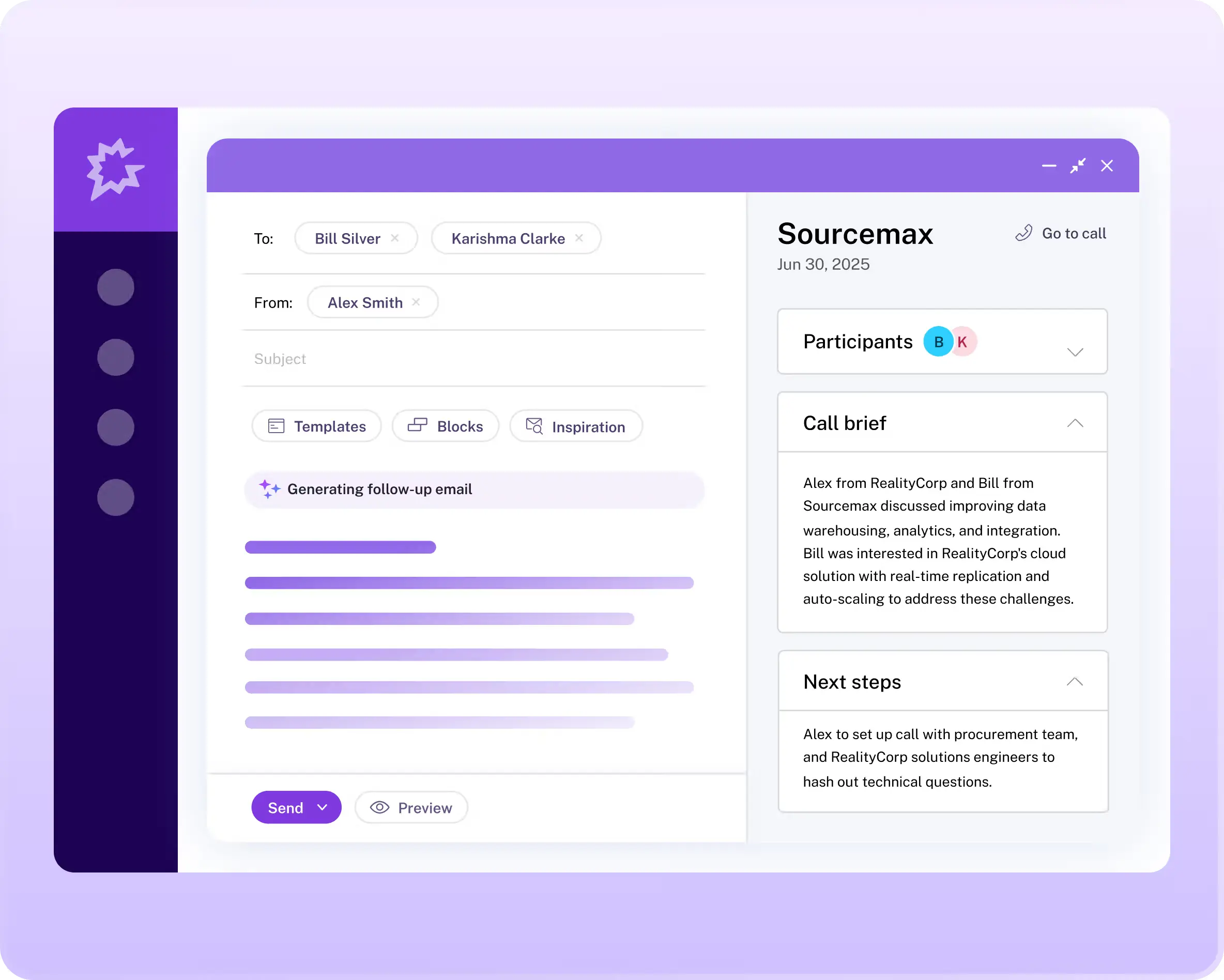
Gong is a revenue AI platform built on the Gong Revenue Graph, which captures calls, emails and meetings across the revenue team. Specialized agents work across deal execution, forecasting and coaching.
In June 2026, Gong launched the Revenue Harness, an agentic execution layer that governs, orchestrates and connects agents across the revenue cycle, along with Custom Agents that teams describe in plain language, with scoped data access and an audit trail.
Gong works with more than 5,000 companies and supports MCP, so outside AI tools can work with its data.
Key features:
Revenue Graph built from customer conversations and activity
Specialized agents for deal execution, forecasting and coaching
Revenue Harness for governing and orchestrating agents
Custom Agents built in plain language
Conversation intelligence, forecasting and engagement modules
Pros:
Deep revenue intelligence from real customer conversations
Strong coaching and deal inspection
Large customer base of 5,000+ companies
Cons:
No public pricing
Agents center on conversation data, so prospecting data comes from elsewhere
Takes time to learn the full platform
What users say on G2: An enterprise sales program manager says “the conversation insights for coaching get acted on frequently.” Another reviewer finds that dashboards “can feel cluttered, and finding specific insights can mean navigating multiple views.”
Best for: Enterprise revenue teams that want agents built on conversation intelligence for deal execution and coaching.
Pricing: Custom.
For a module-by-module look, see our breakdown of Gong features.
5. Salesloft
G2 rating: 4.5/5 (9,907 reviews)
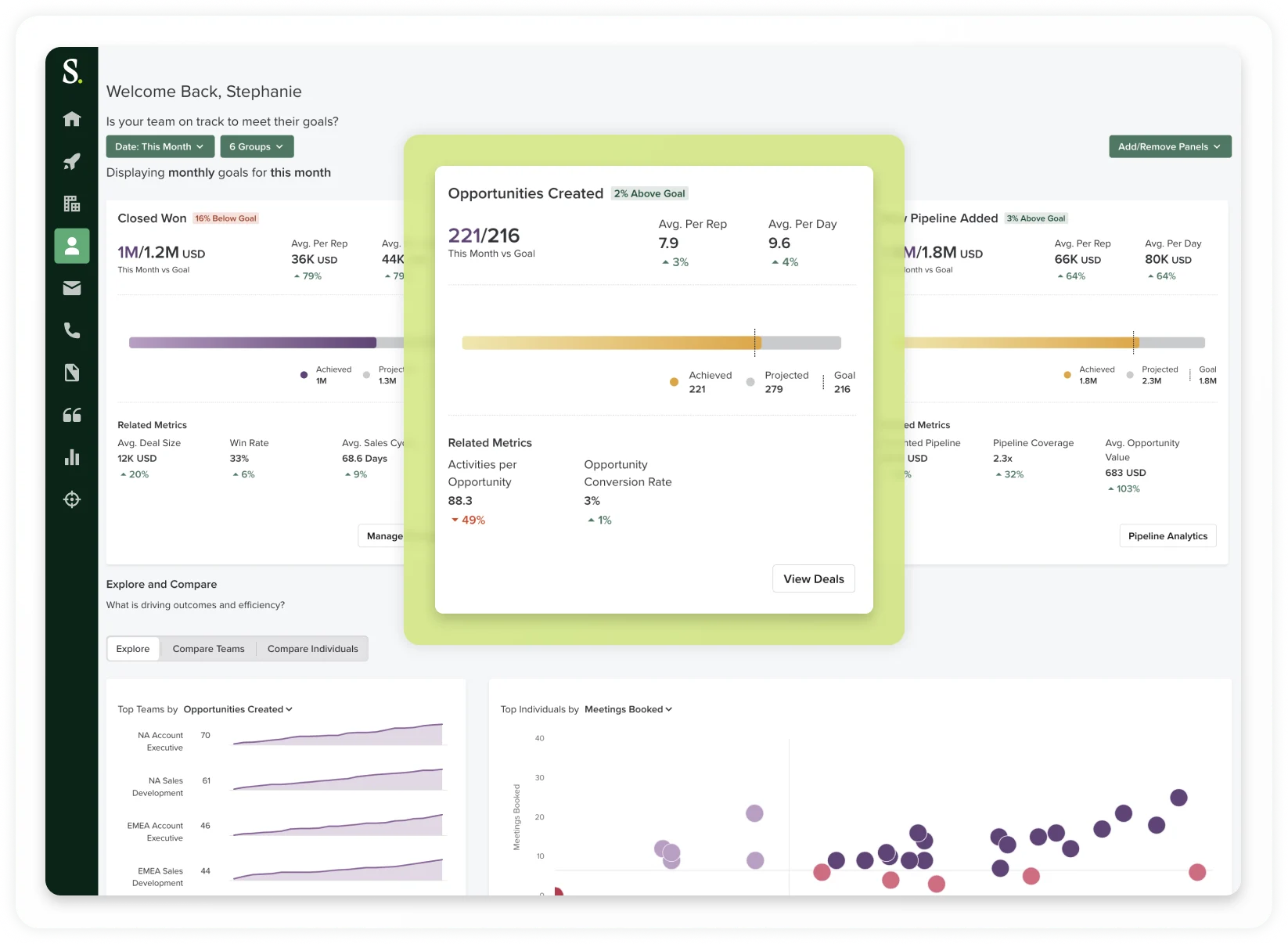
Salesloft merged with Clari in December 2025 and moved to a single Salesloft brand in September 2026. The platform combines Cadence, conversation intelligence, deal management and Clari Forecast, the one product that kept the Clari name. Its AI includes Rhythm, which ranks the next best action for each rep, AI Email Steps that draft a personalized message at each cadence step and an Account Research agent.
Salesloft launched an MCP server in April 2026 and expanded it in July to cover forecasting, deal inspection and call data, so assistants such as Claude and ChatGPT can work with Salesloft data and write back to it. Agent Teams connects to Salesloft natively, so teams can run plays in ZoomInfo and keep execution in Salesloft cadences.
Key features:
Cadence for multichannel sequences
Rhythm for signal-based action prioritization
AI Email Steps and an Account Research agent
Conversation intelligence and Clari Forecast
MCP server with write-back for external AI tools
Pros:
Engagement, conversations and forecasting in one platform
Strong cadence governance for large teams
Native connection to Agent Teams
Cons:
No B2B contact data of its own
Agents are mostly assistive, so reps still execute outreach
No public pricing
What users say on G2: A mid-market user likes Salesloft’s “task management and the email tracking/automation” and found it “fairly easy to use and set up.” On the AI side, the same reviewer notes that “the AI-guided prioritization only sometimes points me to the right next step.”
Best for: Enterprise sales teams that want AI to prioritize and draft inside structured cadences, with forecasting in the same platform.
Pricing: Custom.
For a closer look at each module, read our breakdown of Salesloft features.
6. Outreach
G2 rating: 4.3/5 (3,669 reviews)
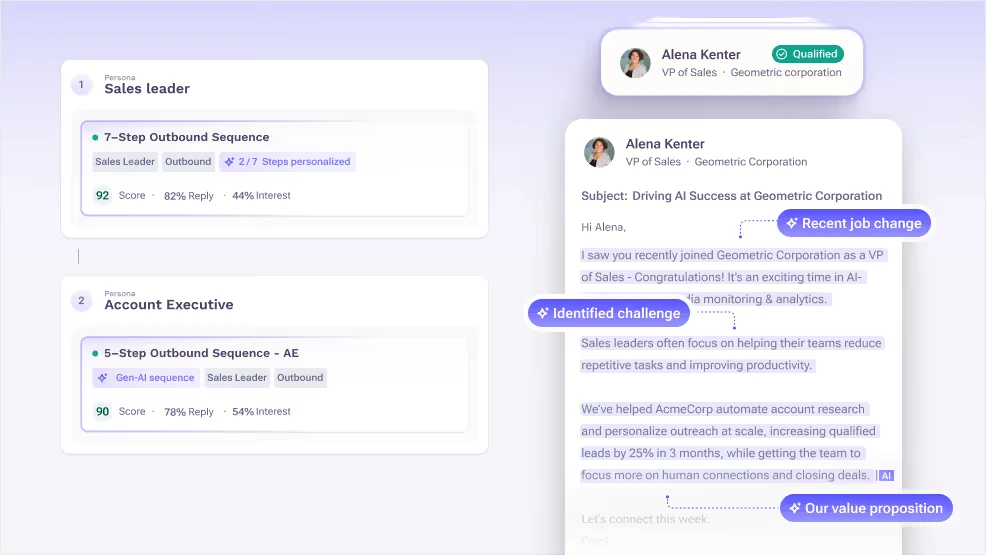
Outreach is an agentic AI platform for revenue teams, with agents across prospecting, deal management and coaching. Its April 2026 release added Omni, a conversational agent that sellers, managers and leaders can use in the app, Slack or mobile, and Agent Studio, a visual canvas where RevOps teams build and schedule custom agents from ready-to-run templates. Named agents include a Meeting Prep Agent for pre-meeting briefs and a Deal Agent that suggests deal-field updates in Slack. In June 2026, Outreach added a full MCP suite so external AI tools can work with its data.
Outreach is one of the sales engagement platforms Agent Teams works with natively, so teams can keep their Outreach email sequences and let Agent Teams research accounts and enroll the right buyers.
Key features:
Multichannel sequences across email, phone and LinkedIn
Agent Studio for building and scheduling custom agents
Omni conversational agent, plus Meeting Prep and Deal agents
Outreach Knowledge to ground AI output in approved content
MCP suite for external AI tools
Pros:
Mature sequencing engine many enterprise teams already use
Agents across the sales cycle in one platform
Custom agents without engineering through Agent Studio
Cons:
No B2B contact data of its own
More platform than many teams need on day one
No public pricing
What users say on G2: A mid-market customer engineer says Outreach “made my outreach much more consistent” and that deal and pipeline insights “flagged the right deals very reliably.” An account executive finds the AI outputs “only moderately accurate and consistent.”
Best for: Enterprise sales organizations that want agents inside an established sales engagement platform.
Pricing: Custom.
For a hands-on view, read our full Outreach review.
7. Qualified
G2 rating: 4.9/5 (1,565 reviews)
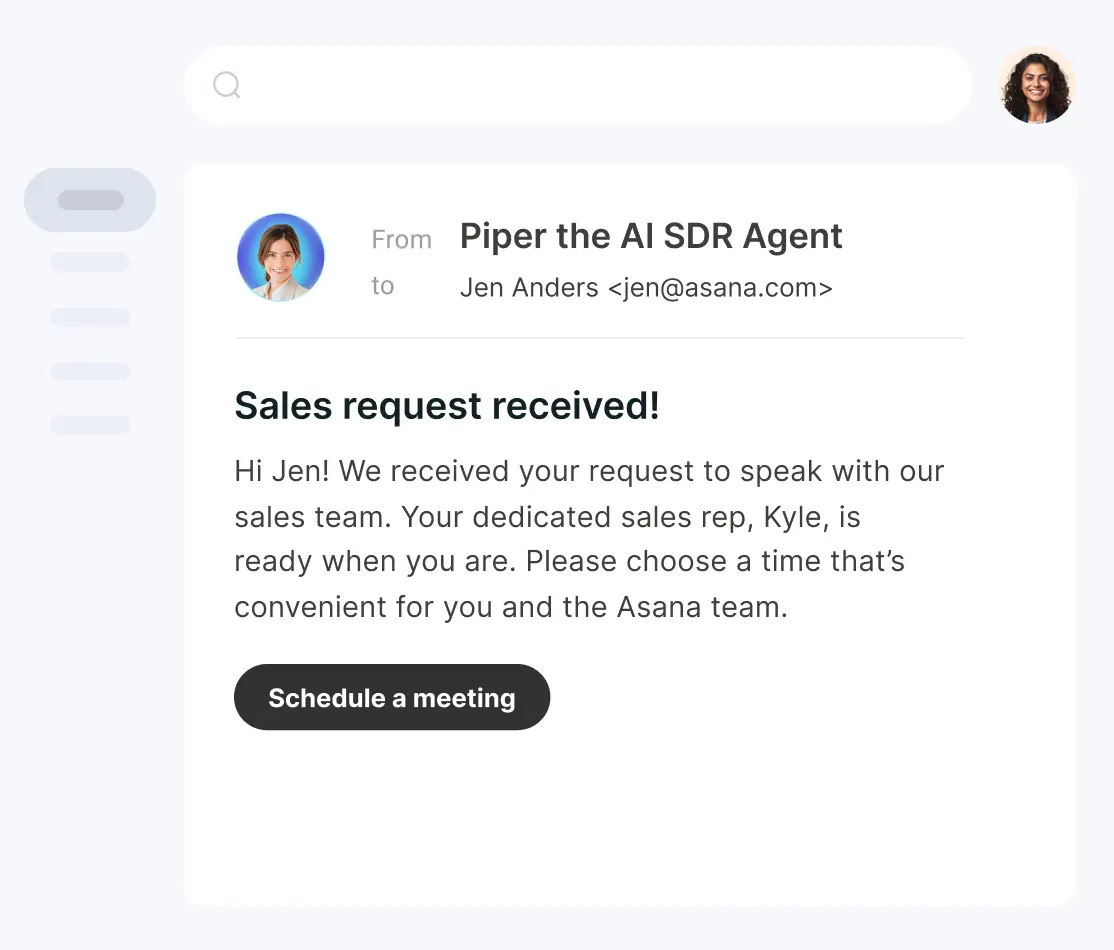
Qualified sells Piper, an AI SDR agent for inbound used by more than 500 companies.
Piper meets website visitors over live chat, voice and video, qualifies them, answers product questions, books meetings and follows up with inbound leads by email. Salesforce completed its acquisition of Qualified in April 2026, so buyers should confirm how packaging will change as Qualified’s capabilities move into Agentforce.
Key features:
Piper AI SDR for website chat, voice and video
Piper email follow-up for inbound leads
Visitor qualification and meeting booking
Routing to reps with activity logged in Salesforce
Built on Salesforce
Pros:
Purpose-built for inbound conversion
Very high G2 satisfaction, with frequent praise for the support team
Fast response to high-intent website traffic
Cons:
Focused on inbound, with no outbound prospecting
No public pricing
Packaging may shift as it moves into Agentforce
What users say on G2: A director of business operations says the team was “able to get to MVP and begin ROI weeks ahead of schedule,” and praise for the support team is a common theme. Another reviewer finds that as Qualified adds more AI, the platform can “feel more complex each quarter.”
Best for: Enterprise B2B teams on Salesforce with high-intent website traffic to convert.
Pricing: Custom.
Weighing other inbound options? Compare them in our roundup of Qualified alternatives.
8. Relevance AI
G2 rating: 4.3/5 (20 reviews)
Relevance AI is a no-code platform for building an AI workforce of agents and multi-agent teams. Teams start from templates, including Bosh, an AI BDR agent, or design agents from scratch, then connect them to their own data sources and tools. It suits teams with a specific workflow that packaged products don’t cover and the GTM engineering capacity to build and maintain it.
Enterprise adds calling and meeting agents, agent evaluations, A/B testing, SSO, role-based access and audit logs across 2,000+ integrations.
Key features:
No-code agent and multi-agent builder
Templates, including the Bosh AI BDR agent
2,000+ integrations with CRMs, data sources and APIs
Agent evaluations and A/B testing on Enterprise
SSO, role-based access and audit logs on Enterprise
Pros:
Maximum flexibility for custom workflows
One platform for agents beyond sales
Free plan for testing
Cons:
You build and maintain every agent
No data of its own, so agents rely on the sources you connect
Enterprise pricing isn’t published
Best for: RevOps and technical teams that want to build custom agents. Teams building on their own stack can pair it with verified data through GTM.AI.
Pricing: Free plan to start, with custom Enterprise pricing.
Planning your own build? Our guide to the context layer for AI agents explains the data an agent needs to reason well.
What B2B Teams Need From an AI Sales Agent Platform
B2B deals involve several buyers, months of back and forth and strict rules on data. A platform that writes good email can still fall short on any of these, so check four things before you buy.
Buying-committee coverage. B2B purchases involve several stakeholders, so agents need to find and engage the whole group. Look for platforms that map buying groups, write role-specific messages and track engagement across each account. This matters most in ABM, where agents build target-account lists, identify the key stakeholders and work toward a discovery meeting, often alongside your ABM software. Our guide to stakeholder mapping covers how to identify who’s involved, and an AI account research agent can build the account brief before outreach starts.
Continuity over long cycles. Deals pause and restart. A fixed sequence ends or starts over when a buyer goes quiet. A platform that works from each account’s current state picks up where it left off when a new signal arrives, such as a pricing-page visit or a champion changing jobs.
Compliance and data handling. Agents act on personal data at scale, so check GDPR and CCPA support, SOC 2 Type II certification, data residency options and how the platform handles opt-outs. Ask how data is sourced and how often it’s re-verified, because stale records add to B2B data decay and send outreach to the wrong people.
Total cost of ownership. License fees are only part of the cost. Factor in implementation, CRM configuration, the time someone spends maintaining agents and how usage-based pricing behaves at your real volume. Platforms that show a cost estimate before work runs make budgets easier to manage.
How Agent Teams Runs Plays Across the Revenue Cycle
Agent Teams works as an orchestration layer across the whole cycle. Specialist agents share context at every step, so the research from prospecting is still there when the deal closes and when it comes up for renewal. Here’s where its plays fit.
Stage | Play | What the Agent Team does |
Pipeline generation | Outbound Prospecting | Researches a target account, builds a list of the key buying-group contacts and writes a complete account brief |
Pipeline generation | Champion activation | Spots a past buyer’s move to a target account, reconstructs their role in the original deal, drafts outreach and briefs the account owner in Slack |
Inbound | Inbound Lead Activation | Researches a new lead, routes it to the right rep and briefs them in Slack |
Deal execution | MEDDIC capture | Pulls qualification details from completed meetings and writes them to the opportunity |
Post-sale | Closed-won handoff | Packages deal context for the account team when a deal closes |
Expansion | Closed-won lookalikes | Finds competitors of a new customer that aren’t customers yet and alerts the rep to reach out |
Retention | Renewal at risk | Flags accounts 90 days from renewal where engagement has dropped and the champion has gone quiet |
Win-back | Closed-lost win-back | Revisits closed-lost deals on a monthly schedule to find accounts worth re-engaging |
Champion activation is the hero play. When a past buyer changes jobs, job change alerts open the play, and the Agent Team turns that signal into outreach grounded in the original relationship, taking champion tracking from an alert to a finished first touch.
Inbound Lead Activation goes a step beyond lead routing, so every qualified buyer reaches the right rep with the full picture. Renewal at risk works from the same engagement signals behind a customer health score, so account teams hear about a quiet champion while there’s still time to act.
Plays start from manual inputs, schedules, webhooks, CRM events in Salesforce or HubSpot, website visits, completed meetings, job changes or ZoomInfo Audiences. Every step is written back to Salesforce or HubSpot, which keeps CRM data enrichment current without manual entry. Admins get monitoring, dashboards, role-based access and a credit estimate before each play runs, and the platform holds SOC 2, ISO 27001 and ISO 27701 certifications.
Agent Teams is built on technology from DoubleO.ai, now part of ZoomInfo, and is part of GTM Studio with no new SKU or contract. Teams that want to run it outside the interface can use GTM.AI’s API, CLI and MCP.
How to Choose an AI Sales Agent Platform
Start from where your revenue process breaks down, then match the platform type to the gap:
You want agents to run complete plays across the cycle. Look at orchestration platforms such as ZoomInfo, especially if pipeline growth depends on acting on signals across many accounts at once.
Your team lives in one CRM. Start with Agentforce for Salesforce or Breeze for HubSpot, and check where the agents get their contact and company data.
Your gap is deal execution, coaching or forecasting. Revenue AI platforms such as Gong, Salesloft and Outreach add agents to workflows reps already run, and our roundup of sales forecasting tools covers the forecasting side.
You need to convert more inbound demand. An inbound agent such as Qualified’s Piper works the website and inbox.
Your workflow is unusual and you have builders. An agent builder such as Relevance AI gives you full control.
Outbound prospecting is the main job. Compare dedicated AI SDRs as well, and see our guide to AI SDRs and AI BDRs.
Whichever way you lean, run a pilot on your own accounts, check that agents write back to the CRM and confirm you can see what each agent did and what it cost.
Choose a Platform That Runs the Whole Play
AI sales agent platforms now reach across the revenue cycle, and each type gets there differently. CRM-native agents work on the data inside one system, revenue AI platforms add agents to existing workflows, inbound agents convert demand you already have and builders give technical teams full control. For a wider view of AI across the sales stack, see our roundup of AI sales tools.
Teams that want agents to run complete plays, from the first signal to a finished CRM record, on verified data and inside the tools reps already use, should look at ZoomInfo Agent Teams. Give your agents an outcome, not a task.
To see Agent Teams run a play on your own accounts, meet with a GTM expert.
Frequently Asked Questions About AI Sales Agent Platforms
These are the questions buyers ask most when comparing AI sales agent platforms, from cost and data needs to ABM and implementation time.
Which AI sales agent platform is best?
It depends on the job. ZoomInfo Agent Teams is the strongest choice for teams that want agents to run complete plays across the revenue cycle on verified data. Salesforce Agentforce and HubSpot Breeze suit teams that want agents inside their CRM, Gong suits deal execution and coaching, Qualified suits inbound conversion and Relevance AI suits teams that want to build their own agents.
What are the main types of AI sales agents?
AI sales agents fall into six types: orchestration platforms that coordinate teams of agents, CRM-native agents, revenue AI and engagement platforms, inbound agents, outbound AI SDRs and agent builders. Many teams combine more than one type.
Which AI sales agent is best for ABM and stakeholder identification?
Look for a platform that builds target-account lists from your ICP, maps the buying committee, writes role-specific outreach and keeps working each account until a discovery meeting is booked. ZoomInfo’s Outbound Prospecting template researches each target account, builds the buying-group list and writes a complete account brief, and teams can run it on a schedule against a ZoomInfo Audience of their target accounts.
Is there an AI agent that sends emails and updates the CRM?
Yes. Most platforms on this list draft or send email and log activity in the CRM. The difference is how far the agent goes. Salesloft and Outreach agents draft inside cadences reps run, HubSpot’s Prospecting Agent drafts outreach inside HubSpot, and ZoomInfo Agent Teams researches the account, enrolls buyers in Salesloft or Outreach sequences and writes every step back to Salesforce or HubSpot.
How much do AI sales agent platforms cost?
Pricing models vary widely. HubSpot charges $1 per lead its Prospecting Agent recommends for outreach, Salesforce sells Agentforce through Flex Credits or add-ons from $125 per user per month, and Gong, Salesloft, Outreach and Qualified price on request. ZoomInfo is free to start with consumption credits based on usage, and Agent Teams shows a credit estimate before each play runs.
Which AI sales agents deliver the highest ROI?
ROI comes from time saved on research and admin, more pipeline from acting on signals and better conversion from reaching the right buyers. Platforms that run on verified data and write back to the CRM tend to show results fastest. After rolling out GTM Workspace, Seismic’s sales team saved 11.5 hours per rep each week and attributed 39% of active pipeline to ZoomInfo signals.
Do AI sales agents work for small B2B teams?
Yes, though the best fit changes with team size. Small teams often get more from CRM-native agents or platforms that bundle data and engagement, because they have fewer systems to maintain. Orchestration platforms make more sense once you have RevOps or sales ops to own plays across the team.
What data do AI sales agents need?
Agents need verified contact details, firmographics, technographics, buying signals such as intent and job changes, and your own CRM history. Without accurate data, agents prioritize the wrong accounts and send outreach to the wrong people at scale, so the data underneath matters as much as the agent.
How long does it take to implement an AI sales agent platform?
It ranges from days to months. CRM-native agents can be switched on quickly for existing customers, while custom-built agents take longer to design and test. Agent Teams can be live in a day, with ZoomInfo’s forward-deployed team helping get the first plays running.
Can AI sales agents handle complex B2B sales cycles?
They can handle a growing share of the work, including research, buying-group mapping, follow-up and CRM updates across long cycles. People still lead negotiation, strategy and relationships in complex deals. Platforms that work from each account’s current state handle long cycles best, because a pause doesn’t reset the plan.
What’s the difference between an AI sales agent and an AI SDR?
An AI SDR is one type of AI sales agent, focused on prospecting and qualification. AI sales agent platforms cover more of the revenue cycle, including deal execution, coaching, forecasting and handoffs. Our AI SDR and BDR guide covers the prospecting side in more detail.
