

If you're comparing Bullhorn vs. Salesforce, you're asking a specific question: does your business need a CRM built for staffing and recruitment, or a general platform you can configure for any industry?
The answer depends on how you think about these five things:
Is your core business placing candidates in roles, or selling products and services across multiple channels?
Do you need an applicant tracking system, a sales pipeline, or both in one platform?
How important is it that your CRM handles staffing workflows (placements, timesheets, contractor redeployment) out of the box?
Are you willing to invest in customization and implementation to get a general-purpose platform working for your industry?
Does the quality of your contact and company data limit what your CRM can do for you?
Here's what we recommend:
Bullhorn is the default choice for staffing and recruitment agencies that want a platform built for their workflow. Its ATS and CRM share a single record, so recruiters and salespeople see the same candidates and clients without data sync delays. Add Middle Office for timesheets, billing, and invoicing, and you have front-to-back staffing operations in one system.
Bullhorn Amplify, its AI platform, runs autonomous digital workers that screen candidates, draft submissions, and re-engage contractors around the clock.
The trade-off: Bullhorn is built for staffing agencies and staffing agencies only. If your business extends beyond recruitment, you'll hit the walls of a system that wasn't designed for general sales, marketing automation, or multi-channel commerce.
Salesforce is the most widely adopted CRM, serving over 150,000 companies across every industry. Its cloud portfolio (Sales Cloud, Service Cloud, Marketing Cloud, Commerce Cloud) covers the full customer lifecycle, and Agentforce brings autonomous AI agents to every function.
For staffing firms, Salesforce can be configured for recruitment workflows, and Bullhorn itself acquired TargetRecruit to serve agencies running on Salesforce.
But configuration is the operative word. Salesforce doesn't understand placements, contractor timesheets, or credentialing out of the box. You'll need AppExchange apps, custom objects, and likely a consulting partner to make it work for staffing.
Both platforms are strong CRMs, but neither solves a problem that limits every CRM: the quality of the data inside it. A CRM is only as useful as the contacts, company details, and buying signals it contains. That's where ZoomInfo fits.
ZoomInfo is a B2B data, intelligence, and GTM platform that feeds both Bullhorn and Salesforce with the data they need to perform.
With 500M contacts, 100M companies, 135M+ verified phone numbers, and 200M+ verified business email addresses, ZoomInfo provides verified identity data, company attributes, technographics, and buyer intent signals that make prospecting, enrichment, and outreach work.
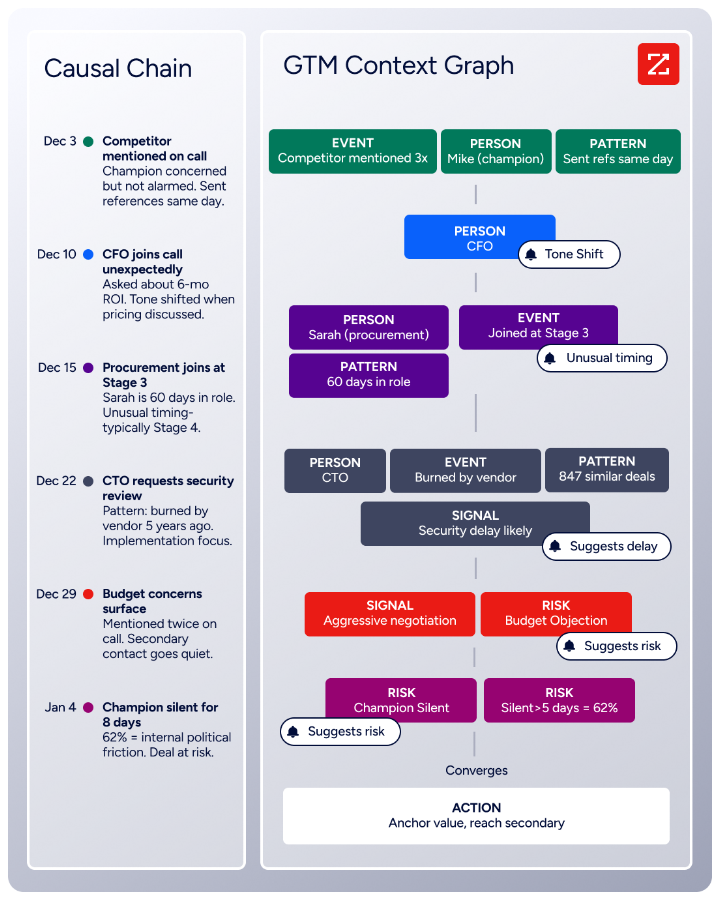
Its GTM Context Graph processes 1.5B+ data points daily, fusing third-party intelligence with your CRM records and conversation data so your team understands not just what happened in a deal, but why.
Teams access that intelligence through the GTM Workspace for sellers, GTM Studio for marketers and RevOps, or through direct integrations with both Salesforce and Bullhorn. ZoomInfo's APIs and MCP make the same intelligence available in any other tool or AI agent.
If better data and buyer intelligence would make your CRM more effective, see how ZoomInfo works with your platform.
Bullhorn vs. Salesforce vs. ZoomInfo at a glance
Bullhorn | Salesforce | ZoomInfo | |
|---|---|---|---|
Core purpose | Staffing & recruitment ATS/CRM | Horizontal enterprise CRM | B2B data, intelligence & GTM platform |
Built for | Staffing agencies exclusively | Any industry, any team | Sales, marketing & RevOps across B2B |
ATS included | Yes, native | No (requires AppExchange or custom build) | No (integrates with both) |
AI capabilities | Amplify Digital Workers (staffing-specific) | Agentforce (general-purpose autonomous agents) | GTM Context Graph, AI-powered prospecting & outreach |
Contact data | Internal database only | Internal database only | 135M+ verified phones, 200M+ verified emails |
Buyer intent signals | None | Limited (requires add-ons) | |
Starting price | $0 (free CRM) to $25/user/month | paid plans custom-quoted | |
Integration | 120+ integrations including Bullhorn and Salesforce | ||
Best for | Staffing agencies of all sizes | Companies needing multi-department CRM | Any B2B team that needs better data and intelligence |
A staffing CRM vs. a CRM that can be configured for staffing
This is the core distinction. Bullhorn and Salesforce both manage customer relationships, but they start from opposite ends.
Bullhorn was founded in 1999 to solve staffing agency coordination problems. Its data model treats candidates, job orders, placements, and client contacts as first-class objects. A recruiter opens a job and immediately sees AI-matched candidates ranked by relevancy.
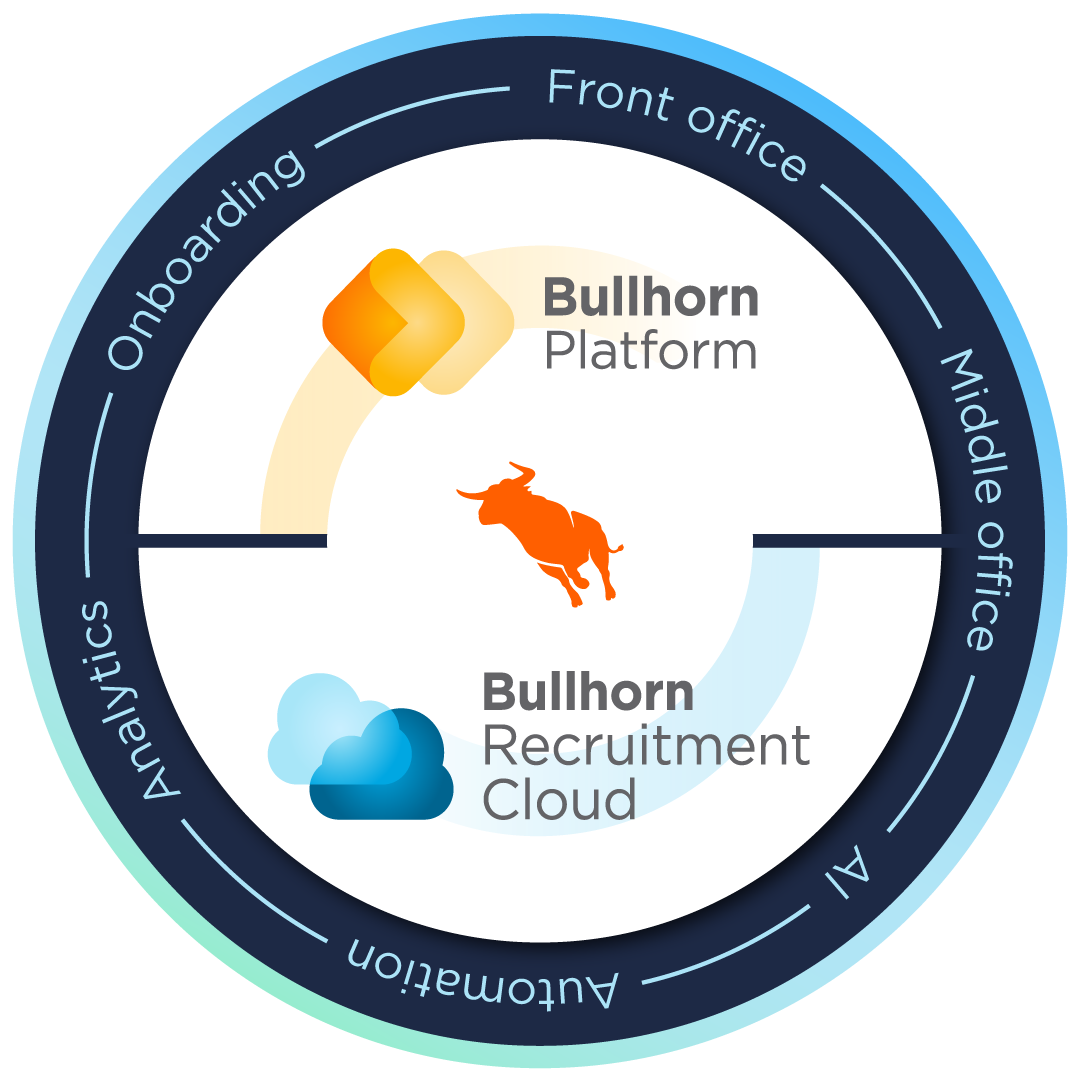
A salesperson logs a client conversation and the recruiter sees it on the same record. This isn't a feature added later; it's how the system was built from the start.
Salesforce was founded the same year with a broader ambition: replace installed enterprise software with cloud-delivered CRM. Its data model is built around leads, accounts, opportunities, and contacts.
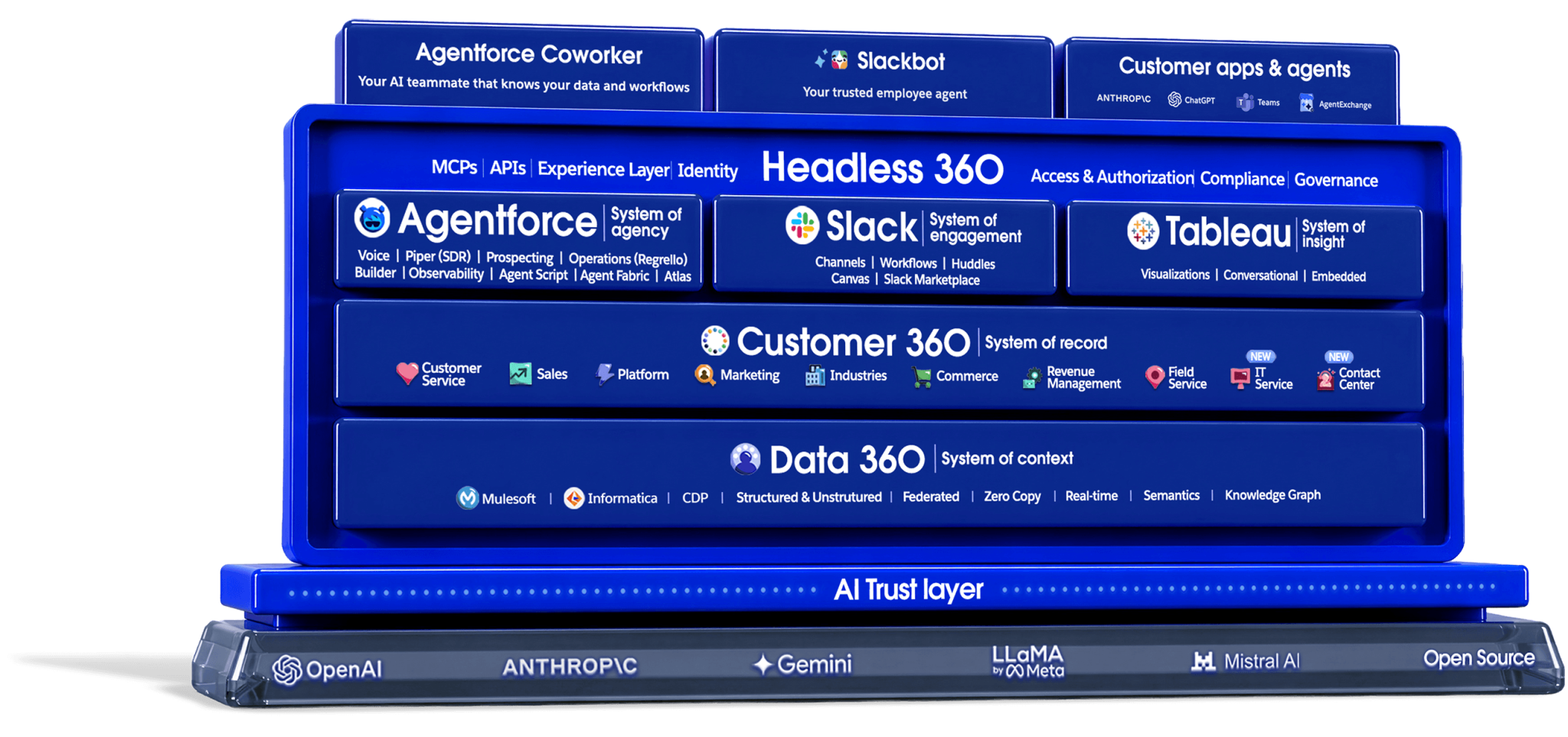
These are sales concepts that apply to any industry, which is the point. Salesforce serves 17 industry verticals with dedicated clouds, but staffing is not one of them. Agencies running Salesforce need custom objects for candidates, placements, and job orders, or a Salesforce-native staffing app layered on top.
For a staffing firm, the practical difference shows up on day one. Bullhorn's small agency deployments take as little as two weeks. Salesforce implementations for staffing workflows typically require months of configuration, custom development, and partner consulting.
For a company that does staffing and other business lines (consulting, managed services, technology sales), Salesforce's flexibility becomes the advantage. Bullhorn won't manage your consulting pipeline or your marketing campaigns. Salesforce can manage everything, provided you invest in making it work.
Bullhorn dominates the staffing lifecycle
Bullhorn's strength is depth in a single vertical. The platform covers the entire staffing workflow without requiring additional vendors for most operations.
The ATS and CRM share a unified database. Recruiters and salespeople work from the same candidate and client records simultaneously.
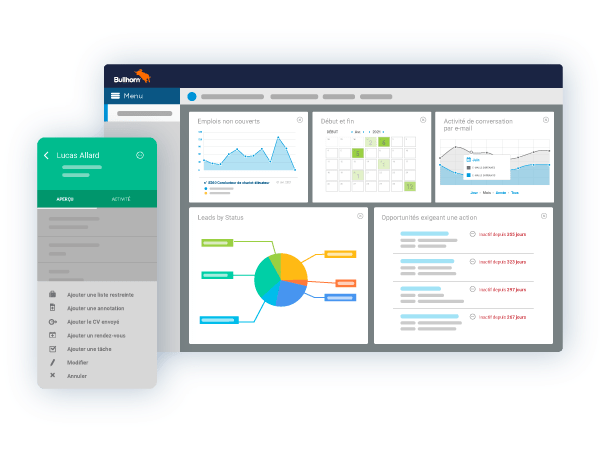
Source: Bullhorn
The Automatic Resume Parser processes incoming resumes into candidate records, with duplicate detection by email address, handling up to 50,000 documents per month on enterprise tiers.
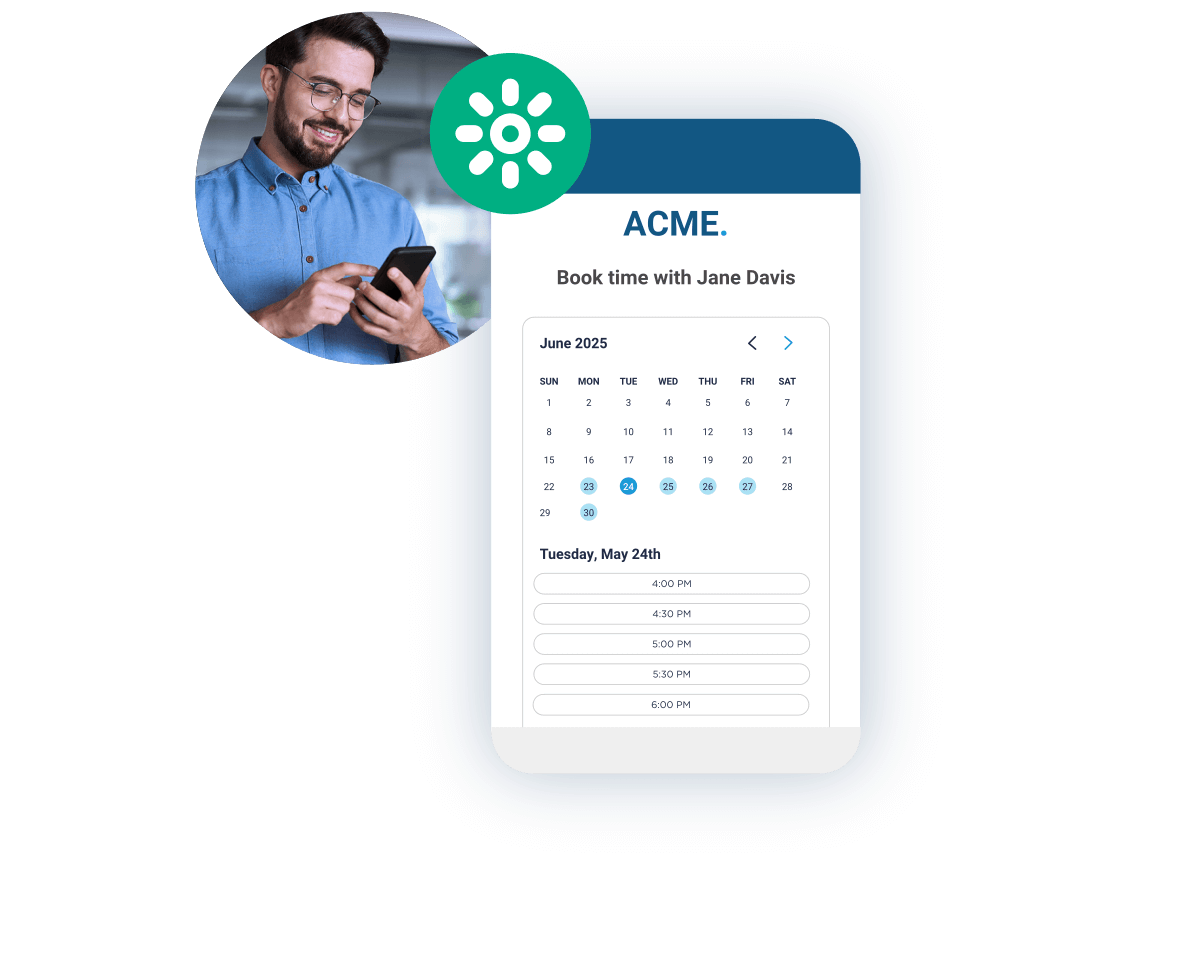
Bullhorn Automation handles the repetitive work that eats recruiter time: interview scheduling, onboarding sequences, contractor redeployment outreach, and data hygiene.
Source: Bullhorn
Middle Office bridges recruiting and back-office operations with shift scheduling, seven time capture methods, automated pay-and-bill calculations, and invoicing.
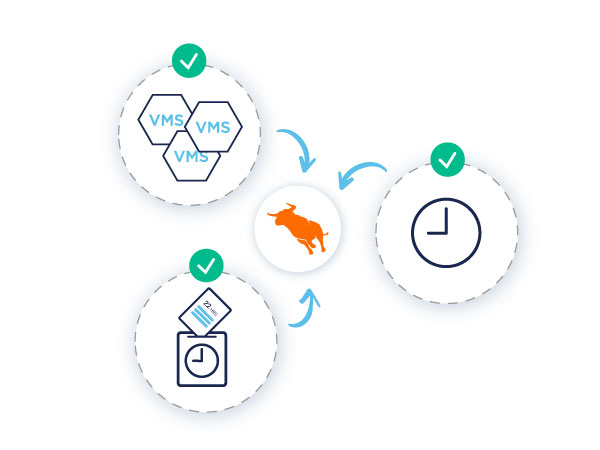
Source: Bullhorn
For healthcare staffing, Bullhorn serves 22 of the top 25 healthcare staffing agencies, with dedicated workflows for credentialing, compliance tracking, and provider onboarding.
The limitation is equally clear: Bullhorn does not attempt general sales, marketing automation, e-commerce, or customer service outside the staffing context.
Salesforce offers breadth no staffing platform can match
Where Bullhorn goes deep in one vertical, Salesforce goes wide across every business function. Sales Cloud manages the full sales cycle from lead to close, with Einstein Lead Scoring, pipeline management, forecast automation, and Agentforce Sales Agents that handle prospecting, research, and coaching autonomously.
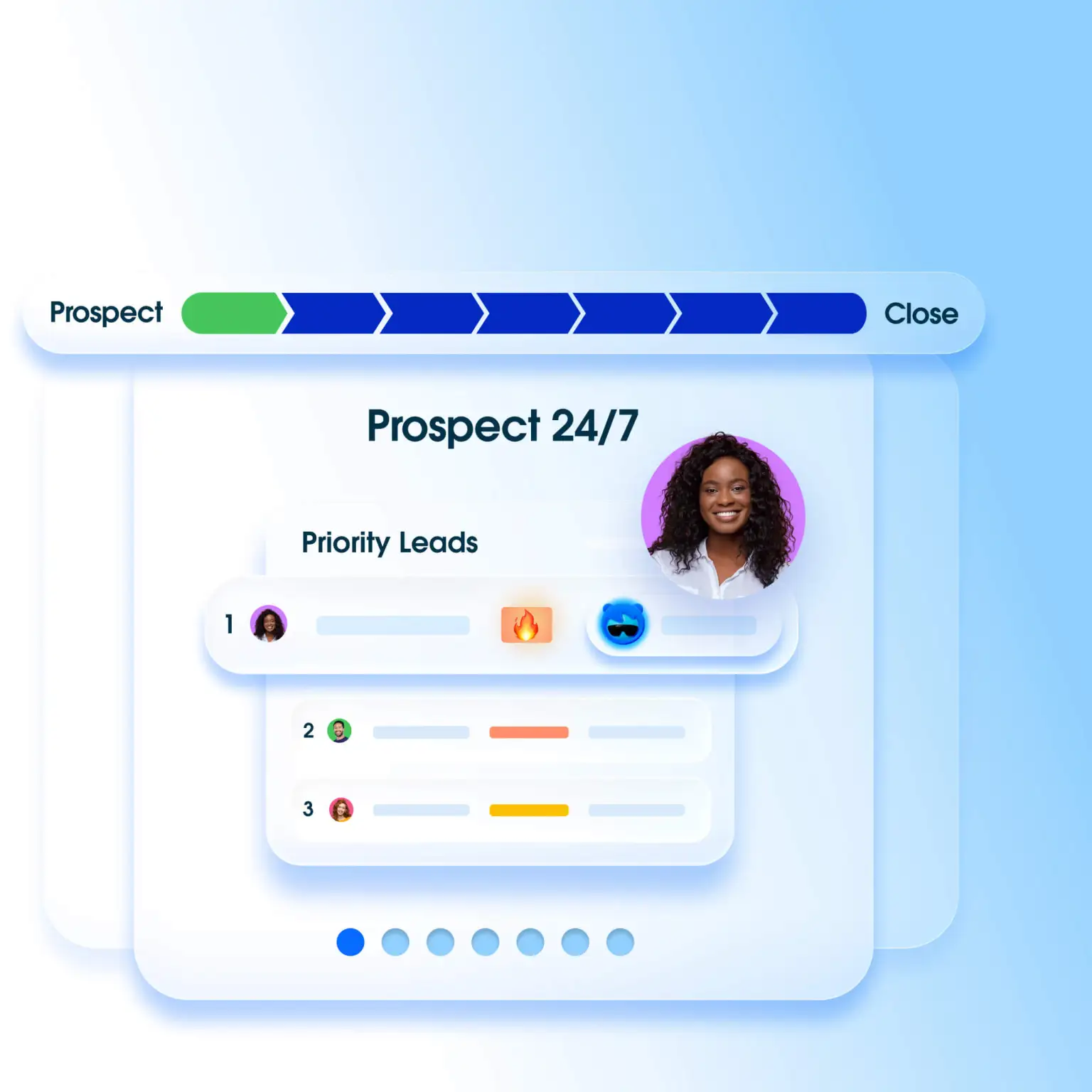
Source: Salesforce
Service Cloud adds customer support with AI-powered case resolution. Marketing Cloud handles campaign orchestration, personalization, and B2B lead nurturing.
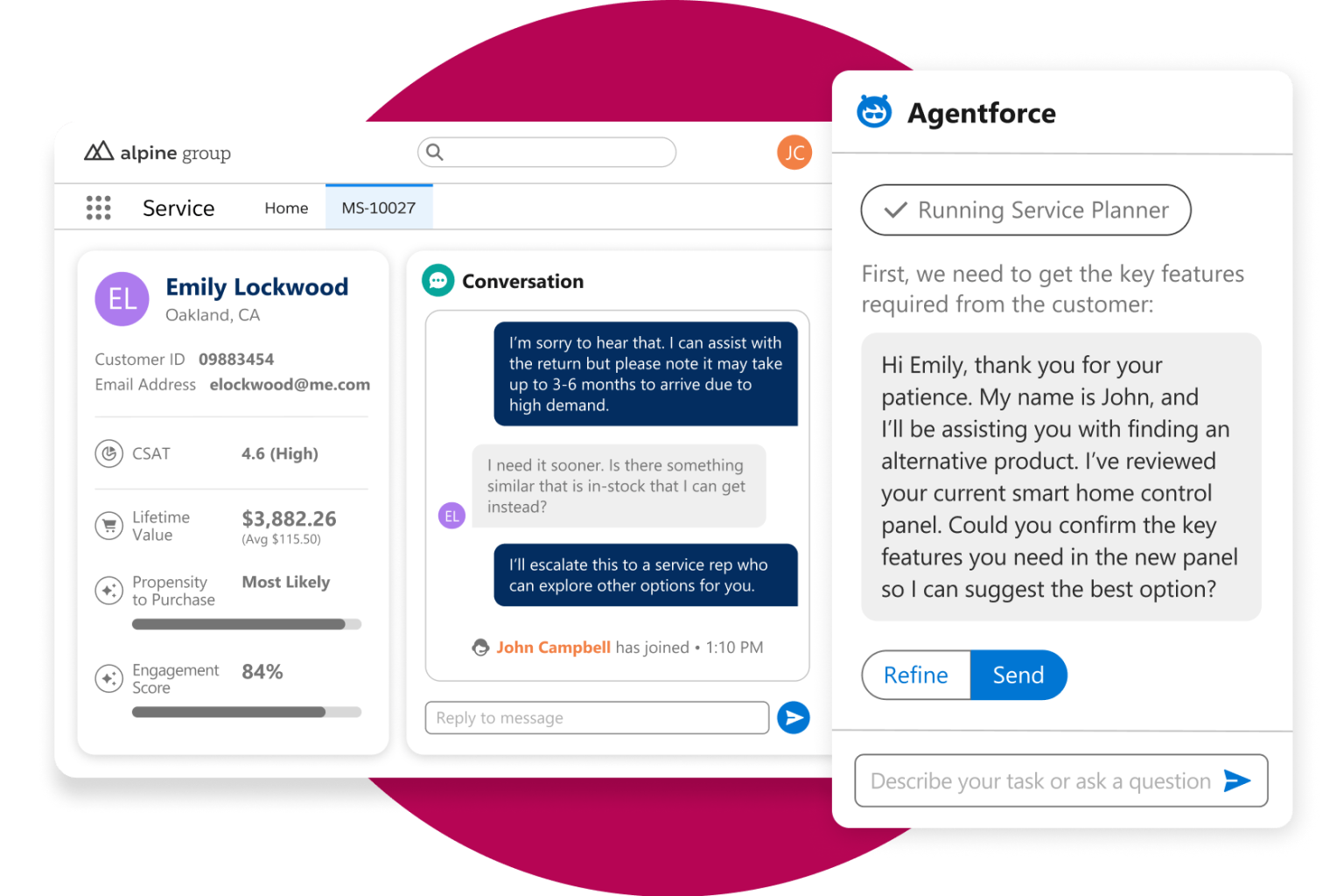
Source: Salesforce
Commerce Cloud powers storefronts. Data Cloud unifies customer data across all of them.
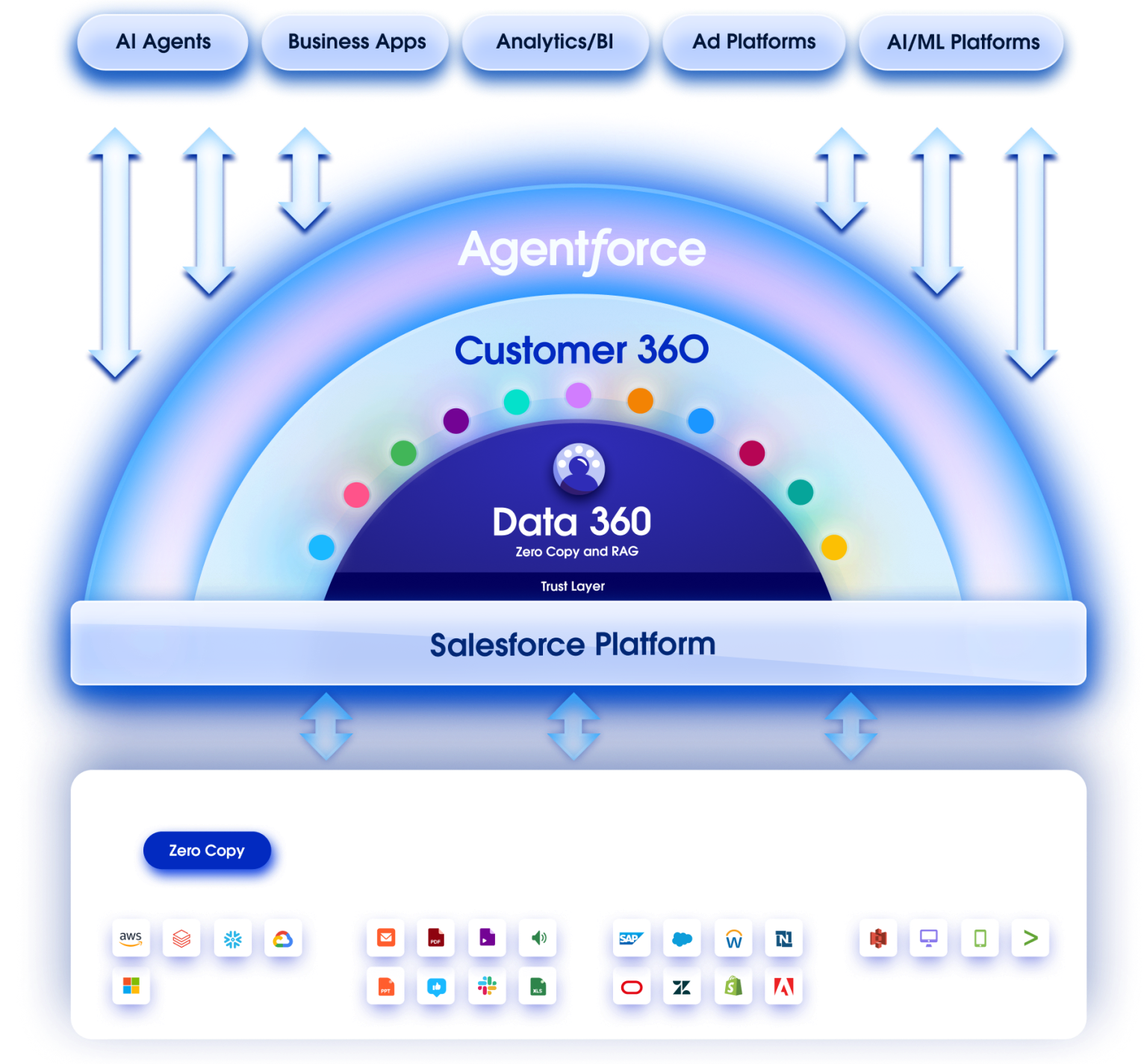
Source: Salesforce
For staffing firms that also operate consulting, managed services, or technology divisions, this breadth matters. A single Salesforce org can manage the staffing pipeline, the consulting sales cycle, marketing campaigns, and client service, all sharing the same customer data.
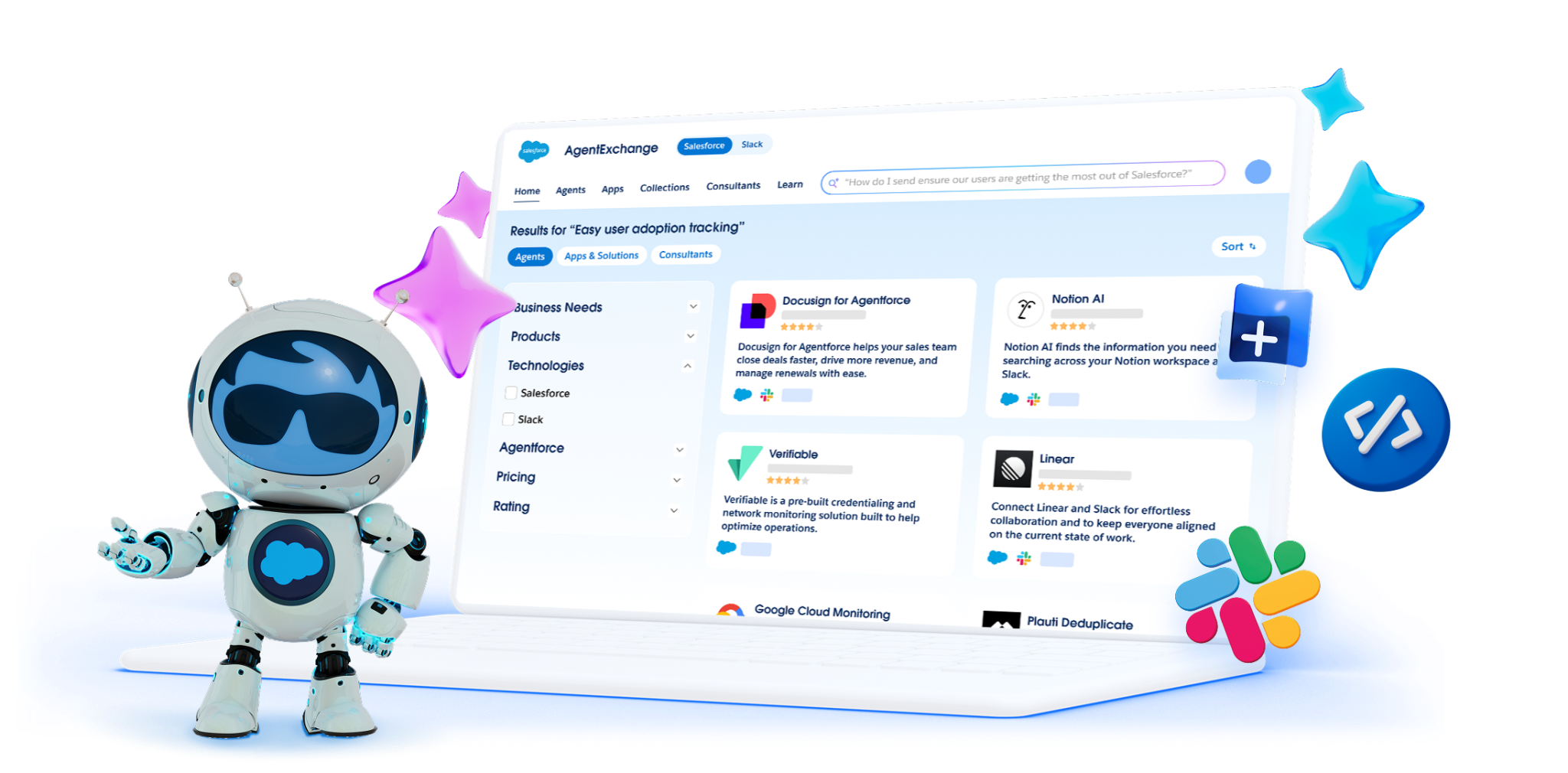
The AppExchange extends capability further with 9,000+ partner apps and 14+ million installs. Staffing-specific apps on AppExchange can add recruitment workflows to Salesforce, though they operate as layers on top of the platform rather than native features.
Source: Salesforce
The cost of this breadth is complexity. Salesforce is one of the most feature-rich enterprise platforms available, with a steep learning curve to match. Over 70% of implementations are led by partners, and meaningful configuration requires trained administrators. The platform rewards investment, but it demands it first.
AI capabilities take different approaches
Both Bullhorn and Salesforce have invested heavily in AI, but their implementations reflect their different philosophies.
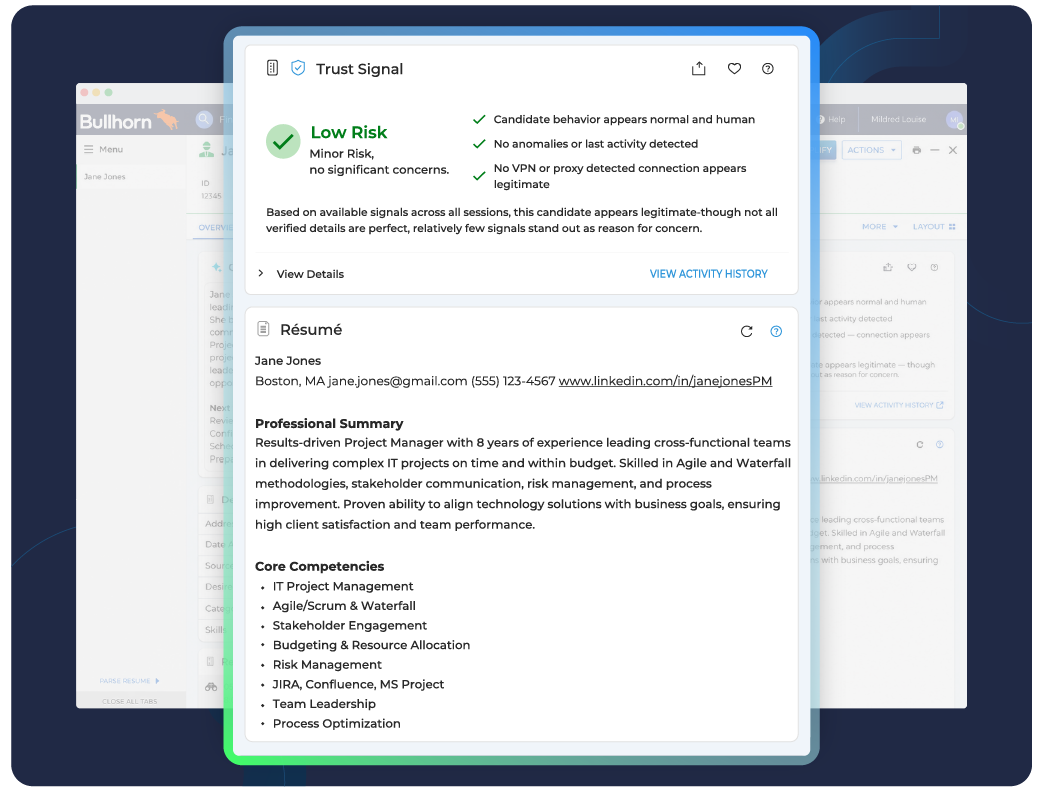
Bullhorn Amplify is a set of autonomous AI agents designed for staffing workflows. Its ten named Digital Workers handle specific recruiter tasks: Match surfaces ranked candidates when a job opens, Screen runs structured interviews via chat or voice around the clock, Present generates branded candidate submissions, and Verify flags AI-generated fraudulent applications.
Source: Bullhorn
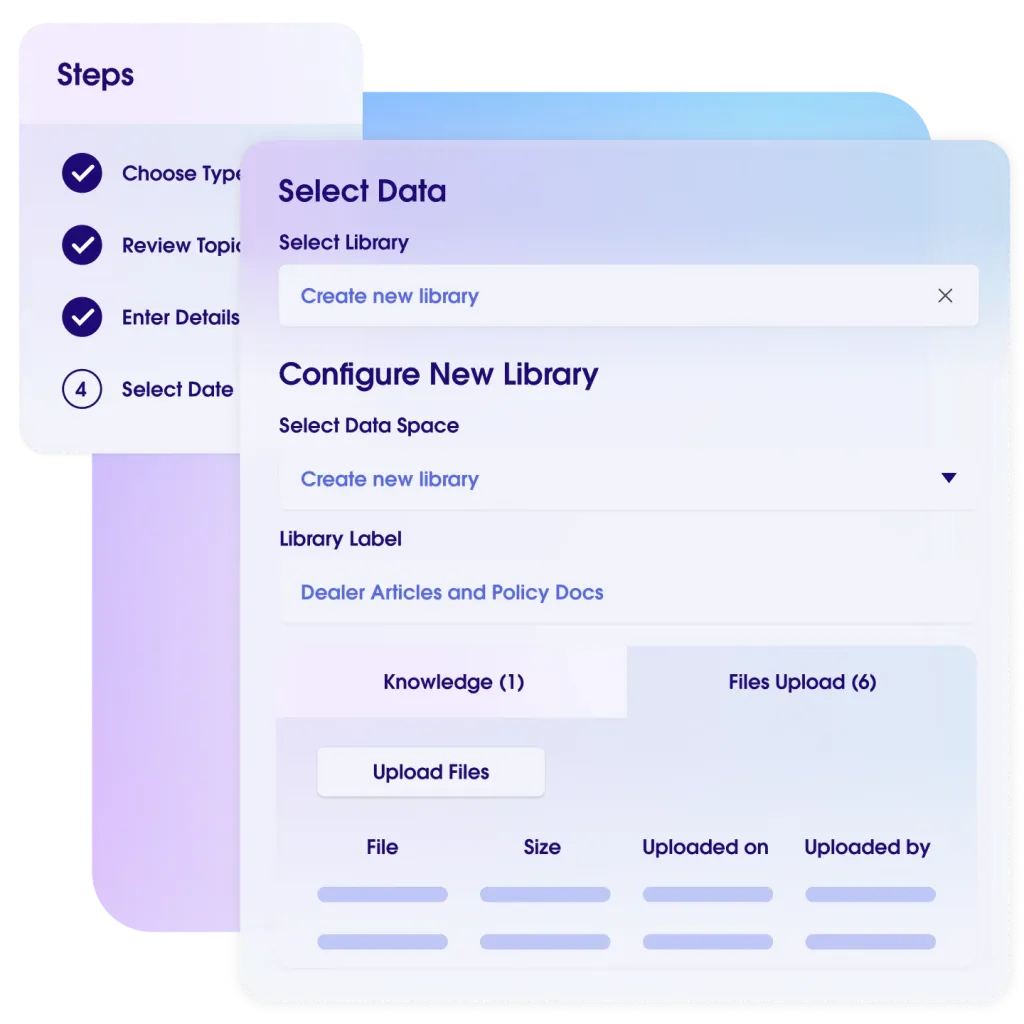
Agentforce is Salesforce's general-purpose autonomous AI platform, powered by the proprietary Atlas Reasoning Engine. Pre-built agents cover sales development, coaching, customer service, shopping assistance, and IT service.
Source: Salesforce
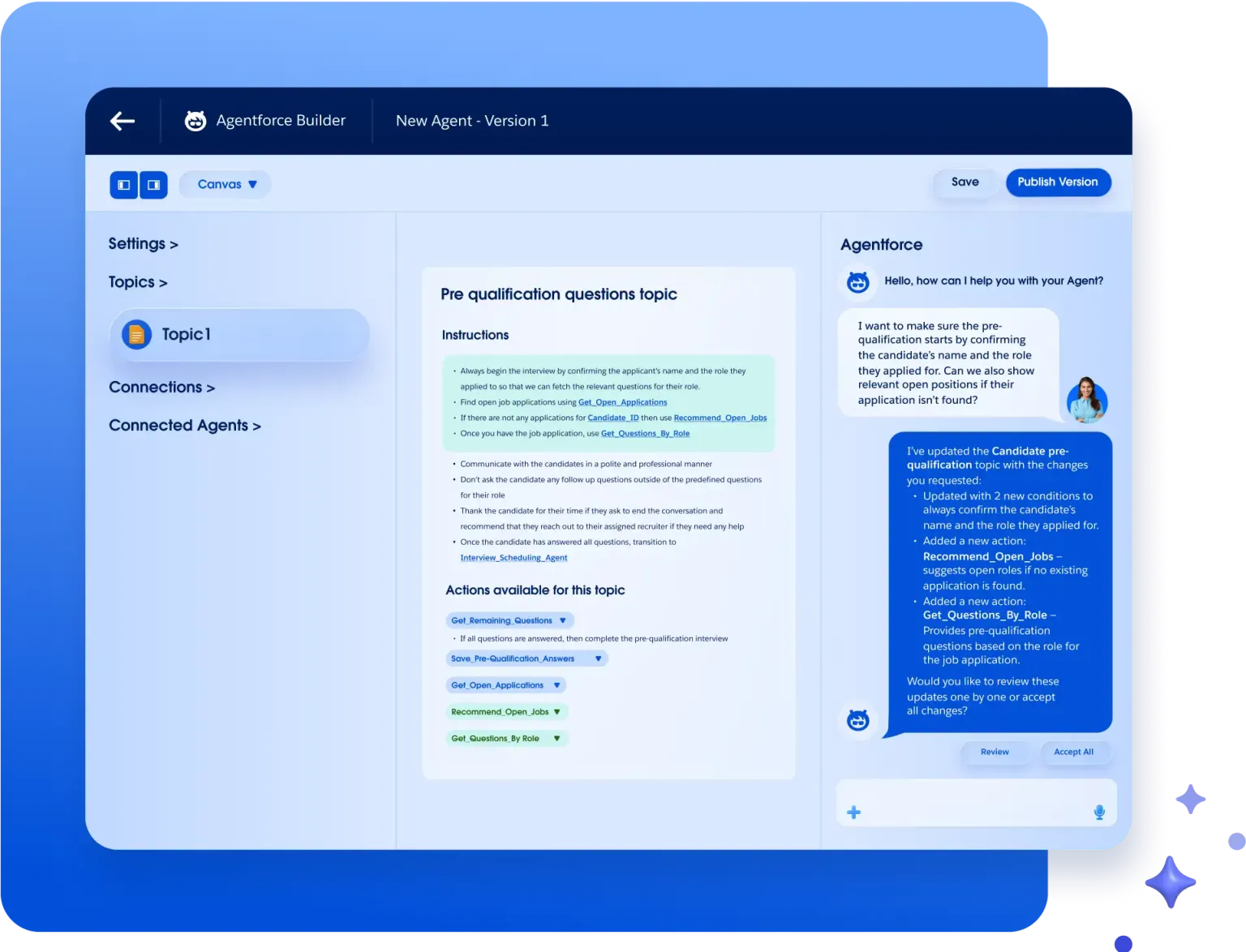
Custom agents can be built using Agent Builder with natural language, and Agentforce Script enables hybrid deterministic and LLM reasoning.
Source: Salesforce
The difference: Amplify's agents know staffing. They understand job orders, candidate profiles, placements, and the recruiting lifecycle without configuration. Agentforce's agents are more flexible but require setup, topic definitions, and action mappings to work in any specific context.
Neither platform's AI solves the upstream data problem. An AI agent that matches candidates to jobs is only as good as the candidate records in the database. A sales agent that researches accounts can only work with whatever company data exists in the CRM. This is where the intelligence layer matters.
ZoomInfo solves the data problem both platforms share
Every CRM inherits whatever data its users put into it. And every CRM suffers when that data is incomplete, outdated, or missing.
A Bullhorn database might have thousands of candidate records from past applications, but half of those candidates have changed jobs since their resumes were parsed. A Salesforce org might have accounts and contacts entered by salespeople over years, but company data decays, direct dials go stale, and new decision-makers arrive without anyone updating the record.
ZoomInfo addresses this gap at the data layer. Its GTM Context Graph processes 1.5B+ data points daily, combining ZoomInfo's B2B database with your CRM records, conversation transcripts, and behavioral signals.
Source: ZoomInfo
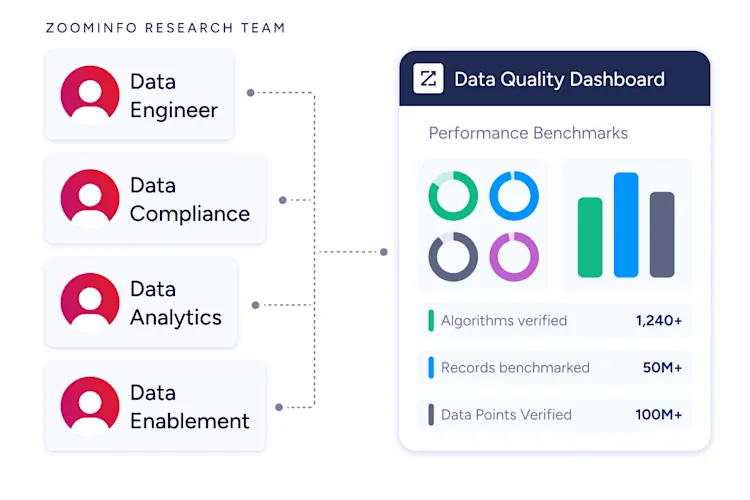
The underlying data is verified through a pipeline backed by 300+ human researchers, achieving up to 95% accuracy on first-party data. In a Fortune 500 competitive RFP analyzing 25 million contacts across vendors, an independent consultant concluded that "no other competitor came even close."
Source: ZoomInfo
For staffing firms using Bullhorn, ZoomInfo's direct Bullhorn integration enriches candidate and client records with verified contact details, company attributes, and org chart data. Recruiters prospecting new client accounts get accurate direct dials and business emails instead of outdated switchboard numbers.
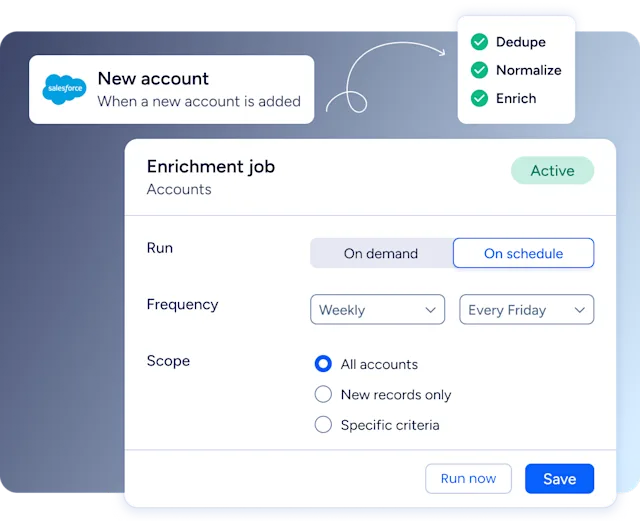
For teams using Salesforce, ZoomInfo's native Salesforce integration enriches accounts and contacts automatically, appending verified data fields, technographics, and intent signals directly into Salesforce records.
Source: ZoomInfo
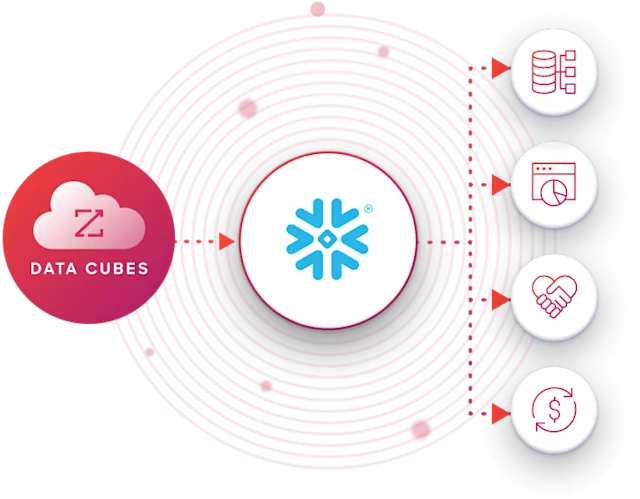
Snowflake uses ZoomInfo for at least one-third of the most critical data features in their Account Propensity Scoring model, and accounts monitored using ZoomInfo-powered scores showed 90% higher opportunity open rates and 2x higher customer conversion rates.
Source: ZoomInfo
For a side-by-side look at how Salesforce and ZoomInfo compare as standalone platforms, see our Salesforce vs. ZoomInfo comparison.
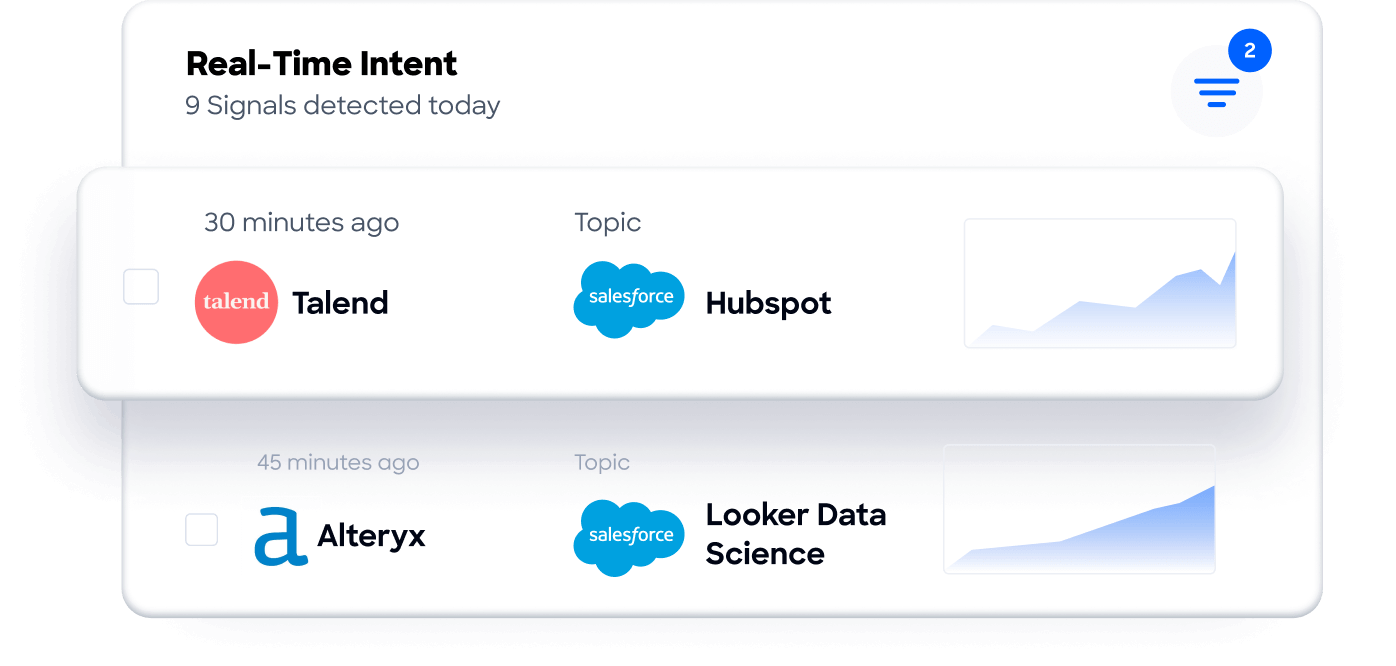
Beyond enrichment, ZoomInfo's Buyer Intent tracks signals from 210 million IP-to-Organization pairings and 6 trillion+ new keyword-to-device pairings sourced monthly.
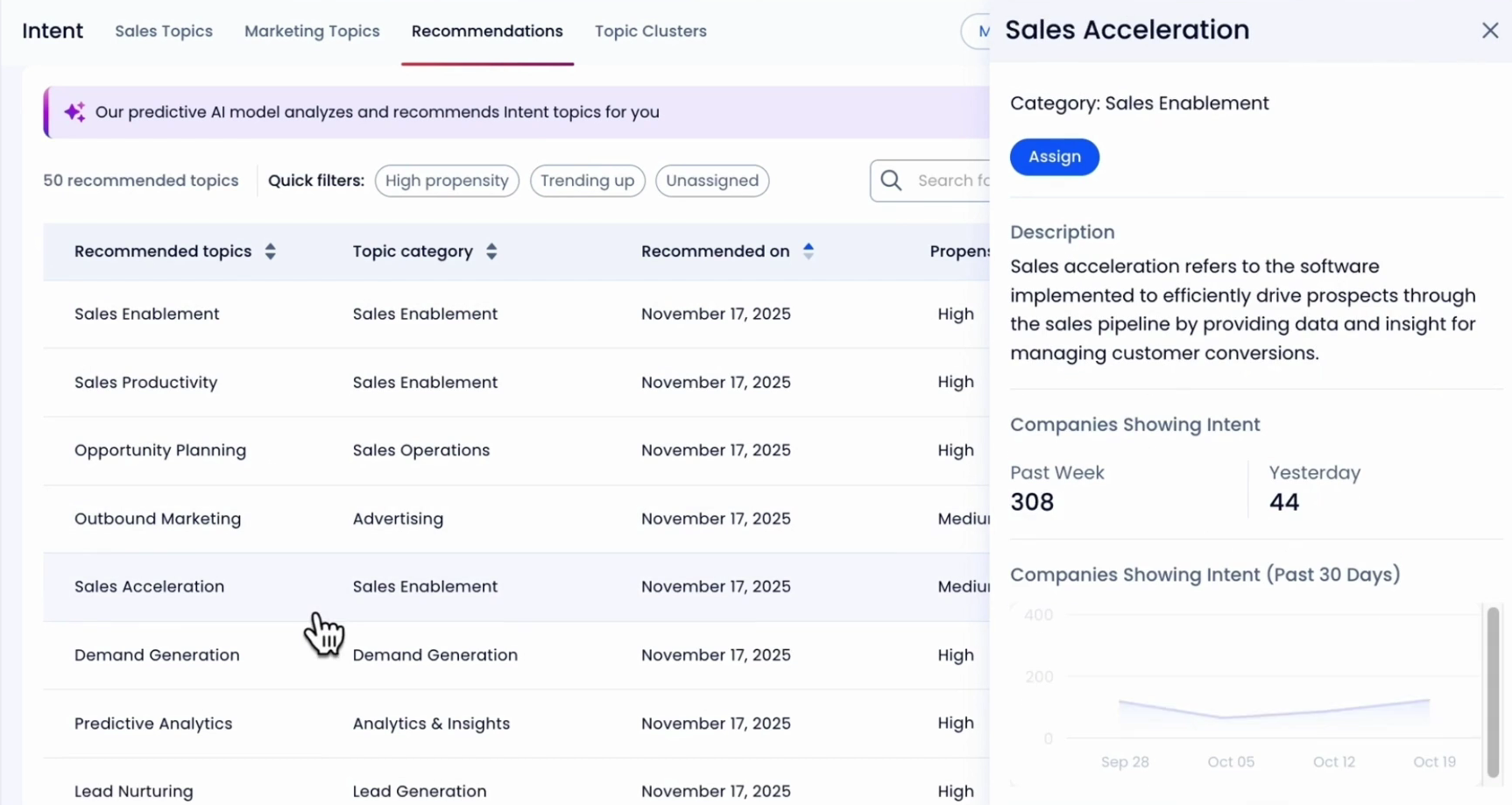
Guided Intent, exclusive to ZoomInfo, identifies topics historically correlated with deal success rather than requiring manual topic selection.
Source: ZoomInfo
Neither Bullhorn nor Salesforce offers this level of third-party buying signal data natively.
Seismic's sales team attributed 39% of active pipeline to opportunities identified or influenced by ZoomInfo signals, boosted productivity by 54%, and saved 11.5 hours per week per seller. (Seismic Case Study)
Integration ecosystems reflect different strategies
How each platform connects with the rest of your tech stack reveals its philosophy.
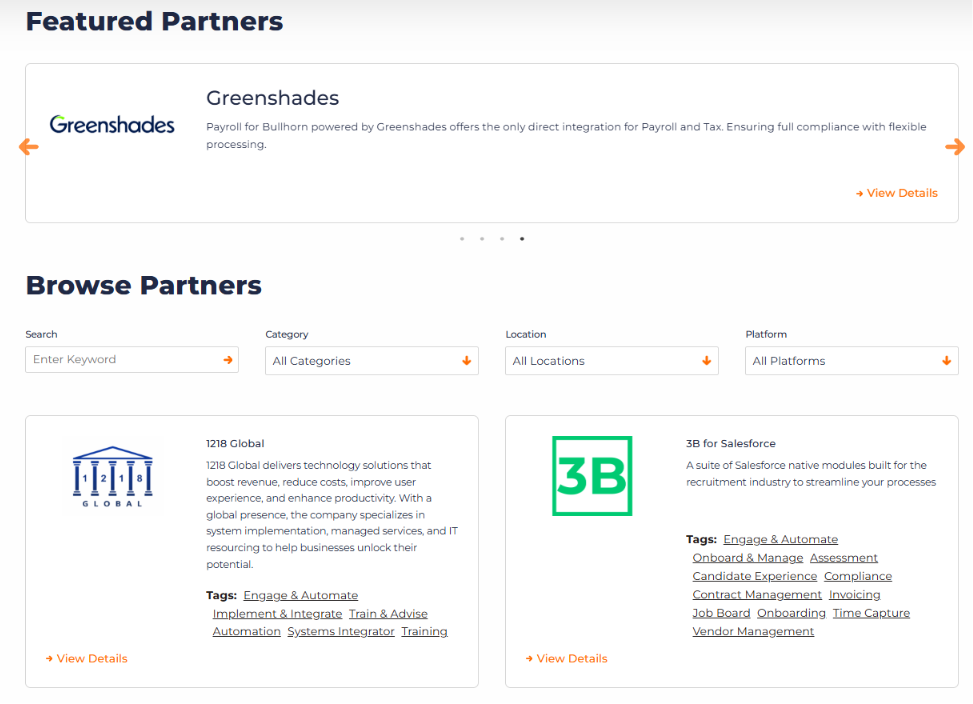
Bullhorn's Marketplace lists 300+ pre-integrated partners organized around staffing functions: job boards, background checks, payroll, VMS connectors, and onboarding.
Source: Bullhorn
The ecosystem is deep within staffing but narrow outside it. This is intentional. Bullhorn expects to be the center of a staffing firm's tech stack, with specialized partners filling gaps around the edges.
Salesforce's AppExchange is the largest enterprise cloud marketplace: 9,000+ apps and 14+ million installs. MuleSoft (acquired for $6.5 billion) provides hundreds of pre-built connectors for enterprise integrations. If a tool exists in the enterprise software market, it probably connects to Salesforce.
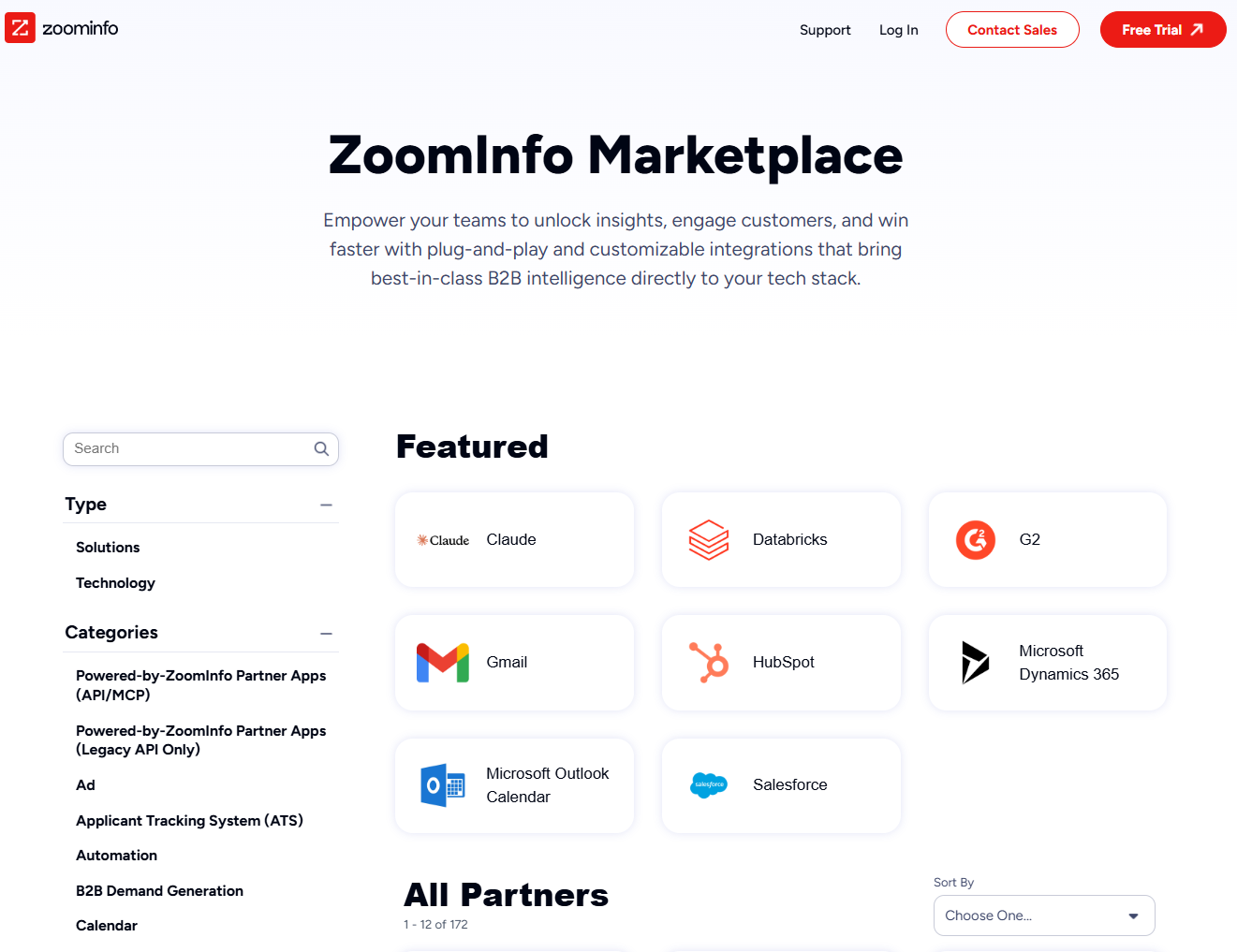
ZoomInfo takes an open approach. Its App Marketplace lists 120+ integrations across CRM, marketing automation, sales engagement, data warehouses, and ATS platforms, including both Bullhorn and Salesforce.
Source: ZoomInfo
The Enterprise API provides programmatic access to ZoomInfo's data and intelligence for any custom application.
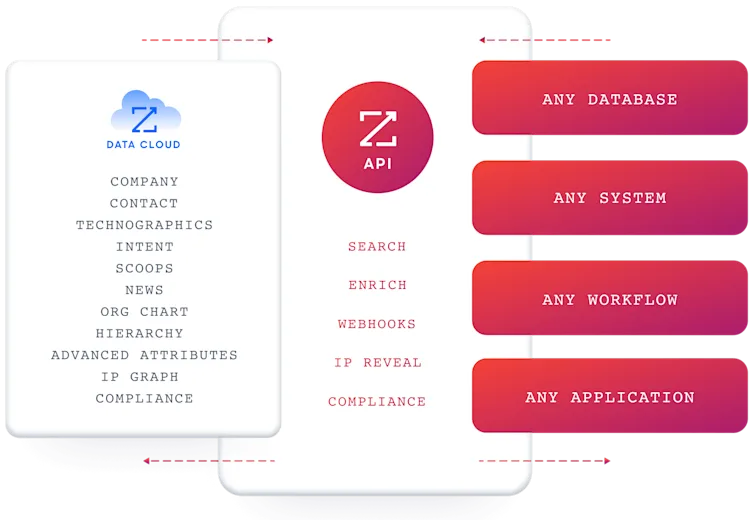
Source: ZoomInfo
The MCP server connects AI models directly to ZoomInfo's data through natural language, with no custom coding beyond configuration.
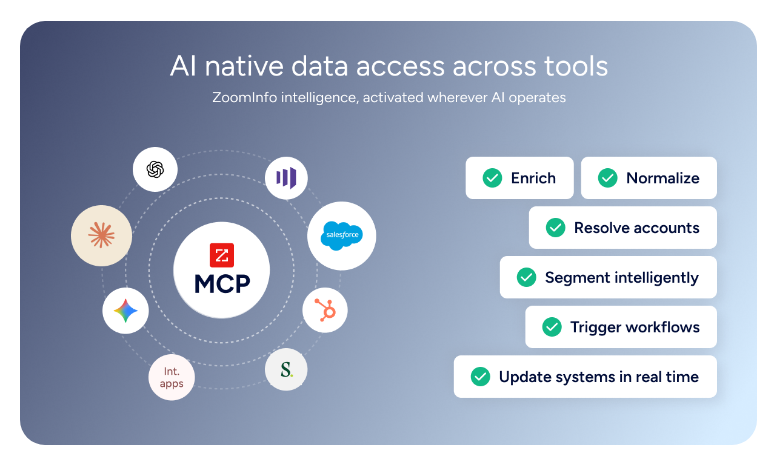
Source: ZoomInfo
API access is included in all relevant ZoomInfo plans. This matters because ZoomInfo's intelligence isn't locked inside its own UI. A staffing firm using Bullhorn, a sales team on Salesforce, or a developer building a custom AI agent all access the same verified data and GTM Context Graph.
"The plug-and-play aspect of the API means I can integrate it into any process and get information at a moment's notice." — Jerry Wilson, Senior Marketing Intelligence Analyst, BDO Canada. BDO achieved an 87% reduction in time spent on updates to their internal data dashboards using the ZoomInfo API. (BDO Canada Case Study)
Pricing structures serve different buyers
The pricing models tell you who each platform was built for.
Bullhorn uses per-seat, per-month pricing with published rates for small agencies: Starter at $99/user/month (limited to 1-2 users), Core at $165/user/month, and Pro at custom pricing. Enterprise and mid-market tiers (Recruitment Cloud Front Office, Middle Office, and 360) are quote-only.
Bullhorn does not offer a free trial or free plan. Add-ons like Amplify, Search & Match, and Onboarding are priced separately.
Salesforce offers the widest range, from a free CRM for up to 2 users to enterprise tiers at $175/user/month (Enterprise) and $350/user/month (Unlimited). Starter Suite at $25/user/month provides a real entry point for small teams.
However, the full platform cost is harder to predict. Agentforce consumption, Data Cloud credits, Premier Success plans (30% of net license fees), and partner implementation all add to the total. A June 2025 restructuring raised Enterprise and Unlimited list prices by an average of 6%.
ZoomInfo uses custom-quoted, consumption-based pricing with no published dollar amounts for paid tiers. ZoomInfo Lite is a permanent free tier (no credit card required) providing access to the B2B database with 10 monthly export credits.
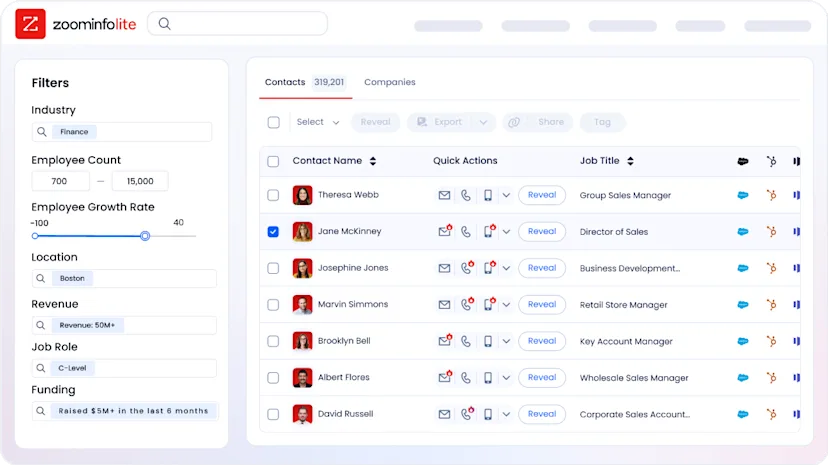
Source: ZoomInfo
A separate 7-day free trial offers broader access. Paid plans scale around seats, credit volume, features, and contract length.
For staffing firms evaluating cost, the relevant comparison isn't just Bullhorn vs. Salesforce licensing. It's the total cost of running your go-to-market operation, including the data that makes either CRM effective.
Reporting and analytics take different shapes
Bullhorn's Reporting & Analytics is built natively on its ATS data, with staffing-specific modules: Jobs Pipeline, recruiter performance dashboards, conversion ratios (submissions to interviews, interviews to placements), and gross margin reporting at the individual placement level.
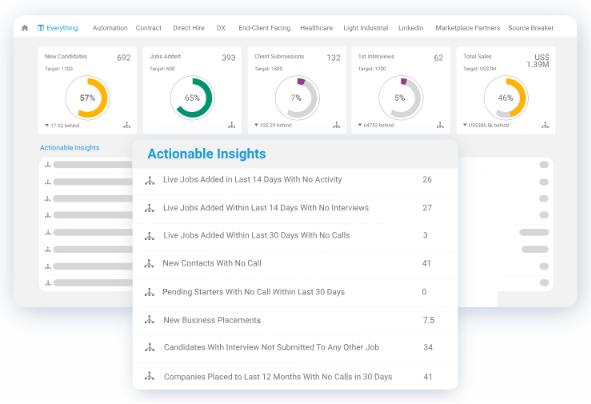
Source: Bullhorn
Because analytics sit directly on the ATS rather than connecting via API, all dashboards reflect live activity.
The limitation flagged by users: custom report configuration can require extra effort and sometimes developer involvement.
Salesforce offers the most extensive analytics ecosystem. Tableau provides enterprise-grade data visualization, Tableau Pulse delivers personalized AI digests, and CRM Analytics embeds analytics natively within Salesforce records.
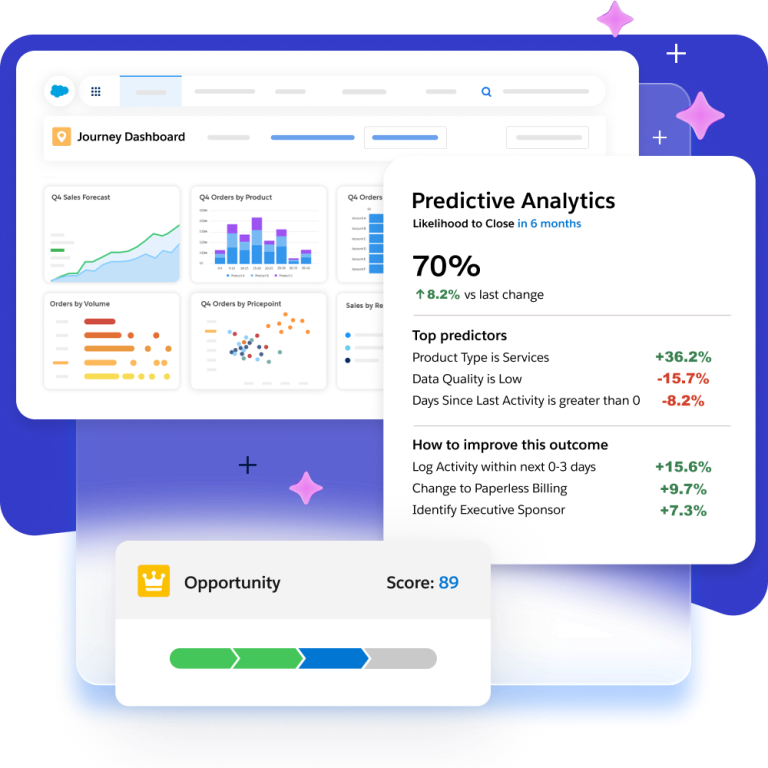
Source: Salesforce
The depth is substantial, but the analytics stack carries its own complexity and cost. Tableau licenses are separate from Sales Cloud, and advanced analytics require data modeling expertise.
ZoomInfo provides analytics that neither CRM generates on its own: market intelligence. GTM Studio offers AI-powered dashboards tracking engagement, funnel progression, and top-performing audience segments.
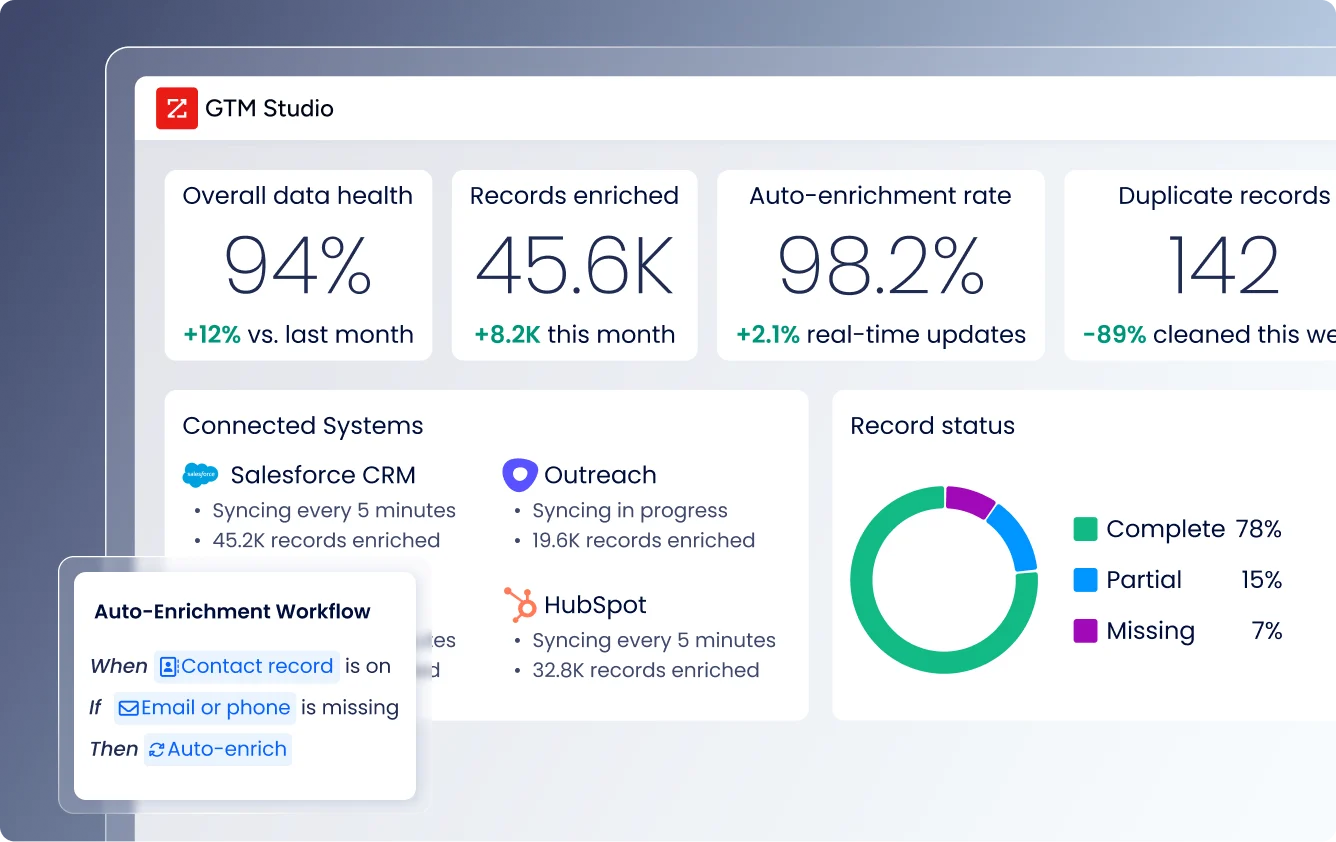
Source: ZoomInfo
ZoomInfo's predictive modeling auto-builds ICP from CRM win/loss data and scores accounts 0-100, helping teams understand which accounts to prioritize before they enter the CRM pipeline.
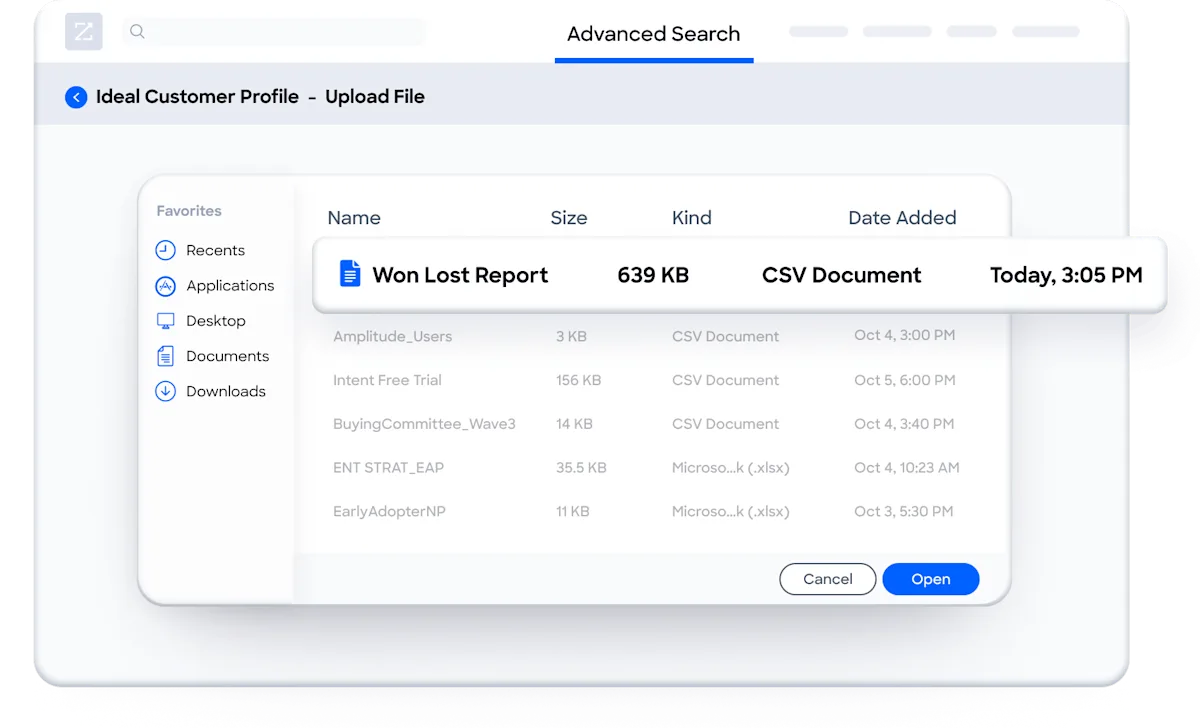
Source: ZoomInfo
Support and learning curve compared
Bullhorn provides 24/7 phone and chat support through over 200 dedicated professionals, with phone or chat connections within 90 seconds. Bullhorn Launch offers structured learning tracks organized by role, with self-paced and instructor-led options.
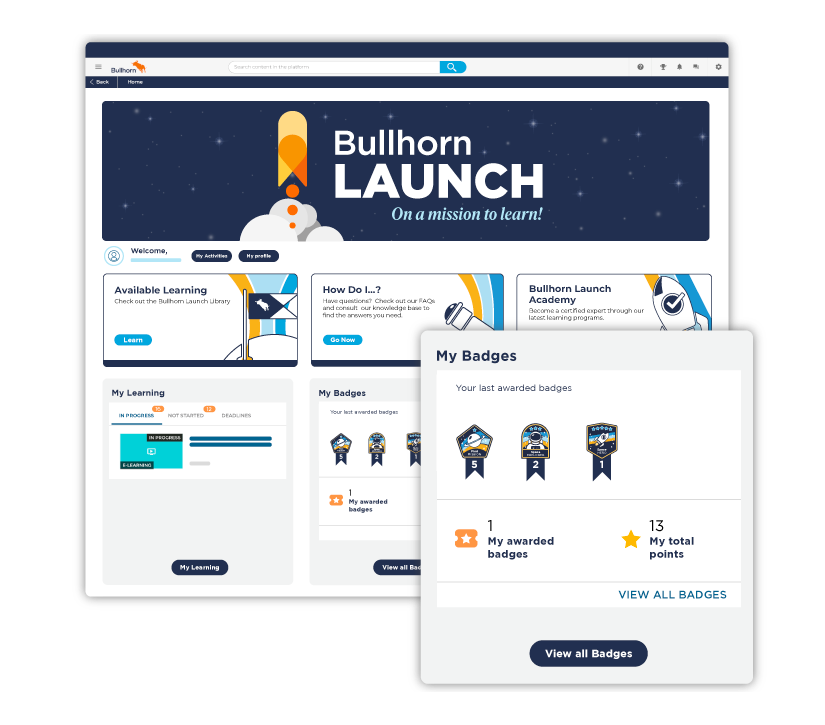
Source: Bullhorn
Small agency deployments can go live in as little as two weeks. The staffing-specific design means new hires familiar with industry concepts can get productive quickly.
Salesforce offers tiered support: Standard (free, self-service), Premier (30% of net license fees, 1-hour response for critical issues), and Signature (dedicated Customer Success Manager, 15-minute response time).
Trailhead is the industry's largest free learning platform, with 6+ million learners, 1,500+ badges, and 60+ certifications.
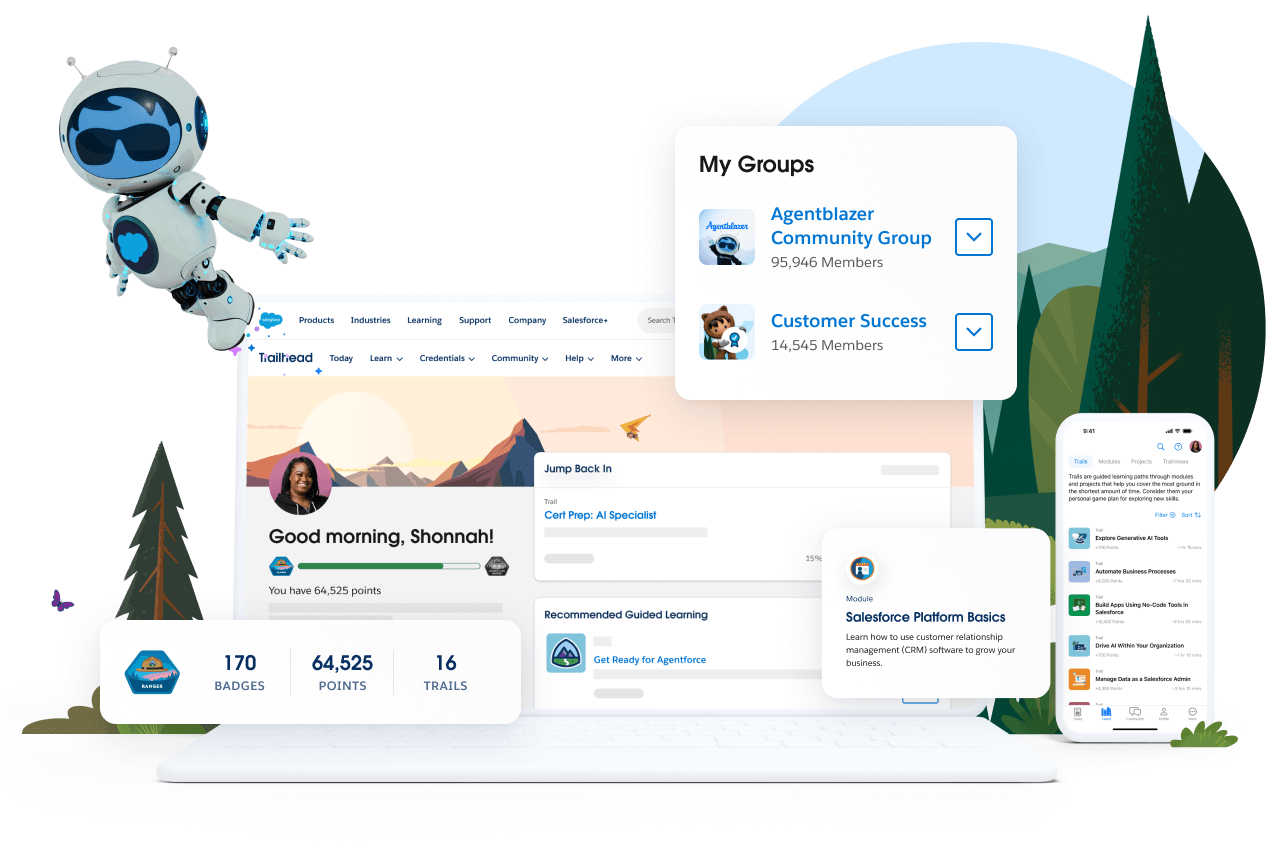
Source: Salesforce
The Trailblazer Community spans 20 million members. The investment in learning resources reflects the reality that Salesforce requires more upfront training to use well.
ZoomInfo redesigned its onboarding program from 30 to 90 days, producing a 25% improvement in customer satisfaction scores.
ZoomInfo University provides role-specific learning paths and certifications.
Support is available via the Help Center, phone, and professional services through ZoomInfo Labs.
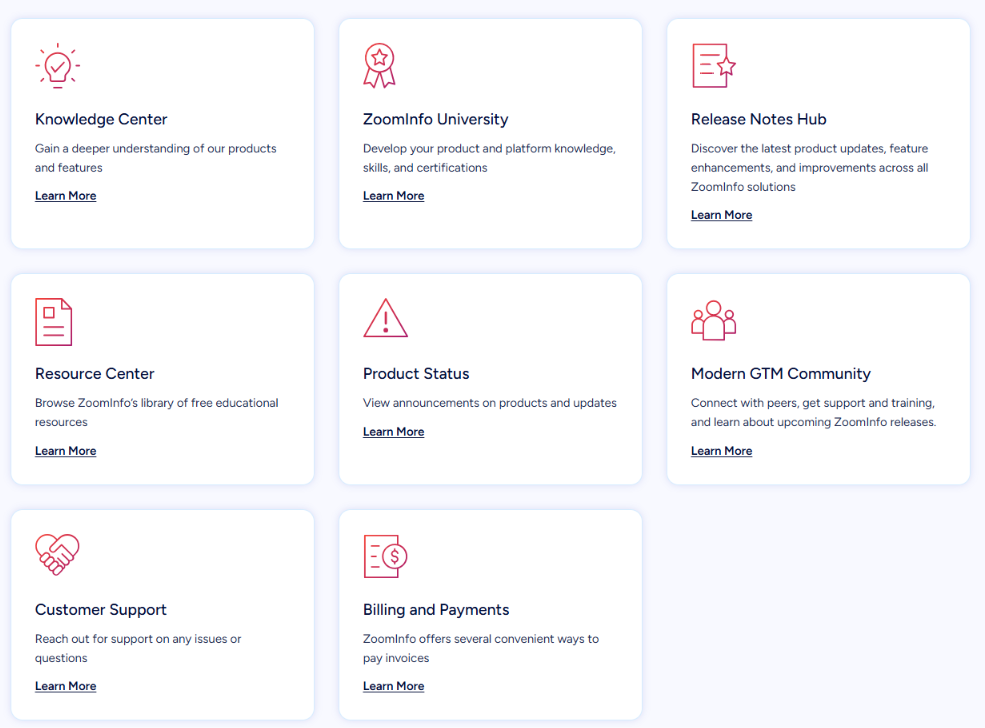
Source: ZoomInfo
Bullhorn vs. Salesforce vs. ZoomInfo: Which should you choose?
These three platforms serve different functions, and for many teams, the right answer involves more than one.
Choose Bullhorn if:
You run a staffing or recruitment agency and need an ATS and CRM in one system
You want staffing workflows (placements, timesheets, contractor redeployment, credentialing) working out of the box
Your operations span front office (recruiting/sales) through back office (billing/invoicing)
You want AI agents built for recruiter tasks like screening, matching, and candidate presentation
Implementation speed matters and your team operates within the staffing vertical
Choose Salesforce if:
Your business spans multiple functions beyond staffing (consulting, technology sales, managed services, marketing)
You need a CRM that serves sales, service, marketing, and commerce teams on one platform
You're prepared to invest in implementation, customization, and ongoing administration
Your organization requires the largest integration ecosystem and partner network
AI agents, analytics, and data unification are strategic priorities
Add ZoomInfo to either platform if:
The quality and completeness of your contact, company, and intent data limits your CRM's effectiveness
You need verified direct dials, business emails, and buyer intent signals that your CRM doesn't generate on its own
You want intelligence that reveals why deals move, not just what stage they're in
You need data and intelligence accessible in any tool, whether it's Bullhorn, Salesforce, or a custom application
Prospecting, enrichment, or account-based marketing are core to your go-to-market motion
Start with ZoomInfo Lite for free, or request a demo to see the full platform.
Bullhorn and Salesforce are both strong CRMs, each designed for different buyers. Bullhorn gives staffing firms a system built for them that works on day one. Salesforce gives multi-function organizations a platform that can do almost anything with enough investment. ZoomInfo gives both platforms the data foundation and buyer intelligence that make their features deliver results. For B2B teams serious about go-to-market performance, the combination of a CRM and a data intelligence layer is stronger than either one alone.
Want more Salesforce Comparisons? Here are our picks:
Bullhorn vs. Salesforce vs. ZoomInfo FAQ
What is the core difference between Bullhorn and Salesforce?
Bullhorn is a CRM and applicant tracking system built for staffing and recruitment agencies. Its data model natively handles candidates, job orders, placements, and contractor timesheets.
Salesforce is a horizontal enterprise CRM serving any industry, with a data model built around leads, accounts, opportunities, and contacts. Staffing firms can use Salesforce but need custom configuration or third-party apps to add recruitment workflows.
Can ZoomInfo replace Bullhorn or Salesforce?
No. ZoomInfo is not a CRM or an applicant tracking system. It is a B2B data and intelligence platform that integrates with both Bullhorn and Salesforce, enriching their records with verified contacts, company data, and buyer intent signals. ZoomInfo makes either CRM more effective by solving the data quality problem that limits CRM performance.
Which platform is best for a staffing agency?
Bullhorn is the standard choice for staffing agencies. It covers the entire staffing lifecycle (sourcing, tracking, placement, timesheets, billing) in a single platform, with AI agents built for recruiter workflows.
Salesforce can work for staffing but requires significant customization and does not include applicant tracking natively.
How do Bullhorn and Salesforce compare on pricing?
Bullhorn starts at $99/user/month for its Starter plan (limited to 1-2 users), with enterprise tiers custom-quoted. Salesforce offers a free CRM for up to 2 users, with Starter Suite at $25/user/month.
However, Salesforce's full cost includes add-ons for AI, data, analytics, and support that can push the total significantly higher. Neither platform publishes complete enterprise pricing.
Does ZoomInfo integrate with both Bullhorn and Salesforce?
Yes. ZoomInfo has native integrations with both Bullhorn and Salesforce listed in its App Marketplace.
The Salesforce integration enriches accounts and contacts with verified data, intent signals, and technographics.
The Bullhorn integration provides contact and company data directly within the staffing CRM. ZoomInfo's API and MCP server also allow custom integrations with any application.
Which platform has better AI capabilities?
Bullhorn's Amplify offers staffing-specific AI agents that handle candidate screening, matching, outreach, and fraud detection autonomously.
Salesforce's Agentforce is broader, with autonomous agents for sales, service, marketing, and custom use cases powered by the Atlas Reasoning Engine.
ZoomInfo's AI operates at the data and intelligence layer, using its GTM Context Graph to reveal why deals move and which accounts to prioritize, intelligence that flows into whichever CRM you use.
What kind of company would use all three platforms together?
A mid-to-large staffing firm that uses Bullhorn for recruiting and placement operations, Salesforce for broader business development, marketing, and client service, and ZoomInfo for verified contact data, company intelligence, and buyer intent signals across both systems. ZoomInfo serves as the shared data foundation that keeps both CRMs current and actionable.
How does data quality affect CRM performance?
CRMs are only as useful as the data inside them. Outdated contacts, missing phone numbers, and incomplete company records limit every CRM function, from pipeline reporting to AI-powered automation.
ZoomInfo's GTM Context Graph processes 1.5B+ data points daily, and the underlying database maintains up to 95% accuracy on first-party data, providing a verified data layer that addresses the decay problem every CRM faces over time.
Comparing Bullhorn and Salesforce? These related breakdowns go deeper:
