
Churn prediction software flags customers who are likely to cancel before the renewal, scoring signals like slipping usage, stalled adoption, and negative sentiment so customer success and account teams can step in while there is still time.
The tools differ mainly in the signal they read: product-usage health, a custom machine-learning model, customer feedback, or the external, people-based signal that sits outside your product and CRM.
This guide compares the 10 best churn prediction tools of 2026 on what turns a prediction into a retained customer, and shows where each one fits.
What is churn prediction software?
Churn prediction software uses machine learning and behavioral data to identify accounts at risk of customer churn, then scores the risk and surfaces the drivers so teams can intervene. It replaces gut feel and lagging indicators like a rising churn rate with continuous scoring across the signals that precede it.
The category pulls its signal from several different places, and few teams rely on only one:
Customer success health scoring: aggregating product usage, surveys, and support into a single health score.
Predictive modeling: training a custom machine-learning model on your historical data to score risk.
Product-usage analytics: reading in-product behavior and adoption to flag disengagement.
Experience and feedback: predicting churn from voice-of-customer sentiment and survey data.
External renewal-risk signals: detecting when the people behind an account change, before usage moves.
The first four watch first-party data: what happens inside your product and CRM. A leading churn signal lives outside those systems. When the champion who bought your product leaves, or a member of the original buying group moves on, renewal risk climbs before a usage dashboard reacts. Protecting customer lifetime value means covering both signals, internal and external.
How we evaluated these tools
Every tool below is measured against the same criteria, drawing on verified user reviews from G2, Capterra, and Gartner Peer Insights alongside each vendor's documented capabilities:
Signal type and data source: what the platform actually watches, and whether that fits product-led, relationship-led, or renewal-risk churn.
Prediction and AI: how well it scores risk and surfaces the drivers behind it, beyond charting what already happened.
Workflow and action: whether risk reaches CSMs and account teams inside Slack, the CRM, and playbooks.
Data integration and quality: native connections to CRM, product analytics, billing, and third-party data, and the quality of what gets ingested.
Time to value and adoption: how quickly it delivers a usable score, and whether teams actually use it.
Pricing model and transparency: published pricing, quote-based contracts, and total cost of ownership.
Best-fit team: the use case, company size, and stage each platform serves best.
Comparison table
Platform | Category | Best for | Primary churn signal |
ZoomInfo | All-in-one AI GTM Platform | External renewal-risk signals inside the GTM workflow | Buyer departures and job changes (third-party people data) |
Gainsight | Enterprise customer success | Large CS orgs needing deep, configurable health scoring | Health scores (usage, surveys, support) |
ChurnZero | Retention-focused customer success | Subscription teams where churn prevention is the mandate | Product usage and engagement (ChurnScore) |
ClientSuccess | Renewal-focused customer success | Growing B2B SaaS teams centered on renewals | Health scores tied to the renewal (SmartScore) |
Planhat | Revenue-focused customer platform | B2B SaaS where NRR and expansion lead | Usage plus revenue and expansion signals |
Vitally | Modern, product-led customer success | Fast-growing teams wanting quick setup | Product usage and health scores |
Custify | SMB and mid-market customer success | Smaller SaaS teams needing core CS fast | Usage, billing, and support signals |
Pecan AI | Predictive analytics / no-code ML | Teams with data wanting a dedicated model | Machine-learning model on your historical data |
Pendo | Product experience analytics | Product-led teams tying churn to adoption | In-product behavior and feature usage |
Qualtrics XM | Experience management | Teams whose earliest signal is sentiment | Customer feedback and sentiment (voice of customer) |
The 10 best churn prediction software platforms
1. ZoomInfo
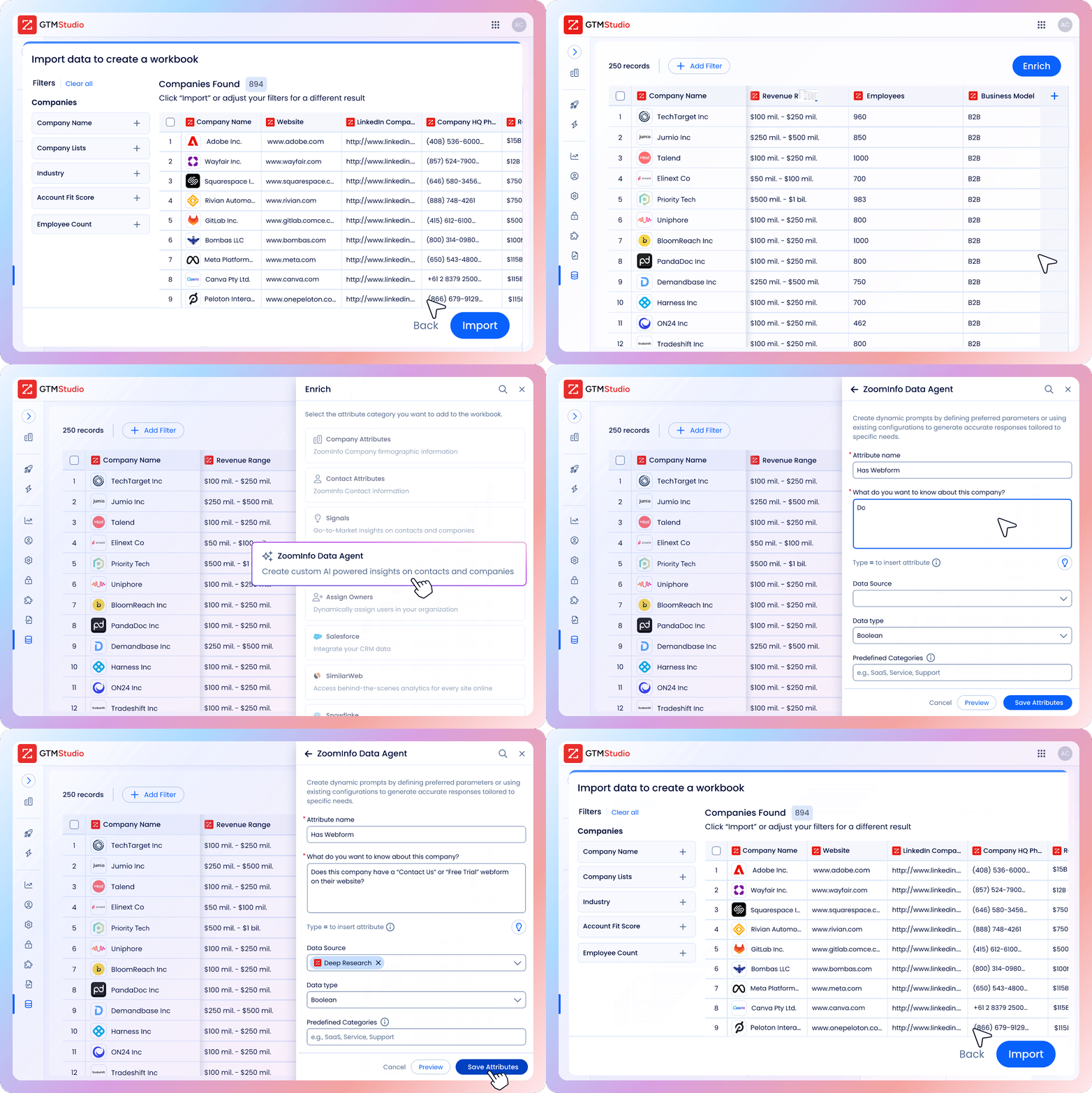
ZoomInfo is an all-in-one AI GTM Platform built as three layers: a B2B data foundation, the GTM Context Graph that reasons over it, and universal access that lets teams use both in any workflow. For churn, that stack does something dedicated customer success tools cannot: it watches the market outside your product. The data foundation tracks more than 100 million companies along with the people inside them, including job changes and departures, hiring signals, and the buying committees behind each account.
On that foundation, the GTM Context Graph processes more than 1.5 billion data points a day, fusing ZoomInfo's data with your CRM, renewal dates, and product signals to explain why an account is at risk, from a usage dip to a departing stakeholder. Teams act on it in GTM Studio, the RevOps and customer success canvas where plays fire automatically, or through the API and MCP.
Inside GTM Studio you can see which customers are up for renewal, detect when a member of the original buying group has left since the contract was signed, find the rest of the buying group you never engaged, and generate personalized outreach automatically.
ZoomInfo is not a health-scoring customer success platform the way Gainsight or ChurnZero are, so a mature retention program pairs it with one. Where it earns its place is the signal those tools miss: turning external buyer movement into a renewal-risk alert that reaches the account team in time to act.
"You'll get 10x the value if you think of ZoomInfo as a full platform and not just a tool for one team."
Key features:
Job-change and departure tracking that flags when a champion or buyer leaves an account.
Buying-committee and decision-maker mapping to find the rest of the group you have not engaged.
Renewal and account signals combined with your first-party CRM and product data.
Waterfall enrichment that keeps contact and account records fresh across the customer base.
Workflows and alerts that route renewal-risk signals into customer success and RevOps workflows.
Automated, personalized outreach to re-engage new stakeholders before renewal.
Pros:
Surfaces the external, people-based churn signal that product and CRM data miss.
Combines first-party and third-party data in one canvas, reducing manual data work.
Verified data foundation grounds AI recommendations that lighter tools cannot match.
Cons:
Not a purpose-built customer success or health-scoring platform, so a formal retention program pairs it with one.
Breadth means teams should scope which renewal signals and plays to run first.
Pricing: Free to start with consumption credits based on usage.
2. Gainsight
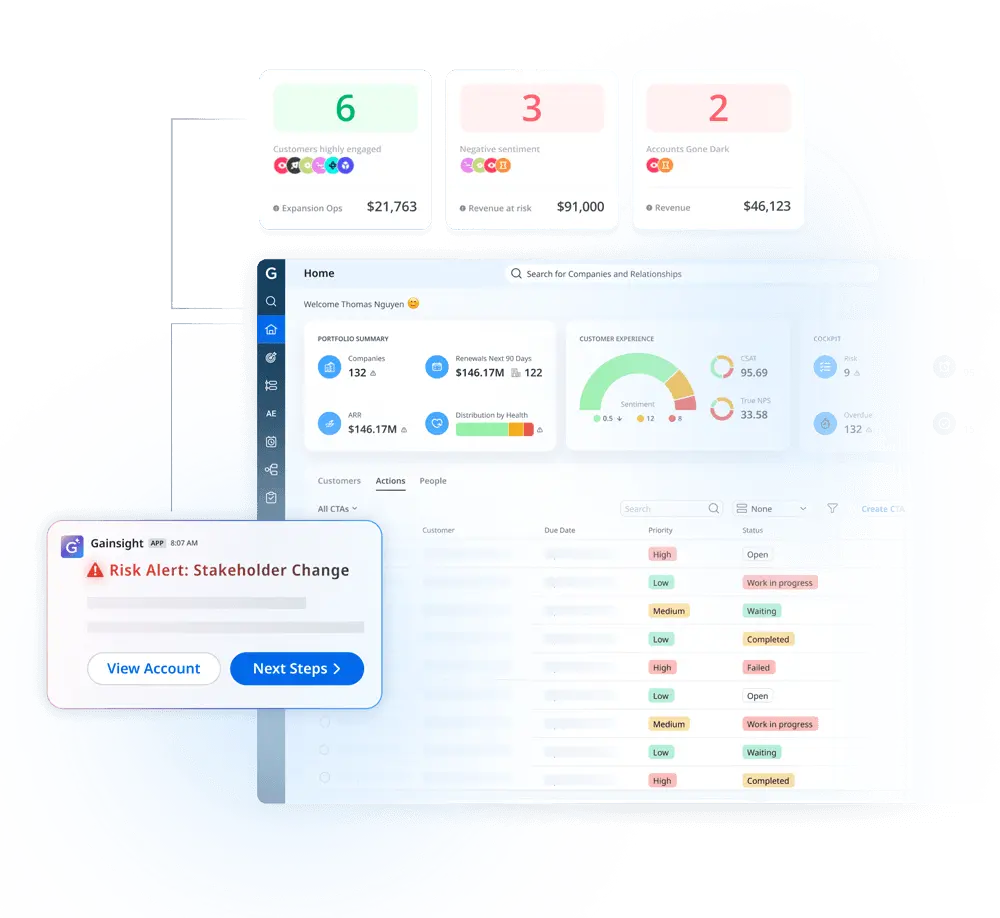
Gainsight is the enterprise standard for predicting churn at scale.
It rolls product usage, survey, and support data into a configurable health score, layers predictive renewal-risk models on top, and turns a falling score into an assigned play through its Calls to Action engine.
Its 2024 Staircase AI acquisition added real-time signals pulled from customer conversations, surfacing a slipping account between quarterly reviews.
Key features:
Configurable health scores across product usage, surveys, and support.
Predictive churn and renewal-risk models.
Playbooks and journey orchestration through Calls to Action (CTAs).
Staircase AI real-time relationship and sentiment signals.
Deep Salesforce and data-warehouse integrations.
Pros:
Broadest, most configurable feature set in the category.
Mature analytics and enterprise governance.
Large ecosystem, community, and CS methodology behind it.
Cons:
Built for large teams with dedicated CS Ops.
Implementation and cost sit at the enterprise end.
Pricing: Custom, quote-based. Third-party estimates place enterprise deployments from around $25,000 per year and up.
3. ChurnZero
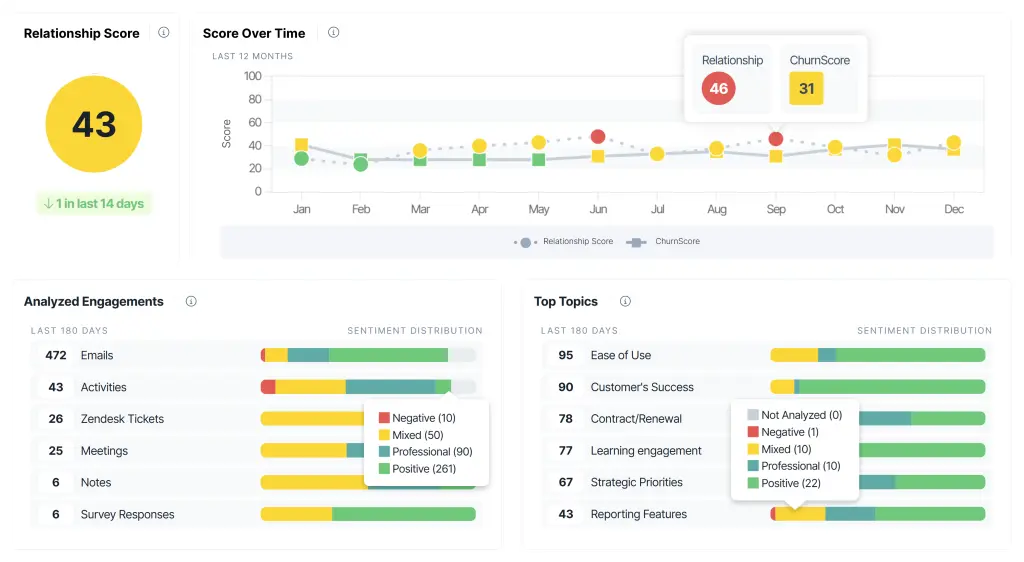
ChurnZero is built to stop churn, and it shows in the workflow.
Its configurable ChurnScore reads product usage, engagement, and lifecycle stage in real time, then fires automated journeys and Plays the moment an account slips, so a CSM can run a save play while there is still time to act.
On G2, reviewers praise its health scoring and automation; the recurring critique is complexity, with users noting that setup and configuration take real time before health scores and playbooks feel meaningful.
Key features:
ChurnScore configurable health scoring.
Real-time usage and engagement tracking.
Automated journeys and playbooks for onboarding and renewals.
In-app communications, including walkthroughs and surveys.
Renewal and forecast reporting.
Pros:
Configurable ChurnScore and Plays that turn a health signal into a concrete save motion.
Strong automation and a centralized view of customer health.
Well-rated support and onboarding, per G2 reviewers.
Cons:
G2 reviewers cite setup and configuration complexity before health scores and playbooks feel meaningful.
No-code reporting gets heavy for complex or layered requirements.
Pricing: Custom, quote-based. Third-party estimates place deployments in the mid-four-figures per month.
4. ClientSuccess
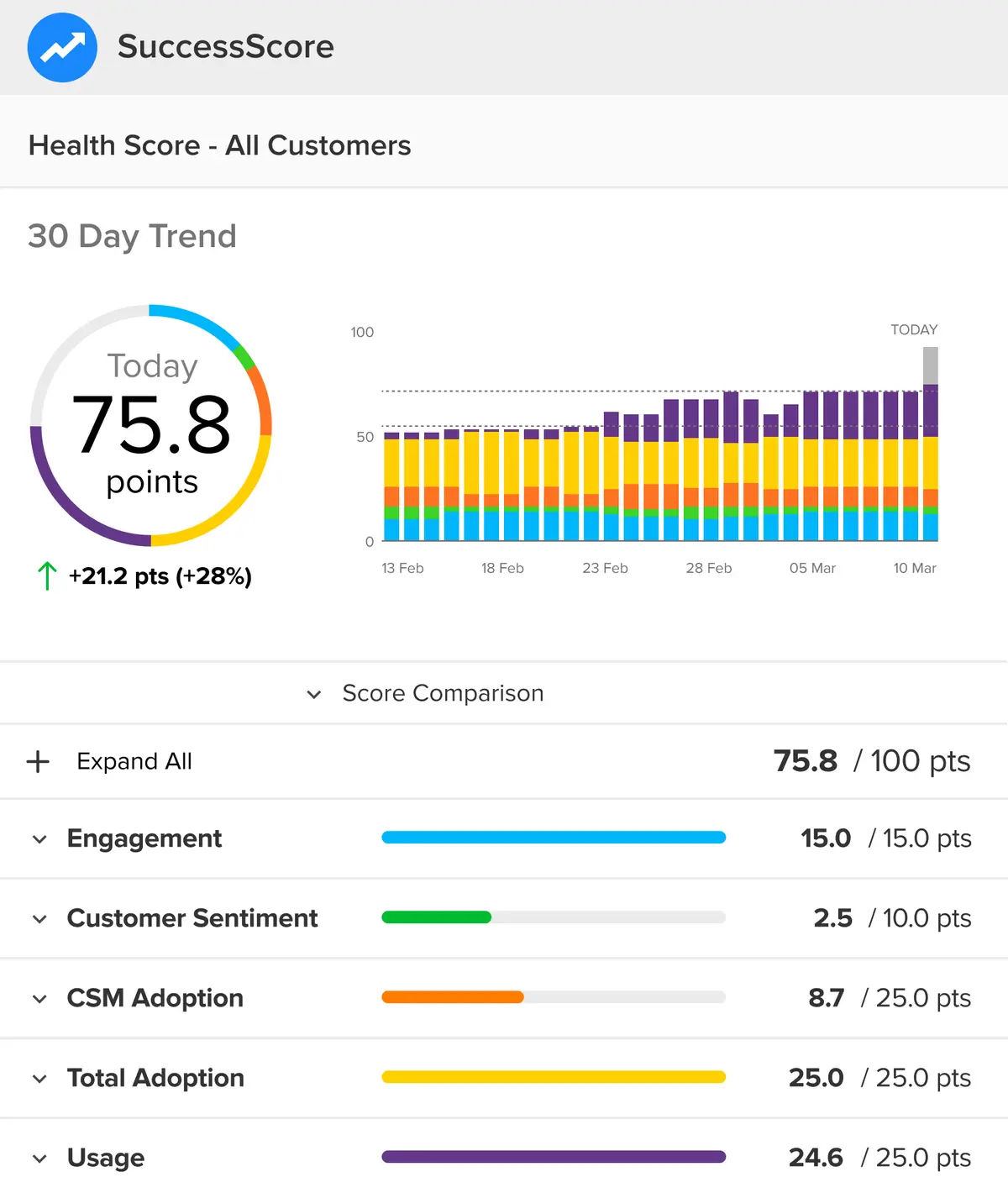
ClientSuccess centers churn prediction on the renewal. Its SmartScore health score blends product usage, engagement, and CSM sentiment into a single early-warning read, then SuccessCycles run the playbooks for onboarding, adoption, and renewal, so a slipping account triggers a save motion instead of a surprise at renewal.
On G2, reviewers highlight the clean interface and responsive support; the recurring critique is that reporting and dashboards are lighter than the enterprise suites. It fits growing B2B SaaS teams that want renewal-focused health scoring without a heavy implementation.
Key features:
SmartScore health scoring across usage, engagement, and CSM input.
SuccessCycles playbooks for onboarding, adoption, and renewal.
Renewal management and revenue forecasting.
Pulse and NPS feedback capture.
Salesforce, CRM, and product-data integrations.
Pros:
Renewal-centered health scoring that maps cleanly to the save motion.
Straightforward setup and responsive support, per G2 reviewers.
Good fit for growing B2B SaaS teams.
Cons:
Reporting and dashboards are lighter than enterprise suites, per G2 reviewers.
Fewer dedicated predictive-ML features than model-first tools.
Pricing: Custom, quote-based.
5. Planhat
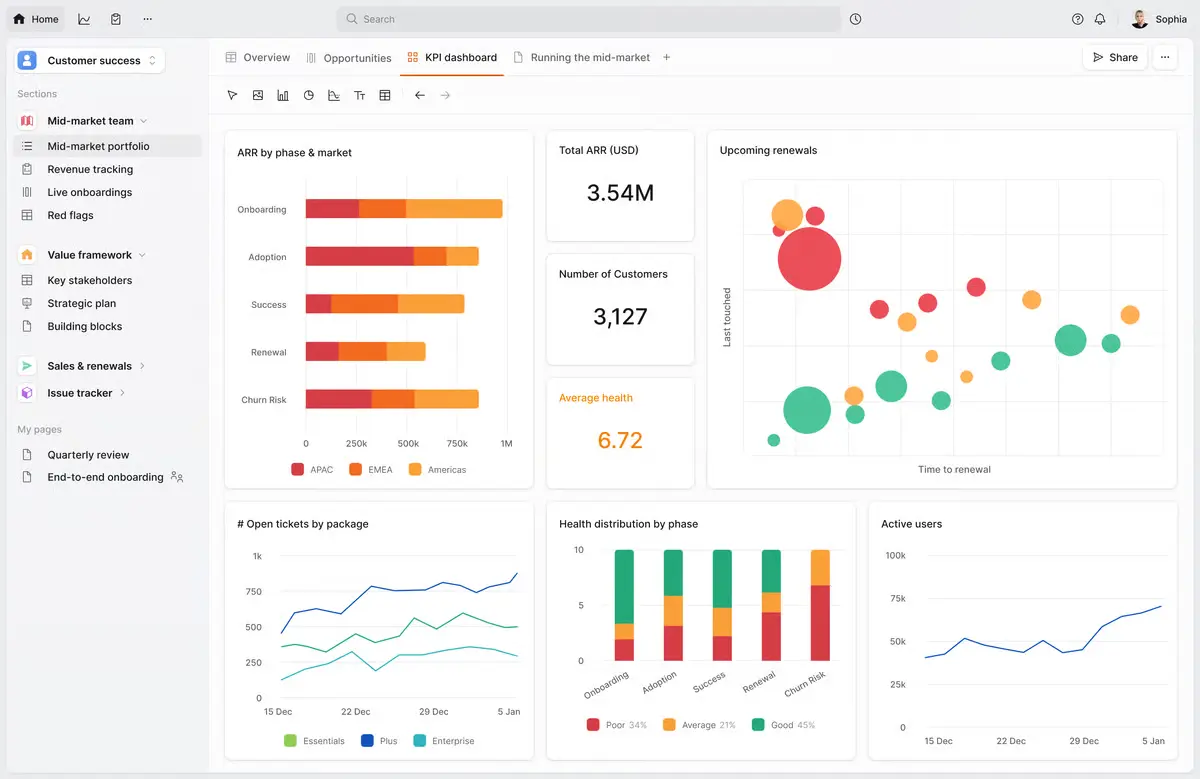
Planhat predicts churn through a revenue lens.
It ties custom health scores to net revenue retention and expansion, so risk and upsell sit in the same view, and its flexible data model handles the complex, multi-product hierarchies that break simpler scoring.
Now positioned as an agentic customer platform, Planhat pairs that data model with Pi, an AI agent that runs commercial work across the lifecycle using context from every touchpoint. Planhat reports 21% less churn and 34% more customers per CSM.
It fits post-sale teams whose core metric is net revenue retention.
Key features:
Custom health scores and churn models.
Pi AI agent that automates commercial work across the customer lifecycle.
Revenue and expansion tracking tied to net revenue retention.
Flexible data modeling for complex hierarchies.
Custom reporting engine.
Pros:
Strong when NRR and expansion visibility are the priority.
Clean interface with deep configurability.
Consolidates scattered post-sale data.
Cons:
Flexibility requires configuration investment to realize.
Best value depends on clean, connected data.
Pricing: Custom, quote-based. Third-party estimates start around the low five figures per year.
6. Vitally
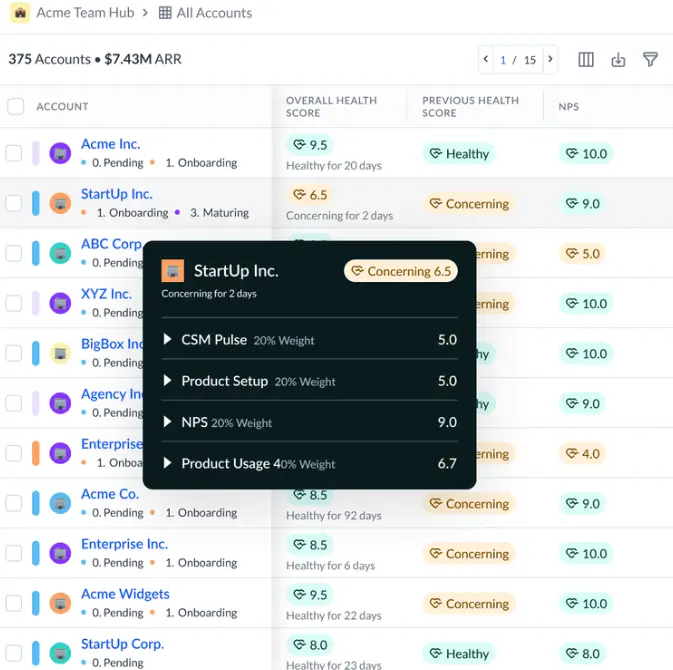
Vitally brings AI health scoring to fast-growing teams without an enterprise implementation.
It unifies product, CRM, and support data into a Customer 360, scores risk automatically, and runs playbooks off health and lifecycle triggers, behind an interface CSMs adopt quickly. A strong fit for product-led motions that need a working churn signal live within weeks.
Key features:
AI-assisted health scores.
Flexible data modeling and Customer 360.
Automated playbooks and projects.
Product analytics and dashboards.
Slack and CRM integrations.
Pros:
Quick setup and an interface teams actually adopt.
Strong automation for lean customer success orgs.
Good fit for product-led motions.
Cons:
Lighter enterprise governance than Gainsight.
Depth scales with the data you connect.
Pricing: Custom, quote-based. Third-party listings start around $499 per month.
7. Custify
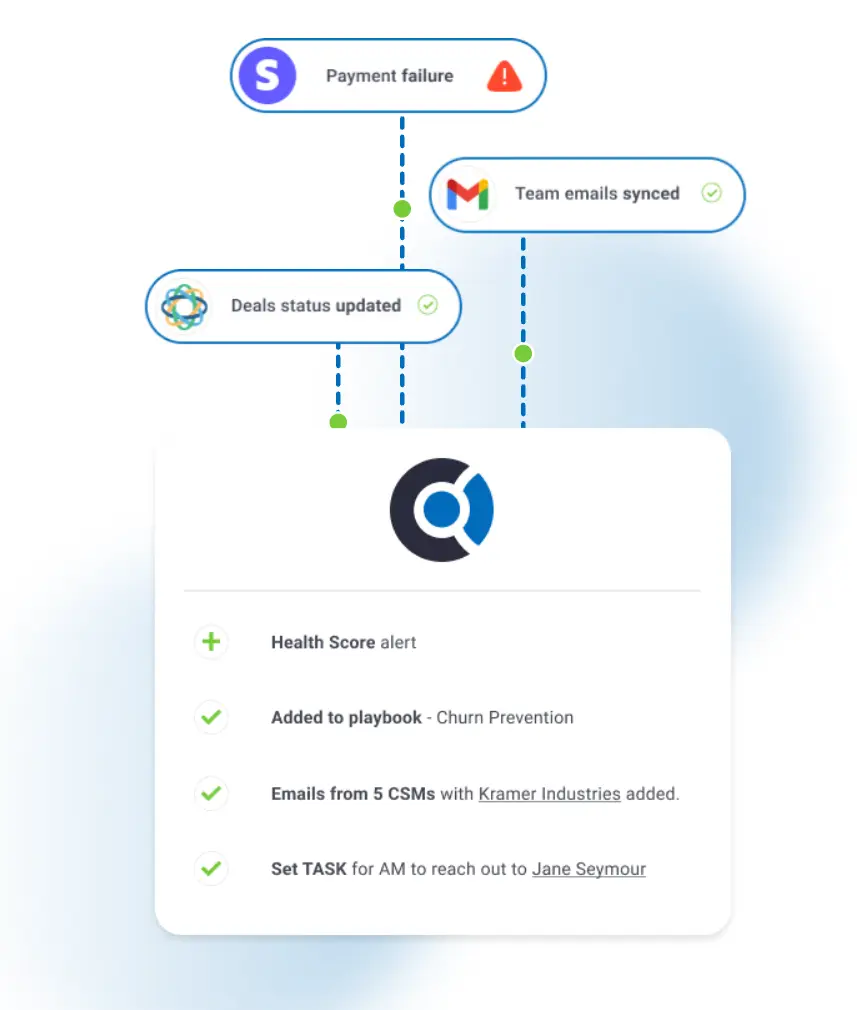
Custify gives smaller B2B SaaS teams a working churn signal fast, aggregating usage, billing, and support into customizable health scores that map to the metrics driving retention and expansion.
Its newer CustifyAI layer adds agentic AI that spots churn signals early, checks the context, and suggests the right action, alongside AI-generated playbooks, account summaries, and sentiment-score trends.
Reviewers on G2 single out the intuitive interface and automation; the most common critique is missing features and reporting that needs configuration to unlock, with AI-driven insights still maturing next to larger enterprise suites.
Key features:
Health scores from usage, billing, and support.
Automated tasks and lifecycle playbooks.
Customer 360 and segmentation.
CSM workflow and alerting.
Integrations with common SaaS stacks.
Pros:
Fast time to value and straightforward setup.
Sensible fit for SMB and mid-market.
Customizable health scoring tied to retention and expansion metrics.
Cons:
G2 reviewers flag missing features and limited customization on advanced reporting.
AI-driven insights are lighter than dedicated predictive tools.
Pricing: Custom, quote-based. Third-party listings start around $399 per month.
8. Pecan AI
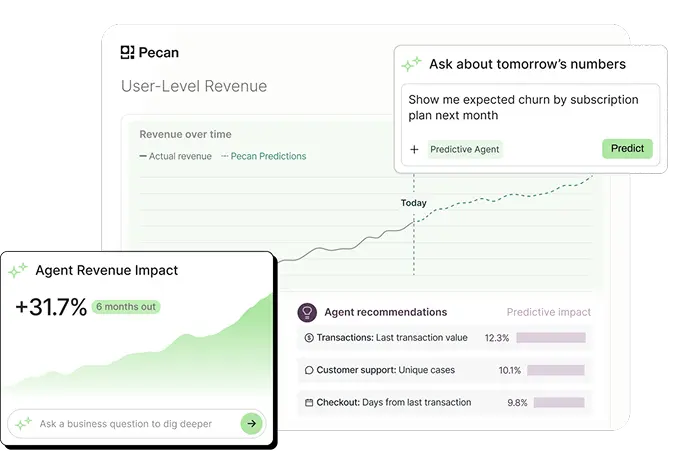
Pecan AI builds machine-learning churn models without a data-science team, It now works as a predictive AI agent: you ask a business question in plain language, the agent prepares the data, builds and validates the model automatically, and surfaces per-customer risk scores where decisions get made. Pecan reports a 28% average reduction in customer churn, and says 90% of its predictions are delivered without data-science support.
On G2, small teams describe getting a working churn model live in weeks after struggling to build one in-house. Pecan generates the score and hands the save motion to your CRM or customer success tools.
Key features:
Predictive AI agent that builds and validates churn models from a plain-language business question.
Automated data preparation and feature engineering.
Continuous model refresh.
Per-customer risk scores with drivers.
Exports into CRM and BI tools, including Salesforce, HubSpot, and Snowflake.
Pros:
Genuine predictive modeling on your own data.
No data-science headcount required.
Delivers a working churn model in weeks, per G2 reviewers.
Cons:
G2 users note limited control over model selection and less visibility into how a prediction is reached.
Delivers scores, so it needs a customer success workflow to act on them.
Pricing: Custom, quote-based. Pecan lists Starter, Team, and Business tiers as contact-us, annual pricing.
9. Pendo
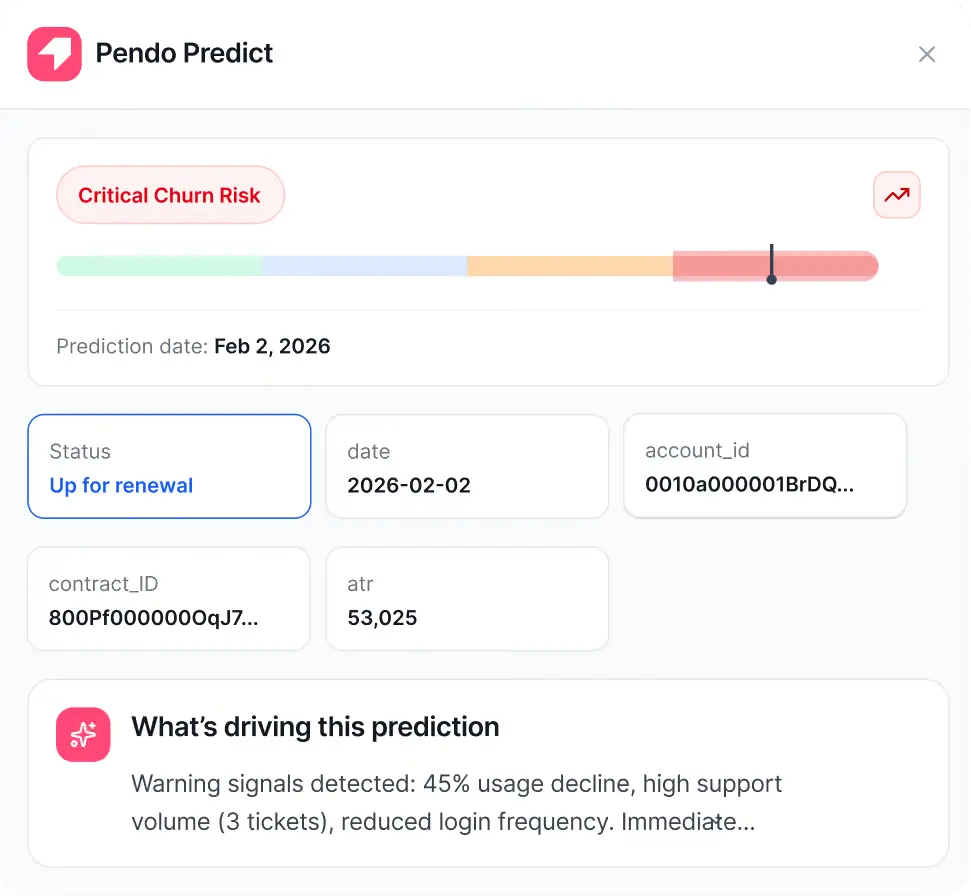
Pendo predicts churn from inside the product. Pendo Predict, its dedicated AI product for churn, scores churn and expansion risk from product-usage behavior, explains what is driving each prediction, and pushes next-best-actions and risk-change alerts into Salesforce and Slack so reps act in the flow of work. Built on Pendo's acquisition of Forwrd.ai, it can flag risk up to six months out and runs on your existing product-analytics data, not only Pendo's own.
On G2, customer success reviewers describe using Pendo to spot which accounts are most likely to churn ahead of a renewal and to trace the reasons behind rising risk. The recurring critique is a steep learning curve and setup that takes time to tag and configure.
Key features:
Product-usage analytics and adoption tracking.
Pendo Predict AI scoring of churn and expansion risk, with explanations and next-best-actions delivered to Salesforce and Slack.
In-app guides and messaging to drive adoption.
Segmentation by feature usage.
NPS and sentiment collection.
Pros:
Ties churn risk directly to feature adoption and usage.
Couples prediction with in-product action.
Free tier for core analytics.
Cons:
Centered on product behavior, so relationship and external signals sit outside its view.
G2 reviewers cite a steep learning curve and time-consuming setup and tagging.
Pricing: Free tier for core analytics; Predict and paid plans are quote-based.
10. Qualtrics XM
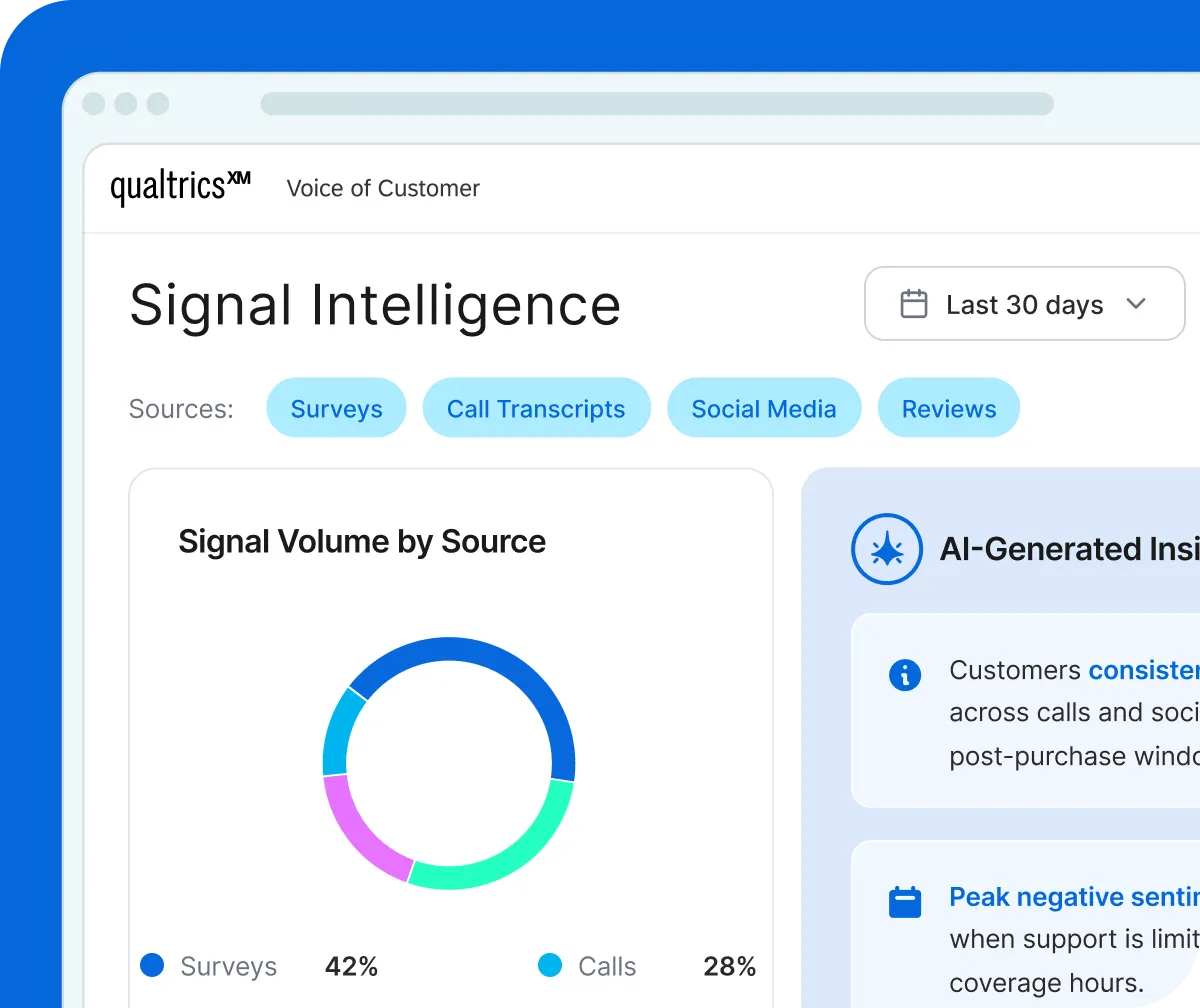
Qualtrics catches the churn that usage misses: the account that still logs in but has quietly soured.
It predicts risk from voice-of-customer data (surveys, sentiment, and journey feedback) and routes flagged accounts into closed-loop workflows, an early read on customer loyalty for teams whose first warning is how a customer feels, well before it shows up in how often they click.
Key features:
Advanced survey design and journey feedback.
Predictive experience and churn analytics.
Sentiment and text analysis.
Closed-loop alerting and workflows.
Enterprise integrations.
Pros:
Deepest voice-of-customer and experience dataset.
Strong for sentiment-led churn signals.
Enterprise-grade analytics.
Cons:
Feedback is one input; pairs best with usage-based signals.
Enterprise pricing and setup.
Pricing: Custom, quote-based, enterprise.
How to choose the right churn prediction software
Henry Schuck, ZoomInfo's CEO and founder, names the gap most retention programs share:
“Most renewal risk doesn't show up in your CRM. The real signal is when someone from the original buying group leaves, and no one notices.”
A health score built on product usage cannot see a champion changing jobs, and that blind spot is where accounts that look healthy quietly slip away.
Use that lens to choose. Four principles matter more than any feature list:
Buy for the signal you are missing. Map where your early warnings come from today (usage, support, feedback, or the account relationship), and spend on the gap that list exposes.
Watch the people behind the account. The strongest leading indicator lives outside your systems: the champion who bought you leaving, or the buying group turning over. Make sure something in your stack tracks job changes and stakeholder movement, not only what happens in-app.
Make sure the score drives action. A risk flag only prevents churn if it reaches the person who owns the save, inside the tools they already work in. If acting on a score means exporting a report, it will not happen at scale.
Match the model to your data maturity. Packaged health scores work out of the box; a custom predictive model rewards teams with clean historical data and the discipline to act on it. Be honest about which one your team can operationalize.
A common setup pairs two things: a customer success platform to score and manage health, and a signal layer that surfaces the external, people-based risk the first cannot see. That second piece is where ZoomInfo fits, and where RevOps and customer success meet, so a buyer walking out the door becomes an alert instead of a surprise at renewal.
Turn churn signals into retained revenue with ZoomInfo
Churn prediction comes down to one question: which signal warns you first, and does anyone act on it? Customer success platforms read health from product usage, predictive tools model risk from your own data, and experience tools read sentiment. The right one depends on the gap you are closing, and they share a limit: each watches inside your own four walls.
The churn that begins outside them, when the people behind an account change, is the one they miss. ZoomInfo closes that gap by bringing job changes, buyer departures, and buying-group mapping into GTM Studio, then triggering the outreach to re-engage new stakeholders before renewal. Run a customer success platform for health scoring, and let ZoomInfo bring the external signal into your go-to-market motion in time to change the outcome.
See how ZoomInfo surfaces renewal risk before it becomes churn. Book a demo.
Frequently asked questions
What is churn prediction software?
Churn prediction software uses machine learning and behavioral data to identify customers who are likely to cancel, then scores the churn risk and surfaces the drivers so teams can act. It monitors signals such as product usage, engagement, support activity, feedback, and account changes, and routes at-risk accounts to customer success and account teams before the renewal is lost.
What is the best churn prediction software?
There is no single best tool, because the category serves different signals. Gainsight and ChurnZero lead customer success health scoring, Pecan AI builds custom predictive models, Pendo reads in-product behavior, and Qualtrics reads customer feedback. ZoomInfo is the strongest fit for the external, people-based signal, detecting buyer departures and buying-group changes that internal tools cannot see.
How much does churn prediction software cost?
Customer success platforms are typically quote-based, commonly running from the low five figures per year, with enterprise deployments such as Gainsight higher. Mid-market tools like Vitally and Custify start in the few-hundred-dollars-per-month range in third-party listings. ZoomInfo is free to start with consumption credits based on usage.
Can ZoomInfo predict churn?
Yes, from the outside in. ZoomInfo surfaces external renewal-risk signals such as when a champion or buyer leaves an account, when the buying group changes, and which stakeholders you have never engaged, then delivers them inside GTM Studio with automated outreach. Teams running a formal retention program often pair ZoomInfo with a dedicated customer success platform.
What is the difference between churn prediction and customer success software?
Churn prediction is the scoring: it identifies which customers are likely to leave and why. Customer success software is the system of record for managing the relationship, running playbooks, and driving the save. Many customer success platforms include churn prediction as a built-in feature, while dedicated predictive tools focus only on the model.
Do I need a dedicated churn prediction tool, or can my customer success platform cover it?
If you already run a customer success platform, you have usage-based health scoring. The gap that often remains is the external, people-based signal. Adding a signal layer that flags buyer departures and buying-group changes catches the renewal risk your product and CRM data cannot see, with far less overhead than a second full platform.
