
Key Takeaways
Manufacturing breaks generic CRMs. Long sales cycles, multi-stakeholder committees, and tight ERP integration mean general-purpose tools need heavy configuration to keep up.
The best platforms pair workflow with data. Pipeline management plus enrichment and buyer intent shows reps which accounts are actively evaluating, not just who's already in the system.
ERP integration is the main differentiator. Some CRMs share a native database with their ERP; others rely on middleware or custom APIs, and the gap shows up in quoting accuracy.
Total cost of ownership beats sticker price. Budget for implementation, training, data migration, and ongoing enrichment, not just the per-user fee.
No single tool covers the whole motion. A CRM organizes your pipeline; a data layer like ZoomInfo fills it with verified contacts and intent signals on top.
Choosing a CRM for manufacturing is not like choosing one for a SaaS or retail business. Sales cycles run longer and more people sign off. The system also has to handle configure-price-quote workflows, distributor relationships, and a tight link to ERP and production data.
This guide ranks the 10 best manufacturing CRM platforms for 2026, from enterprise suites to lean tools for small teams. Each is weighed on industrial workflow fit, ERP and production integration, and data quality.
What Is Manufacturing CRM Software?
Manufacturing CRM software helps industrial companies manage relationships with prospects, customers, distributors, and channel partners. It differs from general-purpose CRMs in one main way: integration depth.
A manufacturing CRM connects customer-facing activity to back-office systems like ERP, MRP, and inventory platforms, so reps can see production schedules, lead times, and stock levels and quote against them.
Most manufacturing CRM platforms cover three areas:
Sales and pipeline management: Track opportunities across long cycles, manage distributor and dealer relationships, and automate quoting.
Customer service and warranty management: Log service cases, handle warranty claims, schedule field visits, and track equipment lifecycles.
Data enrichment and intelligence: Enrich records with verified contacts, intent signals, and firmographics so reps target the right accounts.
Few platforms are equally strong in all three. The right choice usually comes down to which of these is the bottleneck in your current process.
Manufacturing CRM Comparison Table
Platform | Best For | ERP Integration | Starting Price |
ZoomInfo | Data enrichment and buyer intent for any CRM | Salesforce, HubSpot, Dynamics 365, Zoho, Pipedrive (native) | Custom, usage-based |
Salesforce Manufacturing Cloud | Enterprise manufacturers with complex ops | SAP, Oracle, NetSuite (native + MuleSoft) | $275/user/mo |
HubSpot CRM | Mid-market manufacturers scaling inbound | Limited native; API and middleware | $20/user/mo |
Microsoft Dynamics 365 | Manufacturers on the Microsoft stack | Deep native ERP (Dynamics F&O, SAP) | $65/user/mo |
Zoho CRM | Budget-conscious manufacturers | Zoho ERP; third-party via API | $14/user/mo |
Pipedrive | Small manufacturing sales teams | Limited; API-based | $14/user/mo |
Freshsales | Manufacturers wanting built-in phone and email | Limited native; marketplace integrations | $9/user/mo |
Insightly | Manufacturers needing project plus CRM | Limited; AppConnect middleware | $29/user/mo |
Creatio | Process-heavy manufacturers | Native ERP connectors, low-code integrations | $40/user/mo |
NetSuite CRM | Manufacturers already on NetSuite ERP | Native (NetSuite ERP, SuiteCommerce) | Custom pricing |
10 Best Manufacturing CRM Platforms for 2026
The list runs from the intelligence layer that sharpens any CRM through full enterprise suites to lean tools for small teams. Each entry covers where it fits, its strengths, the tradeoffs, and pricing.
1. ZoomInfo
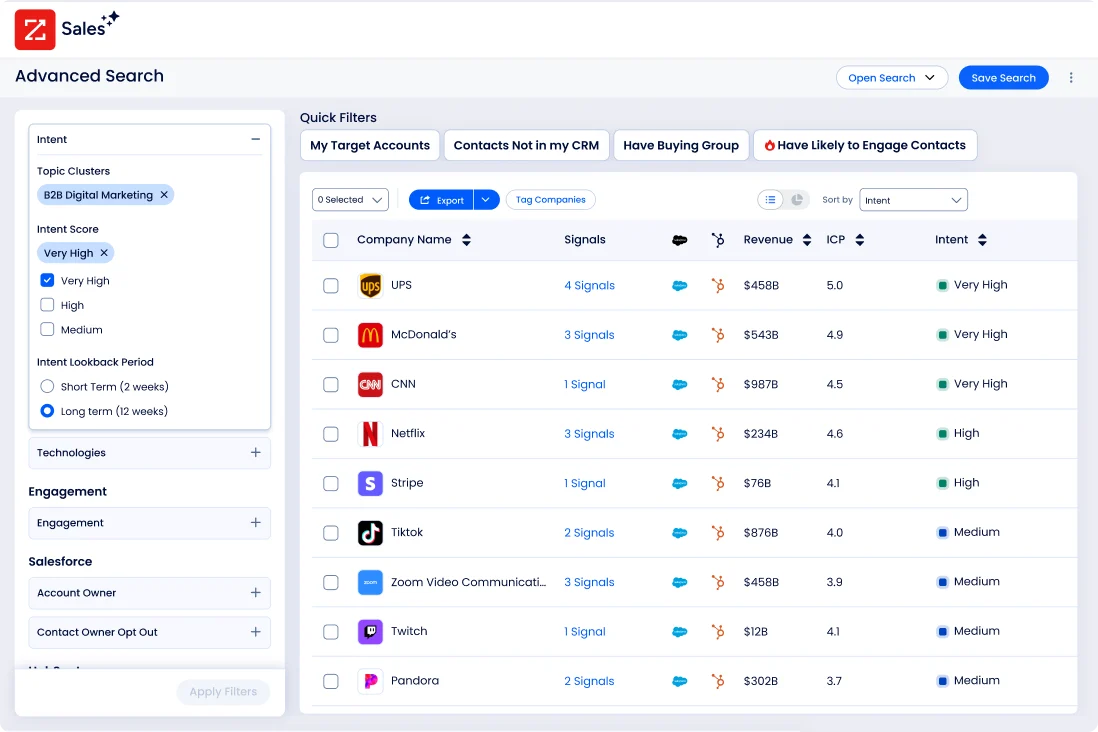
ZoomInfo sits on top of your CRM and keeps it fed with accurate, current data. It's not a CRM itself, but the layer that enriches whichever one you use, combining contact data, company data, intent signals, and AI workflows in one platform.
The data is the foundation: 120M direct-dial phone numbers, 200M+ verified business emails, and 100M+ company profiles with parent-child hierarchies. On top of that sit buyer intent signals that flag which manufacturing accounts are actively researching solutions like yours.
That data powers two tools that earn their keep in manufacturing. Copilot is the AI assistant for SDRs running top-of-funnel prospecting, drafting outreach and surfacing next-best actions. GTM Workspace is the home base for AEs managing complex, multi-site accounts. Together, they cover the three hardest parts of manufacturing sales: finding the right person behind a layered org, reaching them directly, and timing the outreach.
Key features:
Verified direct dials and emails: Reach decision-makers on the plant floor, not switchboards.
Org charts and hierarchy mapping: Navigate multi-site manufacturers and complex buying committees.
Buyer intent signals: Surface accounts in an active buying window so reps reach out at the right time.
Technographic data: See which ERP, MES, and PLM systems an account runs.
Native CRM integrations: Sync enrichment and intent data into Salesforce, HubSpot, Dynamics 365, Zoho, and Pipedrive, with no manual exports.
Pricing: Consumption-based rather than per-seat, tied to usage such as exports, API calls, and enrichment. ZoomInfo Lite is permanently free with 10 monthly export credits, and paid plans come with a 7-day trial.
What our customers say:
At Apricorn, a manufacturer of hardware-encrypted storage, business development manager Derion McGriff used ZoomInfo Copilot to surface buying groups and draft personalized outreach at scale. He cut his email motion from two hours to 20 minutes — saving about five hours a week — and saw a 10% jump in cold-email response rates.
"Copilot is crafting really great emails, and it doesn't feel like an AI wrote it. It feels like it was personally written." — Derion McGriff, Business Development Manager, Apricorn
Read the Apricorn case study →
2. Salesforce Manufacturing Cloud
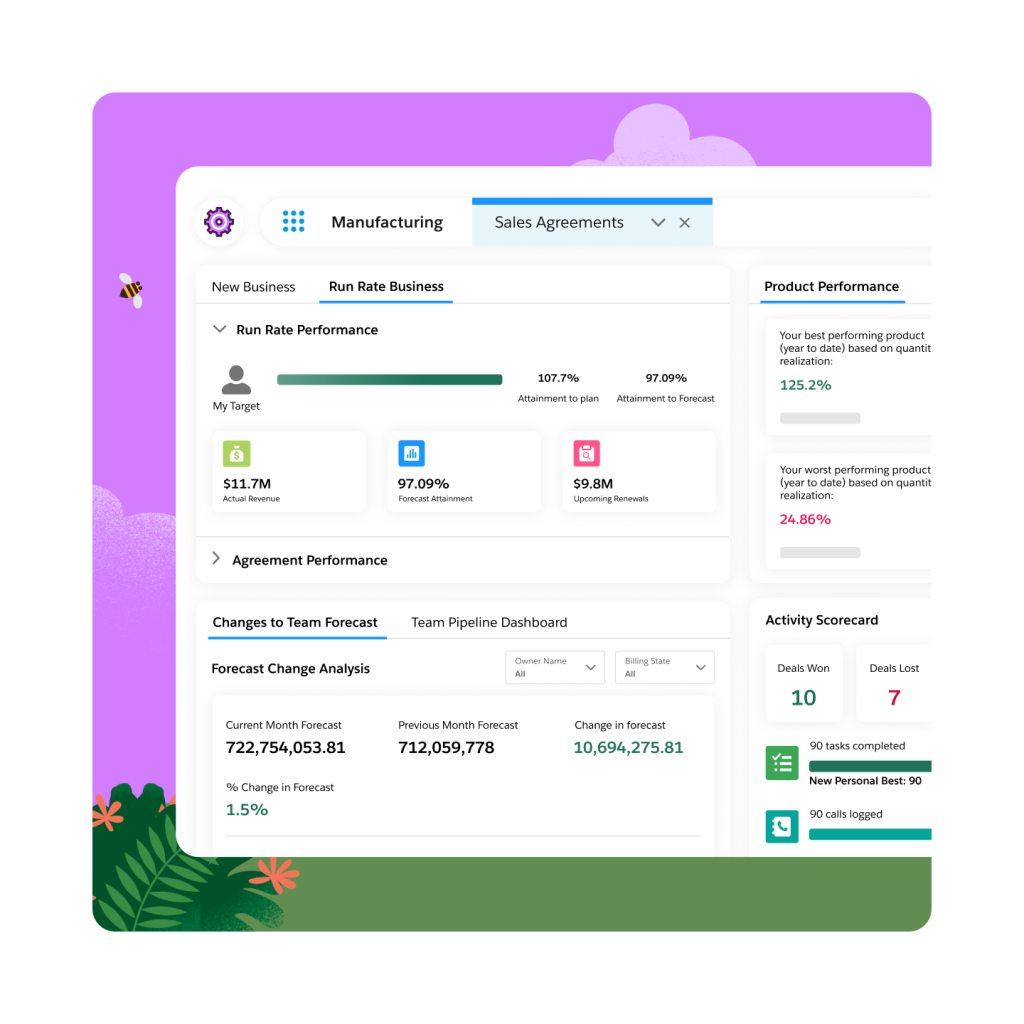
Salesforce Manufacturing Cloud extends the core platform with the contract and forecasting tools industrial sellers actually need, then ties them back to the plant through a shared data model. Planners see pipeline forecasts, sellers see inventory and fulfillment status, and neither side works off a separate version of the truth.
Its real strength is the ecosystem around it. Through MuleSoft, almost any ERP, reporting tool, or industry add-on a large manufacturer runs already has a connector, and the built-in Einstein AI layers prediction on top. For global, multi-division operations, few platforms match its configurability and scale.
The tradeoff is complexity. Implementations run in months, and you will likely need a dedicated admin or consulting partner to keep it running.
Key features:
Sales agreements: Track rebates, volume commitments, and contract terms by account.
Account-based forecasting: Combine pipeline data with run-rate business for demand planning.
Predictive AI: Deal scoring, automated activity capture, and next-step recommendations.
ERP integration: Pre-built connectors to SAP, Oracle, Epicor, and other systems.
Pricing: All editions billed annually. Sales Enterprise (a manufacturing CRM built on Sales Cloud) starts at $275/user/month, Sales and Service Unlimited at $475, and the top Agentforce 1 editions at $700.
3. HubSpot CRM
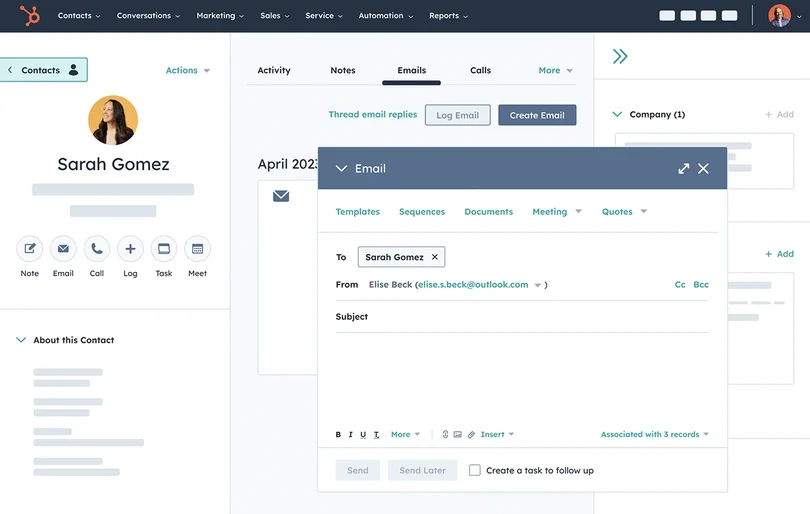
HubSpot CRM is a strong mid-market pick for manufacturers who want a clean interface and a fast rollout. The free tier is generous enough to run a small sales team on its own, and the paid tiers earn their keep once marketing and sales need to work from the same system. Moving up is a pricing decision, not a migration.
Its weak spot for manufacturing is native ERP integration. Syncing with production systems means using Operations Hub or third-party connectors. But for manufacturers focused on inbound lead generation and the marketing-to-sales handoff, HubSpot delivers a polished experience at a lower total cost than enterprise platforms.
Key features:
Free CRM tier: Contact management, deal pipeline, and reporting at no cost for small teams.
Marketing automation: Email sequences, lead nurturing, and content management built in.
Custom objects: Model distributor relationships, product configurations, and other manufacturer-specific data.
Data enrichment: Breeze Intelligence appends company and contact details, drawn from your monthly HubSpot Credits.
Pricing: HubSpot CRM is free for up to 2 users. Paid tiers come through Sales Hub: Starter at $20/seat/month, Professional at $90, and Enterprise at $150, billed annually. Factor in one-time onboarding fees of $1,500 (Professional) and $3,500 (Enterprise).
4. Microsoft Dynamics 365
Microsoft Dynamics 365 fits manufacturers already on the Microsoft stack. Its real advantage is the native link between sales and production data, which spares you the disconnected-systems problem that comes from stitching separate tools together.
Copilot helps adoption more than it impresses: reps trust AI that lives inside the tools they already use every day.
The tradeoff is complexity. The learning curve is steeper than HubSpot or Pipedrive, and licensing gets tangled across modules. But for manufacturers that want CRM and ERP under one roof, it removes the integration work that multi-vendor stacks create.
Key features:
Unified CRM and ERP: Pipeline data flows into supply chain planning and financial forecasting.
AI assistant: Email drafting, meeting prep, and pipeline analysis.
Low-code tools: Build custom workflows and dashboards on the Power Platform.
Native Microsoft integration: Deep connections to Teams, Outlook, Excel, and SharePoint.
Pricing: Sales Professional at $65/user/month, Sales Enterprise at $105/user/month, and Sales Premium at $150/user/month, all billed annually. A free trial is available.
5. Zoho CRM
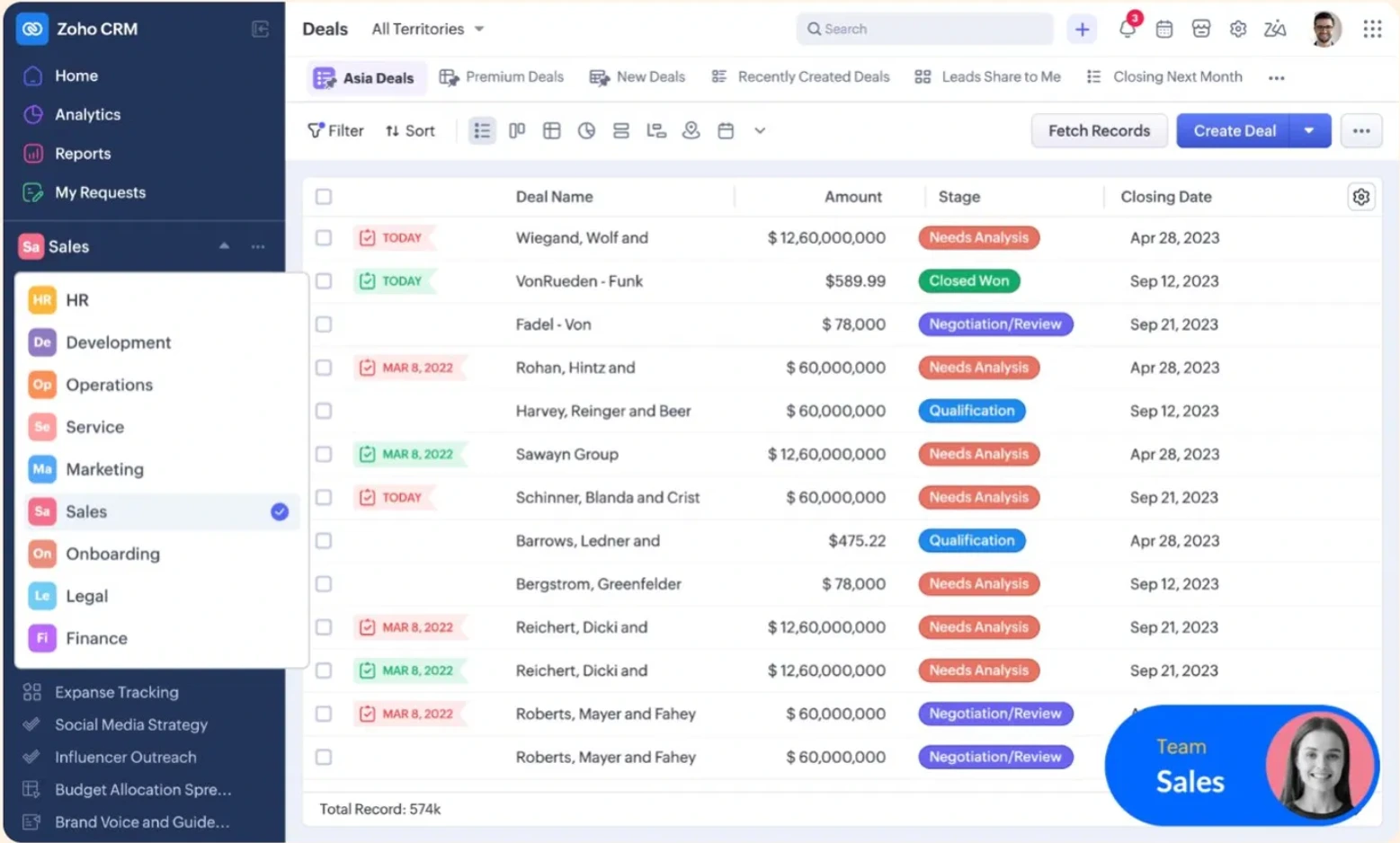
Zoho CRM packs a surprising amount into a price small and mid-sized manufacturers can absorb. The headline is value for money: capabilities that cost extra elsewhere, from AI scoring to workflow automation, come bundled into the base tiers.
The wider draw is reach. For a smaller shop that wants more than a standalone CRM but doesn't need full enterprise ERP, Zoho One can cover inventory, invoicing, projects, and HR on one flat per-employee bill. That collapses a whole tool stack into a single vendor.
Customization runs deep for the price, including custom modules, workflows, and API access. The interface can feel busy, and some advanced features mean digging through Zoho's app marketplace.
Key features:
AI assistant: Lead scoring, deal prediction, anomaly detection, and email sentiment analysis via Zia.
Bundled app ecosystem: Zoho One adds 45+ connected business apps under one per-employee price.
Visual workflow builder: Standardize sales processes with Blueprint, no code required.
Interface customization: Drag-and-drop CRM layouts with Canvas.
Pricing: Standard at $14/user/month, Professional at $23, Enterprise at $40, and Ultimate at $52, billed annually. A free edition covers up to three users.
6. Pipedrive
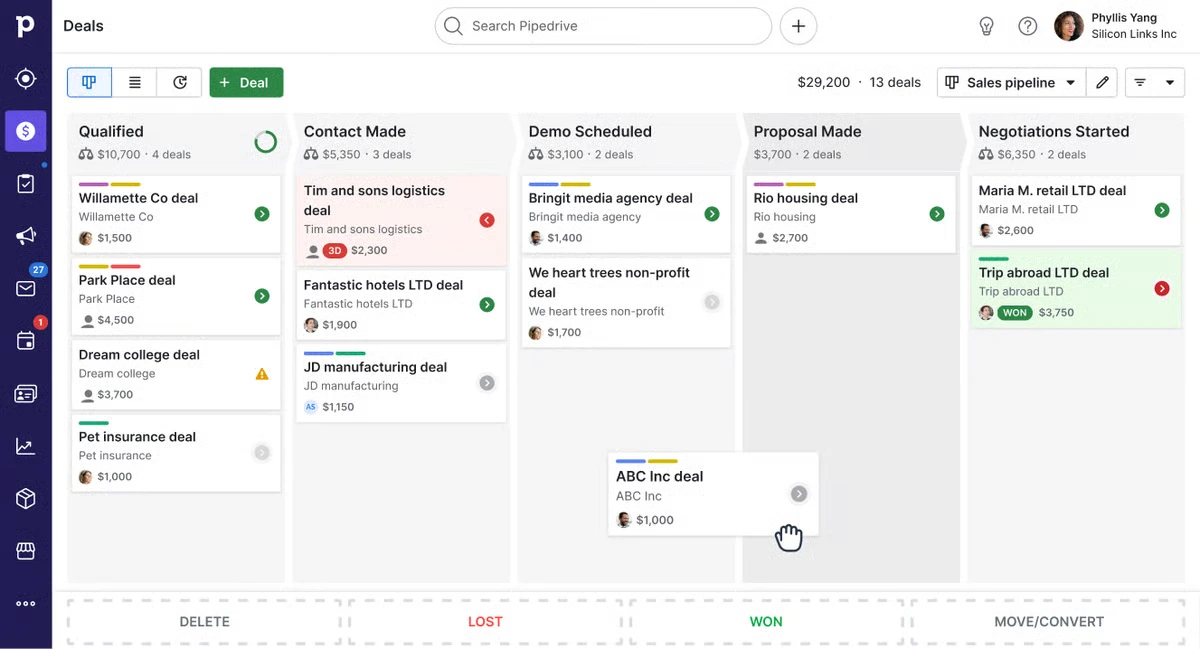
Pipedrive is built around one idea done well: a sales pipeline you can read at a glance and move deals through by dragging them. For small manufacturing teams that value simplicity over depth, that focus is the selling point, not a limitation.
For manufacturers with straightforward processes (direct sales to end customers, limited distributor complexity), setup takes days rather than weeks, and reps are productive almost immediately.
Its limits show in complex environments. There is no native ERP integration, no advanced CPQ, and no multi-entity account management. Add multiple plants, divisions, or distribution channels and you will outgrow it.
Key features:
Visual pipeline: Drag-and-drop deal management with customizable stages.
AI sales assistant: Deal predictions and performance tips from pipeline activity.
Built-in communication: Email, calling, and web-to-lead forms included.
Workflow automation: Trigger-based automation for routine tasks.
Pricing: Lite at $14/user/month, Growth at $39, Premium at $59, and Ultimate at $79, billed annually. A 14-day free trial is available with no credit card required.
7. Freshsales
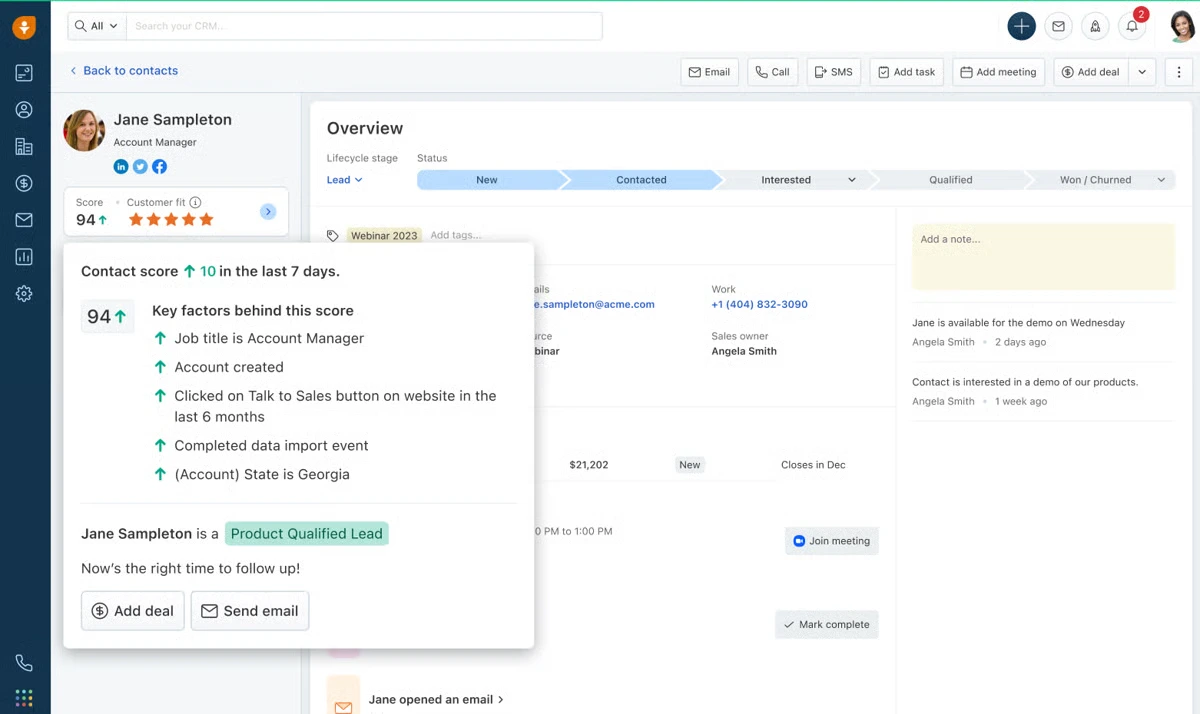
Freshsales, part of the Freshworks suite, folds the tools a rep usually buys separately, dialer, email, and chat, into the CRM itself, so outreach and the record of it live in one place. Its Freddy AI engine then turns that activity into scores and prompts.
For manufacturers, it works well as an all-in-one platform at a competitive price. The built-in dialer is handy for BDMs who spend a lot of time calling distributors and procurement teams.
The weak spot is ERP and production integration. The Freshworks marketplace covers basic connections, but SAP or Epicor shops will need custom API work.
Key features:
Built-in phone and email: Native calling, SMS, and email tracking, no third-party tools.
AI lead scoring: Lead scores, deal insights, and workflow recommendations via Freddy.
Contact lifecycle management: Visual tracking from lead to customer.
Territory management: Assign accounts by region, industry, or product line.
Pricing: Growth at $9/user/month, Pro at $39, and Enterprise at $59, billed annually. Freshsales is free for teams of up to three.
Compare Freshsales vs ZoomInfo.
8. Insightly
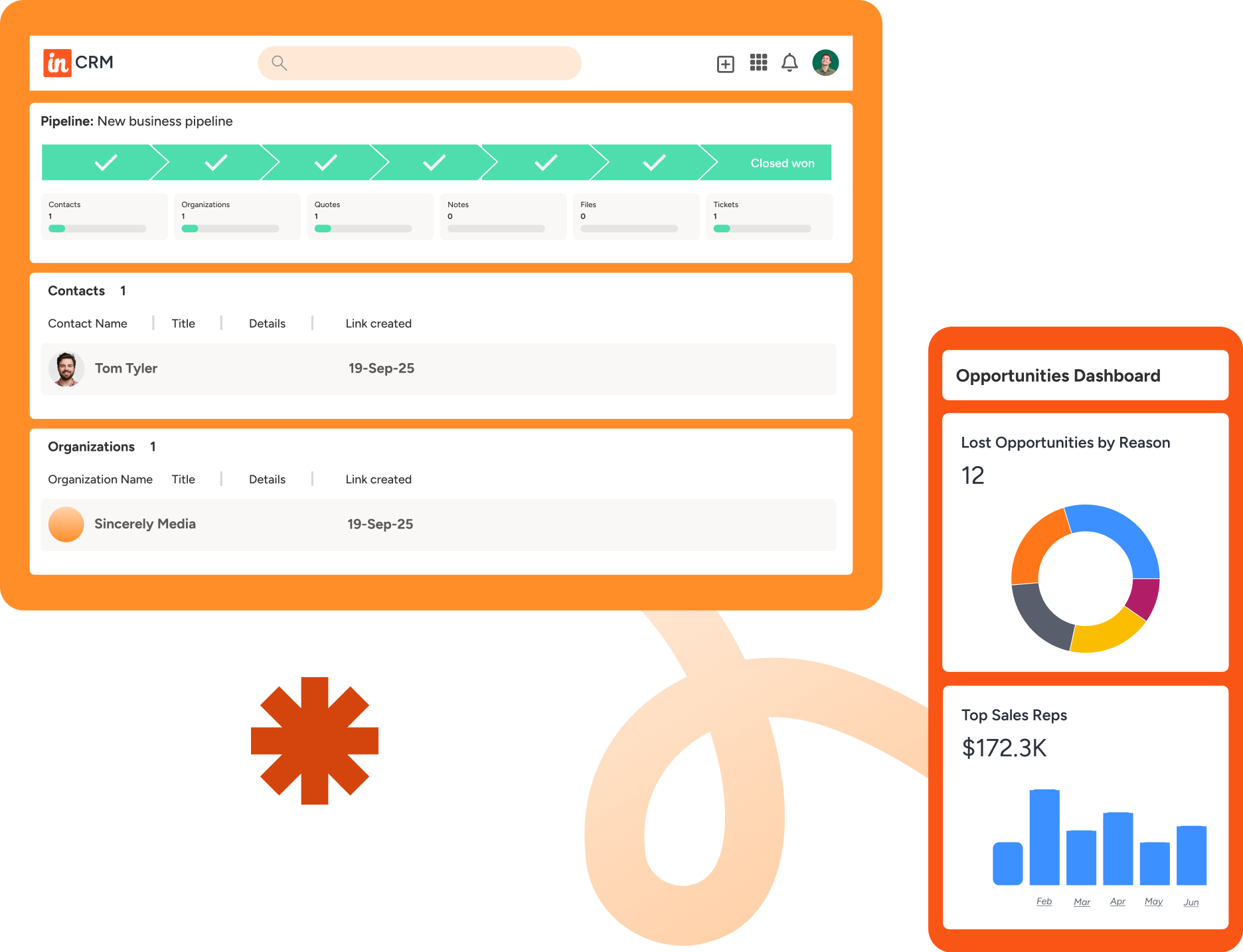
Insightly's hook is that CRM and project management share one system, which suits manufacturers where the handoff from sales to production or installation makes or breaks the customer experience. A deal stays visible from first touch through delivery instead of disappearing the moment it is won.
Connections to ERP and accounting run through AppConnect, which gets the job done but is less robust than the middleware behind Salesforce or Microsoft, worth knowing if your integration needs are heavy. Where Insightly does stand out is mapping the buying committees inside large accounts.
It fits manufacturers in the 50 to 500 employee range. Larger enterprises may find reporting and customization too limited.
Key features:
Project management built in: Track implementation, installation, and delivery alongside the pipeline.
Relationship linking: Map buying committees and org hierarchies across complex accounts.
Integration platform: Connect CRM to ERP, accounting, and marketing tools via AppConnect.
Customizable dashboards: Role-specific views for sales, operations, and management.
Pricing: Plus at $29/user/month, Professional at $49, and Enterprise at $99, billed annually.
9. Creatio
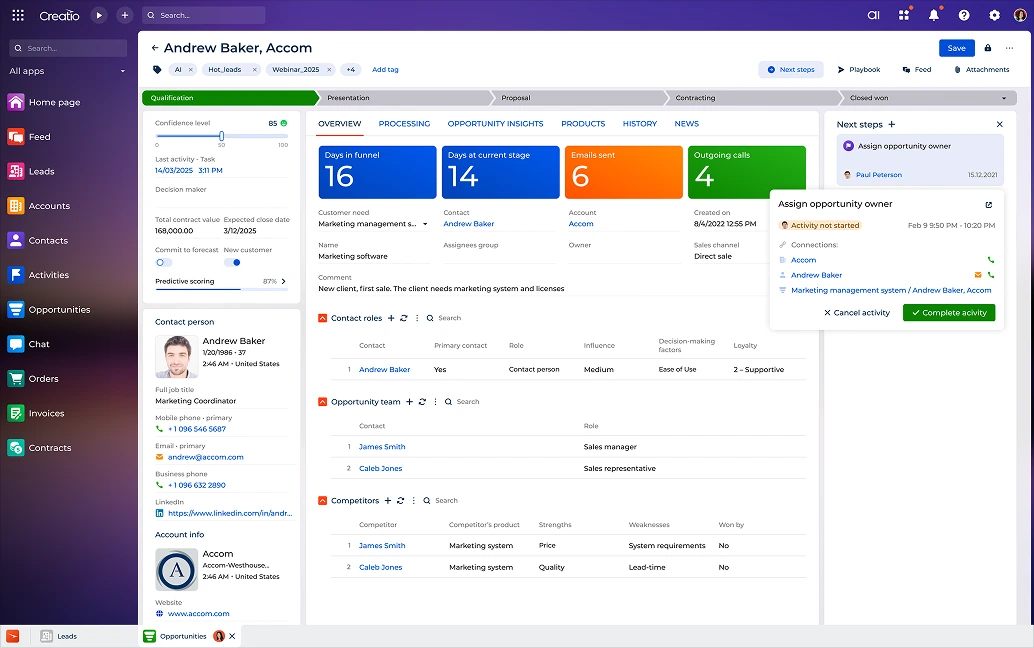
Creatio is a no-code CRM and workflow platform that puts process automation first. Instead of adapting to a fixed pipeline, you build the system around how your business sells, on a platform that ordinary admins can manage.
For manufacturers with structured, repeatable processes like channel sales, RFQ management, and approval workflows, that flexibility is the point. A marketplace of add-ons and native ERP links means you rarely start from scratch. It takes more setup than simpler CRMs, but the result mirrors your processes instead of forcing a generic one.
Key features:
No-code process automation: Build and change complex sales workflows without developers.
Process mining: Analyze how your sales process actually runs to find bottlenecks.
AI and predictive scoring: Built-in AI agents plus lead and opportunity scoring from historical patterns.
Native ERP connectors: Pre-built integrations with manufacturing ERP systems.
Pricing: Growth at $40/user/month and Enterprise at $75/user/month, with a custom-priced Unlimited tier. New customers should note the $10,000 annual minimum and standard three-year contract.
10. NetSuite CRM
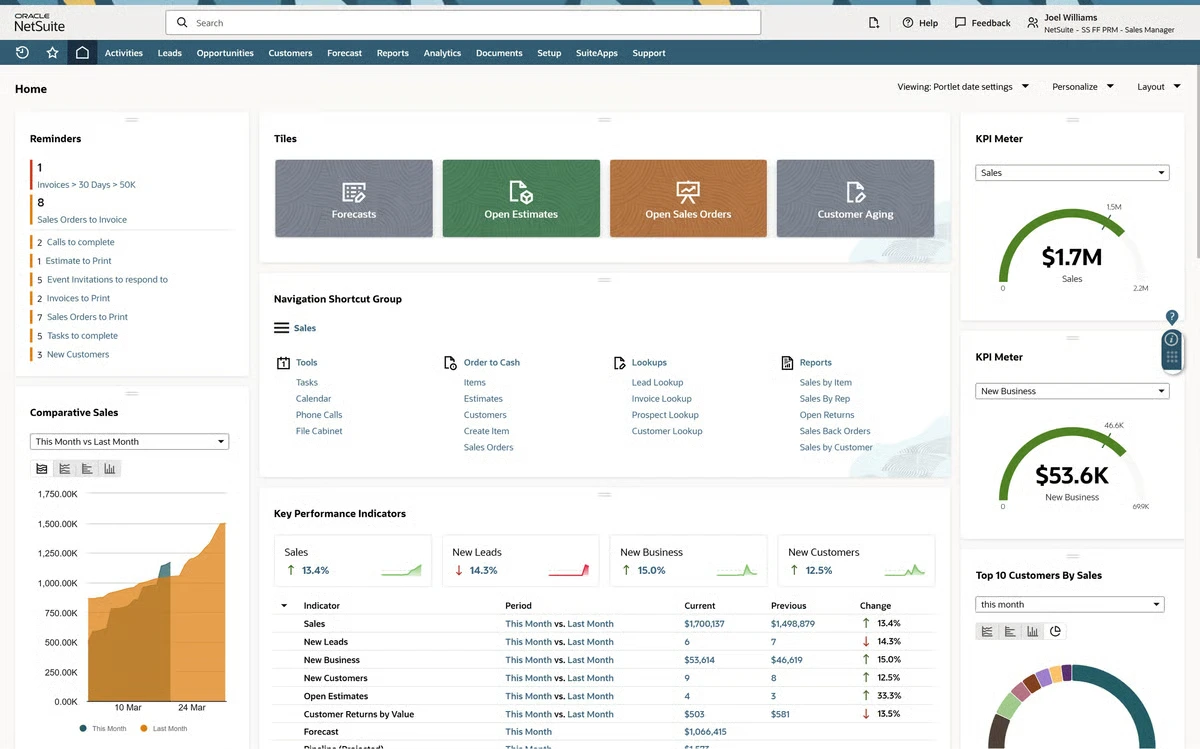
NetSuite CRM, now an Oracle product, is the obvious pick for manufacturers already running NetSuite ERP. Because CRM and ERP share one database, reps quote against live stock and production schedules without leaving the system or pinging operations first. That matters most for make-to-order and long-lead products.
The downsides are cost and lock-in. Pricing is custom-quote only, and migrating off the platform is hard. Manufacturers not already on NetSuite ERP will find better value elsewhere.
Key features:
Unified CRM and ERP database: Sales, inventory, orders, and financials in one system, no sync required.
Real-time inventory visibility: Reps see current stock and production schedules while quoting.
B2B e-commerce integration: Connect distributor and dealer self-service portals via SuiteCommerce.
Advanced analytics: Reporting across sales, financial, and operational data.
Pricing: NetSuite doesn’t publish pricing on its website. Licensing is an annual fee based on the core platform, the modules you enable, and user count, plus a one-time implementation fee. CRM is part of the platform but requires additional CRM licenses.
How To Choose the Right Manufacturing CRM
No single CRM wins for every manufacturer. These four checks help you match the platform to how your team sells and what it runs on.
Start with your sales process
The right CRM fits how you already sell, not the other way around. Map a deal from lead to close, then ask:
Where does it hand off between sales, engineering, and the plant?
Do you need configure-price-quote, distributor and dealer agreements, or multi-plant accounts handled natively?
What slows reps down today, and which features would fix it?
The bottleneck points to the feature set that matters.
Check ERP and production integration
For manufacturers, this is the make-or-break check. A CRM that can't reach your production systems leaves reps quoting blind. Pin down the connection before you commit:
Can it pull live inventory, order status, and production schedules?
Does it have a native connector to your ERP (SAP, Oracle, NetSuite, Epicor), or will you need custom API work?
Is the sync real-time or batch? Batch lags hurt quoting accuracy on make-to-order and long-lead products.
If it can't answer these natively, plan for middleware or custom work.
Assess data quality
Manufacturing buying committees are large and slow-moving, so stale records cost you more than in most verticals. Pressure-test what's already in your system:
Does it tell you who to call, or just store who you already called?
How current are your contacts and direct dials for plant managers, procurement, and operations leaders?
Can you see which accounts are actively evaluating, not just the ones already in your pipeline?
If the answers expose gaps, an enrichment layer like ZoomInfo fills them on top of whatever CRM you pick.
Weigh total cost of ownership
Per-user price is rarely the real cost, especially once ERP integration enters the picture. Budget for all of it:
What will implementation and consulting run? Six figures for some enterprise manufacturing platforms.
How heavy is data migration from your legacy ERP or spreadsheets?
What are the ongoing costs for training, administration, and keeping ERP connectors in sync?
A lower-cost CRM plus a strong data layer often beats an expensive all-in-one with mediocre data.
Power Your Manufacturing Pipeline With Verified Data
A manufacturing CRM organizes your pipeline. An intelligence layer fills it with new manufacturing sales leads. Teams that pair CRM workflow with verified B2B data and real-time buyer intent close more deals and waste less time on dead contacts.
ZoomInfo works with every CRM on this list, enriching your records with accurate contacts, direct dials, and intent signals that show which accounts are ready to buy. Choose Salesforce, HubSpot, Dynamics 365, or any other CRM here, and ZoomInfo adds the data layer on top.
Talk to our team to see how ZoomInfo fits into your manufacturing stack.
Frequently Asked Questions
What makes a manufacturing CRM different from a general-purpose CRM?
Manufacturing CRMs handle longer sales cycles, complex quoting, distributor and dealer management, and integration with ERP and production planning. General-purpose CRMs usually need significant customization to do the same.
How does a CRM integrate with manufacturing ERP systems?
It varies. Some CRMs (NetSuite, Dynamics 365) share a native database with their ERP modules. Others (Salesforce, HubSpot) connect through middleware, pre-built connectors, or custom APIs. Check whether the sync is real-time or batch, since it affects quoting accuracy and order visibility.
Can a CRM help manufacturing companies find new sales opportunities?
A CRM is mostly a system of record for deals already in motion. To generate genuinely new opportunities, manufacturers pair it with a data intelligence platform like ZoomInfo, which adds buyer intent signals and verified contacts for accounts researching solutions in your category.
What is the typical implementation timeline for a manufacturing CRM?
Lightweight platforms like Pipedrive or Freshsales go live faster than enterprise systems like Salesforce Manufacturing Cloud or Dynamics 365, which need configuration, ERP integration, and data migration. The timeline grows with the number of integrations, migration volume, and custom workflows.
How important is AI in a manufacturing CRM?
Increasingly useful. Predictive deal scoring, automated outreach, and intent-based prioritization help reps focus on the right accounts. But AI quality depends on the data feeding it, so clean, enriched data is a prerequisite, not an afterthought.
