
Key Takeaways
ZoomInfo, Thomasnet, and Apollo lead the field for different reasons: depth of B2B data, manufacturing-specific buyer audience, and accessible all-in-one pricing.
Match the source to your sales motion. Outbound SDRs need direct dials and intent. ABM teams need org charts and trigger events. Inbound teams need directories and RFQ platforms. Buying the wrong type costs more than buying the wrong vendor.
Manufacturing breaks generic B2B tools. Without industry sub-code, technology, and plant-level filtering, your SDRs burn hours on accounts that were never going to buy.
Skip free lists. They're scraped, outdated, and already worked by everyone else. The cleanup costs more than a paid trial.
The list is the easy part. Pipeline depends on what happens after: CRM enrichment, qualification, and routing. Pick providers that integrate, not ones that hand you a CSV.
Finding manufacturing sales leads is harder than it looks. The industry covers dozens of sub-verticals with little in common. Decision-makers sit behind plant managers and procurement gates. And generic B2B databases thin out fast the moment you filter them down.
This guide compares the 9 best sources for manufacturing sales leads in 2026, with data coverage, pricing structure, and who each one fits best. Use it to shortlist the right platform for your sales motion, whether you sell into automotive brands, industrial machinery, or contract manufacturing.
What are manufacturing sales leads?
Manufacturing sales leads are contacts at companies that produce physical goods, surfaced for B2B outreach. They cover NAICS 31–33, which includes food and beverage, textiles, chemicals, plastics, metals, machinery, electronics, transportation equipment, furniture, and miscellaneous manufacturing.
A manufacturing lead isn't a single profile. Depending on what you sell, it could be:
A plant manager at a Tier 2 automotive supplier
A VP of Operations at a mid-market food processor
A procurement director at an industrial machinery OEM
A CFO at a contract manufacturer evaluating ERP systems
A director of quality at a medical device manufacturer
The distinction that trips teams up: a lead is not the same as a prospect. A lead is a contact record with firmographic and contact data. A prospect is a lead that's been qualified against your Ideal Customer Profile (ICP) and has shown a buying signal. Most "lead list" purchases give you leads, not prospects. The qualification work happens after.
What makes a high-quality manufacturing sales lead?
Not all leads are worth the same.
A list of 10,000 manufacturer contacts with bounced emails and outdated job titles is worth less than 500 verified mobile numbers tied to in-market accounts. Four factors separate usable leads from wasted records.
Firmographic fit
This is the baseline. Without it, nothing else matters. Strong firmographic data lets you filter by:
NAICS or SIC code down to the 4–6 digit level (not just "manufacturing")
Employee count by site and by parent company
Annual revenue and revenue range
Headquarters and plant locations (multi-site manufacturers need facility-level data)
Ownership structure (private, public, PE-backed, subsidiary)
Years in operation
For a breakdown of the platforms that do this best, see our guide to firmographic data providers.
Technographic and operational signals
Technographics tell you whether your product fits before you reach out. For manufacturing, the signals that matter most:
ERP systems (SAP, Oracle NetSuite, Microsoft Dynamics, Epicor, Infor, Plex)
MES, PLM, and QMS platforms
CRM and marketing stack if you sell GTM tools into manufacturers
Cloud and infrastructure providers
Plant count, production volume, and shift patterns
Certifications (ISO 9001, AS9100, IATF 16949, FDA registration)
If you sell an ERP add-on that only works with SAP, filtering by ERP shrinks your list dramatically but lifts conversion by an even bigger margin.
Buying intent and trigger events
Intent data is what separates modern sales platforms from static lists. The events that move manufacturers into a buying window:
Hiring spikes in operations, IT, or procurement roles
Funding rounds, M&A activity, or PE ownership changes
New facility openings or plant expansions
Leadership changes (new CEO, CFO, COO, VP Ops)
Research activity on relevant topics tracked through intent providers
Public RFPs and procurement announcements
Earnings call mentions of pain points your product solves
A lead with a recent trigger event converts at a meaningfully higher rate than a cold lead with identical firmographics.
Contact accuracy and decision-maker depth
The last mile. A perfectly qualified account is worthless if you can't reach anyone there.
Direct dials and mobile numbers (not switchboards)
Verified business emails with bounce rates under 5%
Full org charts showing reporting structure
Decision-maker and influencer mapping across the buying committee
LinkedIn and other social profiles for multi-channel outreach
A mobile number for a VP of Operations is worth more than 50 generic info@ emails. Manufacturing decision-makers are often on the plant floor, not at a desk. Direct dials matter more here than in most verticals.
Where to find manufacturing sales leads: 9 best sources
Below are the 9 best sources for manufacturing sales leads in 2026, with what each one does well and where it falls short.
1. ZoomInfo
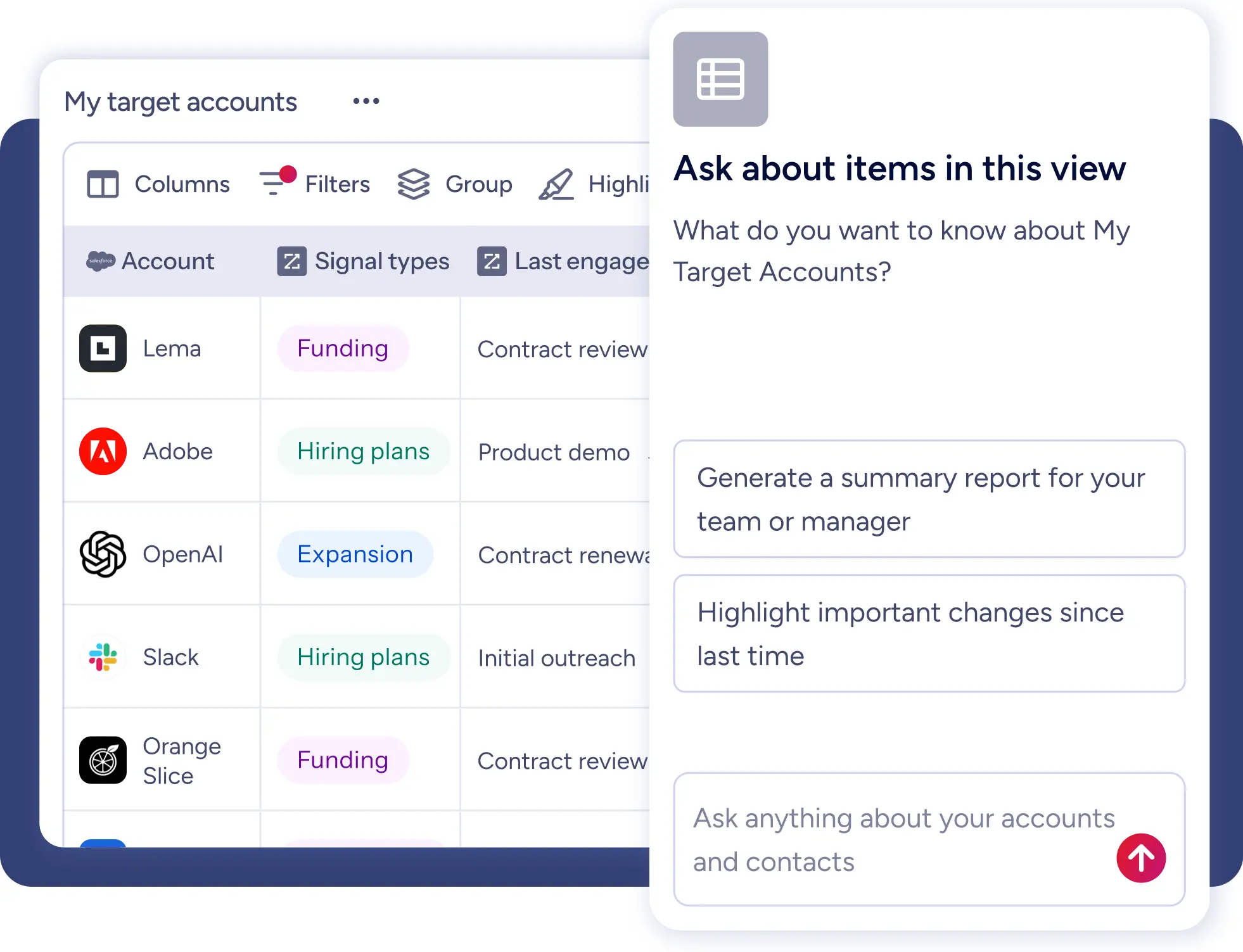
ZoomInfo is the intelligence platform for modern go-to-market teams, combining contact data, company data, intent signals, and AI-powered workflows. The platform includes:
120M direct-dial phone numbers
200M+ verified business emails with up to 95% accuracy on first-party data
30,000+ tracked technologies across 200+ categories
100M+ company profiles with parent-child hierarchy relationships
Buyer intent signals from 210M IP-to-organization pairings
That data powers Copilot, the AI sales agent for SDRs running top-of-funnel prospecting. It also powers GTM Workspace, the seller's home base for AEs managing complex accounts.
Both matter in manufacturing, where buyers sit behind layered org structures and physical operations. ZoomInfo handles the three hardest parts in one platform: finding the right person, reaching them directly, and timing the outreach. Most competitors solve one or two of these, not all three.
Best for: Outbound SDR teams running at scale, mid-market and enterprise sales orgs with defined ICPs, RevOps leaders who need a single source of truth, and marketing teams running ABM into manufacturing accounts.
Key features:
Verified direct dials and emails for manufacturing decision-makers
Org charts and job title mapping for complex manufacturing hierarchies
Industry alerts and intent data on target accounts
Technographic data covering ERP, MES, PLM, and operational systems
AI-generated account briefs, email drafts, and CRM auto-updates
CRM enrichment and native integrations with Salesforce, HubSpot, Outreach, Salesloft
Pricing: Consumption-based. Pricing scales with usage and the modules you turn on across sales, marketing, operations, and data-as-a-service. Contact sales for a custom quote.
Watch out for: Full platform has a learning curve for teams new to GTM data, and premium pricing means it's overkill for small teams running fewer than 1,000 contacts per quarter.
2. Thomasnet
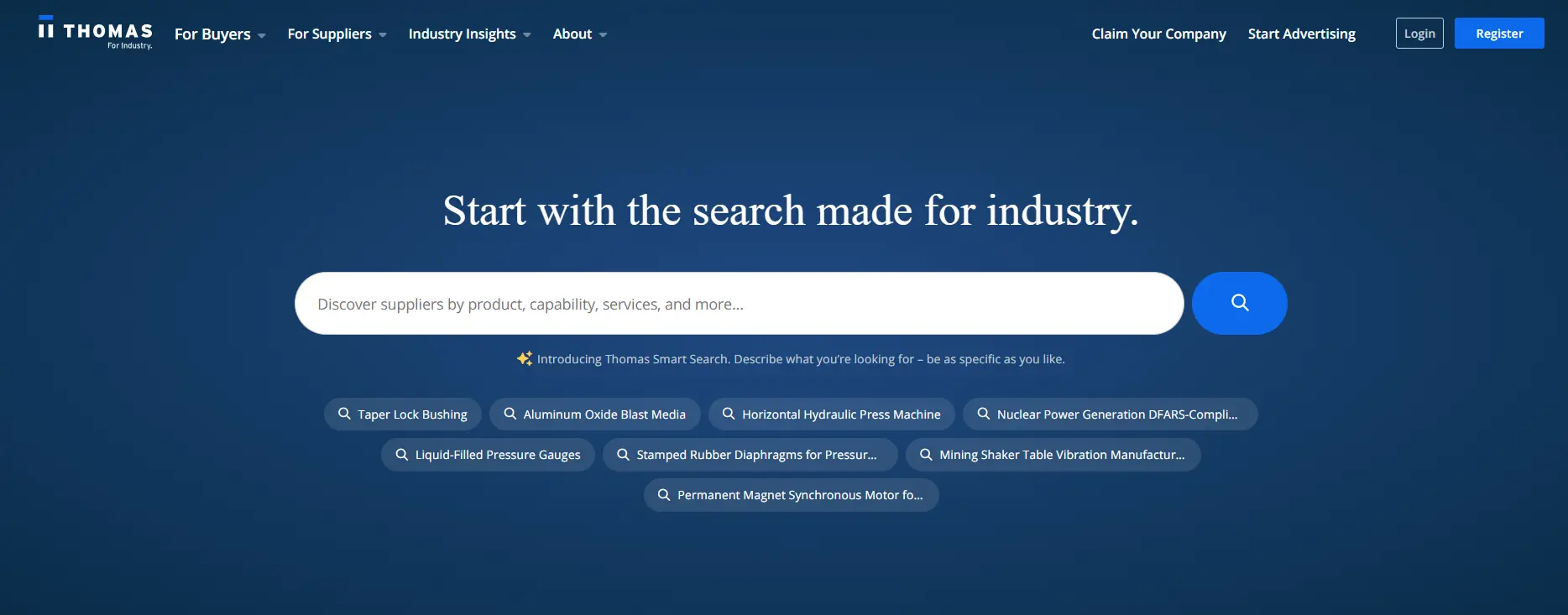
Thomasnet is a North American industrial sourcing platform.
It hosts a directory of 500K+ verified North American suppliers and offers lead generation services targeting manufacturing and industrial buyers actively sourcing products. The platform is built specifically for industrial procurement, so buyers come to it looking for suppliers, which means the leads it generates are pre-qualified by intent.
Compared to ZoomInfo, Thomasnet is the better fit for inbound RFQ capture from procurement buyers, while ZoomInfo drives outbound into named target accounts with verified contact data and intent signals.
Best for: Industrial suppliers and distributors, OEM component manufacturers, contract manufacturers selling to procurement, and North American-focused sales motions.
Key features:
Supplier directory listings with company profiles
RFQ (request for quote) lead generation
Industrial-specific content marketing and SEO services
CAD model hosting and downloads as a lead capture mechanism
Buyer intent data within industrial sourcing categories
Pricing: Performance-based listings model. You define a budget and only pay when buyers interact with your profile, across 80,000+ industry categories. No public tiers. Pricing is set after a consultation based on your target keywords and budget.
Watch out for: Coverage is limited to North America, and the directory model means competitors are listed next to you on category pages. Less useful if your buyers sit outside procurement (operations, IT, executive).
3. Salesgenie (by Data Axle)
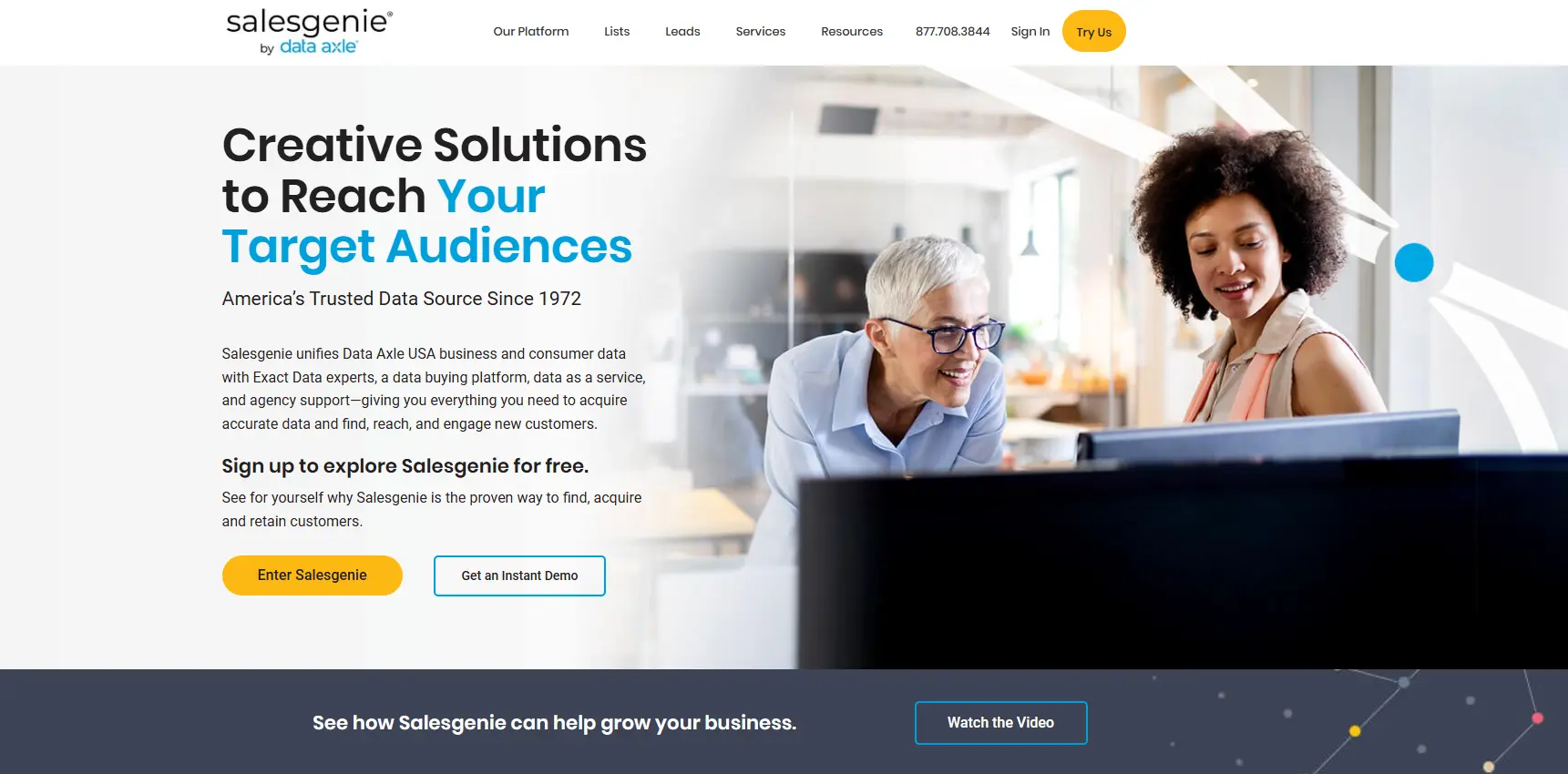
Salesgenie is a Data Axle product offering business and consumer lead lists, including a dedicated manufacturer leads database.
It covers approximately 25M U.S. business records and 245M consumer records, sourced from public filings, directories, and third-party data partnerships. It sits at the SMB end of the market. It's a self-serve list builder with affordable entry pricing rather than an enterprise data platform.
Best for: Small businesses and SMB sales teams running list-based outbound, direct mail and email marketing programs, and local or regional sales motions targeting smaller U.S. manufacturers often missed by enterprise databases.
Key features:
Filterable manufacturer lead lists by NAICS, employee size, revenue, and geography
Email, phone, and mailing address data with CSV export
Built-in email and direct mail marketing tools
Mobile app for field sales reps working territories
Pre-built lead list templates by industry
Pricing:
Plan | Price | Notes |
Basic | $99/month | 1 user license, no exports |
Pro | $149/month | 1 user license, credit-based exports |
Team | $299/month | 5 user licenses, credit-based exports |
Buyer Intent add-on available for $50/month on any plan. Annual billing options available.
Watch out for: No intent data is included in base plans (available only as a $50/month add-on), and filtering depth is limited for manufacturing-specific attributes (no ERP, no certification, no plant-level data). Data freshness lags top-tier providers on direct dials.
4. SalesLeadsInc
SalesLeadsInc is a managed lead generation service focused specifically on industrial and manufacturing B2B sales leads in North America. Unlike platforms where you buy data and run outreach yourself, their team builds the target list, runs the outreach, and delivers qualified meetings back to your sales team. The model fits manufacturers without an in-house SDR function or with technical products that benefit from human-led qualification.
Best for: Manufacturers without an in-house SDR team or BDR function, companies that want a done-for-you lead gen program, and teams testing outbound viability before investing in headcount.
Key features:
Targeted lead lists built per campaign by industry, geography, and role
Appointment setting and meeting generation as the core deliverable
Multi-channel outreach across email, phone, and LinkedIn
Campaign reporting, attribution, and lead-level transparency
Industry-specific messaging and playbook development
Dedicated account manager for campaign strategy
Pricing: Not publicly listed. Pricing is quoted per campaign based on target audience, geography, and outreach volume. Contact sales for a custom proposal.
Watch out for: Agency model means you don't own the data, process, or institutional knowledge, and campaign quality depends entirely on the team assigned to your account. Less scalable long-term than building in-house on a data platform.
5. MarketJoy
MarketJoy is a B2B lead generation agency that runs managed outbound campaigns across multiple verticals, with a dedicated manufacturing practice.
They handle list building, multi-channel outreach, and appointment setting, positioning themselves as an SDR-as-a-service alternative to hiring internally. Manufacturing campaigns span sub-verticals from industrial machinery to packaging and contract manufacturing.
Best for: Mid-market manufacturers outsourcing top-of-funnel pipeline generation, teams without SDR headcount or onboarding bandwidth, and companies entering new market segments or geographies.
Key features:
Managed outbound campaigns across email, LinkedIn, and phone
Custom list building and data sourcing per campaign
Appointment setting and SDR-as-a-service offerings
Account-based marketing campaign execution
Reporting dashboards with lead-level visibility
Flexible engagement models (project-based or ongoing retainer)
Pricing: Not publicly listed. Engagements are scoped per campaign as project-based or monthly retainer. Contact sales to book a discovery call and get a custom quote.
Watch out for: Agency markup compared to running outbound on a platform in-house, and quality varies by the campaign manager assigned to your account. You also give up real-time control over messaging and brand voice.
6. Callbox
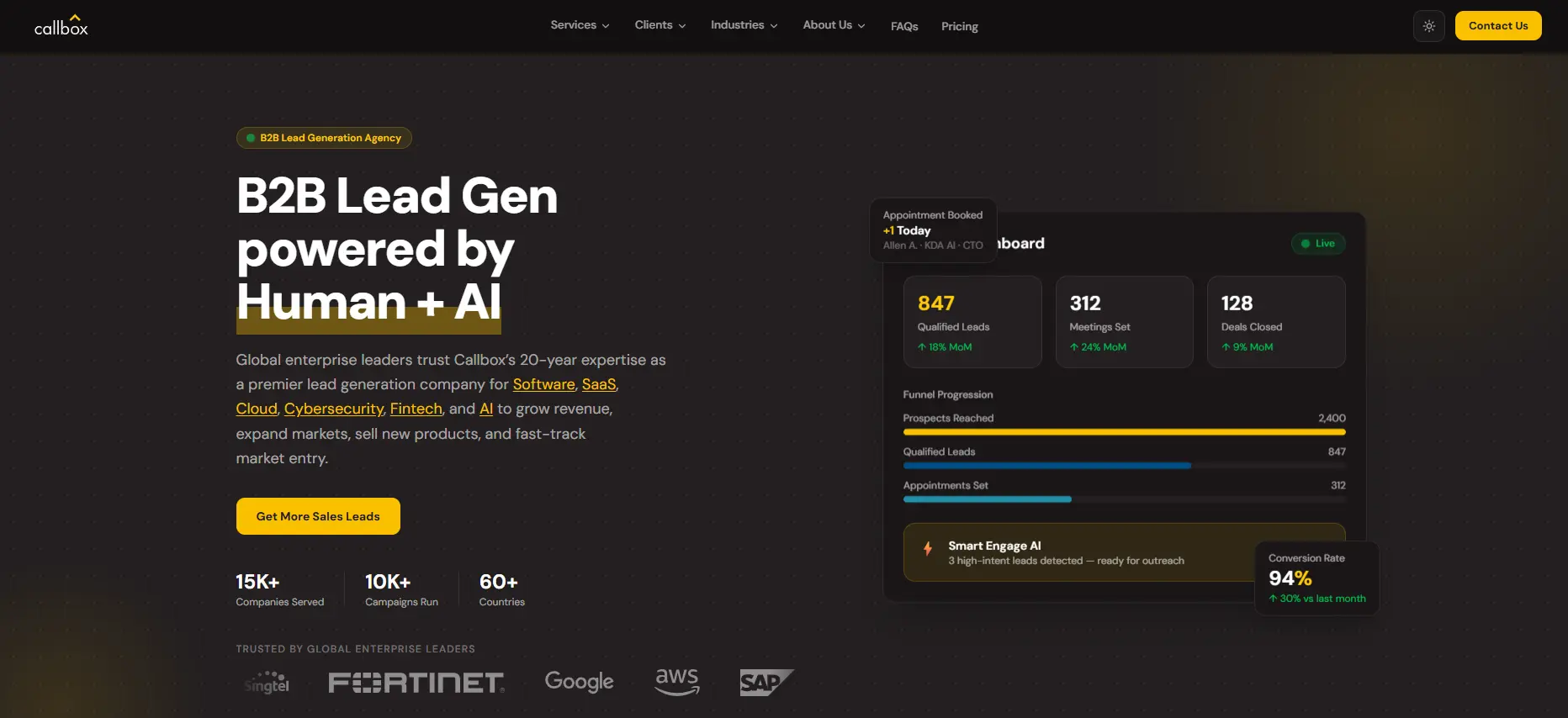
Callbox is a B2B lead generation and appointment-setting company with a dedicated manufacturing vertical practice. The differentiator is geographic reach.
Callbox operates across North America, APAC, and EMEA with local SDR teams, which makes it a fit for manufacturers expanding internationally or selling into regional accounts that need native-language outreach.
Best for: Manufacturers expanding into new geographic markets, companies that need local outbound expertise across multiple regions, and mid-market or enterprise sales orgs running ABM into international accounts.
Key features:
Multi-channel outbound across voice, email, social, web, and chat
Account-based marketing campaign design and execution
Global SDR coverage with native-language reps in target markets
Lead nurture programs for longer manufacturing sales cycles
Database access for list building within campaigns
Pipeline management and lead handoff workflows
Pricing: Campaign Pod model, starting at $15,000–$30,000 per month per pod. Each pod includes a dedicated SDR, multi-channel outreach cadence, AI-enriched contact data, campaign manager oversight, and weekly reporting. Add more pods to scale.
Watch out for: Agency model means less control than running on a platform, and ramp is typically 4–6 weeks to first meetings. Per-meeting pricing can be high relative to building internal capability long-term.
7. LinkedIn Sales Navigator
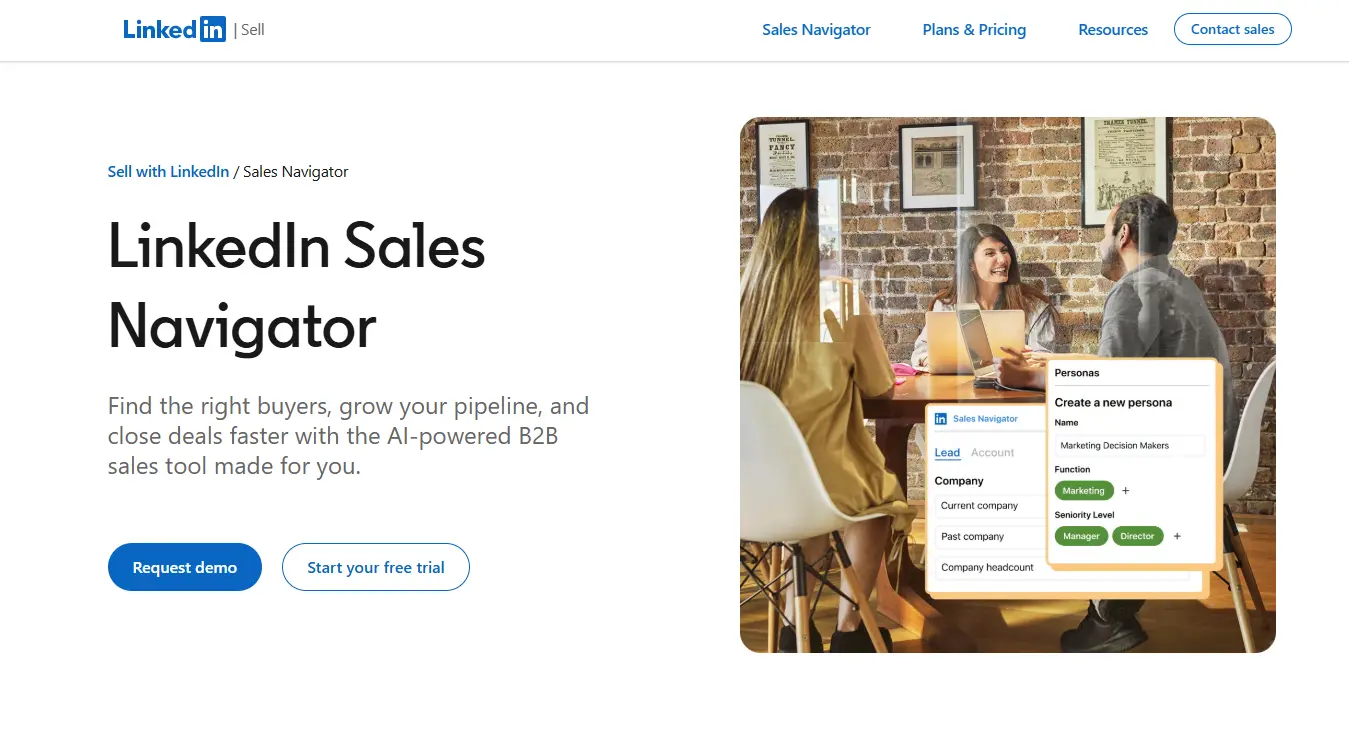
Sales Navigator is LinkedIn's B2B prospecting tool, built on top of LinkedIn's 1.3B+ members globally.
It filters by company, role, industry, seniority, geography, and engagement signals like recent job changes or posts. For manufacturing sales, it works best as a complement to a data platform rather than a standalone source. LinkedIn data is strong on professional profiles but doesn't give you direct dials or personal emails, only InMail.
Best for: Social selling teams and AEs running account-based outreach, reps prospecting plant managers and executives who are active on LinkedIn, and account expansion within named target accounts.
Key features:
Advanced search filters across LinkedIn member and company data
InMail messaging credits to reach contacts outside your network
Saved leads and account lists with real-time alerts
Notifications on job changes, promotions, posts, and shared content
CRM sync with Salesforce, HubSpot, and Microsoft Dynamics
TeamLink to surface internal connections to target accounts
Pricing:
Plan | Price | Best for |
Core | $99.99/month (or $79.99/month annual) | Individual sellers |
Advanced | $159.99/month | Sales teams (2+ seats) |
Advanced Plus | Custom, starts ~$1,600/seat/year | Sales teams with CRM sync needs (10+ seats) |
All plans include 50 InMail credits per month and a 30-day free trial.
Watch out for: No native direct dials or exportable business emails. Sales Navigator does support granular manufacturing sub-verticals and basic technology filters, but lacks plant-level data and operational certifications (ISO 9001, AS9100, IATF 16949). Plant-floor decision-makers like line supervisors and plant managers often have limited LinkedIn presence.
See how LinkedIn Sales Navigator compares to ZoomInfo.
8. D&B Hoovers
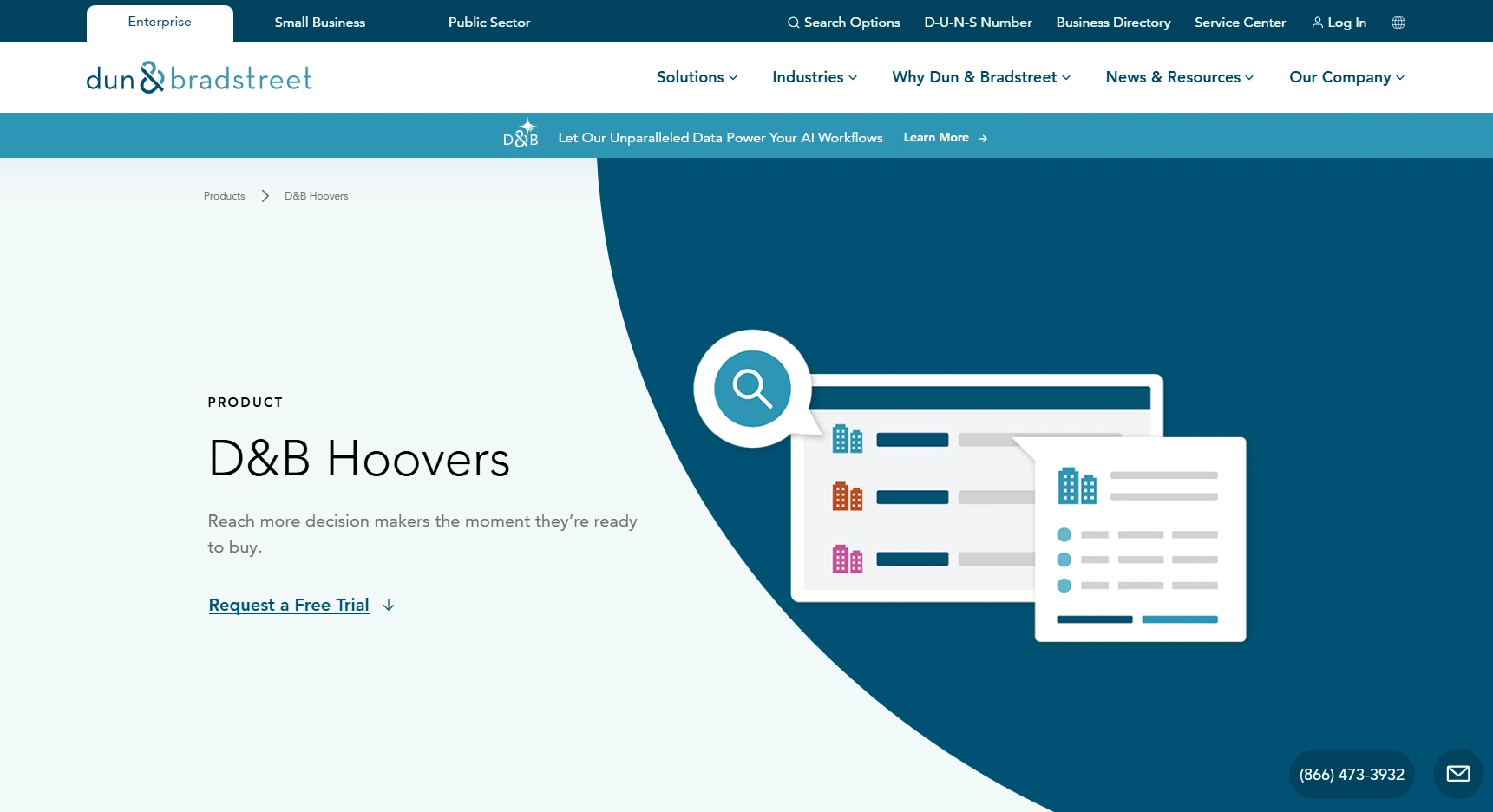
D&B Hoovers is Dun & Bradstreet's sales acceleration platform, built on the D&B commercial database of 500M+ businesses globally.
The platform's edge is depth on financial firmographics, credit data, and corporate family trees. It's useful for enterprise sales teams selling capital equipment, large contracts, or anything where the buyer's financial health matters as much as their fit on paper.
Best for: Enterprise sales teams needing global manufacturer coverage outside North America, credit-sensitive sales (large equipment, capital investments, leasing), and teams that need DUNS-level company hierarchy for complex multi-site manufacturers.
Key features:
Global company and contact database with 500M+ business records
Financial, credit, and risk data including D&B scores
Industry filtering by SIC, NAICS, and proprietary classifications
Buying intent signals via third-party integrations (e.g., Bombora) and trigger event tracking
Family tree and corporate linkage data (parent, subsidiary, branch relationships)
Integrations with major CRMs and enrichment workflows
Pricing: D&B Hoovers Essentials (SMB plan) starts at $49/month for 150 company credits + 150 contact credits, or $529/year for 1,800 of each. First month free, cancel anytime. Full D&B Hoovers enterprise pricing is custom and quoted on request.
Watch out for: UI and workflow feel dated compared to newer GTM platforms, contact data accuracy varies by region, and integration with modern sales engagement stacks like Outreach and Salesloft is weaker than alternatives.
9. Apollo
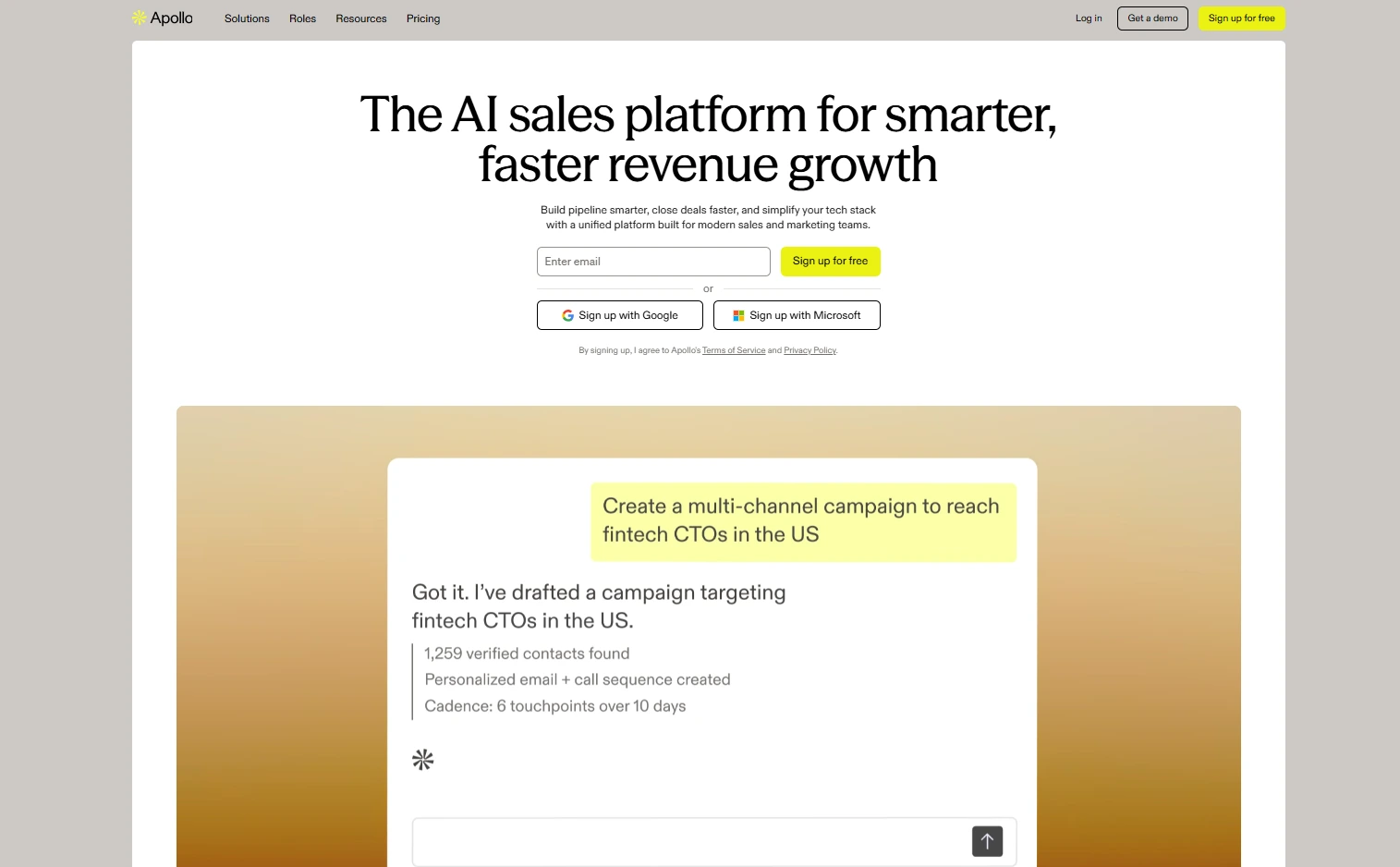
Apollo is a B2B sales engagement platform with a 275M+ contact database and built-in outbound sequencing, dialing, and email tools.
The pitch is consolidation. Instead of paying separately for a data provider and an engagement tool, Apollo bundles both, which makes it a strong fit for SMB and early-stage teams that don't have separate budgets for prospecting and outreach.
Compared to ZoomInfo, Apollo wins on entry price and consolidation, while ZoomInfo wins on data accuracy, intent quality, and depth of manufacturing-specific filtering for teams running outbound at scale.
Best for: SMB and early-stage sales teams running outbound on tight budgets, founders prospecting before hiring SDRs, and sales orgs with simple ICPs that don't require deep vertical filtering.
Key features:
Contact and company search across 275M+ records
Built-in email sequencing, multi-touch cadences, and meeting scheduler
Native dialer with call recording and analytics
Chrome extension for LinkedIn and web prospecting
Basic intent data and job change alerts
AI writing assistance for emails and sequences
Pricing (annual billing):
Plan | Price | Credits per seat/year |
Free | $0 | 900 (granted monthly) |
Basic | $49/seat/month | 30,000 |
Professional | $79/seat/month | 48,000 |
Organization | $119/seat/month (3-seat min) | 72,000 |
Credits cover emails (1 credit), phone numbers (8 credits), and enrichment. Add-ons available for inbound visitor tracking and advanced dialer ($119/team/month each).
Watch out for: Data accuracy lags top-tier providers, particularly on direct dials and mobile numbers. Manufacturing-specific filtering is shallow (no plant data, no certifications, limited ERP coverage), and intent data is less reliable than dedicated providers.
See how Apollo and ZoomInfo compare.
Manufacturing sales leads: side-by-side comparison
Here's how the top options for manufacturing sales leads stack up.
Provider | Best sales motion | Data strength | Mfg-specific filtering | Starting price |
ZoomInfo | Outbound + ABM | 120M direct dials, org charts | NAICS, ERP, certs, plant data | Consumption-based (custom) |
Thomasnet | Inbound RFQs | 500K+ industrial supplier audience | Industrial sourcing categories | Performance-based (custom) |
Salesgenie | SMB outbound | 25M U.S. business records | NAICS, size, geo only | $99/month |
SalesLeadsInc | Outsourced outbound | Meeting delivery | Custom per campaign | Custom quote |
MarketJoy | Outsourced outbound | Multi-channel campaigns | Custom per campaign | Custom quote |
Callbox | International outbound | Native-language SDRs | Custom per campaign | From $15K/month |
LinkedIn Sales Nav | Social selling, ABM | 1.3B+ profiles, social signals | Sub-verticals, roles, basic ERP | $99.99/seat/month |
D&B Hoovers | Enterprise, global | Financial data, family trees | NAICS, SIC, financials | $49/month (Essentials) |
Apollo | SMB all-in-one | 275M+ contacts, engagement stack | NAICS and role only | Free or $49/seat/month |
Common mistakes when buying manufacturing leads
The fastest way to waste a lead-gen budget is to treat all leads the same and skip the work that turns data into pipeline. These are the mistakes that show up most often in manufacturing sales motions, and the ones worth checking your team against before the next campaign goes out.
Filtering by "manufacturing" only. The industry is too broad. Always filter by NAICS sub-codes, sub-vertical, or operational characteristics.
Ignoring data freshness. A 12-month-old list of plant managers will be substantially out of date. Ask providers when records were last verified.
Buying volume over quality. A list of 50K unqualified contacts will hurt deliverability more than 500 verified ones will help.
Single-threading the buying committee. Manufacturing purchases involve operations, IT, procurement, finance, and an executive sponsor. Reaching one person is rarely enough.
Skipping the trigger event. Cold outreach without a reason to reach out today converts poorly. Use intent and trigger data to time your outreach.
Not integrating data into the CRM. A list sitting in a spreadsheet outside your CRM doesn't get worked. Enrich your manufacturing CRM records directly when possible.
Relying entirely on agencies long-term. Outsourced lead gen is a fine bridge but a poor permanent strategy. The institutional knowledge of who buys, why, and when belongs in-house.
Get manufacturing sales leads with ZoomInfo
ZoomInfo has the deepest direct-dial coverage in B2B — mobile numbers for the people manufacturing reps actually need to reach, not the gatekeepers in front of them.
That's paired with org charts built for multi-site operations, intent signals tied to real buying behavior, and native sync into Salesforce, HubSpot, Outreach, and Salesloft.
If outbound into manufacturing is a real channel for your team, this is the stack to run it on.
Talk to our team to see how it fits your team size and motion.
FAQs
How much do manufacturing sales leads cost?
Pricing depends on the model. SMB list tools start around $50–$100/month. Mid-market platforms run $50–$160 per seat per month. Enterprise platforms typically use consumption-based pricing scoped to your usage. Managed services and agencies start around $15,000/month per campaign. The right comparison isn't price per lead, it's cost per qualified opportunity sourced.
Are free manufacturing sales leads worth it?
Rarely. Free lead lists are usually scraped, outdated, or pulled from public directories that everyone else is also using. The hidden cost is data hygiene: validating emails, finding direct dials, and re-confirming job titles takes more SDR time than the list is worth. Free trials of paid platforms are a better way to test data quality before committing.
What's the difference between a lead list and a lead generation service?
A lead list is data: names, contact info, firmographics. You do the outreach. A lead generation service runs the outreach for you and delivers meetings, opportunities, or appointments. Lists scale with platform investment; services scale with agency headcount. Most teams use both at different stages.
How often should manufacturing lead data be refreshed?
Quarterly at minimum. B2B contact data decays steadily as people change jobs, facilities reorganize, and procurement teams turn over. Platforms with continuous enrichment (rather than one-time list pulls) solve this automatically.
Can I build a manufacturing lead list myself?
Yes, and many teams do for niche ICPs. Combine public sources (NAICS lookups, industry associations, state manufacturing directories), LinkedIn Sales Navigator for contact discovery, and an enrichment tool for direct dials and emails. This works at small scale but doesn't compete with platform-level data for teams running 1,000+ contacts per quarter.
