
Your sales team has 200 open deals, and maybe 30 will close this quarter. The hard part is figuring out which 30.
That's the problem opportunity scoring solves. Without a system to rank active deals, reps spread their time evenly across the pipeline or fall back on gut instinct, burning hours on deals that were never going to close. Over time, that clutters your sales pipeline with prospects that stretch cycles without adding revenue. This guide covers:
What opportunity scoring is and where the concept came from
How it fits alongside lead qualification and account-based scoring
The four signal types that feed a useful score
What to look for in an opportunity scoring solution
What Is Opportunity Scoring?
Opportunity scoring is a method for ranking deals in your pipeline by how likely they are to close. Each active opportunity gets a numerical score based on the signals that correlate with closed-won outcomes:
Historical win/loss patterns
Buyer engagement
Deal velocity
Stakeholder involvement
Buyer intent and trigger events
The concept has two roots worth knowing about, because product managers and revenue teams use the same term for different purposes.
In product management, opportunity scoring comes from Anthony Ulwick's Outcome-Driven Innovation (ODI) framework and the broader "Jobs to Be Done" tradition. It measures the gap between how important a customer need is and how well existing solutions satisfy it. High-importance, low-satisfaction needs signal a real opportunity for product investment.
In sales, opportunity scoring takes the same underlying idea (rank by opportunity, not by gut) and applies it to active deals. The score answers a single question: which of the deals in my pipeline right now will close, and which are consuming rep time without converting?
The rest of this guide focuses on the sales version.
Opportunity Scoring vs Lead Scoring vs Account-Based Scoring
The three scoring approaches sound similar and get confused constantly, but they solve different problems at different points in the funnel. Lead scoring, opportunity scoring, and account-based scoring all quantify priority, but the target and the timing are different. Here's how they compare:
Dimension | Lead scoring | Opportunity scoring | Account-based scoring |
Funnel stage | Top of funnel | Mid to bottom of funnel | Pre and post-opportunity |
Target | Individual prospects | Active deals in pipeline | Whole accounts |
Question | Should we pursue this prospect? | Will this deal close? | Is this account worth investing in? |
Primary signals | Demographics, content engagement, web activity | Deal velocity, stakeholder access, buying signals, historical patterns | Firmographic fit, buying committee coverage, intent |
Typical owner | Marketing and SDR team | Sales and RevOps team | ABM and sales leadership |
Action triggered | Outreach sequence, MQL handoff | Deal prioritization, resource allocation | Territory planning, ABM plays |
Pro tip: Don't pick one and skip the other two. The three work together as a stack: lead scoring feeds qualified prospects into pipeline, opportunity scoring prioritizes the deals that arrive, and account-based scoring shapes where the team invests over the longer term.
Why Opportunity Scoring Matters for Revenue Teams
Plenty of sales teams still treat their pipeline like a to-do list where every deal gets roughly equal attention. That doesn't scale. High-performing teams are consistently more likely to base forecasts on data-driven insights than gut feel, and opportunity scoring is one of the mechanisms that makes that possible.
Systematic scoring changes four things:
Rep time gets protected. No more spending Thursday afternoons on a deal that was never going to close. Reps focus on higher-probability deals, which lifts individual sales productivity without asking anyone to work more hours.
Win rates improve. When effort concentrates where the odds are best, lead conversion rate goes up. The math is straightforward: a rep working 10 well-qualified deals closes more than a rep working 25 mixed-quality deals.
Expensive resources get deployed wisely. Sales engineers, executives, and solution architects are your most expensive sales tech stack components. Opportunity scoring tells you where to spend those hours for the biggest impact.
Forecasts get more reliable. Scored pipelines produce sales forecasts grounded in data patterns, not rep optimism. CROs stop getting surprised at quarter-end, and pipeline management becomes proactive rather than reactive.
For B2B teams, the constraint on pipeline conversion is rarely lead volume. The real constraint is lead priority, and opportunity scoring is what fixes that at the deal stage.
The Four Signal Types That Feed a Useful Score
Modern predictive opportunity scoring uses machine learning models trained on your CRM's closed deals to identify what "won" really looked like, then applies those patterns to score every active opportunity. The engine matters less than what feeds it, though: the signals reaching the model determine whether the score reflects reality.
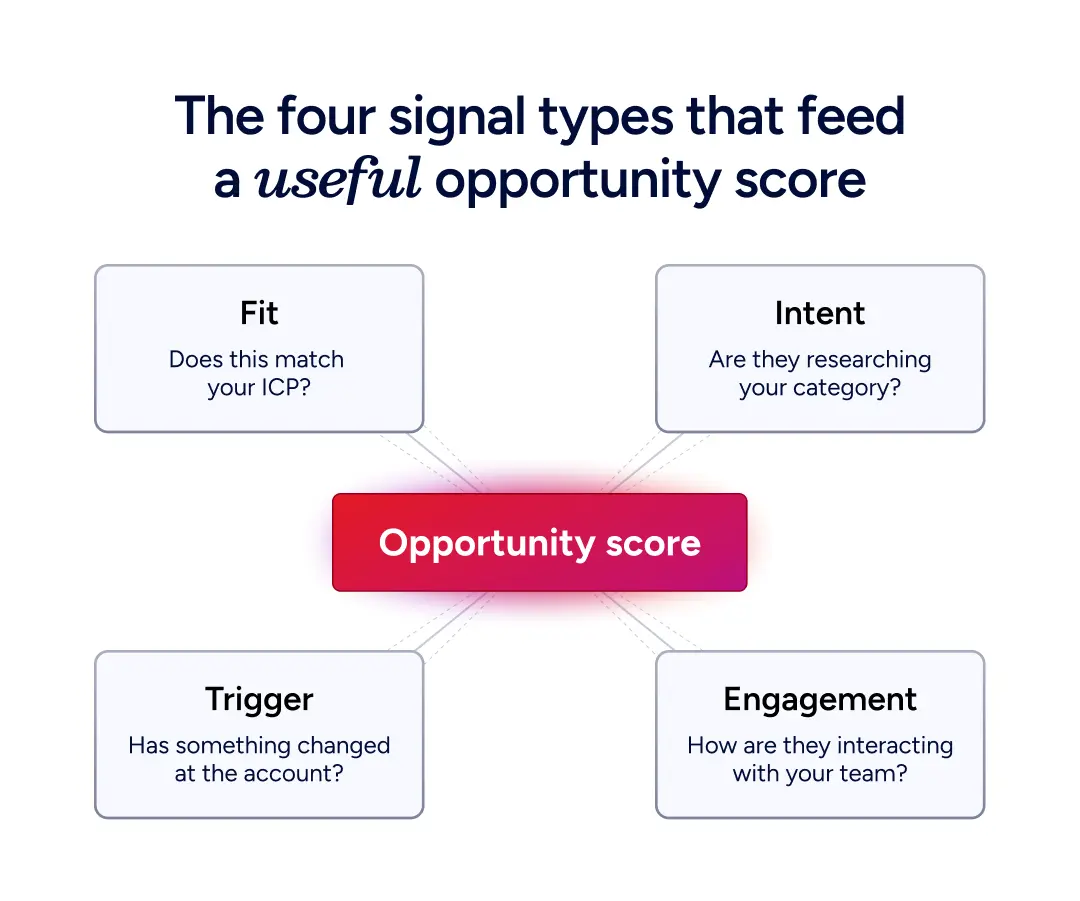
Single-signal scoring misses the full picture. A deal with strong firmographic fit but no engagement behaves very differently from a deal with weaker fit but active intent. Modern scoring frameworks combine four signal types, and each answers a different question about the opportunity.
Fit
The question: Does this account match your ideal customer profile?
Fit combines firmographic data, technographic signals, and company attributes to measure alignment with your best customers. Two accounts can look identical in the CRM, but the one that matches your ICP is fundamentally worth more time and resource.
Intent
The question: Is this account actively researching your category?
Buyer intent data reveals which accounts are showing in-market behavior right now, which is often the difference between a deal that closes this quarter and one that stalls. Intent platforms track keyword research, content consumption, and comparison behavior across the open web, and the top buying signals sales teams watch for are almost all captured in this layer.
Trigger
The question: Has something changed at the account that creates a buying window?
Trigger events include funding rounds, executive hires, technology changes, restructuring, and expansion signals. An account that just closed a Series C is a completely different opportunity from the same account with no recent activity, which is why revenue intelligence platforms treat trigger events as high-value signals.
Engagement
The question: How is the account interacting with your team right now?
CRM activity, email engagement, meeting attendance, and content consumption fill in the behavioral picture. Multi-threaded engagement across multiple stakeholders usually signals a stronger opportunity than a single champion, because deals with only one point of contact are one job change away from stalling.
Together, these four axes produce a score that reflects both structural fit and current momentum. Missing any one axis means missing part of the picture.
What To Look for in an Opportunity Scoring Solution
Not every scoring tool delivers the same results. Five criteria separate strong solutions from noise generators.
Data Quality and Coverage
Scoring models built on incomplete or outdated data produce misleading results, and stalled opportunities often stem from bad data underneath rather than bad sales work on top. Look for platforms with broad, verified data refreshed continuously rather than quarterly, and check the underlying data quality controls before committing.
Transparency Over Black Boxes
If reps can't see why a deal scored the way it did, they'll ignore it. Two failure modes show up constantly:
A deal scores 87 but the rep can't see why. They read it as "the tool is guessing" and fall back on their own judgment.
A deal scores 32 but the rep knows their champion is a former colleague of the CEO. They override the score and stop trusting the system.
Choose a solution that shows the component breakdown behind every score and the specific data points driving each axis, so reps see the score as a second opinion rather than a black box.
CRM Integration
Scores that live outside your CRM add friction. The solution should push scores, insights, and recommended actions directly into where reps already work, whether that's Salesforce (including Sales Cloud Einstein), HubSpot Sales Hub, or Microsoft Dynamics 365 Sales, so scores show up as part of the CRM strategy rather than as a separate dashboard.
Automation and Real-Time Updates
Manual scoring doesn't scale, and scores that sit stale between weekly refreshes miss the moments they were built to catch. A funding round announced Tuesday morning should shift the score by Tuesday afternoon, not the next reporting cycle. Good tools do three things:
Update scores continuously as new signals arrive
Push alerts to reps when a score crosses a threshold
Recalculate automatically when CRM records change
Anything that requires someone to re-run a report weekly is a spreadsheet in disguise.
Multi-Signal Coverage
A score built on one dimension of the account has too many blind spots to be reliable. Strong solutions combine firmographic fit, intent data, trigger events, and engagement patterns into a unified score, which is what separates a scoring model reps use daily from one they close within a week of rollout.
How ZoomInfo Powers Opportunity Scoring
Scoring tools tend to look at one or two signal types. ZoomInfo takes a different approach.
Multi-axis scoring on verified data. ZoomInfo scores accounts across fit, intent, trigger, and engagement simultaneously, powered by 500M+ professional profiles, 100M+ companies, and 135M+ direct dials refreshed through 1.5B+ data points processed daily. The underlying data doesn't decay between scoring runs.
The GTM Context Graph. ZoomInfo's context graph fuses third-party B2B data with your CRM records, conversation intelligence, and engagement history into a single view. That means scores reflect not just what happened in the deal, but the causal chain of which actions led to which outcomes.
Scores that reach every rep tool. ZoomInfo's headless context engine delivers scores and recommended actions into GTM Workspace, GTM Studio, Salesforce, HubSpot, and any AI agent your team builds. Reps see the score and the reasoning next to the deal, not in a separate tab.
For sales teams, that turns the score into part of the daily rep workflow rather than something RevOps owns behind the scenes.
The Takeaway for Revenue Teams
Opportunity scoring turns your pipeline from a list of deals into a ranked set of priorities.
Teams that adopt it stop guessing which deals to focus on and start making decisions backed by data, but the score is only as strong as the data behind it. Incomplete contact records, missing intent signals, and disconnected systems degrade every prediction the model makes, which is why serious teams treat go-to-market data quality as the foundation for scoring rather than an afterthought.
Talk to our team to see how ZoomInfo's verified data changes what your pipeline is telling you.
Frequently Asked Questions
How Does Opportunity Scoring Differ From Lead Scoring?
Lead scoring evaluates prospects before they become pipeline deals, focusing on demographic fit and early engagement. Opportunity scoring evaluates active deals already in your pipeline, using signals like deal velocity and stakeholder involvement to predict which will close. Both feed the same revenue engine at different stages.
What Data Do You Need for Effective Opportunity Scoring?
At minimum you need clean CRM data with historical win/loss outcomes, firmographic information on your accounts, and engagement metrics from your rep activity. For stronger predictions, add buyer intent signals, trigger events, and conversation intelligence on deals on top.
Can You Automate Opportunity Scoring?
Yes. Machine learning models can continuously score deals based on real-time signals from your CRM, engagement tools, and third-party data sources. Automated scoring removes manual effort and keeps scores current as deal conditions change, so the priority list reps see in the morning reflects what happened at the account overnight.
What Is a Good Opportunity Score?
There's no universal benchmark, because scores depend on your model, your data, and your thresholds. The real test is whether your high-scoring deals close at a meaningfully higher rate than low-scoring ones. If they do, your model is working. If not, recalibrate your inputs and weights.
How Is Opportunity Scoring Different From Salesforce Einstein Opportunity Scoring?
Salesforce Einstein Opportunity Scoring is one implementation of the concept, native to Sales Cloud and trained on your Salesforce data. Opportunity scoring as a discipline is broader and can run through Einstein, HubSpot, Dynamics 365, or third-party platforms. The principles are the same across tools, but data sources and model quality vary a lot.
