

Your AE walks into a discovery call with a 4,000-person fintech in Boston. They've read the ICP doc your marketing team built six months ago. It says "B2B financial services, 500 to 5,000 employees, North America." The fintech checks every box. The deal stalls in week three because the prospect uses none of your integration partners and the buying committee can't find budget.
That ICP wasn't wrong. It was just too thin to be useful.
An ICP builder analyzes your closed-won and closed-lost data, scores every account in your TAM against the patterns it finds, and refreshes the profile as your pipeline shifts. The output is a scored target list your reps can call from today. This guide covers how ICP builders work, what separates a useful one from a fancy template, and how ZoomInfo's AI-Generated ICP builds yours in minutes.
How an ICP Builder Works
An ICP builder analyzes patterns in your existing customer base to surface what a good-fit account actually looks like. The workflow runs in three steps.
You upload your account data. A list of closed-won accounts (your best fits) and closed-lost accounts (the ones that ghosted, churned in six months, or never reached a verbal). Quality of input matters here. A list of your top 20 ACV deals is different from a list of your most profitable, most retentive, most likely-to-expand accounts. The second list is the right one.
The AI scans for shared attributes. Firmographic patterns (size, industry, revenue). Technographic patterns (the tools your best customers run that your bad customers don't). Behavioral patterns (the signals that fired before they entered your pipeline).
The output is a scored ICP plus a target universe. A structured ideal customer profile, a best-fit/good-fit/bad-fit scoring framework, and a list of lookalike accounts your AEs can prospect into this week.
Accuracy of the output depends on two things: the quality of your input list, and the depth of company attributes the builder can analyze. A tool with access to 300+ firmographic and technographic data points will surface patterns a basic builder misses entirely.
Modern ICP builders also layer behavioral and intent data on top of the static profile. Firmographic fit tells you who could buy. Intent signals tell you who's evaluating right now. The combination is what makes the output actionable.
Where Most ICPs Break Down
Before we get to what a good builder produces, it's worth saying out loud why most ICPs fail.
Intuition over data. The workshop ICP reflects who leadership thinks buys the product. The CRM shows who does.
No scoring layer. Reps can't prioritize 800 accounts in a territory from a generic firmographic outline.
Intent data missing. Firmographics show who could buy. Intent shows who's evaluating now.
Stale by next quarter. Your 2023 ICP isn't your 2026 ICP. Win patterns shift faster than annual rebuilds.
Lives in a Google Doc. A doc doesn't change which accounts reps call. An ICP scored across your CRM, feeding lead routing, does.
Copied from a competitor. Their ICP reflects their pricing, positioning, and motion. You'll compete for the same accounts with weaker context.
A real ICP builder solves all six.
What a Good ICP Builder Includes
These are the non-negotiables. A tool missing any of the six is a template with extra steps.
Firmographic analysis
Industry, company size, revenue range, geography. Table stakes, but specificity matters more than presence. Something like B2B SaaS, sales technology subsector, 200 to 2,000 employees, North America gives reps enough to work with. Tech companies as a description is too broad to drive any account-level decisions.
The best builders go deeper than employee count and revenue. Funding stage, growth rate, parent-child corporate hierarchy, and ownership structure all change buying behavior at the same headcount.
Technographic analysis
The tools a company runs reveal three things. Integration potential: do they use the systems you connect with. Replacement opportunity: are they on outdated platforms you can displace. Operational maturity: does their stack signal the sophistication level your product was built for.
ZoomInfo tracks 30,000+ technologies across 200+ categories from 20+ source types, with nearly 90% of active pairings updated within three months. That granularity surfaces patterns thinner tools never catch. A company running Salesforce, Outreach, and Gong is operationally different from one running HubSpot and nothing else, even at the same headcount.
Behavioral and intent signals
Hiring patterns. Funding events. Executive changes in the revenue function. Topic-level intent research. New office openings. M&A activity. These signals tell you which accounts are in active buying mode, beyond what firmographic fit alone can show.
ZoomInfo's intent data pulls from 210M IP-to-organization pairings and over 6 trillion keyword-to-device pairings monthly. Guided Intent, exclusive to ZoomInfo, surfaces the topics historically correlated with deal success. You don't have to guess which keywords to track.
Fit-score framework
A best/good/bad rating system applied at the account level, with weights you can tune. Without scoring, your ICP becomes a marketing artifact. With scoring, it drives lead routing, territory planning, AE prioritization, and ABM list-building.
Here's what a usable scoring framework looks like in practice:
Attribute | Weight | Best fit | Good fit | Bad fit |
Firmographics | 35% | B2B SaaS, 200-2,000 employees, NA | Adjacent verticals, 100-200 employees | Under 50 employees, outside NA |
Technographics | 25% | Uses Salesforce + Outreach + Gong | Uses 1-2 of the above | No overlapping tech stack |
Intent signals | 25% | Active research on category | Recent funding or hiring spike | No signals firing |
Geography | 15% | NA core regions | EMEA expansion markets | LATAM, APAC |
Apply that scoring to your full TAM and you'll surface the 50-150 accounts your reps should call this week.
Lookalike expansion
Once the builder identifies the attributes of your best customers, it should expand from that seed into other accounts that match. This is how a 200-account customer list becomes a 5,000-account target universe.
The Find Similar Companies capability in ZoomInfo does this from any seed account, surfacing accounts that match the firmographic and technographic profile of your reference set.
Continuous refresh
Markets move. Your win patterns evolve. New competitors enter the category and shift the definition of a good-fit account. A builder that requires a manual rebuild every quarter is operationally fragile.
ZoomInfo's AI-Generated ICP can regenerate as often as you need, so the profile stays aligned with your live pipeline.
How ZoomInfo's ICP Builder Works
ZoomInfo's AI-Generated ICP builds your profile from your own pipeline in three steps.
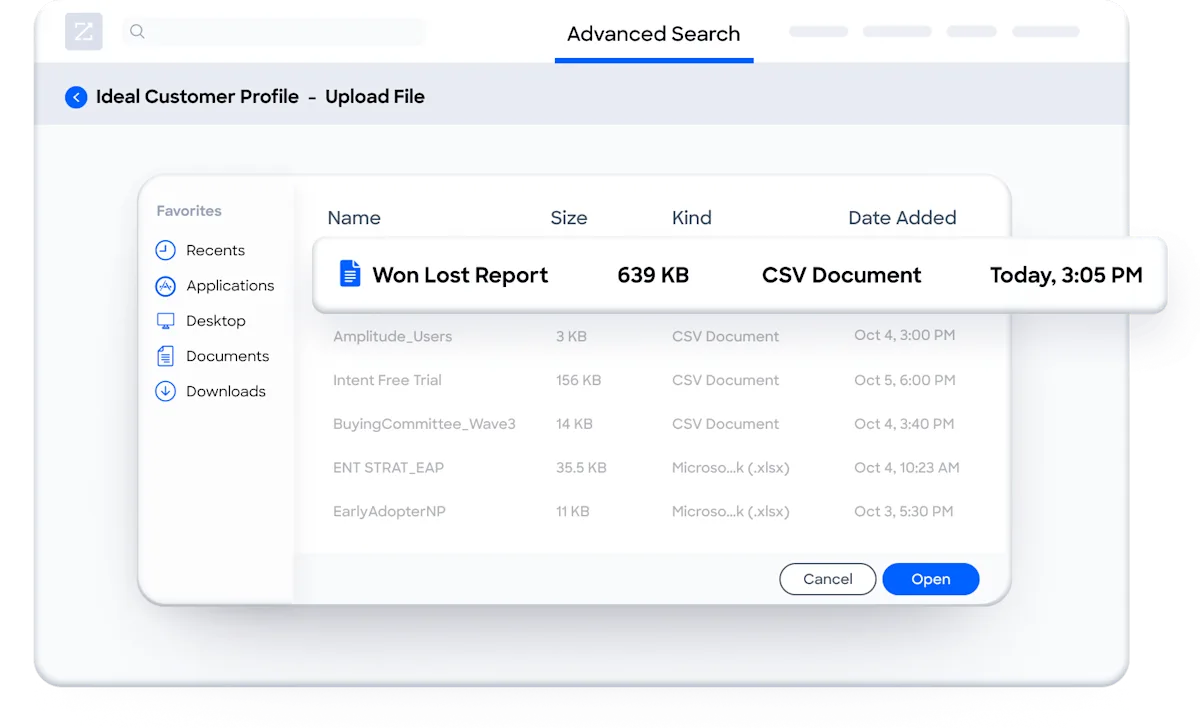
Upload your won/lost report. Pull a CSV of closed-won and closed-lost accounts from your CRM. This becomes the training set.
The AI scores your TAM. The algorithm learns which of ZoomInfo's 300+ company attributes correlate with your wins, then applies that pattern across the full database. Intent data layers on top automatically, so you see fit and timing in one view.
You get a scored ICP plus a lookalike universe. Output is a structured profile, a scoring framework, and a ranked list of accounts your reps can prospect this week. Regenerate as often as your pipeline shifts.
From there, GTM Studio operationalizes the ICP. Scores feed automated plays, enrichment, and lead routing across your stack. The ICP drives daily prospecting decisions instead of sitting in a dashboard.
A few customer outcomes ground what this delivers:
Seismic's outbound team saved 11.5 hours per rep per week, attributed 39% of pipeline to ZoomInfo signals, and reported being 54% more productive.
Spekit built an account-scoring model on ZoomInfo data; opportunities at higher-scoring accounts were 43% more likely to convert and moved 58% faster through qualification.
ResellerRatings sourced 19% of closed-won business from ZoomInfo and cut non-selling time by 90% after using it to define their ICP.
Dumpsters.com built their ICP in ZoomInfo's Advanced Search, added 250k contacts and 1,000+ opportunities, and grew 60% year-over-year.
These are the kind of numbers an ICP builder should be judged on. Pipeline that converted, deals that closed faster, reps spending their time on the right accounts.
ICP Builder vs Lead Scoring vs Buyer Persona Tools
These three categories overlap, and buyers often conflate them. They solve different problems.
Tool category | Operates at | What it does | Output |
ICP builder | Account level | Defines which companies to target and scores your TAM against that profile | Target account universe with fit scores |
Lead scoring tool | Person level | Ranks inbound leads by likelihood to convert, using behavioral signals (email opens, page views, content downloads) and demographic fit | Prioritized inbound queue |
Buyer persona tool | Role level | Defines who you talk to inside a target account: VP of Sales, RevOps Director, CFO | Messaging frameworks, pain points, and discovery questions per role |
You need all three. Sequence matters. The ICP comes first. Without a clear account-level definition of fit, lead scoring just ranks the wrong inbound faster, and personas describe how to talk to people at accounts that were never going to buy.
Build Your ICP from Your Own Pipeline
Stop building ICPs from assumptions, templates, and the customer your CEO wishes you had.
ZoomInfo's AI-Generated ICP analyzes your closed-won data across ZoomInfo's 300+ company attributes, layers in live intent signals, and outputs a scored account universe your team can prospect into today.
See your ICP built on your own pipeline data. Request a demo.
ICP Builder FAQ
Can I build an ICP without historical customer data?
Yes, but the output is weaker. With no won/lost data, you're working from category-level market research and informed hypotheses. The AI can suggest a starting ICP based on your value prop and competitive set, and precision improves significantly once real conversion data feeds the model. If you're a startup with under 20 customers, build a hypothesis ICP, run it for two quarters, then regenerate with real data.
How often should I rebuild my ICP?
Quarterly at minimum. Faster if you're in a high-growth phase, launching into new segments, or seeing a noticeable shift in your win rate by segment. An ICP builder that refreshes continuously removes the manual cadence question and keeps the profile aligned with your actual pipeline.
What size company benefits most from an ICP builder?
Companies with at least 100 closed-won accounts and a defined sales motion. Below that, you don't have enough signal in the data for the AI to find statistically meaningful patterns. Above it, the value scales with TAM size. A company with 50,000 accounts in their TAM benefits more from automated scoring than one with 2,000.
Does an ICP builder work for account-based marketing?
This is the canonical use case. ABM depends on a tight, scored target account list. An ICP builder generates that list from your conversion data, and the lookalike expansion feature scales it to ABM-program size. The scored output also tells your ABM platform which accounts get the high-touch treatment versus the air-cover treatment.
Can the ICP output feed downstream tools?
A good ICP builder integrates with your CRM, ABM platform, sales engagement tools, and ad platforms. ZoomInfo integrates natively with Salesforce, HubSpot, Outreach, and Salesloft, and GTM Studio acts as the native activation layer that turns ICP scores into running plays.
How is an AI ICP builder different from a manual ICP exercise?
A manual exercise typically produces a one-page profile after a half-day workshop. An AI builder produces a scored profile across 300+ attributes in minutes, applies it to every account in your TAM, and refreshes it as your pipeline evolves. The manual version captures intuition. The AI version captures the patterns your intuition misses.
