
Your best-fit prospect is comparing you to competitors, reading your reviews, and building a shortlist, and none of that activity shows up in your CRM until they fill out a form. By that point, the decision is mostly made.
Intent-based marketing closes that gap when the data layer underneath holds up. This guide covers how the methodology works, the B2B data behind it, and the failure modes that drain budgets when that data layer doesn't hold.
What Is Intent-Based Marketing?
Intent-based marketing is a B2B strategy that targets prospects based on buying signals indicating purchase readiness. Instead of broadcasting to your full ideal customer profile and hoping the right people see your message, you read behavioral cues to surface accounts already in an active buying cycle. Those cues include topic searches, content consumption, competitor comparisons, and review site visits.
Intent data is what makes it possible. It's the digital signals that reveal when a company or individual is researching a specific topic or solution category. The strategy itself is what you do with those signals.
Active intent vs. passive intent
Not every intent signal carries the same weight. Treating them as if they do wastes spend in both directions.
Active intent is high-readiness behavior, the kind that shows up in demo requests, repeat pricing-page visits, RFI submissions, and comparison searches against competitors. The contact is close to a decision and expects a fast, specific response. Sales should reach out within hours, reference what the prospect did, and offer a concrete next step as part of a broader sales prospecting motion.
Passive intent is early research behavior, things like reading category overviews, downloading whitepapers, and browsing general topic content. The contact is learning. Push them into a nurture email automation sequence and let it build interest until active signals appear.
Pitching a demo to a passive researcher kills the relationship before it starts. Letting an active buyer sit in a nurture queue hands the deal to whoever responds first.
Intent-based marketing vs. account-based marketing
These get confused constantly, but they solve different problems.
| Intent-based marketing | Account-based marketing |
Starting point | Buyer behavior and signals | Pre-selected target account list |
Account selection | Data-driven; intent signals surface ready buyers | Manual or firmographic; selected by sales and marketing |
Timing | Responds to real-time research activity | Campaigns run on a planned cadence |
Scope | Can surface net-new accounts outside your target list | Focused on known, named accounts |
Best for | Identifying in-market accounts you didn't know about | Deep engagement with strategic accounts |
The strongest programs run both. Account-based marketing gives you a focused account list, usually built from firmographic data and known-target criteria. Intent data tells you which accounts on that list, and which ones outside it, are showing buying behavior right now.
Why Intent-Based Marketing Matters Now
At any given moment, only a small fraction of your ICP is actively in the market. The rest are getting on with their year. Without behavioral signals to point at that fraction, marketing spreads spend evenly across accounts that won't convert this quarter no matter how good the creative is.
Run well, intent-based marketing produces four concrete outcomes:
Higher conversion rates. Campaigns reach accounts already researching your category, which lifts response rates and pipeline per dollar.
Shorter sales cycles. Reps start conversations knowing what the prospect has been reading. Sales qualification collapses.
Smarter resource allocation. Spend lands on the small subset of accounts likely to convert instead of spreading thin across thousands.
Sales and marketing alignment. Both teams work from the same behavioral signals, which sharpens handoffs and gets everyone agreeing on what "in-market" looks like. See how to improve communication between marketing and sales for more on closing that gap.
How Intent-Based Marketing Works
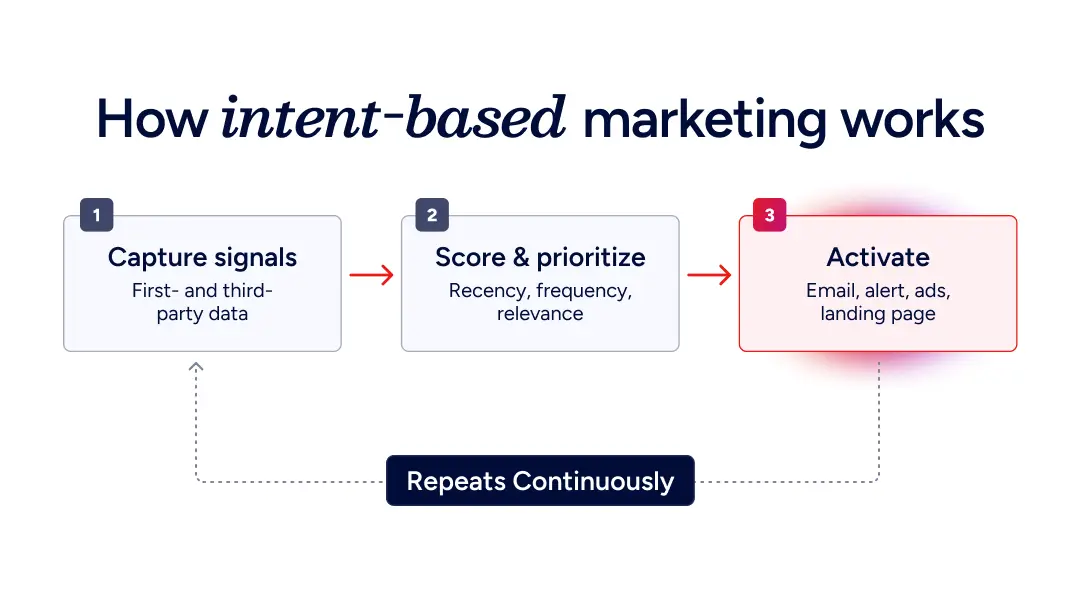
Intent-based marketing runs on a three-step loop. A weak link anywhere in the chain shows up as wasted spend at the end.
Step 1: Capture signals
Pull behavioral data from your owned channels and from third-party providers tracking research behavior across publisher networks.
First-party signals like website visits, content downloads, email engagement, and CRM activity. These tie to known contacts and are higher fidelity.
Third-party signals, broader in scope, surfacing accounts before those accounts ever touch your site. Data enrichment is what makes these signals usable once they arrive.
The end of the funnel is the wrong place to start watching.
Step 2: Score and prioritize
Weight each signal by recency, frequency, and topic relevance.
A pricing-page visit from a CFO this morning matters more than a whitepaper download from an unknown contact six weeks ago.
Lead scoring ranks accounts by buying readiness so reps work the hottest first.
Recency decays fast. A signal from this morning and a signal from three weeks ago are not the same signal, even if the topic matches.
Step 3: Activate against the signal
When an account crosses your score threshold, route it to the right play.
A personalized sales email sequence
A sales alert
A retargeting campaign
A custom landing page
Speed matters here more than anywhere else in the loop. Active intent signals decay within days, and a play that launches a week late is reaching a buyer who's already moved on.
Where Buyer Intent Shows Up in 2026
Intent signals scatter across channels. Every channel you don't monitor is buying activity you can't see. Most of this shift traces back to how B2B buying behavior has changed over the last few years, with research moving onto channels vendors don't own.
Traditional intent channels
Search engines. Solution-keyword and "best [category]" queries reveal active research. High-intent demand you capture through SEO and paid search.
Review sites (G2, Capterra, TrustRadius). Category browsing and competitor comparisons signal decision-stage intent. Buyers reading reviews are close to choosing.
Owned web properties. Pricing visits, demo requests, and repeat sessions on your own site are the strongest first-party signals, tied to known contacts you can act on now. Site visitor identification turns this anonymous traffic into accounts you can name.
Content syndication and inbound forms. Whitepaper and report downloads on third-party networks surface early, passive research interest at the account level.
Emerging: AI answer engines
Buyers now use ChatGPT, Claude, Gemini, and Perplexity the way they once used Google. They research solutions, compare vendors, and shortlist options before they ever fill out a form.
The visibility problem is structural. The conversation happens inside the AI tool, so marketers can't see whether their brand appears in the generated answers. A channel you can't measure is a channel you can't influence, and intent expressed there goes uncaptured.
Answer engine optimization (AEO) is the emerging discipline of tracking and improving how your brand shows up in AI-generated responses. It sits alongside SEO and traditional intent data tooling. Teams adding it now are catching intent on a surface competitors aren't watching yet.
Where Intent-Based Marketing Breaks Down
Capturing intent signals is relatively easy. The harder part is what happens after, turning those signals into coordinated action across accounts, people, and channels.
A few challenges show up repeatedly:
Stale contacts. Buying signals are only useful if the contact data attached to them is accurate. When records fall out of date, sales teams spend time chasing the wrong people instead of acting on real opportunities. Data hygiene best practices are the unglamorous fix here.
Incomplete account coverage. B2B purchases involve multiple stakeholders. Identifying a single engaged contact provides limited visibility into the broader buying committee evaluating and approving a purchase.
Fragmented signals. First-party engagement, third-party intent, CRM activity, and conversation data often sit in different platforms. Without a unified GTM data strategy, buying activity appears as disconnected events rather than a coordinated research process.
Activation gaps. Intent data only creates value when it reaches the systems responsible for acting on it. Too often, signals remain isolated from the marketing automation and sales automation workflows that drive engagement.
When evaluating an intent strategy, ask a simple question. Do intent signals and verified contacts reach the same system at the same time? If they don't, execution gets significantly harder.
How ZoomInfo Marketing Powers Intent-Based Marketing
This is the question ZoomInfo Marketing is built around. It maps your ideal customer profile against its database to surface sales-ready prospects already researching topics and keywords related to your business, detecting that activity before a prospect ever fills out a form. Coverage at this scale:
210 million IP-to-organization pairings
6+ trillion keyword-to-device pairings, sourced monthly from over 90% of accessible devices across the U.S.
Once an account is in view, ZoomInfo doesn't stop at the company name. It identifies the entire buying team based on who's researching specific topics. With Person-Level Intent, you can see which named contacts are associated with that research activity, turning a single signal into a real list of decision-makers a team can reach across phone, email, and digital marketing channels. That solves the incomplete-coverage problem directly. One engaged contact stops being the whole picture.
Guided Intent is what separates this from a standard intent feed. Rather than surfacing every topic an account browses, it prioritizes trending topics proven to drive successful outcomes, cutting the guesswork out of deciding which signals are worth acting on.
From there, the platform runs the play automatically, in three steps:
AI signal stacking. AI connects signals across accounts and contacts to identify moments of buyer readiness.
Intelligent orchestration. GTM Studio routes accounts, launches campaigns, and triggers rep actions in real time across every channel.
Automatic execution. When a signal fires, the play starts. Programmatic ads launch across the open web, with no manual list building or waiting on weekly reports.
Redwood Logistics is a clear example of what this looks like layered together. After folding intent signals into a targeting mix that also included job titles, website behavior, and account lists, the company saw clickthrough rate jump 310% and cost per click drop nearly 99%. Paired with cleaner, enriched data and automated lead routing, the team now saves 20 to 25 hours a week previously spent on manual research and CRM hygiene.
"It's not just the data itself. It's more about the right data at the right time to help us reach out with the right message across that full buyer journey." — Chelsea Kenyon, Senior Director of Digital Strategy, Redwood Logistics
Reach Buyers Before the Shortlist Closes
Intent-based marketing is the closest thing B2B marketing has to a fair fight. You see what buyers are researching, you act on it before competitors do, and the rest of the marketing funnel handles itself.
The teams that pull it off share three traits. They keep signals and contacts on the same infrastructure, prioritize the signals that actually predict conversion, and activate fast enough that nothing goes cold before someone acts on it. The GTM platform you pick should give you all three under one roof.
Your buyers are already out there, comparing, reading, shortlisting. The only question is whether you find out before they fill out a form, or after the decision's already made. Book a demo with ZoomInfo and see what it looks like to catch them first.
Intent-Based Marketing FAQ
Is intent-based marketing the same as ABM?
No, but they pair well. ABM targets a predefined list of high-value accounts whether or not they're in-market. Intent-based marketing targets accounts showing active buying signals whether or not they're on your list. Run together, intent data prioritizes your ABM list so spend goes to the dream accounts that are in-market right now.
Do I need third-party intent data to start?
Not necessarily. Start with the first-party data you already have, like website behavior, content downloads, pricing visits, and email engagement. These tie directly to known contacts and tend to convert at higher rates. Third-party intent data, the kind that surfaces accounts before they ever visit your site, is worth layering in once that first-party program is producing measurable lift. It's an addition, not a replacement.
What's the difference between intent data and buyer intent signals?
Intent data is the broad category of behavioral information indicating purchase interest. Buyer intent signals are the specific actions within that data, like a pricing-page visit, a topic surge, or a demo request. Data is the input. Signals are what you act on. ZoomInfo's three tiers of actionable insights breaks this down further.
How long does it take to see results from intent-based marketing?
Plan for 90 days to see meaningful patterns, with leading indicators in the first 30 to 45 days. B2B sales cycles typically run three to six months, so high-intent leads need time to convert. Track engagement and intent score distribution weekly while waiting for pipeline and revenue to materialize.
Does intent-based marketing work for small teams?
Yes, with different priorities. Small teams should focus on first-party signal capture before paying for third-party intent, often as part of a broader demand generation effort. The fastest gains come from tightening response time on demo requests and pricing visits the team is already getting. Small business lead generation covers this in more depth.
