

Key Takeaways
A marketing orchestration platform unifies account data, buyer signals, and execution channels into one decisioning layer that runs coordinated plays across the GTM stack in real time.
Marketing automation runs sequences you built in advance. Orchestration chooses which sequence to run based on what an account is doing right now across every system you own.
Six capabilities define the category: unified account data, multi-source signal detection, AI decisioning, cross-channel execution, sales coordination, and account-level measurement.
Platform investments succeed or fail at the data layer. Clean firmographic data, reliable intent, and proper identity resolution are prerequisites, not features.
The top 5 platforms B2B teams shortlist in 2026 are ZoomInfo, Demandbase, 6sense, HubSpot Marketing Hub, and Adobe Marketo Engage. Each is built for a different GTM motion, which is the deciding factor in choosing between them.
The window between a buyer signal and a sales conversation has collapsed. Accounts research, shortlist, and decide faster than weekly campaign meetings can keep up.
Marketing orchestration platforms are how teams act on buying behavior the moment it happens, before competitors do.
This guide covers the capabilities of marketing orchestration, how it differs from marketing automation, and the top 5 platforms B2B teams shortlist in 2026.
What Is a Marketing Orchestration Platform?
A marketing orchestration platform is software that runs coordinated B2B plays across channels in real time.
Most B2B teams currently stitch this work together manually across customer relationship management (CRM), marketing automation platforms (MAP), ad platforms, intent providers, and sales tools.
Marketing orchestration replaces that manual stitching with a single decisioning layer that handles four jobs:
Unify. Pull data from every system in the GTM stack into one resolved view of the account and buying group.
Detect. Watch first-party, second-party, and third-party sources for behavior that signals buying intent.
Decide. Choose the next-best action automatically when conditions are met, instead of waiting for a human to assemble the campaign.
Execute. Fire coordinated actions across email, ads, web, chat, and sales tooling.
The payoff is faster pipeline, lower customer acquisition cost (CAC), and sales and marketing alignment that shows up in the numbers.
Marketing Orchestration vs. Marketing Automation
Vendor marketing uses these terms interchangeably, and the distinction shows up during evaluation.
Automation executes predefined sequences on a schedule or in response to a single trigger like a form-fill. Orchestration assembles the sequence in flight, drawing on signals from across the stack to decide what should happen for a given account at a given moment.
Dimension | Marketing Automation | Marketing Orchestration |
Core unit | Pre-built sequences and workflows | Real-time plays across the GTM stack |
Trigger logic | Schedule and form-fill-based | Signal-based, multi-source, weighted |
Decision making | If-this-then-that rules | AI scoring across many variables |
Channel coverage | Primarily email, sometimes SMS and ads | Email, ads, sales, chat, web, direct mail |
Data scope | Inside the MAP and connected CRM | Across the entire GTM stack |
Buyer model | Individual leads | Accounts and buying groups |
Sales involvement | Hand-off after MQL | Continuous coordination |
Consider a target account that hits the pricing page for the third time in a week. A traditional automation workflow triggers a single nurture email and updates a lead score. Sales finds out later, if the score crosses a threshold.
Orchestration treats the same event as one signal in a stack. Inside the same hour, the platform:
Confirms the account is surging on related intent topics.
Checks whether other buying-group members have engaged recently.
Pushes the account into a paid social audience.
Personalizes the next website visit.
Alerts the account executive in Slack with full context.
Queues a personalized outreach email for the rep to review.
Coordinated across channels, without anyone assembling the campaign by hand.
Core Capabilities of a Marketing Orchestration Platform
Most platforms in this category list a similar set of features on the website.
The differences become visible during evaluation, when each capability operates against real data and real workflows.
1. Unified Customer and Account Data
Orchestration runs on a single source of truth for every account, contact, and signal. The platform needs native enrichment, deduplication, and identity resolution across web, CRM, MAP, and ad platforms.
When that foundation is missing, downstream plays run on stale or conflicting records, and the failures surface as bad routing, duplicate outreach, or accounts that never get reached at all.
A practical test during evaluation:
Load a target account list and check how many records resolve cleanly without manual cleanup.
Inspect the freshness of firmographic fields, particularly headcount, revenue, and tech stack.
Check how the platform handles contacts that exist in CRM but not in the MAP, or vice versa.
2. Intent and Buyer Signal Detection
The platform should pull intent from multiple sources rather than relying on a single feed. Three categories of signal matter:
First-party. Your website, content, product, and ads. The strongest signal because it reflects engagement with your brand directly.
Second-party. Review sites, communities, and partner data. Useful for catching accounts before they reach your domain.
Third-party. Research activity across the open web. The broadest coverage and the most noise, which is why weighting and decay matter.
Sourcing varies considerably across vendors. Run a backtest of the intent feed against your own closed-won accounts from the last twelve months before signing. A demo dataset proves nothing about coverage for your specific ICP.
3. AI-Powered Decisioning
This is where the category earns its keep, and also where vendors overstate what they actually deliver. The right question during evaluation is what the AI decides, not whether the platform has AI.
A weak demonstration sounds like “the AI scores leads.” A strong one shows the model weighing dozens of signals against account fit, stage, and recent history to recommend a specific action, and explaining its reasoning in a way a human can audit.
The test is whether the AI can defend its choice: why this account, why this play, why now. Pushing a lead into a Salesforce queue based on a single score does not meet that bar.
4. Cross-Channel Execution
Recommendation without execution puts the work back on the team. The platform should execute natively or integrate deeply enough that timing across channels remains coordinated.
The execution surface to evaluate:
Audience pushes to LinkedIn, Meta, Google, and the trade desks with account-level targeting.
Website personalization without a separate point solution layered on top.
Chat and conversational tools that receive account context, not just a generic visitor session.
Sales tooling that gets real-time alerts with context the rep can act on.
Email execution that respects the same routing and suppression logic as the rest of the stack.
5. Sales and Marketing Coordination
Marketing plays produce limited pipeline if sales never acts on them, and sales activity converts more slowly without parallel marketing air cover.
A capable platform should:
Push real-time alerts into the rep’s workflow with full account context, not a generic “account is hot” notification.
Recommend next-best actions tied to the play that triggered the alert.
Draft personalized outreach the rep can edit and send, rather than asking the rep to start from a blank email.
Pull sales activity back into the platform so marketing sees what is actually happening with the account.
Bidirectional CRM sync is table stakes here. Coordination at the workflow level separates the platforms that move pipeline from the ones that produce dashboards.
6. Measurement and Attribution
Closed-loop measurement runs from signal to pipeline to closed revenue. The platform should support:
Multi-touch attribution at the account and buying-group level, not just first-touch or last-touch on a contact.
Control-group comparison so orchestrated plays can be measured against baseline activity.
Channel and play-level breakdowns that show which orchestrations contribute to pipeline.
A vendor that cannot show account-level attribution out of the box will struggle to defend its own ROI, which makes the platform investment harder to justify at renewal.
Top 5 Marketing Orchestration Platforms
The platforms below are the ones most often shortlisted by B2B teams evaluating marketing orchestration in 2026.
1. ZoomInfo
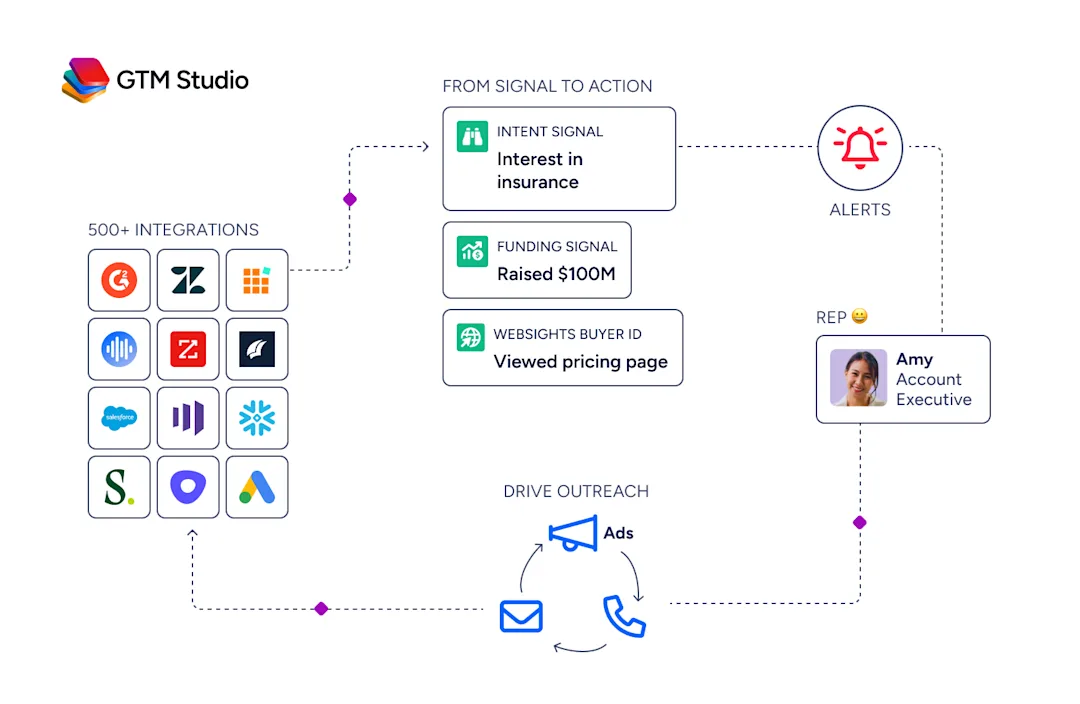
ZoomInfo Marketing is an ABM platform that runs orchestration on top of the largest verified B2B database in the category.
The platform identifies in-market accounts through real-time intent, scores them by fit with predictive AI, and fires coordinated campaigns across ads, sales, web, and chat.
GTM Studio is the orchestration layer that decides which play runs against which account based on the signal stack. It ships with pre-built motions for competitive displacement, champion tracking, and inbound acceleration, and lets teams build custom plays from the same canvas.
Key features
AI signal stacking: combines weak signals into coherent patterns and decays old ones, so plays fire only when intent is current
Buyer intent & signals: research-topic coverage across thousands of B2B topics, sourced from third-party publishers and ZoomInfo's own network
Account fit score: ranks every account in your database by likelihood to convert, drawing on firmographic, technographic, and engagement data
Cross-channel advertising: display and social campaigns delivered through ZoomInfo's native demand-side platform with 300+ company attributes for targeting
Advanced audience targeting: segments accounts and buying groups for sales outreach using firmographic, technographic, and behavioral filters
Site visitor identification: turns anonymous traffic into identified accounts your team can act on
Web form enrichment: turns partial form-fills into qualified leads by enriching with verified data on submission
Pros
Verified B2B data foundation underneath every play, so orchestration runs on accurate accounts and contacts instead of stale records
Real-time intent across thousands of research topics surfaces in-market accounts as buyer behavior shifts
Consolidates data, advertising, audience targeting, and analytics in one suite, replacing the tool sprawl most orchestration motions still depend on
Cons
Best suited for mature ABM or hybrid demand motions; not the right fit for pure inbound SMB
Full value requires committing to the data foundation, not just the workflow layer
Pricing
Consumption-based. Pricing scales with data usage, credits, and the modules activated. Contact sales for a tailored quote.
Customer outcomes
NetSPI: 61% increase in opportunities created from demand generation channels
Librestream: 900% lift in average CTR on targeted ad campaigns
Impartner: 12% pipeline growth quarter over quarter
2. Demandbase
Demandbase is an account-based GTM platform that combines first-party data, account identification, intent signals, and advertising into a single orchestration layer.
The platform is built around the "Account Intelligence" concept, where every play is grounded in account-level context rather than individual lead behavior. Demandbase positions itself directly against ZoomInfo and 6sense in the B2B orchestration category.
Key features
Account-based orchestration: runs coordinated cross-channel plays grounded in account-level context, not individual lead behavior
Native B2B advertising: delivers display campaigns with account-level targeting built into the platform
Account identification: de-anonymizes website visitors to surface in-market accounts as they engage
Intent data and predictive analytics: prioritizes accounts based on research behavior and propensity to buy
CRM and MAP integrations: connects natively with Salesforce, HubSpot, and Marketo
Account-level attribution: ties pipeline contribution back to specific accounts and plays
Pros
Strong account identification technology and B2B advertising execution
Mature ABM heritage with deep account-level features
Robust integrations with the major MAPs and CRMs
Cons
Stack-heavy; full value requires committing to multiple Demandbase modules
Sales coordination workflows are less native than data-first platforms
Pricing
Tiered subscription. Contact sales for a quote.
See how ZoomInfo and Demandbase compare.
3. 6sense
6sense is an account engagement platform built around predictive AI and intent data.
The platform identifies in-market accounts using its "Dark Funnel" intent model, then orchestrates plays across advertising, sales engagement, and web personalization.
6sense is one of the closest competitive overlaps with ZoomInfo for B2B teams evaluating signal-based orchestration.
Key features
Predictive scoring: classifies accounts by buying stage based on intent and engagement patterns
Intent data: tracks research activity across keywords, topics, and competitor terms
Account identification: surfaces anonymous website visitors at the account level
Sales engagement integrations: connects with Outreach, Salesloft, and Salesforce to push signals into rep workflows
Native B2B advertising: runs display and social campaigns targeted at in-market accounts
Conversational email and chat: handles inbound qualification through AI-driven conversations
Pros
Strong predictive AI and account-stage model
Mature intent data infrastructure
Good for teams that want stage-based plays running against the buying committee
Cons
Data foundation is narrower than platforms with native B2B contact and company data at scale
Implementation and adoption typically require significant RevOps resources
Pricing
Tiered subscription, with a free starter plan available. Enterprise pricing on request.
4. HubSpot Marketing Hub (Enterprise)
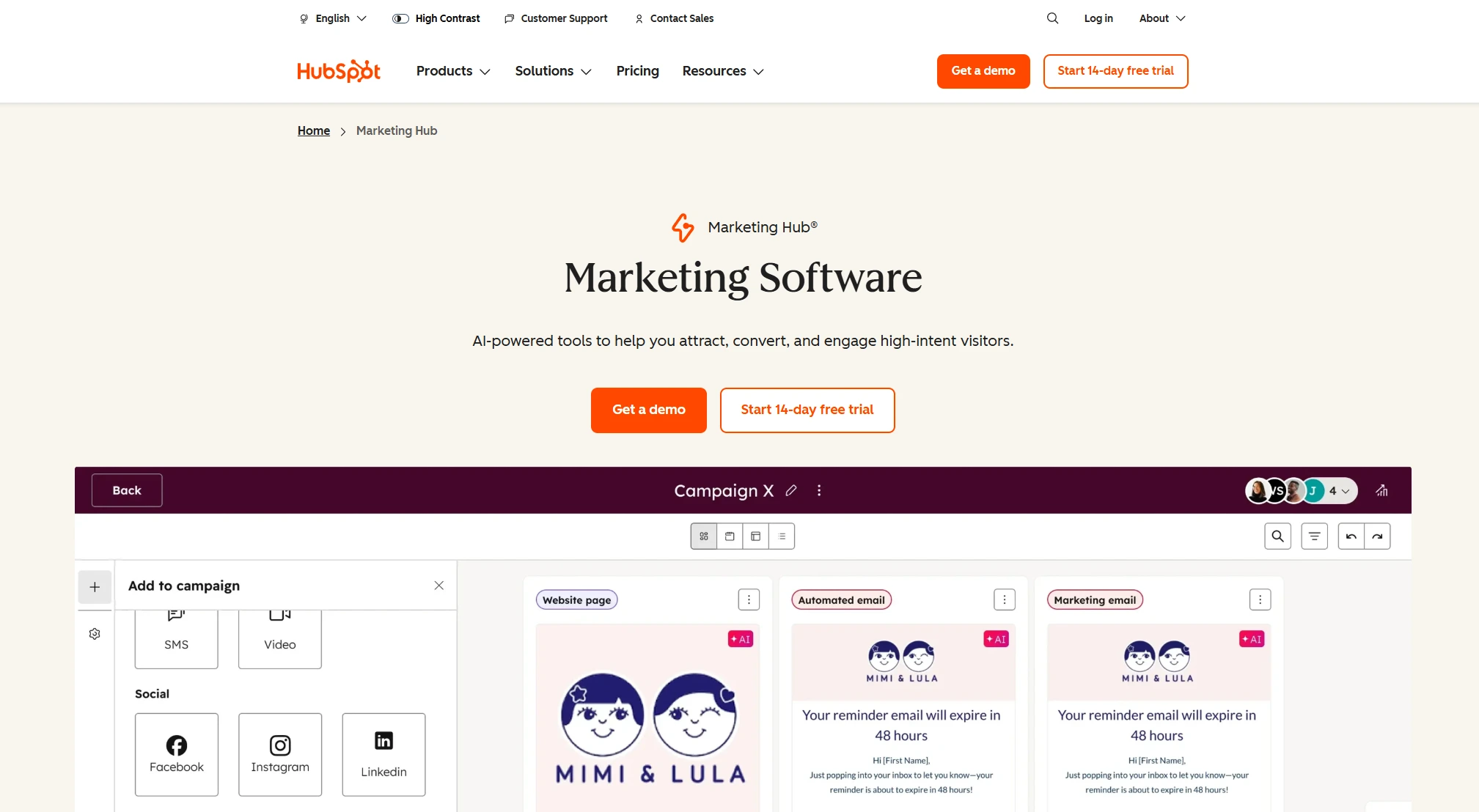
HubSpot Marketing Hub is a suite platform with orchestration capabilities layered on top of its marketing automation core.
At the Enterprise tier, HubSpot adds account-based features, predictive lead scoring, and multi-touch revenue attribution.
The platform fits teams already standardized on the HubSpot ecosystem who want orchestration without changing their CRM and MAP foundation.
Key features
Customer journey builder: maps multi-step plays through a visual workflow interface
Account-based marketing tools: adds account-level targeting and reporting at the Enterprise tier
Native suite: combines CRM, marketing automation, sales tools, and CMS in one platform
Multi-touch revenue attribution: ties pipeline back across campaigns, channels, and touches
AI content and predictive scoring: drafts content and ranks leads by likelihood to convert
App Marketplace: offers 1,500+ third-party integrations to extend the platform
Pros
Lower friction for teams already running HubSpot CRM and MAP
Strong all-in-one user experience and shorter ramp time
Self-serve pricing tiers from Starter to Enterprise
Cons
Orchestration is layered on top of an MAP foundation rather than purpose-built for B2B signal stacking
Account-based features require the Enterprise tier and are less mature than dedicated ABM platforms
Third-party data and intent depth comes through integrations, not natively
Pricing
Tiered self-serve pricing. Marketing Hub Enterprise starts at the upper end of the SaaS market; contact sales for current pricing.
5. Adobe Marketo Engage
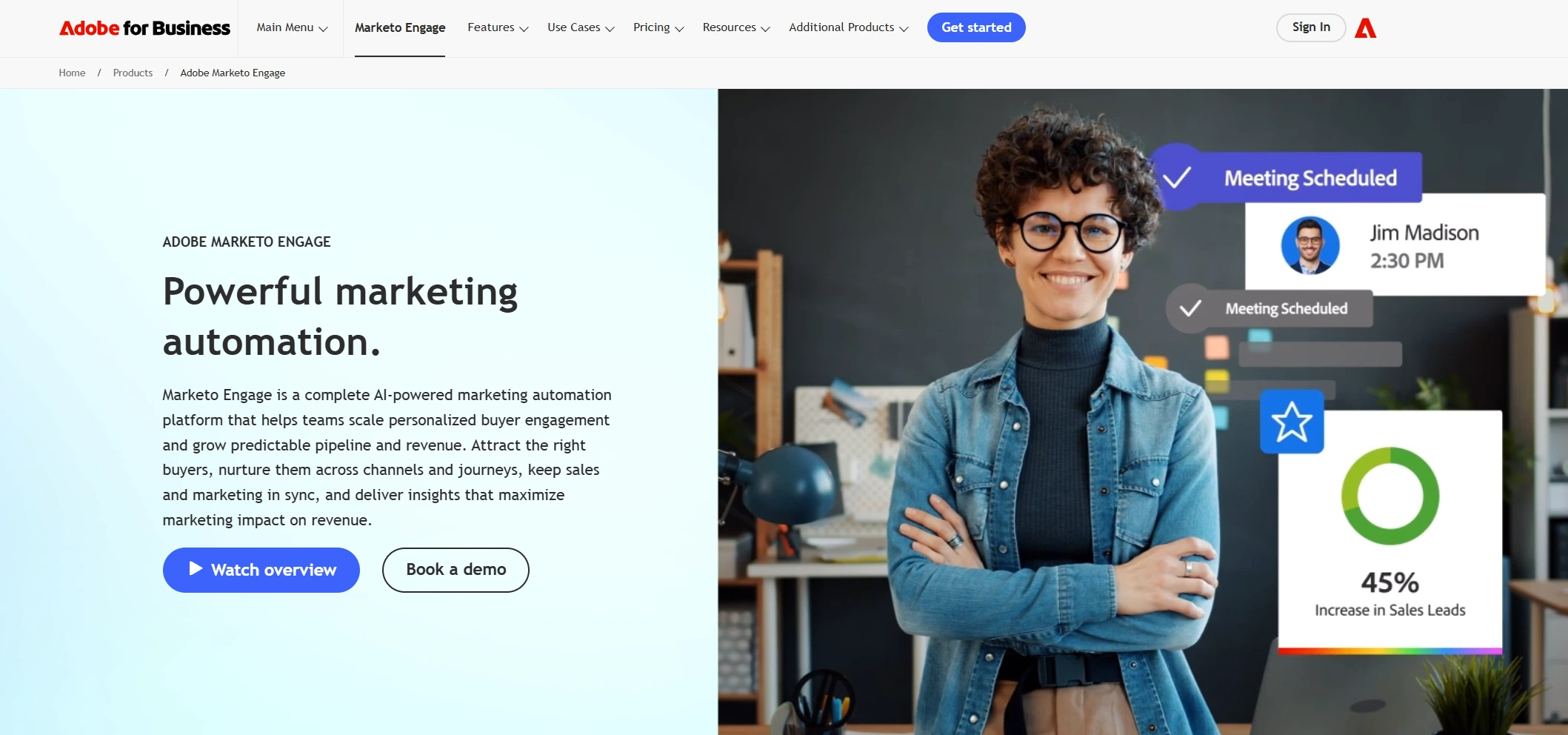
Adobe Marketo Engage is an enterprise marketing automation platform with orchestration capabilities layered on through Adobe's broader Experience Cloud.
Marketo is one of the longest-running platforms in the category and is common in enterprises with dedicated marketing ops teams and complex compliance environments.
Key features
Account-based marketing module: layers account-level targeting on top of the lead-based MAP foundation
Engagement programs: orchestrates multi-step journeys across email and connected channels
Predictive content: recommends audiences and content variants using AI scoring
Adobe Experience Cloud integration: connects to Adobe's analytics, personalization, and content tools
Marketo Measure: delivers multi-touch attribution across campaigns and channels
API and customization depth: supports complex workflows for enterprise marketing ops teams
Pros
Mature platform with strong enterprise adoption
Deep customization for complex GTM motions
Integrates with the broader Adobe stack for teams already using Experience Cloud
Cons
Implementation and ongoing administration require dedicated marketing ops resources
Signal stacking and real-time orchestration are not native; require add-ons or integrations
Slower time-to-value than purpose-built B2B orchestration platforms
Pricing
Enterprise pricing only. Contact sales for a quote.
How to Choose the Right Marketing Orchestration Platform
Here’s a short evaluation framework that filters most vendors out quickly.
Start with your GTM motion
ABM, demand gen, and lifecycle orchestration look similar in a sales demo and behave very differently in production.
A platform tuned for named-account ABM may be heavy for a high-velocity SMB demand engine. A journey-orchestration platform built for consumer messaging tends to struggle with account-level coordination. The platform fit needs to follow the motion.
Ask yourself:
Is our primary motion account-based, lead-based, or lifecycle?
How many target accounts do we run plays against in a typical quarter?
Where is the bottleneck today: signal coverage, decisioning, or execution?
Audit your data foundation
Orchestration runs on data, and a half-populated CRM with two-year-old firmographic records will produce poor outcomes regardless of which platform sits on top. Two viable paths forward:
Fix the data layer first, then layer orchestration on top of clean inputs.
Buy a platform that includes the data layer natively, so the cleanup happens as part of the implementation.
Ask yourself:
How fresh is our firmographic data, and how often does it refresh?
Do we have one resolved view of each account, or several conflicting ones?
Where does our intent data come from today, and how confident are we in its coverage?
Pressure-test the sales coordination story
Most “sales alignment” demos amount to CRM sync plus a digest email.
Ask the vendor to walk through what a sales rep actually sees on a Tuesday morning: the alerts, the context, the recommended next action, the drafted outreach. The quality of that experience is what determines whether marketing plays convert to revenue.
Ask yourself:
What does the rep actually see when a play fires, and is it usable in the moment?
Does the platform draft outreach, or just hand the rep a notification?
How does sales activity flow back into the platform so marketing sees what is happening?
Check integration depth, not breadth
Every vendor has a logo wall of integrations. The relevant question is what each integration actually does.
A “Salesforce integration” can mean anything from a once-daily lead push to a real-time bidirectional sync with custom object support and field-level mapping. The difference is months of implementation work and significant ongoing maintenance.
Ask yourself:
Is the integration with our CRM real-time and bidirectional, or batch and one-way?
Does it support our custom objects and fields, or only the standard schema?
What breaks if the integration goes down for an hour, a day, a week?
Build a real workflow before you buy
Sandbox demos prove very little. Ask the vendor to build one of your real orchestration plays end-to-end in a trial environment, using your data and your stack.
The plays that look easiest in the slide deck are usually the ones that take three months to operationalize, and the gap shows up only when someone tries to ship them.
Ask yourself:
Can the vendor build our top priority play end-to-end in the trial?
How much of the work is configuration versus custom development?
Who maintains this play after it ships, and what does that look like in month six?
From Disconnected Campaigns to Orchestrated GTM
The teams that win at marketing orchestration share three habits:
They invest in the data layer before the workflow layer.
They evaluate platforms against a real GTM motion rather than a feature checklist.
They treat sales coordination as a first-class capability, not a downstream consequence.
Talk to our team to see how ZoomInfo Marketing turns those principles into pipeline.
Frequently Asked Questions
Is marketing orchestration the same as journey orchestration?
They overlap. Journey orchestration focuses on individual journey timing across channels, typically in B2C contexts. Marketing orchestration is broader, covering audience definition, decisioning, execution, sales coordination, and measurement at the account level. In B2B, modern marketing orchestration platforms include journey orchestration as a feature rather than a separate category.
What is the difference between marketing orchestration and a CDP?
A customer data platform (CDP) unifies and stores customer data from across the stack. A marketing orchestration platform uses that unified data to decide what to do next and executes plays across channels. CDPs sit at the data layer. Orchestration platforms sit above it. Some modern orchestration platforms include CDP-style data unification natively; others integrate with a separate CDP.
What is a revenue orchestration platform?
Revenue orchestration platforms coordinate plays across the full revenue motion, not just marketing. They unify marketing campaigns, sales sequences, and customer success workflows on shared accounts and signals. The category overlaps heavily with B2B marketing orchestration. The distinction is mostly about which team owns the platform: marketing-led versus a shared GTM operating layer.
What is the best orchestration tool?
It depends on your GTM motion. ABM-led B2B teams typically evaluate ZoomInfo, Demandbase, and 6sense. Teams running orchestration inside an existing suite often stay with HubSpot or Adobe Marketo Engage. The right choice depends on your data foundation, your sales coordination needs, and the channels you actually run. Start with the motion, not the vendor logo wall.
