
Every go-to-market vendor now says it has a context graph. Some have built one. Others have renamed a database, a CRM, or a search index, and the pitch sounds much the same either way.
The claim is spreading fast. Adam's GTM Report, which tracks the conversation, found that the share of core GTM tech homepages using the word "context" rose from 26% in the first quarter of 2026 to 40% by November.
I explain a context graph the way I would explain meeting prep. Before a big customer meeting I ask the seller to tell me everything we know about the account: every conversation, who the executives are, what technology they run, what changed there last quarter. Pulling that together can take a person eight hours, and they still miss things. A context graph holds all of it, already connected, for a person or an AI agent to use. Our guide to the B2B context graph has the full definition.
This article is for the buyer who already knows the concept and has to choose. It gives you ten things to check and the questions to put to each vendor. Under each, I have set out how ZoomInfo's GTM Context Graph measures up, with evidence you can check.
I run the company that sells one, so test our answers as hard as anyone's. My view is that the first thing to check is the reference data a graph resolves against, and most of this guide follows from that.
Why go-to-market context is harder than it looks
We think a lot about why AI took off in software engineering and struggled in go-to-market. A coding agent sits on top of your codebase. The codebase is machine-readable, it is in one place, and it holds everything the agent needs to write the next line.
Go-to-market has two problems that engineering does not. Your first-party data is scattered across data silos: the CRM, email, call transcripts, marketing programs, enablement documents. And go-to-market context needs third-party data too. If a customer announced on yesterday's earnings call that it is expanding across EMEA, nothing in your own systems knows that.
I think every organization will end up with three context graphs. One will serve product and engineering, one will serve enterprise search, and one will serve go-to-market. The first two run on data the company already owns. The third does not, and it changes every time something happens in the outside world.
The cost of getting it wrong is rarely a crash. AI gives you unlimited cognition, and most teams are running it on little pieces of context. So the agent confidently emails a champion who left two months ago, or books a renewal call with the wrong subsidiary. It is a large part of why AI alone isn't enough to move the productivity numbers on most revenue teams.
Five ways teams try to solve context, and where each falls short
Few people now dispute that context is the problem. They disagree on how to solve it. Adam Schoenfeld, the independent analyst behind Adam's GTM Report, sorts the answers he sees in the market for GTM context into five:
Build your own graph. You get total control and a graph shaped to your motion. You also take on identity resolution, hierarchy, and upkeep yourself.
Buy a GTM-specific solution. A vendor has resolved the outside world and keeps it current. You depend on that vendor's coverage and roadmap.
Make the CRM your context layer. The records and workflows already live there. So do the CRM data quality problems.
Buy an enterprise-wide solution. A warehouse or enterprise search tool gives you data governance across all company data. It knows little about companies and buyers outside your walls.
Use the agent's own context. There is nothing to build, because context comes with the agent you bought. The agent only sees what it does and what you give it.
In the report's data the last answer is the one gaining ground, up from 8% of posts before October to 14% since. It is also the hardest to inspect, which is a good reason to bring a checklist.
Ten things to look for in a GTM context graph, and how ZoomInfo measures up
Do not settle for slides. Any vendor that has a context graph should be able to open it on an account you know well and show you what it holds. We built a visual view of the graph for every account for that reason, because people understood it once they could see every call, email, meeting, and website visit connected to the account.
1. Entity resolution
The graph should give every company and every person one identity and attach every record to it. That is harder than it sounds, because the systems that hold your data share no common identifier. Your call recorder may know a customer as Uber. Your CRM may have it as Uber Freight, or under the name of a company Uber acquired years ago. An agent has to know those are one customer before it can tell you anything about the relationship.
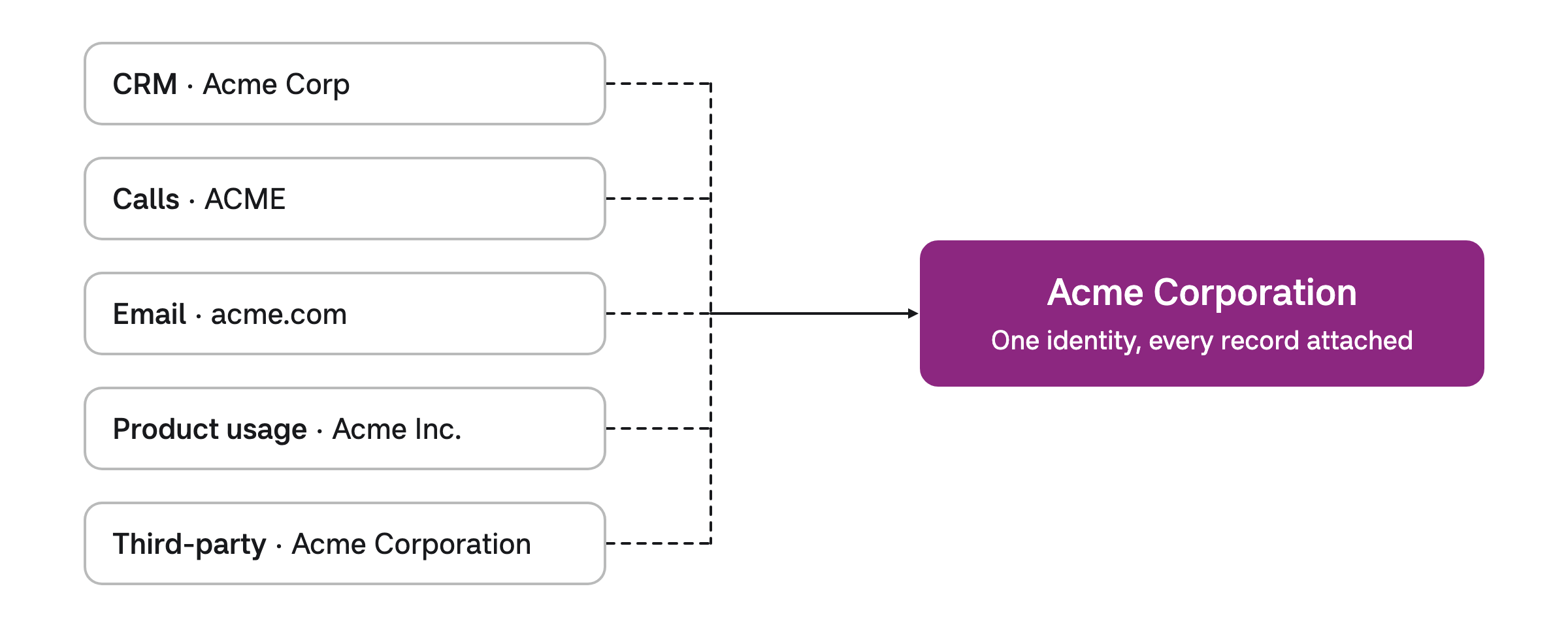
Matching on domain or on name and address alone will miss renamed companies, shared domains, and people who changed jobs. Our guide to the identity resolution API sets out what to evaluate, and our guide to data deduplication covers the cleanup side.
Ask the vendor. How do you match records when two sources disagree? If you show me a benchmark, does it measure matching accuracy, or does it start from records that were already merged?
How ZoomInfo measures up. The GTM Context Graph joins records from systems that share no common identifier, using 16 patented AI GTM-linkages, and resolves them against our own record of each company and person. A parent, its subsidiaries, and the contacts across them sit in one connected picture. This rests on years of work nobody saw. We collected every way a company writes its name and every domain it uses, so that uber.com, uber.co, and a subsidiary's name all roll up to one account in the corporate hierarchy.
2. Reference data underneath it
In any universe where you are building a context graph for go-to-market, you need foundational reference data at the core. Resolution needs something to resolve against: a maintained record of legal names, brands, parents, subsidiaries, and executives, and of how they change. Your first-party data does not update itself when a CEO leaves or an acquisition closes. In data terms this is master data management.
Ask whether the vendor owns that dataset or rents it from another B2B data provider. Renting is not automatically worse, and running a waterfall across several providers can widen coverage field by field. But, it does leave open which record is the master when they disagree.
Ask the vendor. Do you own the dataset you resolve against, how is it verified, and which record wins when sources disagree?
How ZoomInfo measures up. We own it. ZoomInfo maintains 100M+ companies and 500M+ contacts, verified by a multi-source pipeline and 300+ researchers, and validates every record against 40+ sources. We do not know of another system that manages entities at the people level and the company level at that scale.
For comparison, Apollo lists 240M+ contacts and 30M+ companies, sourced partly through a contributor network, and Clay draws on a marketplace of 200+ providers that each verify their own data. In two independent tests in 2026, ZoomInfo matched more direct dials than Apollo: 71% against 52% in clugtm's test and 61% against 43% in Cotera's.
3. First-party and third-party data in the same graph
Your CRM, calls, and emails say what happened with an account. Outside data says what is happening to it: buying signals such as funding, hiring, and leadership changes, the technographics of what they run, and intent data. A graph with only one of the two gives agents half the picture.
Check the depth of the first-party side as well. A great deal of context gets trapped inside conversations and never reaches the rest of the go-to-market motion: the objection a buyer raised, the three features they said they were missing. The graph also needs your business context, so it can tell which facts matter to you. A customer's growth in EMEA is vital to one seller and irrelevant to another. Our guide to context data for AI covers the types in detail.
Ask the vendor. Which outside sources are in the graph? Are calls and emails captured in full, or only logged as activity?
How ZoomInfo measures up. The graph resolves your CRM, calls, and emails with ZoomInfo's intelligence on companies, contacts, and billions of signals into one current record per account. Conversation intelligence feeds what buyers said back into that record. It can also take in signals from other sources alongside our own, which is how some teams run it next to 6sense or Demandbase.
4. Freshness
Once you have tied everything together, it changes constantly, and most of the change comes from outside your walls. Companies grow and shrink. People leave and join. Companies raise funding, buy new technology, change their names, and acquire each other. A coding agent's context is not affected by the outside world in this way, and a go-to-market graph is affected every day. It is why B2B data decay never stops.
Ask the vendor. How often do records update, what triggers an update, and what happens to a fact that has gone stale?
How ZoomInfo measures up. The graph processes 1.5B+ data points daily. Signals, job changes, and company events are refreshed and verified by the same pipeline and researchers, so a contact pulled in March reflects their July job change. Keeping the list current stops being your team's job, which is most of what CRM hygiene work is today.
5. A source on every fact
An agent's answer is only as trustworthy as your ability to check it. Look for the source and a confidence level on each attribute, and for answers that cite the record, call, or signal they came from. Our guide to verified data for AI agents explains why this matters.
Ask the vendor. Can I see where this value came from, and how confident you are in it?
How ZoomInfo measures up. Context is resolved before anyone acts, with a known source behind every fact, and attributes carry confidence scores. When Agent Teams finish a piece of work, it lands in the seller's feed with its sources attached, so a rep can see why an account was picked before approving anything.
6. Decision history
The idea of a context graph came from investors at Foundation Capital, whose essay on context graphs described it as a record of decisions: what was known, what was done, and what happened next. In practice, an agent should know what you discussed with an account in the past, whether you engaged them in the last 30, 60, or 90 days, and what they told you mattered.
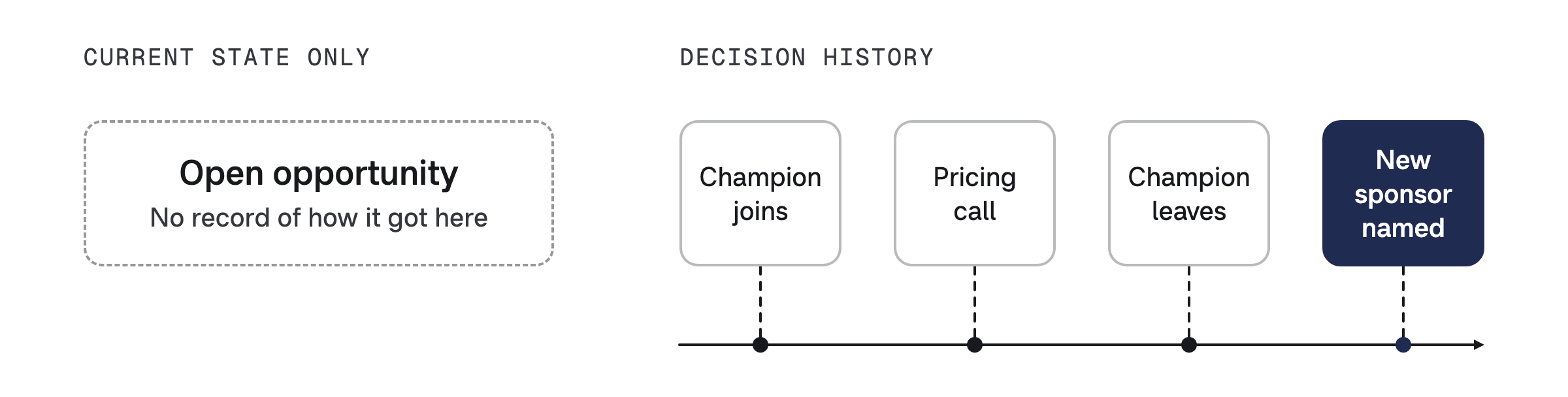
Ask the vendor. Can I see what changed on this account and in what order, or only where it stands today?
How ZoomInfo measures up. The graph holds the sequence of events behind each account's current state: opportunities, meetings, email threads, call recordings, and sequence activity, in order. We have not published a formal decision-trace model of the kind some startups describe, so if that is central to your use case, ask us to show you the account timeline.
7. Write-back
When a rep edits an agent's draft or approves an action, that outcome should update the graph. A graph that agents can only read will not improve with use. Our guide to AI agents in CRM covers how much autonomy to allow.
Ask the vendor. What happens to the graph when a rep edits or rejects an agent's work?
How ZoomInfo measures up. Every approval and edit writes back to the graph, so the next play, campaign, or seller starts from a better picture. What sales learns on an account improves the record that marketing builds its next audience from.
8. Permissions and governance
Agents should see only what the person they act for is allowed to see. Ask how permissions carry over from your source systems, whether agent activity is logged, and which certifications the vendor holds. Our guides to AI agent governance and B2B data vendor compliance go deeper.
Ask the vendor. How do my existing access rules apply to agents, and where is the audit trail?
How ZoomInfo measures up. Access through MCP inherits your existing role-based permissions, and enterprise controls include SCIM, data access controls, and a DPA. ZoomInfo holds ISO/IEC 27001, 27701, 27017, and 42001 for AI governance, plus SOC 2 Type II and the TRUSTe Responsible AI Certification. All of it is published in our Trust Center.
9. Open access and portability
You will run more than one agent, and some will be ones you build. The same graph should be reachable through MCP and an API at a minimum, without a reduced version for outside tools, and a command line is a bonus for technical teams. Our guide to MCP vs API explains when to use which.
Keep one distinction in mind. A connection such as MCP gives an agent access to your systems, and access is different from understanding. Open access is only worth having when what sits behind it is already resolved. We cover that argument in our piece on the GTM harness debate. Ask what you can take with you too, because your corrections and history become part of the graph.
Ask the vendor. Can agents I build use the same graph yours do, and what can I export?
How ZoomInfo measures up. You used to get ZoomInfo data in one place, our own platform. Today the same foundation is open through GTM.ai by MCP, API, and command line, with the same data and the same governance. Agents reach it inside Claude, through the sales plugin for ChatGPT, inside Snowflake, and from Replit, n8n, and the applications you build yourself. Audiences push to your CRM, your engagement tools, and your warehouse.
10. Proof, cost, and time to value
Ask for a controlled comparison against plain retrieval on your own accounts, and for cost at your expected volume. Ask how long setup takes and who does the work.
Ask the vendor. What changed for a named customer, what will it cost at my volume, and how long is setup?
How ZoomInfo measures up. We publish our own test and its method. In GTM Bench v1, an AI agent finished ten GTM tasks in 32 minutes on ZoomInfo's MCP, against 101 minutes on Apollo, and filled 94% of work-email fields against 84%. Run cost was close: $15.80 with our MCP and $10.12 with our CLI, against $14.78.
A scorecard to take to every vendor
Criterion | Question to ask | Red flag | ZoomInfo's GTM Context Graph |
|---|---|---|---|
Entity resolution | How do you match records when sources disagree? | Domain or name match only | 16 patented AI GTM-linkages, hierarchy-aware |
Reference data | Do you own the dataset you resolve against? | "We use your CRM as the source of truth" | Owned: 100M+ companies, 500M+ contacts, 40+ sources per record |
First- and third-party data | Which outside sources are in the graph, and how deep is the first-party capture? | Only one of the two, or no shared identity | CRM, calls, emails, and billions of signals in one record per account |
Freshness | What triggers an update, and how fast? | "Real-time" with no detail | 1.5B+ data points processed daily |
Source on every fact | Can I see where this value came from? | Accuracy percentages with no method | Known source behind every fact, confidence per attribute |
Decision history | Can I see what changed on this account and in what order? | Current state only | Sequence of events per account; no published decision-trace model |
Write-back | What happens to the graph when a rep edits an agent's work? | Read-only access for agents | Every approval and edit writes back |
Permissions | How do my existing access rules apply to agents? | "Agents respect permissions" with no mechanism | Inherited role-based permissions, ISO 42001, SOC 2 Type II |
Open access and portability | Can agents I build use the same graph, and can I export my data? | Limited version for outside tools, or no export | MCP, API, and CLI on the same data and governance |
Proof, cost, and time to value | What changed for customers, what will it cost, and how long is setup? | Vendor-run benchmark with no method | Published benchmark and method, named customers, free start on GTM.AI |
How the main approaches to a context graph compare
Vendors arrive at a context graph from different starting points, and the starting point decides what the graph is good at.
Data-foundation-led. The graph starts from an owned dataset of companies and people, then joins your first-party data to it. ZoomInfo takes this approach.
Conversation-led. The Gong Revenue Graph is built on conversation intelligence: captured calls, emails, and CRM activity. Outside contact data comes through partner providers.
CRM-led. HubSpot's Growth Context and Salesforce Data 360 build on the customer record they already hold. Salesforce offers configurable identity rules across the data you bring to it.
Signal-led. 6sense and Demandbase hold their own account data and intent signals, the model of an intent data platform, and expose them to agents. Common Room resolves product, community, and CRM signals to people.
Revenue-context startups. Day AI, RevSure, Warmly, Vasco, and Clearskies build a graph from your own CRM, calls, and billing. Octave covers a different layer: your positioning, ideal customer profile, and messaging.
Horizontal enterprise tools. Glean and Notion index internal documents, messages, and notes under existing permissions, and reach outside account data through connectors.
Approach | Built on | Strengths | Limitations | Best fit |
|---|---|---|---|---|
Data-foundation-led | Owned B2B dataset joined to your CRM, calls, and signals | Identity, hierarchy, and coverage of accounts you have never touched | Conversation depth depends on what you connect; you rely on one vendor's dataset | Teams whose agents work across the whole market |
Conversation-led | Recorded calls, emails, deal activity | Rich detail on live deals | No owned reference data; thin on accounts with no interactions | Teams focused on deal execution and coaching |
CRM-led | The CRM record and activity | Already where the work happens; mature governance | Inherits CRM duplicates and gaps; outside data comes from partners | Teams standardized on one CRM |
Signal-led | Owned account data, intent, behavioral signals | Timing and prioritization | Little decision history or write-back described | Marketing and ABM teams |
Revenue-context startups | Your own systems only | Clean definitions, cited answers, decision records in some | No market data; young products | Teams that need their own numbers and history to reconcile |
Horizontal enterprise tools | Internal content | Permission-aware search across everything written down | No model of external companies and buyers | Company-wide knowledge, alongside a GTM source |
Why we think ZoomInfo's GTM Context Graph is the fullest
A full graph needs four things in one system: owned reference data, your first-party data resolved against it, live signals from outside, and open access for any agent. Most graphs start strong on one or two of the four and fill in the others through partners. That is what we built the data foundation for agentic AI to avoid.
Could a competitor with unlimited money buy its way here? I do not think so. There is too much domain expertise in how go-to-market teams need data matched, mapped to hierarchies, and delivered, and it took us years and thousands of customer conversations to build.
Should you build a context graph or buy one?
Building is realistic for the first-party half. You can pipe CRM, call, and product data into a warehouse and define your own metrics. Teams with strong data engineering do this well.
The hard part is identity. You need to know when two records are the same company, when similar names are different companies, how subsidiaries roll up, who works where today, and how all of it changes over time. That is a permanent maintenance job. It is also the least interesting data you could ever gather, which is why most teams would sooner buy it.
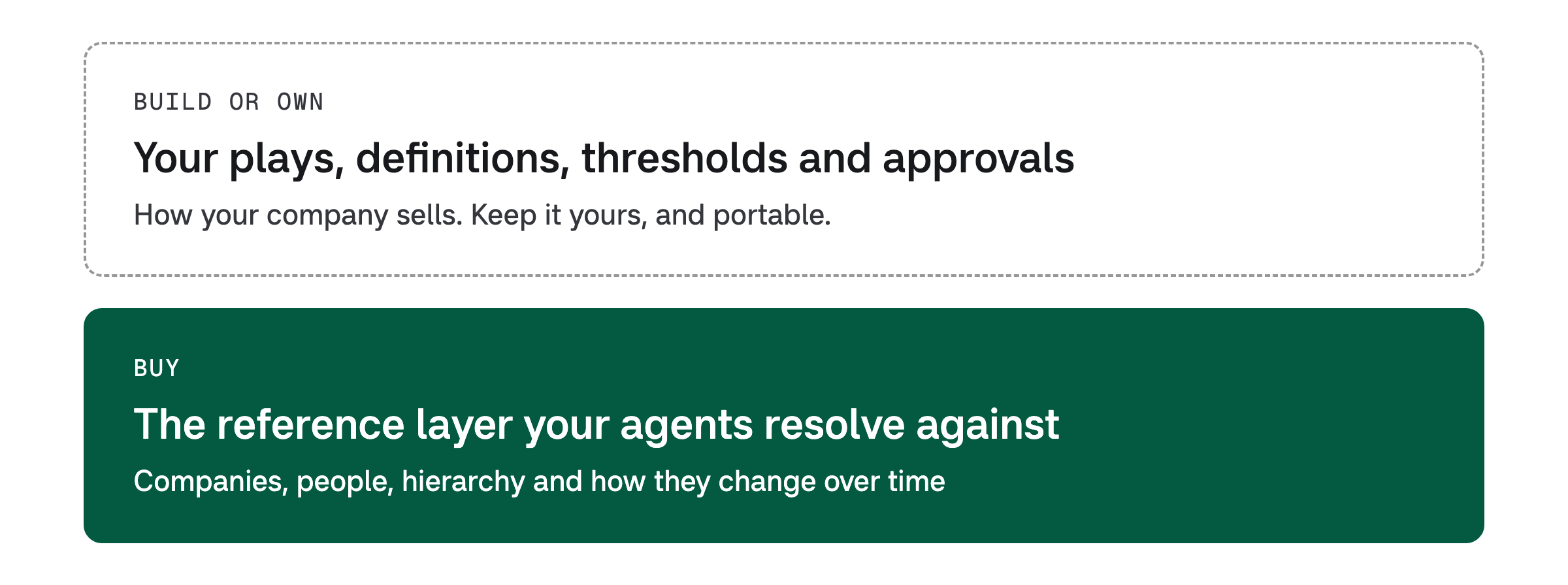
Operators are landing in a similar place. Kyle Norton, a revenue leader, has written on the question. He argues against buying the layer that encodes how your company sells: buy the commodity infrastructure, and build or at least own the rest. By that test a vendor's graph should be the infrastructure, and your plays and definitions should stay yours.
A workable split is to own your plays, thresholds, and approvals, and buy the reference layer. The winners with AI in go-to-market will be the teams that spend their time on the context graph first, whichever way they get it. Our guide to the GTM data foundation sets out a roadmap by company size.
Frequently asked questions about evaluating a GTM context graph
What is a GTM context graph?
A GTM context graph is a connected, queryable structure that links accounts, contacts, engagements, and signals so AI agents can read them as one picture. It combines your first-party data with outside data about companies and people. Our B2B context engine guide covers how that reaches agents.
How is a context graph different from a CRM?
A CRM records the current state of a relationship as people enter it. A context graph resolves records from many systems to one identity and keeps the events behind that state. It does not replace the CRM. It gives agents a reliable way to read it alongside the rest of your go-to-market intelligence.
Which GTM vendors have a context graph?
ZoomInfo, Day AI, RevSure, Warmly, Vasco, and Octave use the term for their own products. ZoomInfo's it built on 20 years' of proprietary data, plus your own sources (CRM, and other tooling you use).
What data does a GTM context graph need?
It needs reference data on companies and people, the core of go-to-market data, plus your CRM and engagement history, conversation data, and outside signals such as intent and job changes. The reference data matters most, because every other record is matched against it.
How do I test whether a context graph improves results?
Run the same agent task on a set of your own accounts twice, once with the graph and once with plain retrieval from your CRM. Compare accuracy, time, and cost per run. Then check a sample of answers against their cited sources.
