
Marketing fills the funnel and sales works it top to bottom, so the deals most likely to close get worked last.
Predictive lead scoring rearranges the order, but the platforms that do it vary widely. Some run out of the box on your CRM data. Others need a RevOps function to keep them tuned. Account-level platforms suit ABM motions, lead-level ones suit inbound funnels. Pick the wrong one and your reps quietly ignore the scores within a quarter.
This guide breaks down the 9 best predictive lead scoring tools for 2026, how they work, what they cost, and how to evaluate them. ZoomInfo sits at the top because the data foundation determines model accuracy, and no other platform here owns its own verified B2B data layer.
What Is Predictive Lead Scoring?
Predictive lead scoring uses machine learning to forecast conversion likelihood. The model trains on your closed-won and closed-lost history, learns the patterns that distinguish the two, and applies that learning to new leads.
That's the core difference from rules-based scoring, which relies on fixed point values you set manually (+10 for a demo request, +5 for a pricing page visit). Predictive scoring finds the patterns automatically, including signals you wouldn't have weighted on your own. For the basics on rules-based scoring, see our lead scoring guide.
Predictive scoring platforms typically combine three signal layers:
Firmographic and technographic fit. Company size, industry, tech stack, and other attributes matching your ICP.
Behavioral and engagement signals. Website visits, email opens, content downloads, product usage, and meeting history.
Intent and external signals. Third-party research activity, funding events, hiring trends, and executive changes that indicate buying readiness.
Models refresh continuously as new outcomes arrive, so prioritization stays current without manual maintenance. The accuracy ceiling is the data underneath. Stale records produce confident but wrong scores.
The 9 Best Predictive Lead Scoring Tools for 2026
Each platform takes a different approach, so the best fit depends on your data maturity, GTM motion, and existing tech stack.
Platform | Best for | Key differentiator | Pricing |
ZoomInfo | Marketing, sales, and RevOps teams scoring against verified B2B data | GTM Context Graph, 500M+ verified contacts, native Copilot AI | Custom (no public pricing) |
6sense | Account-level predictive for ABM | Anonymous intent + buying stage prediction | Custom (no public pricing) |
HubSpot | HubSpot-native teams | Native scoring inside the CRM and marketing platform | From $800/mo (Marketing Hub Professional); predictive scoring on Enterprise |
Salesforce | Salesforce-native predictive | Predictive AI built into Sales Cloud, now sitting alongside Agentforce | Custom (Einstein 1 / Agentforce bundles) |
Clay | RevOps and GTM engineering teams building custom models | AI-powered workflow scoring with Claygent | Free plan; paid from $167/mo |
MadKudu | Product-led growth motions | Product usage signals + firmographic fit | Custom (no public pricing) |
Demandbase | Enterprise ABM as a 6sense alternative | Account intelligence + ABM ad platform | Custom (no public pricing) |
Pecan AI | Mid-market teams without a data science function | No-code predictive modeling on your data warehouse | From $760/mo (Starter) |
Apollo | Outbound teams wanting scoring inside a prospecting platform | AI lead scoring built on prospecting and CRM data, with transparent score criteria | From $49/seat/mo (Basic) |
1. ZoomInfo
ZoomInfo is the GTM intelligence platform behind predictive scoring at companies including Adobe, Microsoft, Snowflake, and PayPal.
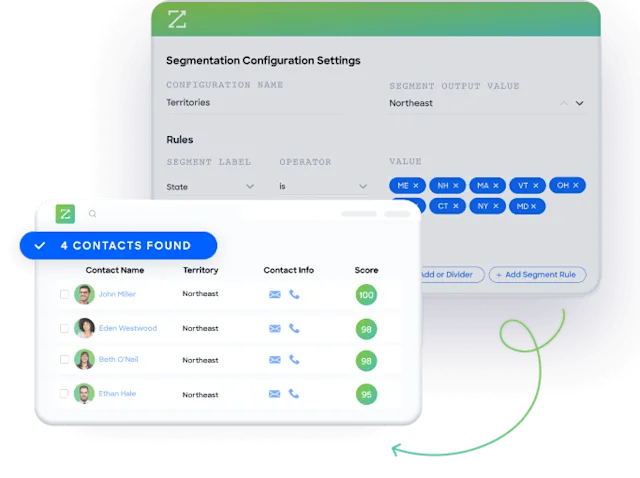
Its lead scoring software lets marketing and RevOps teams build custom models on standard or custom objects, with weighted inputs and a choice of attribute, aggregate, or multidimensional scoring. Scoring runs on ICP fit and intent signals, then pushes to your CRM to power routing. Sellers see the prioritized output through Copilot, which surfaces high-scoring accounts and recommended actions in real time.
The data and the model live in the same platform, which matters for scoring accuracy. Models score against continuously verified contact records with 95% accuracy on first-party data, 30,000+ tracked technologies across 30M+ companies, and proprietary intent signals across thousands of B2B topics. Scoring inputs come from the GTM Context Graph, which processes 1.5B+ data points daily across your CRM history, conversation intelligence, intent signals, and ZoomInfo's verified B2B data.
That foundation has earned 142 #1 rankings in G2's Spring 2026 reports across Sales Intelligence, Buyer Intent, Market Intelligence, and Lead Capture. Forrester named ZoomInfo a Leader in its latest Wave for Intent Data Providers.
Key features:
Instant data segments built on job title, industry, region, and other criteria, with auto-populated CRM fields
Account-based scoring across demographic, firmographic, and technographic ICP criteria
Look-alike modeling against closed-won deals in your CRM
500M+ verified contacts, 135M+ verified phone numbers, and 200M+ verified business emails
Native integrations with Salesforce, HubSpot, Outreach, Salesloft, and 120+ other platforms
Limitations:
Pricing is consumption-based and custom, with less public transparency than competitors offering published tiers
Full value requires the broader platform (Copilot, Chorus, intent infrastructure) rather than scoring as a standalone feature
Best ROI assumes RevOps capacity to operate the GTM Context Graph workflow end to end
Pricing: Consumption-based, custom to seats and feature tier. Free trial available.
2. 6sense
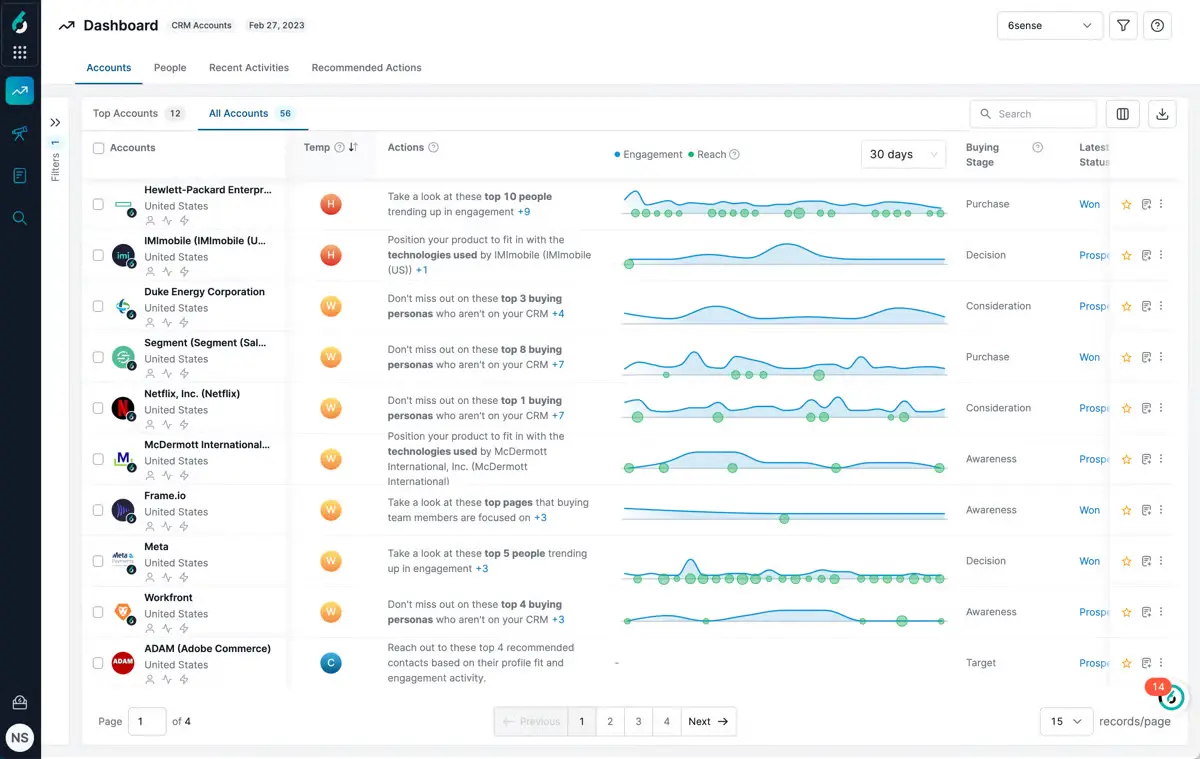
6sense is an account-based predictive platform built around buying-stage prediction. The model scores entire buying committees rather than individual contacts, using anonymous intent signals, web behavior, and firmographic data to predict which accounts are in-market right now. Scores update continuously based on third-party research activity across the web.
Best fit for ABM motions where the goal is identifying anonymous in-market accounts before a form fill. 6sense has been named a Leader in Forrester Wave reports covering ABM and revenue marketing platforms.
Key features:
Account-level predictive scoring with anonymous intent signals
Buying stage prediction (Awareness, Consideration, Decision, Purchase)
Unlimited keyword tracking for research activity
AI-driven Predictive Audiences for advertising and outbound
Native integrations with Salesforce, HubSpot, Outreach, and Salesloft
Topic intent powered by 6sense's proprietary signal network
Limitations:
Scoring at the individual contact level requires workarounds or a layered tool like Marketo or HubSpot
Intent data accuracy drops on EU traffic and VPN users due to privacy regulations
Enterprise pricing and feature set put it out of reach for inbound-led SMB teams
Pricing: Custom. 6sense does not publish pricing publicly.
See how it stacks up directly in our 6sense vs ZoomInfo comparison.
3. HubSpot
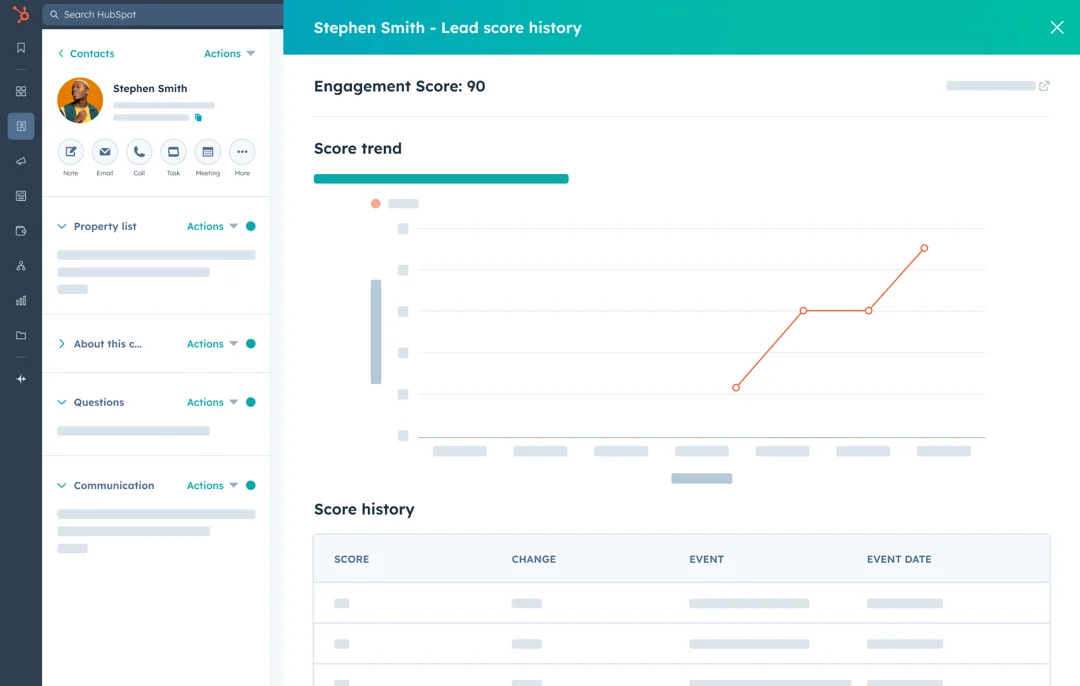
HubSpot's lead scoring is included in Marketing Hub Professional (up to 5 scores), with predictive lead scoring and AI recommendations available on the Enterprise tier (up to 50 scores). The model trains on your historical conversion data, identifies which contact attributes and engagement behaviors most strongly correlate with closed deals, and scores new leads automatically. Scoring lives natively in the same platform as your CRM, marketing automation, and email workflows, so there is no separate sync to manage.
Strongest fit for teams already standardized on HubSpot. The native integration eliminates the data sync problems that plague third-party scoring tools.
Key features:
AI predictive scoring trained on past conversions
Automatic model refresh as new data flows in
Score-triggered workflows for routing, sequence enrollment, and rep alerts
Visual workflow builder with no engineering required
Real-time score updates as prospects engage
Lifecycle stage and lead status tracking built in
Limitations:
Predictive scoring with AI recommendations requires the Enterprise tier
Less effective on small contact databases. Model accuracy improves with data volume
Limited customization compared to dedicated predictive platforms
No native intent data. Signals are limited to first-party HubSpot activity
Pricing: Marketing Hub Professional starts at $800/mo with up to 5 scores. Predictive lead scoring (with AI recommendations and up to 50 scores) sits in the Enterprise tier, starting at $3,600/mo.
Compare scoring depth side by side in our HubSpot vs ZoomInfo breakdown.
4. Salesforce
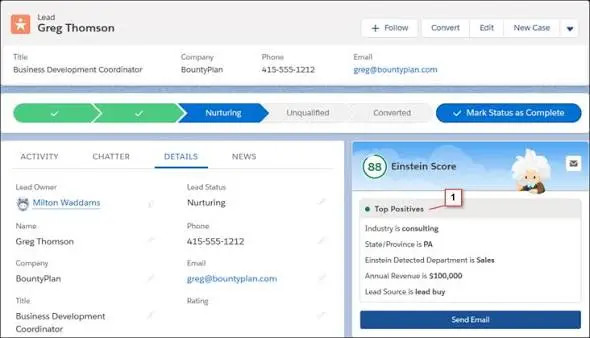
Einstein is Salesforce's AI layer across the platform, and predictive lead scoring is one of its longest-running applications. The model runs natively inside Salesforce, analyzing field values, engagement history, and conversion outcomes to surface contributing factors alongside each score. Reps see why a lead scored high directly in the lead record.
Salesforce has also been pushing Agentforce as the next layer above Einstein, with agentic lead qualification as a headline use case. Different mechanism than predictive scoring, but likely where Salesforce-native teams evaluate next.
Strongest fit for Salesforce-native teams that want predictive scoring without adding another vendor to the stack.
Key features:
Native AI scoring built into Sales Cloud
Score factor transparency showing top reasons each lead scored as it did
Zero-configuration setup. Einstein trains on existing CRM data
Automatic model retraining at regular intervals
Direct integration with Sales Cloud workflows and reports
Limitations:
Requires a minimum of 1,000 leads and 120 conversions in the past 180 days to build a custom model
No native intent data. Scoring is limited to data already in Salesforce
Custom field weighting requires admin work and Einstein expertise
Limited cross-channel signal coverage beyond CRM activity
Pricing: Historically positioned as an add-on to Sales Cloud. Pricing has restructured under Einstein 1 and Agentforce bundles, so current cost depends on which package you're on. Contact Salesforce for a quote.
5. Clay
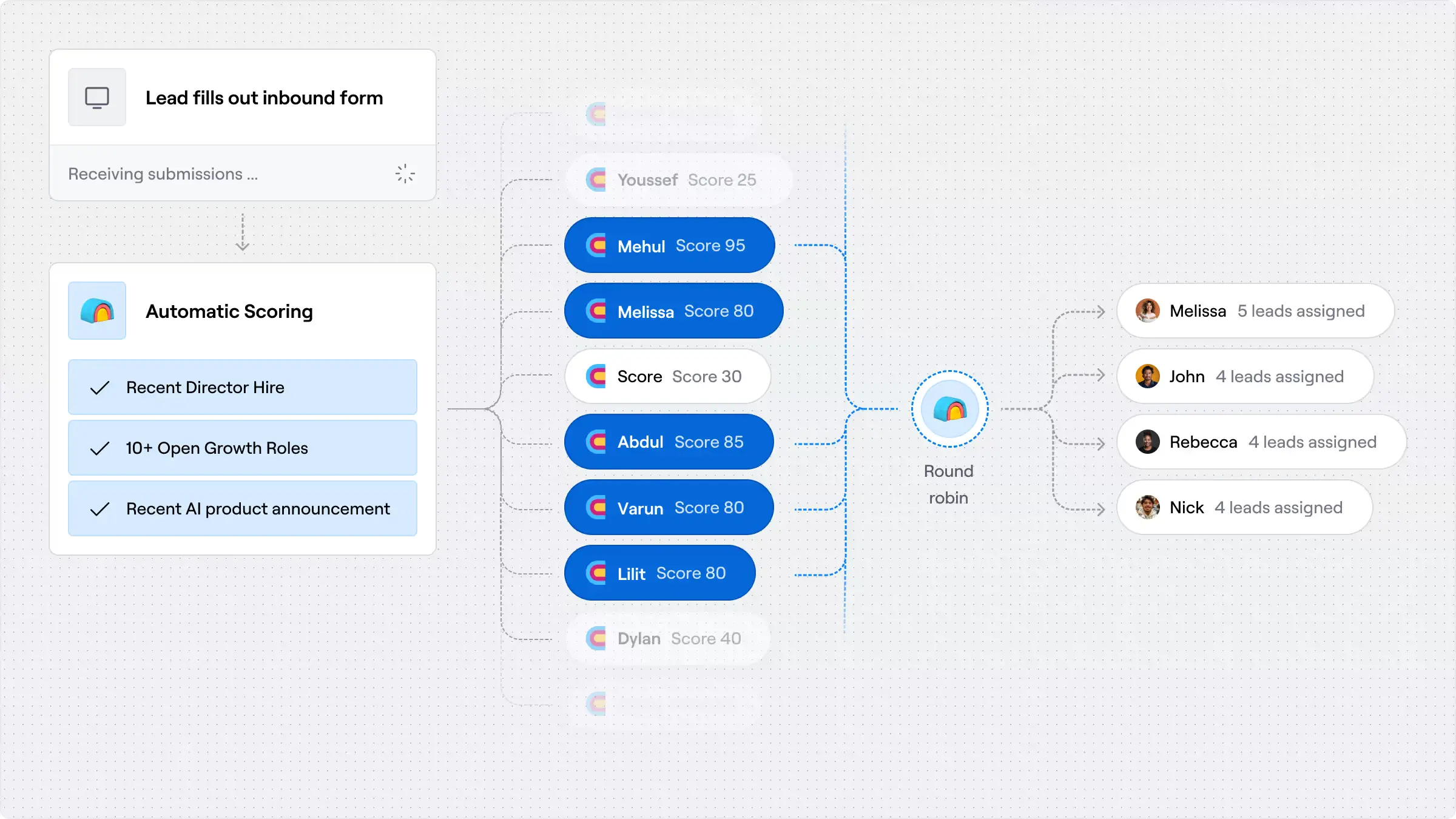
Clay takes a different approach from the packaged ML platforms above. Rather than shipping a fixed predictive model, Clay gives RevOps and GTM engineering teams a workflow canvas to combine firmographic data, intent signals, product behavior, and AI-extracted attributes (via the Claygent AI researcher) into a custom scoring formula. The score runs before a lead enters your CRM, so disqualified leads never reach the pipeline.
Best fit for teams with strong RevOps or GTM engineering capacity who want full control over scoring logic. Less plug-and-play than 6sense or HubSpot, more flexible in exchange.
Key features:
AI-powered formula builder for custom scoring logic
Claygent AI researcher pulls unstructured signals (website content, recent news, LinkedIn profiles)
Waterfall enrichment from 100+ data providers feeds the scoring inputs
Native integrations with Salesforce, HubSpot, and outbound sequencers
Scoring runs pre-CRM, so disqualified leads never enter the pipeline
Free plan available for prototyping
Limitations:
Requires GTM engineering or RevOps capacity to build and maintain models
Usage-based pricing (actions plus data credits) can escalate quickly at scale
Phone number coverage weaker than dedicated B2B data providers
No out-of-the-box ML model. You build the scoring logic yourself
Pricing: Free plan with limited actions and data credits. Launch starts at $167/mo, Growth at $446/mo (Clay's recommended tier). Custom enterprise pricing available.
See where the approaches diverge in our Clay vs ZoomInfo comparison.
6. MadKudu
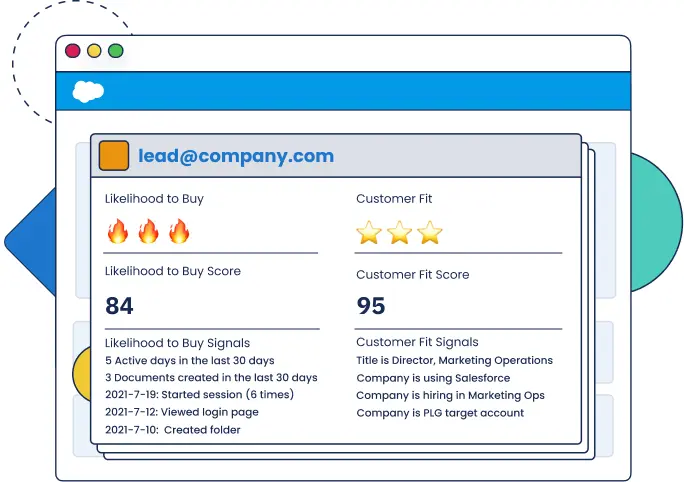
MadKudu is purpose-built for product-led growth motions, where product usage signals predict conversion better than any form-fill. The platform combines firmographic fit (Customer Fit score) with behavioral and product engagement (Likelihood to Buy score) to give PLG teams two distinct prioritization signals. Native integrations with Segment, Mixpanel, and Amplitude pull product behavior directly into the model.
Strongest fit for freemium and free-trial SaaS where the meaningful question is whether a user hit a usage threshold, not whether they downloaded a whitepaper.
Key features:
Separate Customer Fit and Likelihood to Buy scores for distinct prioritization angles
Native product analytics integrations (Segment, Mixpanel, Amplitude)
Model transparency with top contributing factors per score
Real-time scoring updates daily as new signals fire
Pre-built scoring workflows for common PLG motions
Customer success team known for hands-on implementation support
Limitations:
Requires enough closed-won data to train accurate models. Early-stage teams may not have it
Niche fit. Less useful for traditional B2B outbound motions
Smaller integration ecosystem than 6sense or HubSpot
No public pricing anchor, which makes early evaluation harder
Pricing: Custom. MadKudu does not publish pricing publicly.
7. Demandbase
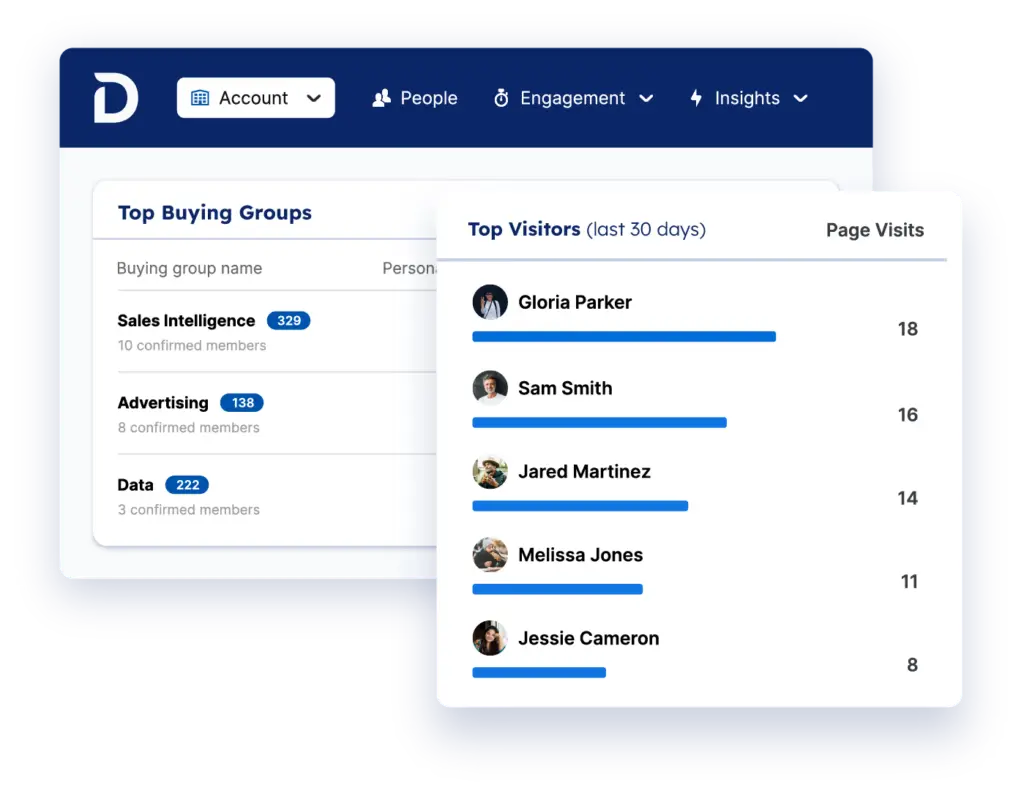
Demandbase is an account-based predictive platform that competes head-on with 6sense in the enterprise ABM space. The platform scores accounts using a combination of intent data, engagement signals, and firmographic fit, then routes high-scoring accounts to sales with recommended plays. Account Intelligence pulls technographic, firmographic, and intent data from Demandbase's proprietary network.
Strongest fit for enterprise ABM teams that want an alternative to 6sense, particularly those running advertising and outbound scoring together in one platform.
Key features:
Account-level predictive scoring with intent and engagement signals
Account Intelligence combining firmographic, technographic, and intent data
Native ABM advertising platform tied to scoring outputs
AI-powered audience building and segmentation
Predictive Account Identification for anonymous web visitors
Integrations with Salesforce, Marketo, HubSpot, and Outreach
Limitations:
Enterprise pricing limits accessibility for smaller teams
Intent data network smaller than 6sense's
Steeper learning curve than HubSpot or Einstein
Implementation typically takes weeks to months
Pricing: Custom. Demandbase does not publish pricing publicly. Quotes are gated through their sales team.
Compare data depth and ABM workflow in our Demandbase vs ZoomInfo breakdown.
8. Pecan AI
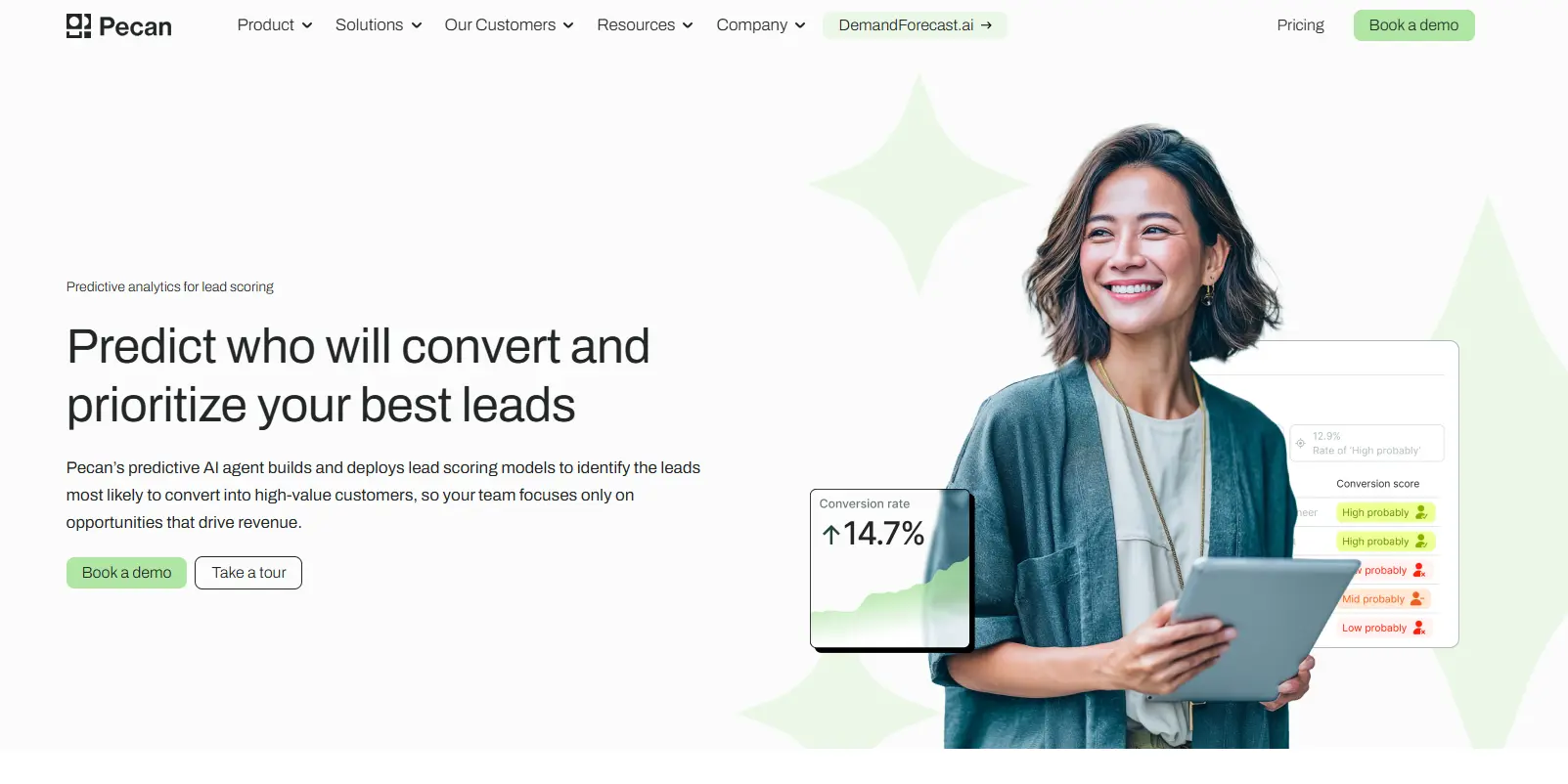
Pecan is a predictive AI platform built for business teams that want machine learning without hiring a data science function. Users connect Pecan to their data warehouse, CRM, or marketing automation platform, and the platform handles feature engineering, model selection, and prediction generation. For lead scoring specifically, Pecan trains on historical conversion data and predicts which leads will close.
Best fit for mid-market teams with reasonably clean data who want to own their predictive models without building a data team. If your data isn't there yet, start with the AI use cases that fix it first.
Key features:
No-code predictive modeling interface
Native data warehouse connectors (Snowflake, BigQuery, Redshift)
Pre-built use cases for lead scoring, churn prediction, and LTV
Model explainability with contributing factor breakdowns
Continuous model retraining as new outcomes arrive
Integrations with Salesforce, HubSpot, and major marketing automation platforms
Limitations:
Requires reasonable data hygiene to produce accurate models
Less workflow tooling than HubSpot or 6sense. Scoring is the core, activation is layered on
Smaller integration ecosystem than larger platforms
Best for teams with an existing data engineering or RevOps function
Pricing: Starter from $760/mo (2 monthly prediction batches, 500M rows of storage). Team from $1,400/mo (10 batches, 2Bn rows). Business is custom.
9. Apollo
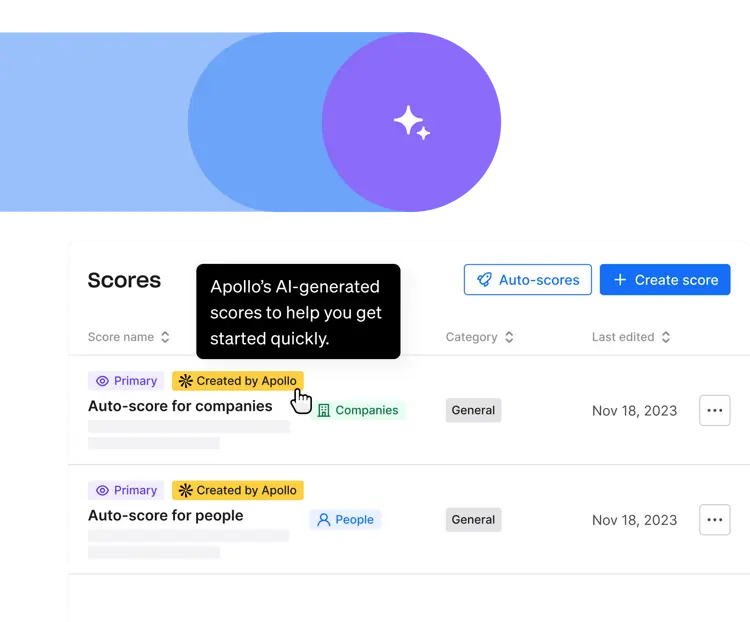
Apollo is best known as a sales prospecting and engagement platform, with AI lead scoring built in as a use case alongside its B2B database and sequencing tools. The scoring engine pulls from your CRM history, Apollo activity, and the firmographic and behavioral data already in the platform. Reps see scores directly in their prospecting workflow rather than a separate dashboard.
Strongest fit for outbound teams already using (or considering) Apollo for prospecting who want scoring inside the same platform rather than a separate tool. Less suited to teams running enterprise ABM motions or pure-PLG product-usage scoring.
Key features:
AI-generated auto-score models trained on CRM and Apollo activity
Custom scoring models with full control over criteria, weightings, and variables
Real-time score filtering inside Apollo's prospecting search
Score transparency showing the exact criteria behind each lead's score
Intent topics and filters for layering buying signals into scoring
Native integrations with Salesforce, HubSpot, Gmail, Outreach, and other GTM tools
Limitations:
Lead scoring is a feature inside a broader prospecting platform, not a dedicated predictive tool
Less account-level depth than dedicated ABM platforms like 6sense or Demandbase
Credit-based pricing for data and dialer usage can scale with team size
Pricing: Free plan with 900 credits per seat per year. Basic at $49/seat/mo (annual), Professional at $79/seat/mo, Organization at $119/seat/mo with a 3-seat minimum. AI Lead Scoring is included from Basic upward.
Compare AI scoring depth and B2B data quality in our Apollo vs ZoomInfo comparison.
How To Evaluate Predictive Lead Scoring Software
Run every vendor through these five criteria before you sign.
Data quality and freshness
The model is only as good as the data underneath. If contact and account records decay between training and scoring, the model is predicting against stale assumptions.
What to check:
Where the vendor's contact and firmographic data comes from, and how often it's verified
How the platform handles data decay between scoring cycles
Whether the platform enriches existing CRM records before scoring runs
Model explainability
A score without reasoning gets ignored. Sales reps who can't see why a lead scored high won't trust the prioritization, no matter how accurate the model is.
What to check:
Whether the model surfaces top contributing factors per score
Whether reps can see firmographic, behavioral, and intent reasoning broken out
How score changes are communicated when they happen
CRM and signal integration
Scoring that lives in a dashboard nobody opens doesn't move pipeline. The score needs to land where reps already work.
What to check:
Native push of scores into Salesforce or HubSpot fields
Score-triggered workflows, routing rules, and rep alerts
Lift to integrate first-party intent data from your website, product, or email tools
Data volume requirements
Predictive models need historical data to learn from. Some platforms require 1,000 or more conversions before they produce reliable scores.
What to check:
Minimum data volume required to train an accurate model
Time to reliable predictions after onboarding
Fallback approach if your data volume is insufficient
Account-level vs lead-level scoring
B2B buying happens at the account level with multiple stakeholders. Lead-level scoring on its own misses buying-committee signals.
What to check:
Whether the platform scores at the account level, lead level, or both
How the platform handles buying committee signals when one person fills a form
Whether anonymous web activity gets connected to known accounts
Build Predictive Scoring on a Verified Foundation
Predictive lead scoring tools each bring something different. Account-level prediction, PLG-specific signals, no-code modeling, native CRM integration. Pick the one that fits your motion, your team's capacity, and the data you can feed it.
Whichever platform you pick, run it through the five criteria above before you sign. The model is one input. Everything that flows into it is the rest.
Talk to our team about how ZoomInfo's verified contact records and buyer intent feed predictive scoring at scale.
Frequently Asked Questions
How is predictive lead scoring different from traditional lead scoring?
Traditional lead scoring assigns fixed point values to actions and attributes (+10 for downloading a case study, +5 for visiting the pricing page). Predictive lead scoring uses machine learning to analyze historical conversion data, identify the patterns that predict closed deals, and score new qualified leads automatically. Predictive models often catch signals humans wouldn't think to score, such as specific page visit sequences or technology stack combinations.
How much data do I need to use predictive lead scoring?
Most platforms require at least 1,000 to 2,000 closed-won and closed-lost records before the model produces reliable predictions. Salesforce Einstein, for example, requires 1,000 leads and 120 conversions in the past 180 days for a custom model. Early-stage teams without enough conversion history should start with rules-based scoring and layer predictive on top once data accumulates.
Can I use predictive lead scoring without a CRM?
Most predictive scoring tools require a CRM to pull conversion outcomes from. A few platforms like Clay and Pecan can read from data warehouses, spreadsheets, or marketing automation tools, but the model still needs historical outcome data to train against.
Does predictive lead scoring work for ABM?
Yes, particularly with account-level platforms like 6sense, Demandbase, and ZoomInfo. These tools score entire accounts based on buying committee signals, intent, and engagement, rather than individual leads. For ABM motions, account-level predictive scoring typically outperforms lead-level scoring because B2B buying decisions are made by committees, not individuals.
What's the difference between predictive lead scoring and AI lead scoring?
The terms are largely used interchangeably. Predictive lead scoring traditionally refers to machine learning models that forecast conversion likelihood. AI lead scoring sometimes implies continuous model updates and more dynamic learning. Most modern platforms market themselves as both.
How long does it take to implement predictive lead scoring?
Implementation timelines vary by platform. Native scoring inside HubSpot, Salesforce, or Apollo can be running in days. Dedicated predictive platforms like 6sense or Demandbase typically take 4 to 12 weeks for full implementation, including data integration, model training, and team enablement. Plan for additional time to build sales team trust in the scores before tying them to routing rules or quotas.
