
A multi-agent orchestration platform is software that coordinates several specialized AI agents under a supervisor, passes context between them and governs what they do, so a team of agents can finish a complete process. For GTM teams, that process is a play: from a buying signal to a briefed rep and an updated CRM record.
The category is crowded and the labels are loose. Many products marketed as multi-agent run one agent that calls a few tools, and lists of the best platforms mix developer frameworks with business software. This list checks every platform against its own documentation, tests it on a real GTM play and ranks it by how ready it is for sales, marketing and RevOps teams.
What Is a Multi-Agent Orchestration Platform?
A multi-agent orchestration platform is the software layer that builds, runs and governs teams of AI agents in production. It gives you a supervisor or orchestrator agent that plans and routes the work, specialist agents that each handle one job, shared state between them, and the monitoring and access controls to run them safely.
The platform is what turns AI agent orchestration from a design pattern into something your team can run every day. Our guide to that topic explains the components, patterns and control models in depth. This list focuses on the products.
Platforms vs frameworks vs single-agent tools
Four kinds of product show up when you search for multi-agent orchestration, and they ask very different things of your team:
Type | Who it's for | Examples | What you still have to build |
GTM orchestration platform | Sales, marketing and RevOps teams | ZoomInfo Agent Teams, Salesforce Agentforce, Relevance AI | Your plays and rules, with data and integrations included or close to it |
General agent platform | IT and enterprise automation teams | Microsoft Copilot Studio, Gemini Enterprise Agent Platform, IBM watsonx Orchestrate | GTM data, CRM and engagement integrations, and every play |
Developer framework and platform | Engineers and GTM engineering teams | CrewAI, LangGraph with LangSmith | The agents, data connections, hosting choices and governance setup |
Single-agent tool | One team with one job | AI SDRs, meeting notetakers, chatbots | Everything outside that one job |
Single-agent tools stay off this list. An AI SDR can be excellent at first touches, but it doesn't coordinate other agents or hand work across systems.
How We Picked These Platforms
Every platform on this list passed a three-part multi-agent test, checked against the vendor's own product documentation, and was then judged on a real GTM play. Here's the test each one had to pass:
Orchestration. A supervisor or orchestrator agent plans the work and hands steps to several specialist agents.
Shared context. Agents pass state and context to each other across handoffs, so no agent starts from zero.
Production readiness. The multi-agent features are generally available, with monitoring, access control and an audit trail.
Platforms that failed any part stayed off the list. HubSpot Breeze, for example, has strong agents, but its multi-agent capabilities were still in beta when we checked.
We then ran a GTM test on every platform: could it run champion activation from start to finish? A past buyer changes jobs, an agent spots the move, another researches the new account, the supervisor checks ownership, a writing agent drafts outreach and every step lands back in the CRM. For general and developer platforms, each entry says what your team would need to build to get there.
Data weighed heavily in the ranking. ZoomInfo's GTM Bench gave the same agent the same ten GTM research tasks with different data tools, and specialist data tools returned verified work emails about four times as often as web search. A platform that brings GTM data with it skips the hardest part of the build.
Multi-Agent Orchestration Platforms Compared
The eight platforms split into three groups: built for GTM, general enterprise platforms and developer platforms. Here's how they compare at a glance:
Platform | Best for | GTM data built in | Build style | Pricing model |
ZoomInfo Agent Teams | Complete GTM plays across the revenue cycle | Yes, verified contacts, companies and signals | Templates, plain language, API, CLI or MCP | Flexible packages, with GTM.AI free to start |
Salesforce Agentforce | Teams standardized on Salesforce | CRM data, with ZoomInfo data in the Prospecting Agent | Low-code builder and packaged agents | Flex Credits or per-user add-ons |
Relevance AI | Custom GTM workflows without code | No, you connect your sources | No-code | Free plan, then usage-based plans |
Microsoft Copilot Studio | Microsoft 365 and Dynamics shops | No | Low-code | Prepaid credits or pay-as-you-go |
Gemini Enterprise Agent Platform | Google Cloud teams building their own agents | No | Code and low-code | Usage-based on Google Cloud |
IBM watsonx Orchestrate | Regulated enterprises | No | Low-code and code | Monthly plans from Essentials to Premium |
CrewAI AMP | Engineers building role-based crews | No | Code, plus a visual Studio | Free tier, custom Enterprise |
LangGraph with LangSmith | Engineers who want full control | No | Code | Per seat plus usage |
1. ZoomInfo Agent Teams
Agent Teams is the multi-agent product in ZoomInfo's GTM Studio, and the only platform on this list that ships with its own GTM data. ZoomInfo is an all-in-one AI GTM Platform and the number one place for sales, marketing and RevOps to run agentic workflows. Its data covers 500M contacts and 100M companies, kept current by 300+ researchers, and the GTM Context Graph joins that data with your CRM records, calls, emails and signals.
You give an Agent Team an outcome, such as opening a target account or protecting a renewal. Specialist agents handle research, writing, routing and CRM updates, all working from the same account context, while a supervisor agent checks every step with real-time evaluations before the play moves on.
This short video shows four ways to structure an Agent Team, from a single run to fan-out workflows.
Champion activation runs out of the box. A scheduled play watches an Audience of past champions, spots the job change and matches the champion to the right record at the new company. It checks for an open opportunity or another owner before anything goes out, drafts outreach grounded in the old relationship and briefs the account owner in Slack. When the champion visits your pricing page two weeks later, the play picks up again with the full history.
Key features:
Plays that adapt. Job changes, intent spikes, website visits and CRM events open or resume a play, and Playbooks set the goal and bounds.
Native actions. Agents act in Salesforce, HubSpot, Outreach, Salesloft, Slack and Gmail and write every step back to the CRM.
50+ ready-made agents. Start from templates for outbound prospecting, inbound lead activation and renewals, or describe a new play in plain language.
A headless route. GTM.AI lets agents in Claude, ChatGPT or your own code use the same data and context. They connect through its API, the GTM CLI or the ZoomInfo MCP server.
Live in a day. ZoomInfo's forward-deployed team helps get the first plays running.
Guardrails. Hand over the work. Keep the control. Every Agent Team runs inside guardrails your admins set:
Monitoring. Every play is monitored, so mistakes are found and fixed before they affect the business.
Cost controls. AI credit usage is estimated before a play is activated and tracked for each Agent Team.
Admin oversight. Organization-wide dashboards show what every Agent Team is doing.
Access control. Role management decides who builds and runs Agent Teams.
Grounding. Organization-level knowledge bases keep agents aligned with your ICPs, brand and SOPs.
Real-time evaluations. Each step is checked, so a play runs the same way every time.
Audit trail. Every step is written back to Salesforce or HubSpot, with every decision recorded in one place.
ZoomInfo maintains SOC 2 controls and is ISO 27001 and ISO 27701 certified.
Pros:
An Agent Team can take on a complete GTM motion
Agents work from current, verified context, so plays don't run on stale records
No babysitting, thanks to the supervisor and real-time evaluations
Cons:
AI credits need scoping against your real volume
Built for teams, though solo founders can start with GTM.AI
Pricing: Flexible packages built around your needs. Agent Teams is part of GTM Studio with no new SKU or contract, and GTM.AI is free to start, with consumption-based credits.
Best for: Mid-market and enterprise revenue teams that want agents running complete plays across the revenue cycle, from first touch to renewal.
2. Salesforce Agentforce
Salesforce Agentforce is Salesforce's platform for building and running AI agents on CRM data. If your go-to-market process already lives in Salesforce, it's the natural place to start, because agents inherit your data model, permissions and sharing rules.
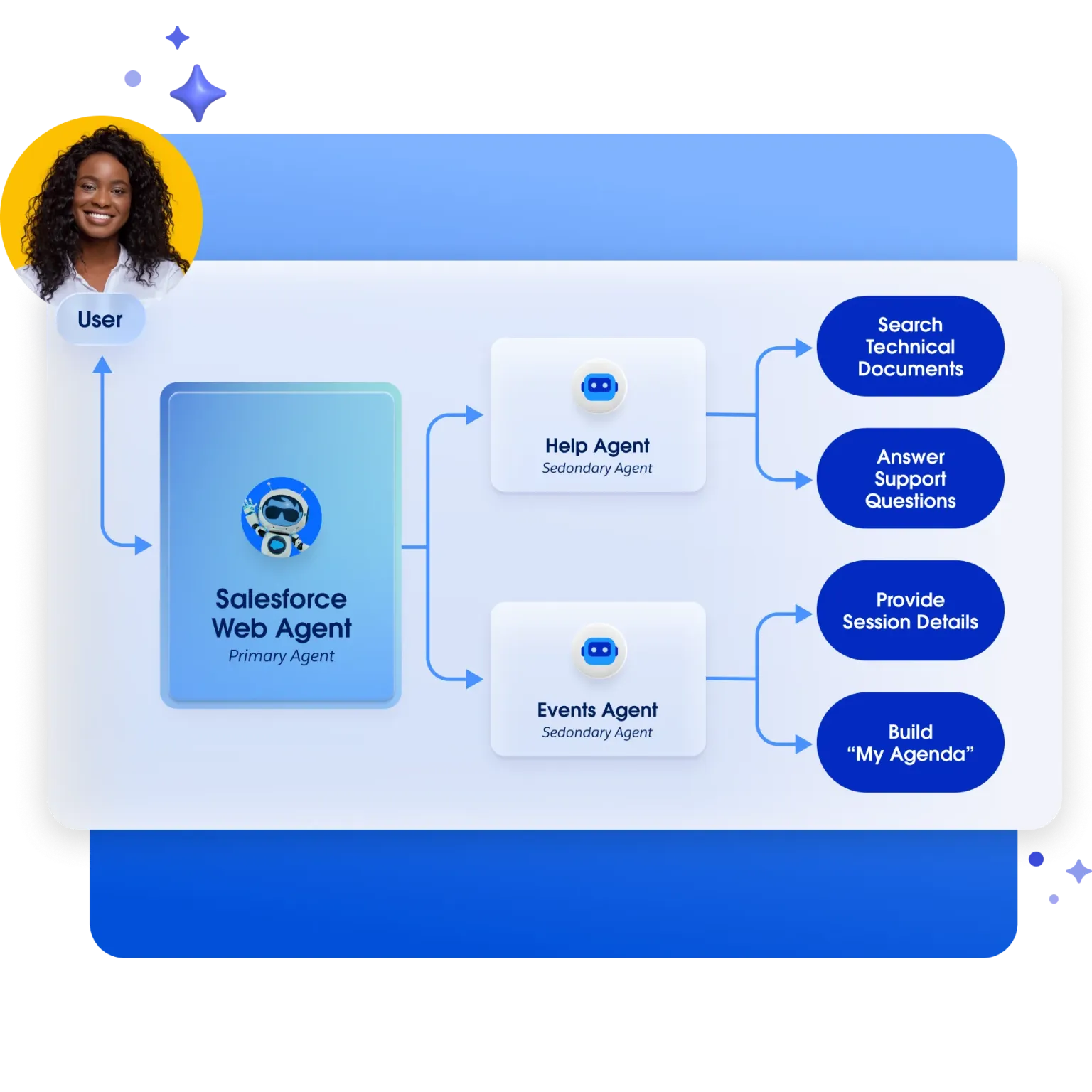
Orchestration runs through a primary agent that acts as the single entry point. Salesforce's multi-agent orchestration page explains how the Atlas Reasoning Engine reads each agent's description, instructions and actions, routes the task to the right specialist and passes the answer back. Agent2Agent (A2A) brings in third-party agents, and Agentforce Observability traces what happens between them.
For champion activation, the routing check and write-back come almost for free, since opportunities and ownership already sit in Salesforce. The gaps are upstream. You need a reliable job change signal and a custom agent or flow that ties detection, research and outreach together. ZoomInfo data already powers the Agentforce Prospecting Agent, which covers much of the research step for mutual customers.
Key features:
Packaged sales agents. Prospecting, pipeline management, account management and Sales Coach agents.
Atlas Reasoning Engine. Routes each task to the specialist agent best suited to it.
A2A support. Connects agents built outside Salesforce.
Agentforce Observability. Monitors performance and traces interactions across the agent team.
Pros:
Agents run inside the system many teams treat as their source of truth
Salesforce permissions and data model carry over automatically
A broad agent library across sales, service and marketing
Cons:
Designed for teams that run on Salesforce
Agents are only as good as the CRM data underneath
Pricing: Flex Credits at $500 per 100,000 credits, with a standard agent action using 20 credits, or Agentforce add-ons for Sales from $125 per user per month.
Best for: Sales organizations standardized on Salesforce that want agents inside their CRM.
3. Relevance AI
Relevance AI is a no-code platform for building teams of AI agents connected to your own tools and data. It's popular with RevOps and growth teams that have a specific workflow in mind and no appetite for writing code.
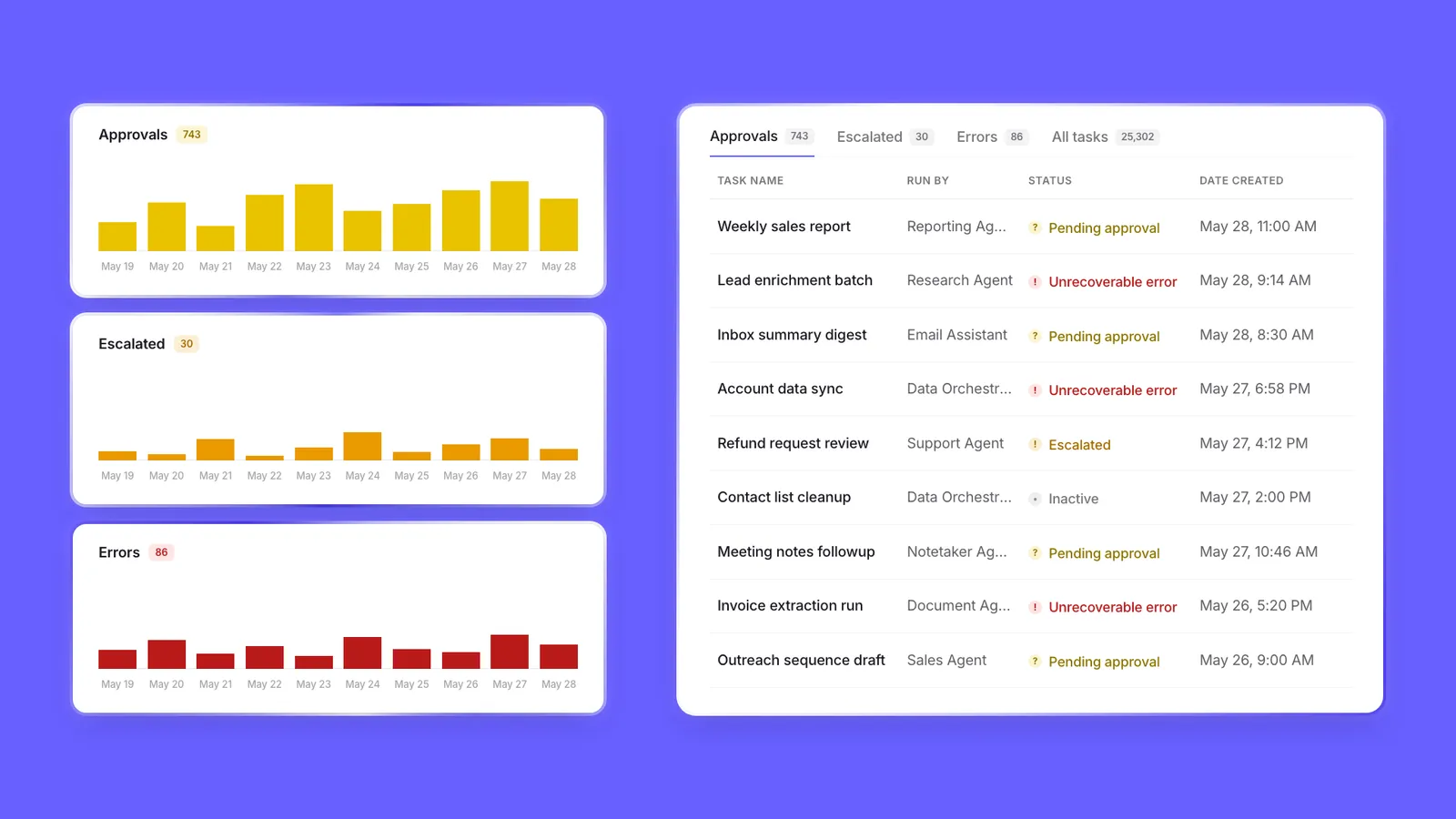
Multi-agent work happens in the Workforce, a visual canvas where you design specialist agents, connect them and watch them run. Each agent sticks to one job and the Workforce handles the handoffs, while Task View gives you one place to monitor and manage the work. Templates include Bosh, an AI BDR agent, along with agents for account research and lifecycle marketing.
Champion activation is a build, but a quick one for a no-code tool. You'd connect a job change source, build research, routing and outreach agents, link them in a Workforce and set up the CRM write-back. Relevance AI has no B2B data of its own, so the play is only as good as the sources you plug in.
Key features:
Workforce canvas. Design, connect and monitor multi-agent teams visually.
No-code tool builder. Agents can send email, update a CRM and call APIs.
Agent templates. Start from templates or generate an agent from a description.
Human oversight. Approval workflows and escalation settings keep people in the loop where you need them.
Pros:
Flexible enough for almost any custom workflow
Multi-agent teams with no code
A free plan for testing
Cons:
You build and maintain every agent and play
No data of its own, so agents rely on what you connect
Pricing: A free plan, paid plans billed on Actions and Vendor Credits, and custom Enterprise pricing.
Best for: RevOps and GTM engineering teams that want to build custom agent teams without code.
4. Microsoft Copilot Studio
Microsoft Copilot Studio is Microsoft's low-code platform for building agents across Microsoft 365, Dynamics 365 and the Power Platform. It makes sense when your company already runs on Microsoft and IT wants every team building agents in one governed place.
A main agent delegates to other agents, picking among its tools, topics and agents based on their names and descriptions. Child agents live inside the main agent and share its settings, while connected agents are separate agents with their own orchestration. External agents can join over the A2A protocol, and connections to Microsoft Foundry, Fabric and Microsoft 365 Agents SDK agents are in preview.
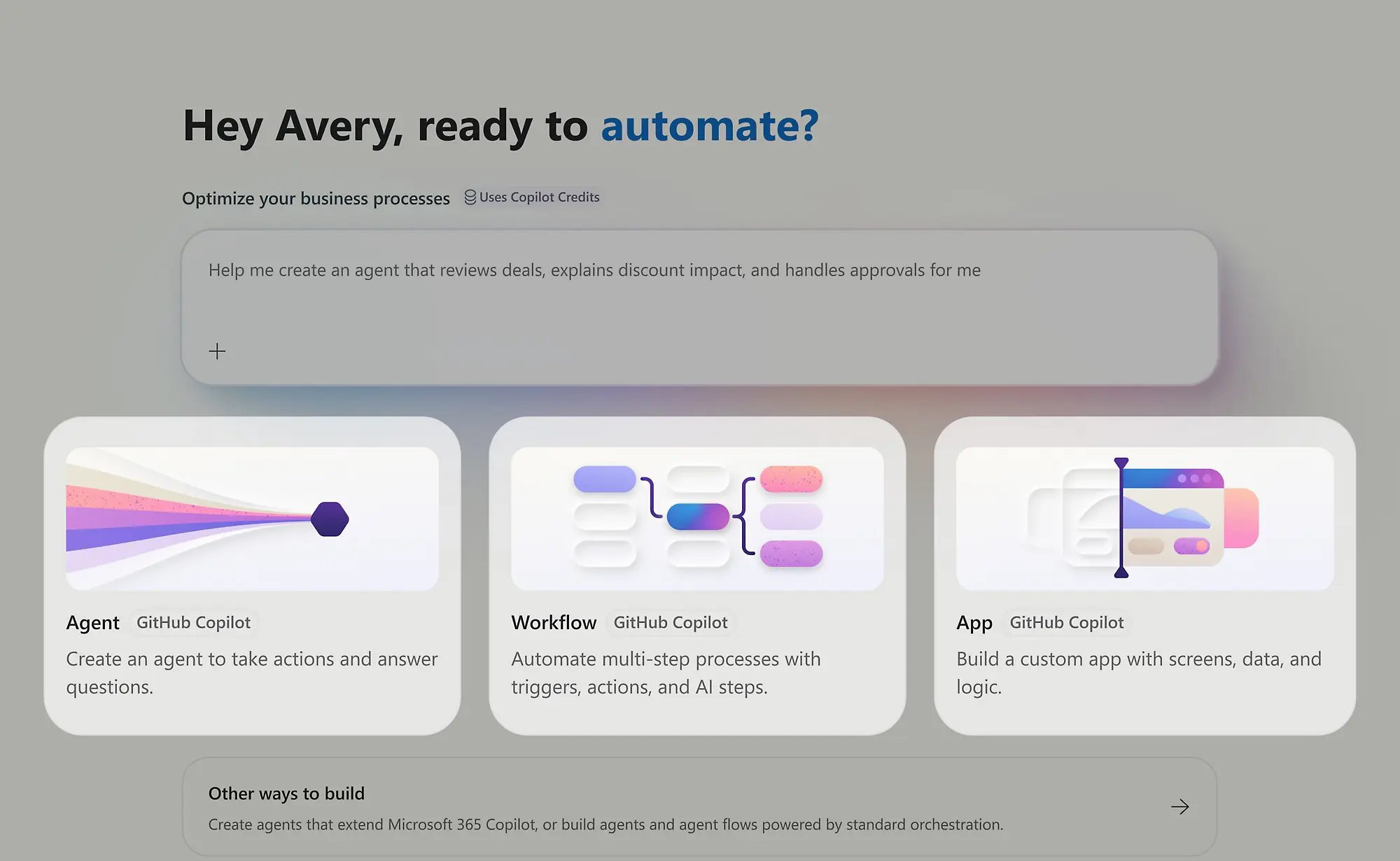
There's no GTM play to switch on, so champion activation is a project. Your team would bring in job change data through a connector, build the research and outreach agents and wire the routing check and write-back to your CRM. Microsoft also warns that routing gets less precise as the number of tools, topics and agents grows, so tight descriptions for each agent matter.
Key features:
Child and connected agents. Split work across agents inside one main agent or across separate agents.
A2A connections. Bring in agents built on other platforms.
Microsoft 365 and Teams deployment. Put agents where employees already work.
Topic redirects. Hand a conversation to another agent and pick it back up when that agent finishes.
Pros:
Deep Microsoft 365, Teams and Dynamics integration
Low-code building that IT and business teams can share
Included for internal agents with Microsoft 365 Copilot licenses
Cons:
No GTM data or ready-made GTM plays
Several external agent connections are still in preview
Pricing: A pre-purchase plan with Copilot Credit Commit Units, which saves up to 20% for paying upfront, or pay-as-you-go. Both need an Azure subscription.
Best for: Enterprises standardized on Microsoft that want to build their own GTM agents.
5. Google Gemini Enterprise Agent Platform
Gemini Enterprise Agent Platform is Google Cloud's platform for building, scaling and governing agents. Google launched it in April 2026 as the evolution of Vertex AI, and it suits engineering teams already building on Google Cloud.
The upgraded Agent Development Kit organizes agents into a graph of sub-agents and supports both generative and deterministic orchestration. Deterministic flows keep compliance-critical steps on a fixed path, Agent Runtime supports agents that run for days, and Memory Bank keeps context between sessions.
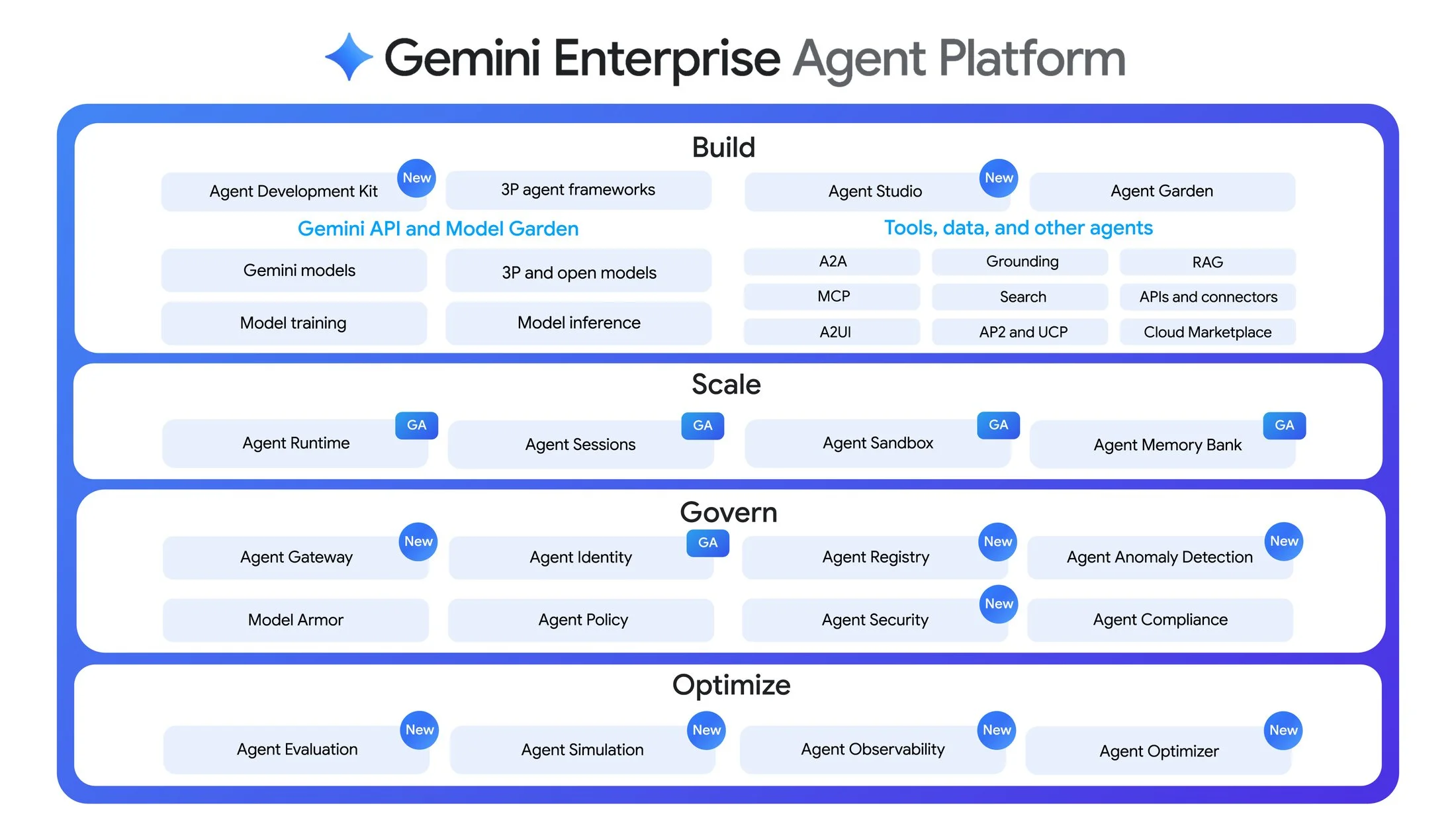
Those long-running agents fit a play like champion activation, which can stretch over weeks. Everything GTM-specific is still yours to build, though: the job change data, the CRM and engagement integrations and the play logic.
Key features:
Graph-based sub-agents. Define how agents work together with the Agent Development Kit.
Agent Runtime and Memory Bank. Long-running agents with persistent context.
Agent Identity and Agent Registry. A unique ID and audit trail for every agent, and one index of approved agents and tools.
Agent Gateway and Agent Observability. Secure connections between agents and tools, plus full execution traces.
Pros:
Strong governance, with an identity and audit trail for every agent
Built for long-running agents with persistent memory
Agents reach employees through the Gemini Enterprise app
Cons:
Engineering-heavy, with no GTM templates
Costs span several metered services, which makes forecasting harder
Pricing: Usage-based on Google Cloud, with models billed per token and agent compute, memory and storage metered separately. New customers get $300 in free Google Cloud credits, and Gemini Enterprise seats are sold separately.
Best for: Google Cloud teams with engineers building custom agents across the business.
6. IBM watsonx Orchestrate
IBM watsonx Orchestrate is IBM's platform for building, orchestrating and governing AI agents across the enterprise. It's strongest in regulated industries that need tight control over models, data and deployment.
watsonx Orchestrate brings prebuilt, partner and custom agents into one system. An agent can call other agents as collaborators, and supervisor agents use each collaborator's description to decide where a request goes. Agents from other platforms, including Salesforce Agentforce, connect through A2A, and teams can pick ReAct, Plan-Act or deterministic orchestration depending on the task.
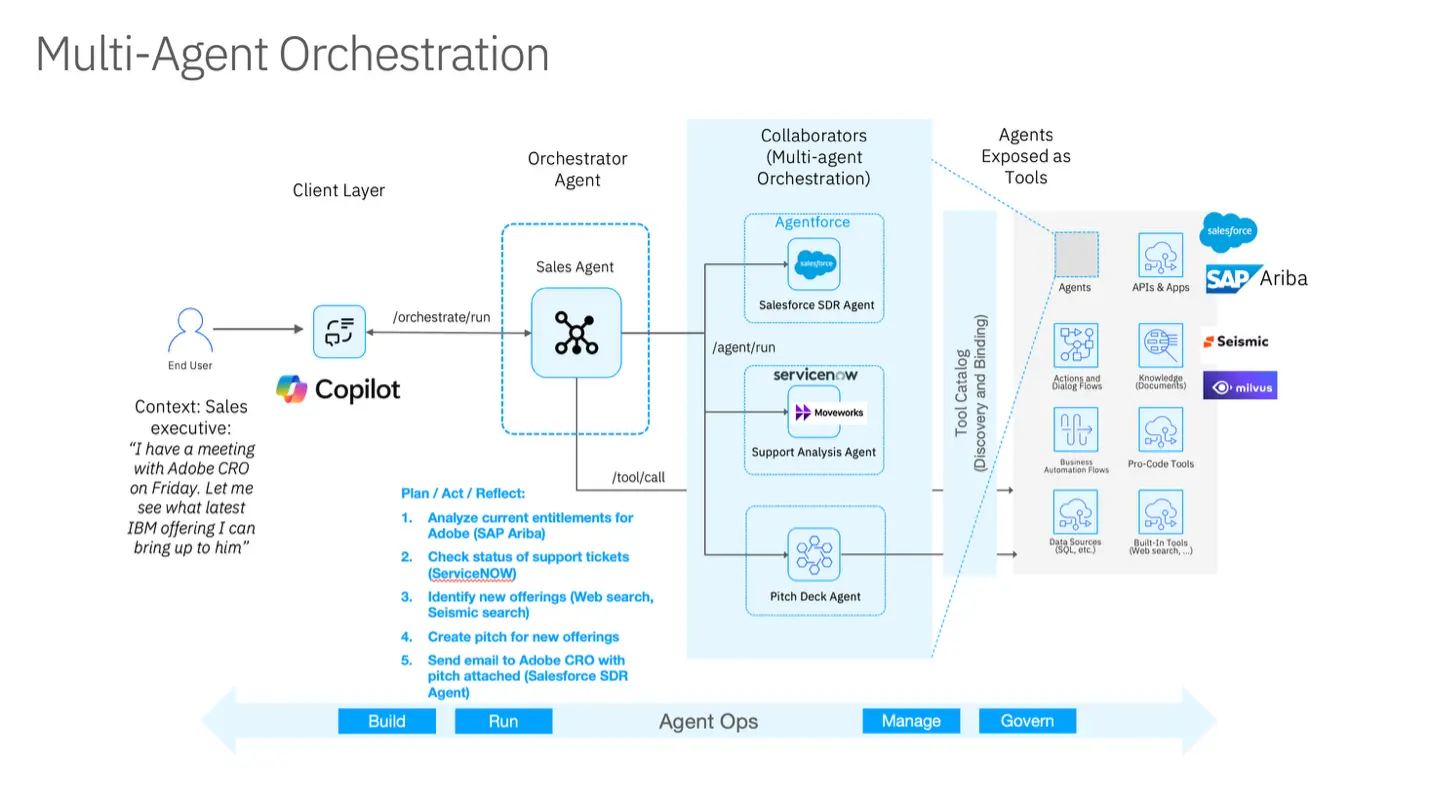
Champion activation would sit on top of that collaborator model. You'd connect a job change source, build or add research and outreach agents as collaborators and set up routing and CRM write-back through its integrations.
Key features:
Collaborator agents. Native or external agents that another agent can call to finish a task.
AI Gateway. Routes work across models from IBM, OpenAI, Anthropic, Google, Mistral and Meta.
Agentic control plane. Discover, govern and manage agents across the enterprise from one place, including agents running in environments such as Amazon Bedrock.
Prebuilt domain agents. Ready-made agents for common business tasks.
Pros:
No lock-in to a single model provider
Runs on IBM Cloud, AWS or on premises
Connects agents built on other platforms, including Agentforce
A Premium tier with data isolation for regulated industries
Cons:
No GTM data or GTM plays out of the box
Higher entry pricing than self-serve tools
Pricing: A 30-day free trial, then Essentials from $530 per month, Standard from $6,360 per month and custom Premium pricing.
Best for: Large and regulated enterprises orchestrating agents across many departments.
7. CrewAI AMP
CrewAI AMP is the agent management platform behind CrewAI, the open-source framework for building crews of role-based agents. It suits engineering teams that want an open-source core with managed deployment and monitoring on top.
Crews run as a sequential or hierarchical process. Sequential crews pass each task's output to the next, while hierarchical crews add a manager agent that plans the work, delegates by capability and checks every output. AMP deploys crews to managed infrastructure and adds execution traces and logs.
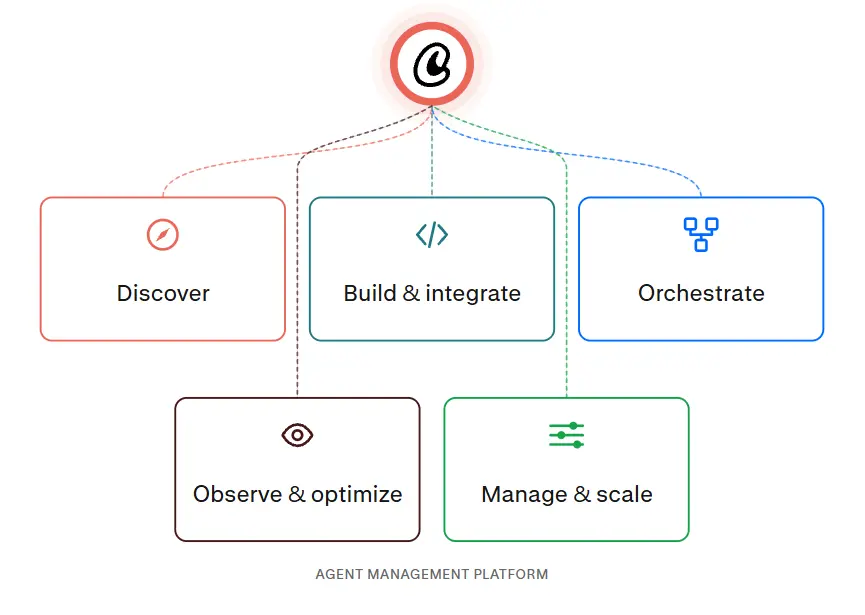
A hierarchical crew maps neatly onto champion activation, with a manager over research, routing and writing agents. Your engineers would still code the data connections, CRM write-back and scheduling.
Key features:
Role-based crews. Each agent gets a role, a goal and the tools to match.
Studio. A visual editor with an AI copilot for creating and customizing crews.
Tracing and observability. Execution traces, OpenTelemetry support, guardrails and human-in-the-loop input for every run.
Flexible deployment. CrewAI's cloud, or your own VPC or infrastructure on Enterprise.
Pros:
An open-source core with a large developer community
Role-based crews are quick to design and easy to read
Self-hosting options on Enterprise
Cons:
Engineers own the build and its upkeep
No GTM data or ready-made GTM plays
Pricing: A free plan with 50 workflow executions a month, and custom Enterprise pricing with SSO, role-based access and private deployment.
Best for: Engineering teams that want an open-source multi-agent framework with a managed platform on top.
8. LangGraph With LangSmith
LangGraph is LangChain's open-source framework for building agents as graphs, and LangSmith is the platform for tracing, evaluating and deploying them. Together they give engineers complete control over how agents coordinate.
LangChain's docs cover supervisor, swarm and handoff patterns. A supervisor agent can coordinate specialists, or agents can hand control to each other directly. By default every agent sees the shared message history, and you can narrow what each one receives.
Champion activation means coding every agent, the job change trigger, the routing check and the CRM write-back, then tracing and evaluating the play in LangSmith. Teams can bring in verified GTM data through the ZoomInfo MCP server at this stage.
Key features:
Graph-based orchestration. Model agents, state and routing as a graph.
Supervisor and swarm libraries. Prebuilt patterns for central or peer-to-peer coordination.
LangSmith tracing and evaluation. See every step and test changes before they ship.
Hosted deployments. Run agents on LangSmith, in a hybrid setup or self-hosted on Enterprise.
Pros:
Full control over state, routing and every agent's behavior
Strong tracing and evaluation in LangSmith
A free Developer plan to start
Cons:
The most engineering effort on this list
GTM data, integrations and play logic are yours to build
Pricing: A free Developer plan for one seat, Plus at $39 per seat per month with usage on top, and custom Enterprise pricing.
Best for: Engineering teams that want to design every part of a multi-agent system themselves.
Questions to Ask in a Multi-Agent Orchestration Demo
The fastest way to compare platforms is to ask every vendor to run your champion activation play live, on your own accounts, and to answer six questions while it runs:
Where does the data come from? Ask which contacts, companies and signals agents read, and how current they are. Stale records turn into wrong actions, which is why a data foundation for agentic AI matters as much as the agents.
How does the supervisor check work? Ask to see a step that failed a check and what happened next.
Which actions run natively? Confirm agents can act in your CRM, sales engagement platform and Slack without custom code.
How does cost show before a run? Ask for a cost estimate on a real play before it starts.
What does the audit trail record? Ask to see every step and decision for one account.
How long until the first live play? Ask for a date, and who on the vendor's side gets you there.
For the full evaluation checklist, see the How to Choose section of our AI agent orchestration guide. Once agents are live, our guide to governing AI agents at scale covers ownership, monitoring and audit.
Give Your Agents an Outcome, Not a Task
Every platform on this list can coordinate multiple agents. What separates them for GTM teams is how much of the play comes ready: the data, the integrations, the supervisor and the guardrails. General and developer platforms give you the parts, and GTM-built platforms give you the play. ZoomInfo is the number one place to run that work, with Agent Teams running complete plays on verified data inside the tools your team already uses.
To see an Agent Team run champion activation on your own accounts, meet with a GTM expert.
Frequently Asked Questions
These answers cover common questions about multi-agent orchestration platforms, from examples and frameworks to cost and staffing.
Is ChatGPT a multi-agent system?
ChatGPT on its own works as a single assistant that calls tools. Developers can build multi-agent systems with OpenAI's models and agent tooling, and agents in ChatGPT or Claude can reach GTM data through MCP servers. A multi-agent system needs several specialist agents coordinated by a supervisor or handoff logic.
What is an example of multi-agent orchestration in sales?
Champion activation is a common example. One agent detects that a past buyer changed jobs, a research agent rebuilds the relationship and finds the new account owner, a supervisor checks for an open opportunity, a writing agent drafts outreach and the CRM records every step. Another example is inbound lead conversion. So is turning closed-won deals into lookalike accounts.
What is the best multi-agent orchestration framework?
For engineers, LangGraph and CrewAI are two widely used open-source frameworks. LangGraph gives full control over state and routing, while CrewAI makes role-based crews quick to design. For GTM teams that don't want to build from a framework, a platform with GTM data and plays built in gets to a live play faster.
How is a multi-agent orchestration platform different from an AI orchestration platform?
An AI orchestration platform coordinates any AI component, including models, data pipelines and automations. A multi-agent orchestration platform specifically coordinates autonomous agents, with a supervisor, shared context between agents and governance over what they do.
Are there free or open-source multi-agent orchestration platforms?
Yes. CrewAI and LangGraph are open source, and both have free tiers for their managed platforms. Relevance AI has a free plan, IBM offers a 30-day watsonx Orchestrate trial, and ZoomInfo's GTM.AI is free to start for teams building their own agents.
How much does a multi-agent orchestration platform cost?
Cost depends on the pricing model. Platforms charge per seat, per credit or action, by consumption or through custom enterprise packages, and many add usage on top of a base fee. The work agents do to find data also drives cost, so platforms with structured GTM data built in tend to use fewer tokens per task.
Do you need engineers to run a multi-agent orchestration platform?
It depends on the platform. Developer platforms such as LangGraph and CrewAI need engineers to build and maintain agents. GTM-built platforms such as ZoomInfo Agent Teams let RevOps and sales teams start from templates or describe a play in plain language, with engineers optional.
