

Reps rarely have time to work every open deal properly. Deal prioritization ranks your deal pipeline so your hours go to the deals most likely to close.
This guide starts with the five factors that decide which deals deserve your time and shows you how to turn them into a weighted score. Then it covers a weekly routine for reps and managers, and how to tell when a deal is worth dropping.
What Is Deal Prioritization?
Deal prioritization is the process of ranking the open deals in your pipeline by how likely they are to close and how much they are worth, so sales teams spend their time on the opportunities most likely to become revenue. It is also called opportunity prioritization.
Deal prioritization is often confused with lead and account prioritization. All three rank opportunities, at different points in the sales process:
Type | What it ranks | Main inputs | Owned by | Pipeline stage |
Lead prioritization | Individual leads | Lead scoring, form fills, engagement | Marketing and SDRs | Lead generation |
Account prioritization | Target companies | Account fit, intent data, trigger events | Sales and marketing | Before pipeline |
Deal prioritization | Open opportunities | Deal amount, momentum, timing, risk level | AEs and sales managers | Active pipeline |
Deal scoring and deal prioritization also work as a pair. Opportunity scoring produces the number. Deal prioritization decides what happens next, including where reps spend their time, which deals get manager attention, and which ones get dropped.
Why Deal Prioritization Matters
Every hour spent on a deal that will never close is an hour taken from one that would. That makes prioritization a resource allocation decision, made deal by deal.
James Roth, Chief Revenue Officer at ZoomInfo, says:
"The reality is that in tech, everybody's cost of sale is going up. But we can now save dollars through hyper-efficient motions and reinvest those dollars into sales capacity for high-impact segments. It's about making strategic bets. Where can we run leaner, and where do we need boots on the ground?"
ZoomInfo applies the same thinking to its own sellers. Its AEs focus only on closing, with prospecting, administrative tasks, and downstream work handled elsewhere. That focus helps them close with a median sales cycle of under 30 days, according to ZoomInfo's Data-Driven Account Executive report.
Done consistently, prioritization pays off in four places:
Conversion. Reps spend their hours on deals that can close, which lifts conversion rates.
Speed. Deals with momentum get the next step faster, before the buyer's urgency fades.
Forecasting. A ranked pipeline shows which deals are real, which improves forecast accuracy.
Coaching. Managers review the deals that matter most instead of walking through every opportunity.
The Five Factors That Decide Which Deals to Focus On
Five factors decide which deals deserve your time. Fit and value tell you whether a deal is worth winning. Momentum and timing tell you whether it is winnable now. Risk tells you what could stop it.
Factor | What it tells you | Signals to check |
Fit | How closely the buyer matches your best customers | Industry, size, tech stack, use case |
Value | What the deal is worth now and later | Deal amount, expansion potential, strategic alignment |
Momentum | Whether the buyer is actively moving | Meetings held, replies, content views, stakeholders engaged |
Timing | Whether there is a reason to buy now | Trigger events, buyer intent, budget cycle, agreed close plan |
Risk | What could stall or kill the deal | Single-threading, competitor activity, champion changes, pushed dates |
Fit and Value
Fit and value are the most stable factors, and the easiest to score. Fit comes from your ideal customer profile and the firmographic and technographic data behind it. Value covers the deal amount plus strategic fit, such as a first logo in a new market segment or a clear path to expansion.
Momentum
Momentum measures buyer engagement, and it changes week to week. Look for:
Decision-maker involvement. A deal where the person with decision authority is engaged deserves more time than one resting on a single contact.
New stakeholders. People joining calls or reviewing material show the deal is spreading inside the account.
Behavioral signals. Content views and fast replies show active interest. Website visitor identification ties those views back to named accounts.
Call sentiment. Conversation intelligence shows whether the buyer is warming or cooling across client interactions.
Timing
Timing answers why the buyer would act now. Trigger events such as a funding round, a new executive, or an expansion often reset priorities inside an account, and rising intent data shows the account is researching your category.
This is where CRM data falls short, even with good CRM hygiene. Reps log meetings and stages, but they rarely log a prospect's earnings call or a new CFO.
On The GTMnow Podcast, ZoomInfo CRO James Roth explained to host Sophie Buonassisi how buying signals change the job. Instead of working 50 named accounts blind, reps now see the handful where something is happening:
"Now we can basically say in your territory, in your total addressable market, in your particular 50 named accounts, you have five that are exuding significant signals. They just hired a new CRO, they just said on earnings that they did XYZ, one, two, three, they just raised funding. Why on earth would you not action that?"
That is the shift from volume to timing. A rep who works those five accounts first is reaching buyers who already have a reason to act, instead of calling down a list and hoping one call lands at the right moment.
ZoomInfo feeds the timing factor directly. Its intent signals show which accounts are researching your category, Scoops flag company news as it breaks, and job change alerts catch new decision-makers arriving and champions leaving.
Here is how Seismic's sellers put signal-based prioritization to work.

"The AI chatbot that's given all that context has helped us craft very specific account- and persona-based messages. And people have responded to them right away."
Risk
Risk is the factor reps skip most often. A deal with strong fit and value can still be in trouble if it is single-threaded, if the champion has left, or if a competitor has entered the evaluation.
Contact coverage matters most. ZoomInfo's RevOps analysis found the likelihood of closing a deal is proportional to the number of contacts worked in the opportunity, according to the Data-Driven Account Executive report.
Prioritization Frameworks for Quick Decisions
Once you know the five factors, you need a way to turn them into a ranking. The frameworks below are fast enough for a Monday morning review. The weighted scoring model in the next section is the most precise option.
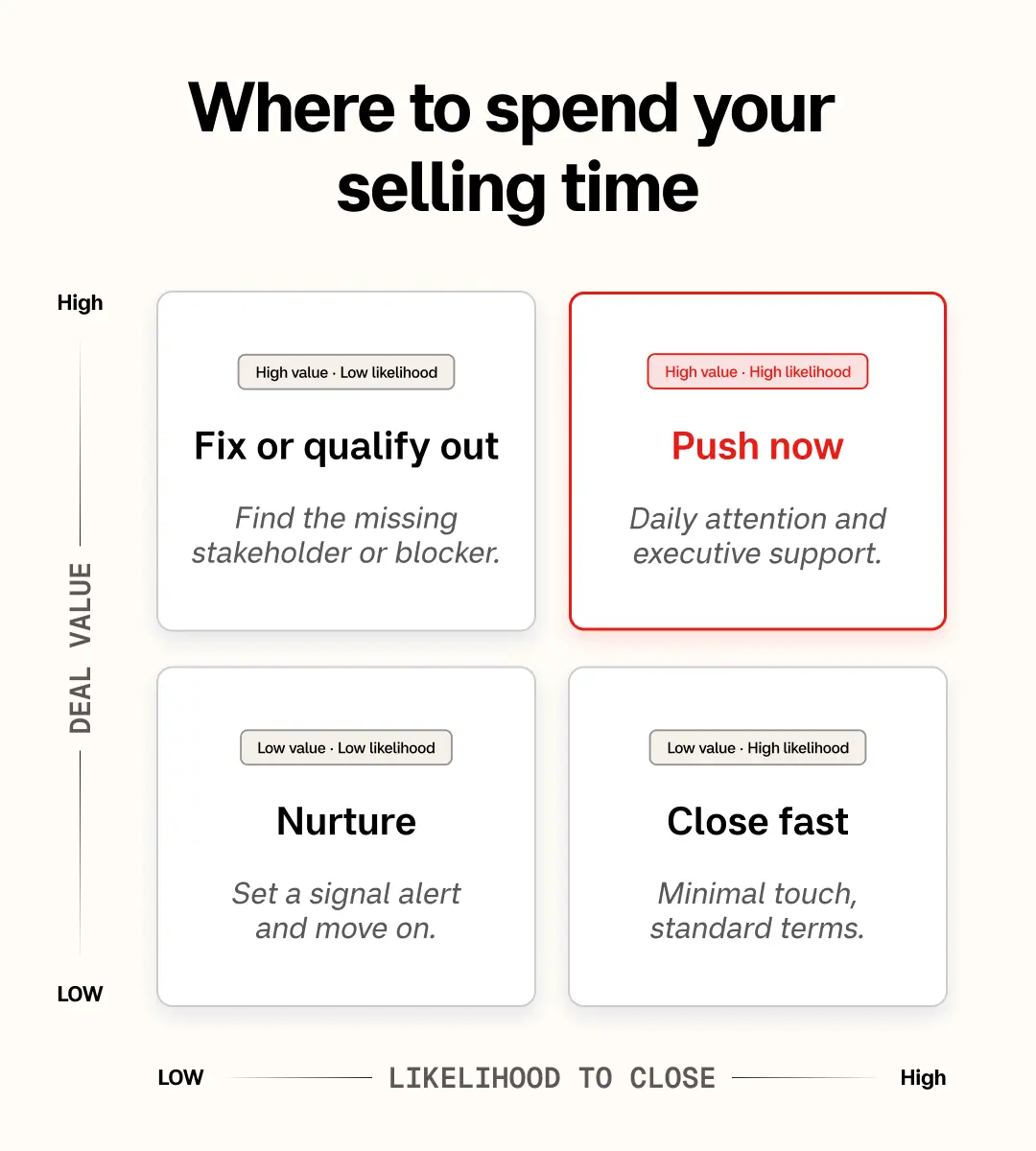
Value vs likelihood decision matrix. Plot each deal by value and likelihood to close. High value, high likelihood deals get pushed now. High value, low likelihood deals need a fix, such as a missing stakeholder, or they get qualified out. Low value, high likelihood deals get closed quickly with minimal effort. The rest go to nurture.
Eisenhower Matrix. This time-management framework sorts work by urgency and importance. For deals, urgency comes from the close plan and trigger events, and importance comes from value and fit. Urgent, important deals get your time first.
Pareto Principle. The 80/20 rule suggests a small share of deals drives most of your revenue. Check how concentrated your closed-won revenue is, then make sure your calendar matches it.
Tiered deals. Group deals into Tier 1 for daily attention and executive support, Tier 2 for weekly progress, and Tier 3 for light-touch follow-up. Tiers are easier to run than raw scores in large pipelines.
Whichever framework you pick, use the same one across the team. Shared criteria make pipeline reviews faster and keep lead qualification and deal prioritization aligned across the sales process.
How to Score and Rank Your Deals
A weighted scoring model turns the five factors into one number you can sort by. It works in any CRM system or spreadsheet, and it takes about an hour to set up.
Score each factor from 1 to 5. Write clear definitions so two reps would score the same deal the same way. For risk, 5 means the lowest risk.
Weight each factor. Start with fit 20%, value 20%, momentum 25%, timing 20%, and risk 15%.
Calculate the score. Deal score = (Fit × 0.20) + (Value × 0.20) + (Momentum × 0.25) + (Timing × 0.20) + (Risk × 0.15).
Sort the pipeline. The top of the list is where reps spend their time this week.
Rescore weekly. Momentum, timing, and risk change fast. Fit and value rarely do.
Then calibrate the weights against your own results. A win-loss analysis of your last 20 to 30 deals shows which factors separated wins from losses. Revisit the weights when market conditions or your sales strategy change.
Worked Example: Two Deals at the Same Stage
Two deals can look identical in the CRM and deserve very different attention. Both deals below are worth $60K, sit at the proposal stage, and have a close date this quarter.
Deal A has one contact, the champion. The last reply was three weeks ago, the close date has been pushed twice, and the account shows no intent activity.
Deal B has four engaged stakeholders, including the economic buyer. The account shows an intent surge on your category and hired a new VP of Sales 30 days ago.
Factor | Weight | Deal A score | Deal A weighted | Deal B score | Deal B weighted |
Fit | 20% | 4 | 0.80 | 4 | 0.80 |
Value | 20% | 3 | 0.60 | 3 | 0.60 |
Momentum | 25% | 1 | 0.25 | 5 | 1.25 |
Timing | 20% | 2 | 0.40 | 4 | 0.80 |
Risk | 15% | 1 | 0.15 | 4 | 0.60 |
Total | 100% |
| 2.20 |
| 4.05 |
Deal B scores almost twice as high, even though the CRM shows the same stage, amount, and close date. Deal B gets the rep's time this week. Deal A gets one re-engagement attempt aimed at a second stakeholder, and if nothing changes, it moves down the list.
Scale Scoring With Predictive Models
Manual scoring works for one rep's pipeline. Across a team, predictive prioritization takes over. Predictive prioritization models learn which deal characteristics led to wins and rank new deals against those patterns, and AI-assisted ranking reads signals across the CRM, calls, email, and third-party data to recommend which deals to work next.
ZoomInfo runs this inside its own sales team. Its RevOps team built two models, an ACV propensity model and a demo-to-win propensity model, that estimate each new opportunity's chance of closing and its likely size. Every opportunity gets a score from 1 to 5, and the strongest route automatically to the best-fit AEs, according to the Data-Driven Account Executive report.
You do not need a data science team to start. GTM Studio lets RevOps teams build and run scoring models on ZoomInfo data, and predictive scoring sharpens as your closed-won history grows.
Any model is only as good as the data it reads. As Joseph Santos, Director of Data Advisory at ZoomInfo, puts it, "AI fails because of inputs, not models." ZoomInfo's GTM Context Graph processes more than 1.5 billion data points a day, combining intent, CRM activity, conversation intelligence, and behavioral signals with a data foundation of 500M contacts and 100M companies. Teams can bring that context into AI assistants such as Claude through the ZoomInfo MCP and ask which deals in a territory show the strongest signals this week.
Turn the Ranking Into a Weekly Routine
A ranked list only helps if it changes what happens each week. The routine below takes a rep about 30 minutes and fits into an existing pipeline review for managers.
For Reps
Pick your top five deals each Monday and set one action for each that moves momentum forward:
Book the next meeting before the current one ends, with an agenda tied to the buyer's decision process.
Add a stakeholder on any deal with fewer than three engaged contacts. Use stakeholder mapping to find who is missing.
Act on new signals the day they appear, from a hiring spike to a new executive.
Confirm contact details before outreach. Verified direct dials and emails keep a bounce or a dead switchboard from costing you days.
ZoomInfo's GTM Workspace puts this in one view. It surfaces the buying signals on each account, flags deals where only one stakeholder is engaged, and gives reps verified contacts for the people they still need to reach.
For Managers
Run the weekly pipeline review from the ranked list instead of the stage view. Spend most of the time on the top-scored deals and on high-value deals whose scores dropped.
Coach on the actions reps take rather than activity volume. ZoomInfo tracks how often its reps act on high-intent buying signals instead of counting dials and emails, as Roth explained on the same episode. Ask each rep which signals they acted on last week and what happened next. Sales coaching built around those answers sharpens both prioritization and sales training.
How to Prioritize Renewal and Expansion Deals
Renewal and expansion deals need ranking too, but the factors shift. Risk becomes the chance the customer leaves, and value includes the revenue you protect as well as the revenue you add.
ZoomInfo's account managers rank their book with two inputs, according to ZoomInfo's Data-Driven Account Manager report:
A likelihood-to-churn score from A to F. A-rated customers are very unlikely to churn, so account managers hold firm on pricing and focus on upsell. F-rated customers are likely to leave, so account managers move into save mode.
A growth segment. Customers fall into Preserve, Growth, and VIP segments based on seat saturation, employee growth, tenure, contract value, contract expiration date, and firmographics. VIP and Growth accounts get the most resources.
Apply the same split to your own book. Rank renewals by churn risk and contract value. Churn prediction software flags at-risk accounts early, and a clear contract renewal management process protects customer satisfaction and revenue.
Rank expansion deals by growth signals inside the account. A customer expansion strategy built on those signals points to the cross-selling opportunities worth pursuing first.
When to Deprioritize or Walk Away From a Deal
Dropping a deal is as important as choosing one to push. Deals that will never close hide the ones that will, and they inflate the sales forecast. Three questions help you decide.
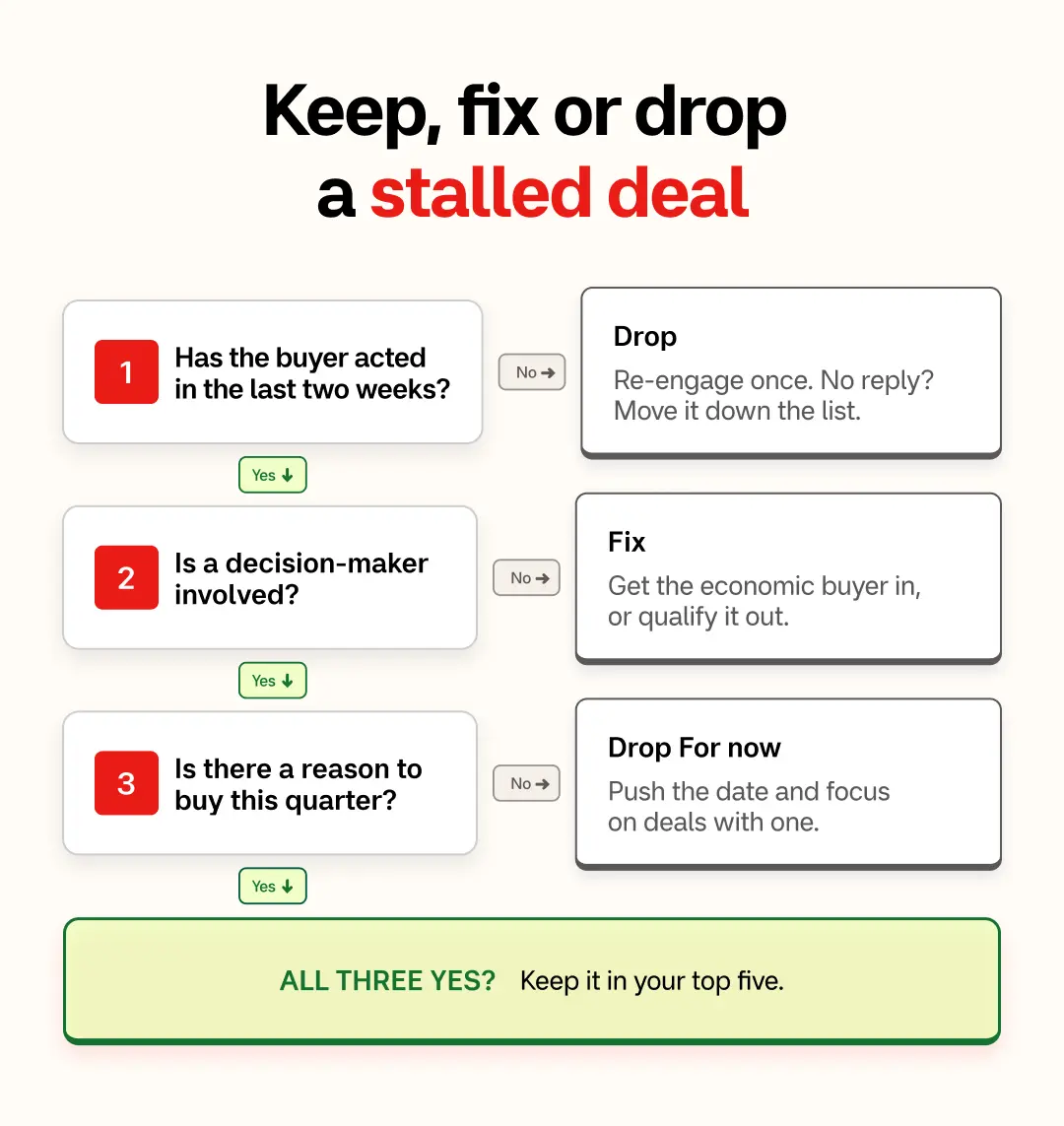
Has the buyer acted in the last two weeks? Buyers who stop replying, cancel meetings, or skip agreed steps have usually lost urgency. Make one direct re-engagement attempt, then move the deal down the list.
Is a decision-maker involved? Without access to the economic buyer, you cannot close. Ask your champion for the introduction. If they cannot make it, use your qualification questions to decide whether to qualify the deal out.
Is there a reason to buy this quarter? Without a trigger event, a budget, or a deadline, the close date is a guess. Push the date out and focus on deals that have one.
Walking away does not mean losing the account. Move it to nurture and set alerts on the signals that would bring it back, such as a new executive, a funding round, or an intent spike. Drawn-out sales cycles often restart when something changes inside the account, and clearing stale deals from the forecast also reduces revenue leakage.
Common Deal Prioritization Mistakes
Four habits quietly undo a prioritization routine. Watch for these in your pipeline:
Ranking by deal amount alone. A large deal with no momentum ties up time that smaller, active deals need.
Working whoever replied last. A quick reply from a junior contact says little about the decision.
Trusting gut feel. Reps overrate deals they like. A shared scoring model keeps rankings consistent.
Protecting the forecast call. Reps keep pushing deals they already committed in the forecast, even when a stronger deal needs the time. Rank first, then update the forecast.
Focus Your Time Where Deals Will Close
You can start this week. Score your open deals on the five factors, pick your top five, and run anything that has stalled through the three-question test. The deals left at the top of the list are where your time goes.
See which deals in your pipeline are worth your time. Book a ZoomInfo demo to rank deals by live buying signals and reach every stakeholder who decides. ZoomInfo is free to start with consumption credits based on usage.
Frequently Asked Questions
These are the questions sales teams ask most often about deal prioritization.
What is deal prioritization?
Deal prioritization is the process of ranking open deals in a sales pipeline by likelihood to close and value, so sales teams focus their time on the opportunities most likely to become revenue. It is also called opportunity prioritization.
How do you prioritize deals in a sales pipeline?
Score each deal on fit, value, momentum, timing, and risk. Weight the factors, calculate a total score, and rank the pipeline by score. Rescore weekly, because momentum, timing, and risk change quickly.
Which deals should sales reps focus on first?
Focus first on deals with strong fit, engaged decision-makers, and a clear reason to buy this quarter. A deal with active stakeholders and recent buying signals usually deserves more time than a larger deal that has gone quiet.
What is the difference between deal scoring and deal prioritization?
Deal scoring assigns each opportunity a number based on criteria such as fit and engagement. Deal prioritization uses that score, along with judgment about timing and risk, to decide where reps and managers spend their time.
What frameworks are used for deal prioritization?
The most common are a weighted scoring model, a value vs likelihood decision matrix, the Eisenhower Matrix, the Pareto Principle, and tiered deal lists. A weighted scoring model is the most precise, while matrices and tiers are faster for weekly decisions.
Can AI prioritize deals?
Yes. Predictive prioritization models and AI-assisted ranking learn from past wins and losses and read signals across CRM, calls, email, and third-party data. Their accuracy depends on the quality and completeness of the data they use.
