
Lead enrichment used to mean wiring an API into your CRM and maintaining the field mappings by hand. The Model Context Protocol moved the entry point. You can now ask an AI client to find an account, complete a contact, and check whether a record is still current, and it calls the right data tools on its own.
That lower barrier is why a wave of lead enrichment MCP tools arrived inside a year, and why the category is easy to misjudge. A server is a doorway to a data source, and two servers with identical plumbing return very different quality depending on the source behind the door. The protocol is the easy part. The data is the part that decides whether the record your AI hands back is worth acting on.
Choosing an MCP for lead enrichment comes down to a handful of criteria, and this guide scores the seven best against them, then names where each one earns its place. For the fundamentals underneath enrichment, our guide to what data enrichment is covers the mechanics.
What an MCP for Lead Enrichment Does
An enrichment MCP server gives your AI client a set of data tools it can call on its own. You describe the outcome, and the client reasons over those tools to reach it, often chaining several in a single request.
A run tends to look like this. You ask for the buying committee at a target account. The client searches for the company, finds the relevant contacts, then enriches the ones worth keeping with direct dials and verified emails. You never open a query builder. The payoff arrives when that enriched output feeds straight into scoring, routing, and outreach, which is where clean data earns its keep.
The mechanics are similar from one vendor to the next. Where they diverge is the source each doorway leads to, and that gap is what the criteria below measure.
How We Evaluated These Tools
We ranked each option against seven criteria, ordered by how much they move real outcomes:
Data grounding. How the underlying data is sourced and verified. This carries the most weight, because a server cannot be more accurate than the source it calls.
Coverage and fill rate. Breadth across geographies, industries, and seniority, and how often a query returns something usable rather than a blank.
Native server versus bridge. Whether the vendor runs a first-party hosted server with real authentication, or you assemble a community shim over someone else's data.
Single source versus waterfall. Whether a missing field falls back across several sources or returns nothing.
Cost transparency. Whether you can predict what a call costs and avoid paying for non-matches or repeat lookups.
Client and workflow support. Which AI clients connect cleanly, and whether the same data reaches non-AI workflows too.
Security and entitlements. Read-only behaviour where it matters, per-user authentication, respect for existing data permissions, and a clear stance on AI-provider data retention.
Why the Data Behind the Server Decides Everything
The gap between an MCP that impresses in a demo and one that holds up in production is the layer underneath it. In a ZoomInfo survey of 50 senior GTM leaders, discussed on its Revenue Architects podcast, agents querying GTM data through MCP divided the room more than anything else asked, with 52% undecided and only 16% calling it genuinely working. The hesitation traced less to the protocol than to whether teams trusted the data it reached.
A contact record is only worth its match rate, and match rate comes down to how fast the source catches change. A record that was right last quarter is worth little if the buyer changed roles in March and nothing flagged it. As Florin Tatulea, ZoomInfo's GTM engineer in residence, frames it on the show, the test of a grounded agent is whether you can trace its output to a verifiable source, and whether that output changes when the underlying data changes. Verification method and source freshness decide that, long before the protocol wrapper does.
"Data needs to be verified and current, and 70% of contact data gets old quite quickly."
John Lloyd, Principal GTM Consultant at ZoomInfo
Coverage works the same way. A single-source server returns a blank the moment its one database misses, while a waterfall approach falls back across sources and fills the gap. When you weigh these tools, put the source and its verification first, then the fallback behaviour, then the protocol niceties. The ranking below follows that order.
The 7 Best MCP Servers for Lead Enrichment
Each MCP server for lead enrichment below is scored against the same seven criteria, with a short description of what it is followed by its key capabilities, where it shines, where it falls short, and what it costs. The field runs from broad web-data connectors to grounded, verified sources, so the right pick depends on how much the accuracy of each record matters to your motion.
1. ZoomInfo
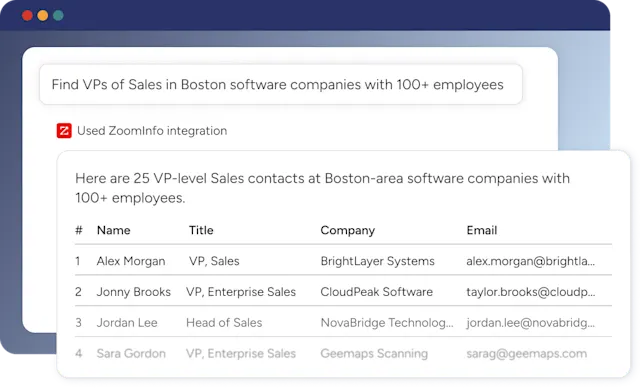
ZoomInfo is an all-in-one AI GTM Platform, and its enrichment MCP server draws on that whole stack rather than a single feed. The verified data foundation supplies the contact and company records, the GTM Context Graph adds the reasoning that ties a record to intent and relationships, and Universal Access is the principle that you reach the same data and intelligence through whichever surface you already work in, whether that is a seller's workspace, a marketer's studio, or an AI agent calling the server.
Key Capabilities:
A first-party hosted server on a single endpoint, with per-user OAuth sign-in that connects Claude, ChatGPT, Claude Code, Cowork, Codex, Cursor, Microsoft Copilot, Perplexity, Gemini, Slack, and any custom MCP client.
Twelve tools spanning search, enrichment, discovery, intent, and research, including Search and Enrich for companies and contacts, Find Similar and Find Recommended, intent search, and the Account Research, Contact Research, and Conversation Intelligence agents.
A verified data foundation of 600M+ contacts and 100M+ companies, with more than 300 human researchers, over 1.5 billion data points processed a day, and up to 95% accuracy on first-party data.
Waterfall enrichment across 25 or more sources through GTM Studio when a field is missing, so coverage holds where a single source returns a blank.
Read-only and entitlement-aware. The server honours your existing package permissions, so it returns only data you are already licensed for.
Where ZoomInfo Shines:
Grounding. Enrichment runs on verified first-party data plus the GTM Context Graph, so an answer carries intent and relationship context rather than a bare record.
Predictable spend. Free search lets an agent qualify records before it enriches, and Records Under Management stops you paying twice across surfaces.
Governance. Per-user OAuth, read-only behaviour, and package entitlements are enforced at the gateway rather than left to prompt discipline.
Reach. One endpoint connects to effectively every major AI client, so the same grounded data follows the team into whatever tool they use.
Where ZoomInfo Falls Short:
Access. It needs a ZoomInfo subscription with bulk credits enabled, so it is a grounded source you connect rather than a free-standing wrapper you bolt on in isolation.
Interactive scope. It is built for AI-assisted work rather than bulk export or CRM write-back. For batch pipelines or write-back, the REST API or the GTM CLI is the right lane, drawing on the same credit pool.
Cost:
Free to start with consumption credits based on usage. Search, lookup, and find-similar are free, enrichment draws bulk data credits at one credit per new record, and research draws AI credits.
Records Under Management means a record enriched anywhere in the platform is not charged again for twelve months, and the current model lives on the pricing page.
Best for: Teams that want enrichment grounded in verified data, with intent and relationship context attached, reachable from Claude, ChatGPT, and any MCP-compatible client.
The grounding shows up downstream, where enrichment error compounds through scoring and routing. ConnectWise saw it on the input side after pointing ZoomInfo enrichment at its CRM.

"We're qualifying leads faster than ever. We have all the information we need up front, including fields like job titles and company size which are not included on our webforms."
On the output side, teams working from verified, well-scored records report gains like Snowflake's 90% higher opportunity open rates and 2x customer conversion on ZoomInfo-scored accounts.
2. Clay
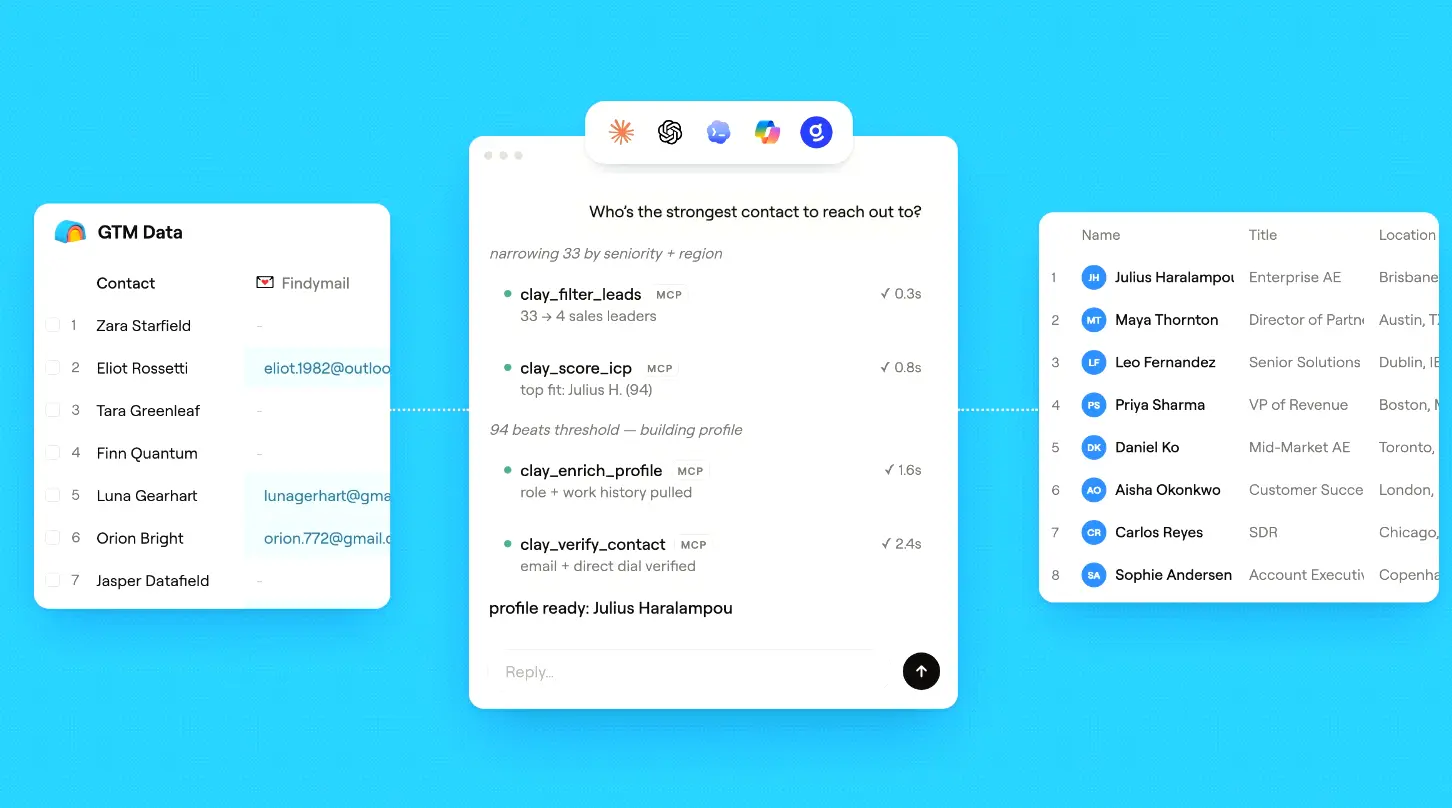
Clay is an orchestration layer that sits above traditional providers and brings data from more than 150 providers, plus Ops-managed workflows, into the AI tools reps already use. Its pitch is prospecting data in natural language, governed centrally so reps move fast without Ops losing control.
Key Capabilities:
An MCP server that connects Claude, ChatGPT, Codex, Copilot, and Glean, letting reps find contacts, retrieve emails and phone numbers, and push to sequences by prompt.
Waterfall validation across its 150-plus providers, so each email and phone is checked against multiple sources rather than trusted from one.
Functions, which package a team's best playbooks as reusable workflows an agent can call, and Audiences it can reason across.
People Search returning up to 1,000 results per call, with CRM dedup that keeps only net-new validated contacts before pushing to your sequencer and CRM.
Ops governance through budget guardrails, admin controls, and centrally managed CRM write-back and compliance logic.
Where Clay Shines:
Custom logic. Multi-provider enrichment a single source cannot express, governed so spend and compliance stay under Ops control.
Write-back. CRM write-back and push-to-sequencer from inside the chat, which read-only servers do not offer.
Reusable playbooks. Proven rep workflows packaged as Functions the whole team can run.
Where Clay Falls Short:
Borrowed data. It conducts data rather than owning it, so output quality rests on the providers you connect and the credits you spend across them.
Complexity. Cost and setup effort climb as the waterfall logic grows.
Ops dependency. Full value assumes Ops investment to build and govern the workflows first.
Cost: Credit-based across the providers you connect, with 500 free credits on first connect and per-rep credit limits admins set centrally.
Best for. RevOps and growth engineers who want to design and govern their own multi-provider data flow. Our data enrichment tools comparison covers where an orchestration layer helps, and the Clay vs ZoomInfo breakdown goes deeper on data quality and governance.
3. Apollo
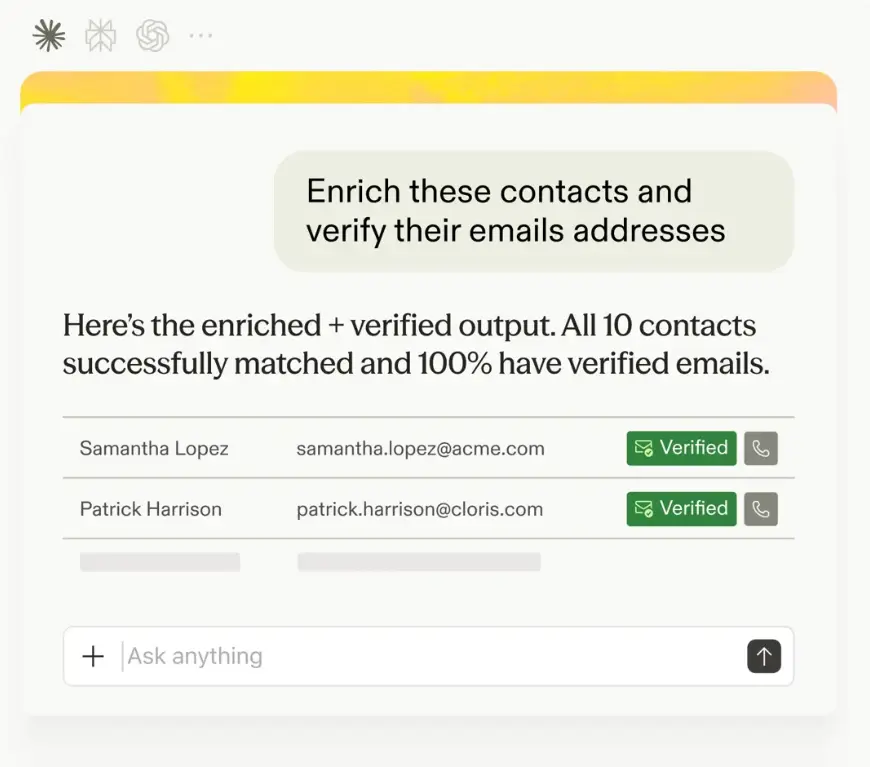
Apollo pairs a broad self-service database with an official hosted server, which makes it a common starting point for startup and SMB teams running high-volume prospecting. It carries the full sales motion, from finding contacts to sequencing them, inside a single connector.
Key Capabilities:
A first-party remote server over Streamable HTTP, connecting over OAuth or an API key with no local install, with built-in connectors in Claude, ChatGPT, and Perplexity plus support for Claude Code, Cursor, Copilot, Codex, and any MCP client.
People and organization search, enrichment for verified emails and phone numbers, CRM operations across contacts, accounts, deals, tasks, and notes, and email sequence management, all in natural language.
Access scoped to the authorizing Apollo user's permissions and credits, with destructive bulk actions blocked by design.
Where Apollo Shines:
All-in-one motion. One server covers prospecting, enrichment, CRM, and sequencing, so a rep runs a whole outbound motion without leaving the conversation.
Free to connect. It works on any plan including the free tier, with credit costs surfaced in the tool descriptions so an agent avoids surprise charges.
Low friction. A fast entry point for volume outbound.
Where Apollo Falls Short:
Enterprise depth. Senior contacts and direct dials thin out at scale, where community-contributed data weakens connect rates, and a miss has no waterfall fallback because the data comes from one source.
Fragmented ecosystem. Unofficial Apollo servers sit alongside the official one, several using single-key stdio setups that scored poorly on security review, so connect the first-party server rather than a community shim.
Interactive only. No triggers or scheduled runs once the chat is closed.
Cost: Free tier on any plan, with enrichment drawing credits while search and contact management typically do not, so cost tracks the enrichment you run.
Best for. SMB and startup outbound teams that weight breadth, price, and an all-in-one motion over enterprise-grade depth. Our Apollo alternatives breakdown weighs that trade-off, and the Apollo vs ZoomInfo comparison lines the two up on coverage and accuracy.
4. Explorium
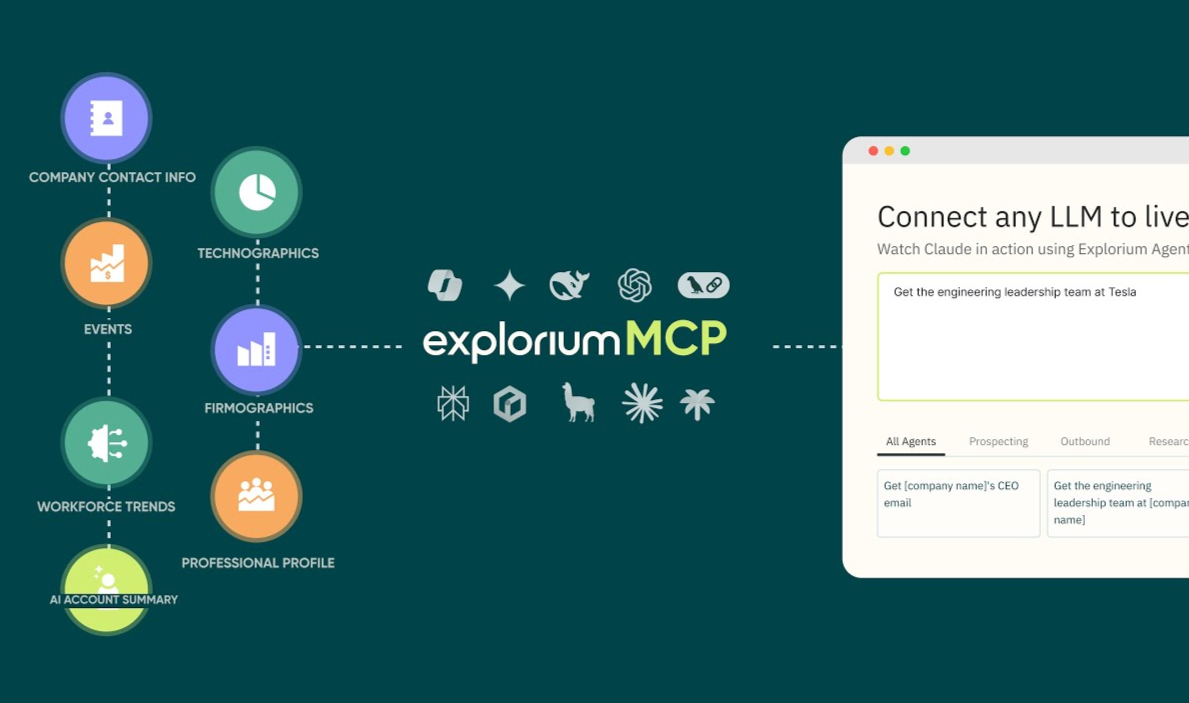
Explorium's AgentSource server connects agents, apps, and workflows to live B2B company and contact data. It leans hard into agent-first patterns rather than human-in-the-loop lookups, and builds around the idea that an unattended agent needs data verified at the moment it is retrieved.
Key Capabilities:
An MCP server that connects any LLM to live company and contact data through natural-language queries.
Purpose-built support for prospecting agents, account research agents, context-aware email agents, and outbound and inbound agents.
Structured and harmonised data, automated target discovery, custom signal creation, and messaging tools with contact detail attached.
An emphasis on verification at retrieval time, aimed at agents that work large lists unattended and cannot afford a bounce spike.
It runs in Claude Desktop, Cursor, n8n, and custom agents, over OAuth on the no-code path or an API key when you build against the raw tools.
Where Explorium Shines:
Signal breadth. Broad, harmonized firmographic and signal coverage for company-level agent research from one connector.
Agent-native. Natural-language target discovery and signal creation built for autonomous workflows.
Structured output. Harmonised data that drops into agent pipelines without a cleanup pass.
Where Explorium Falls Short:
Contact depth. Less established for verified person-level direct dials, so it tends to complement a contact-grade source rather than replace one, and it draws on its own data rather than a multi-source waterfall.
Track record. Enterprise depth and history are narrower than incumbent B2B sources.
Cost: Usage-based, with a free no-code Vibe Prospecting path to start before you build against the raw tools.
Best for. Teams building prospecting or research agents that need broad company and market signal more than verified contact detail.
5. Apify
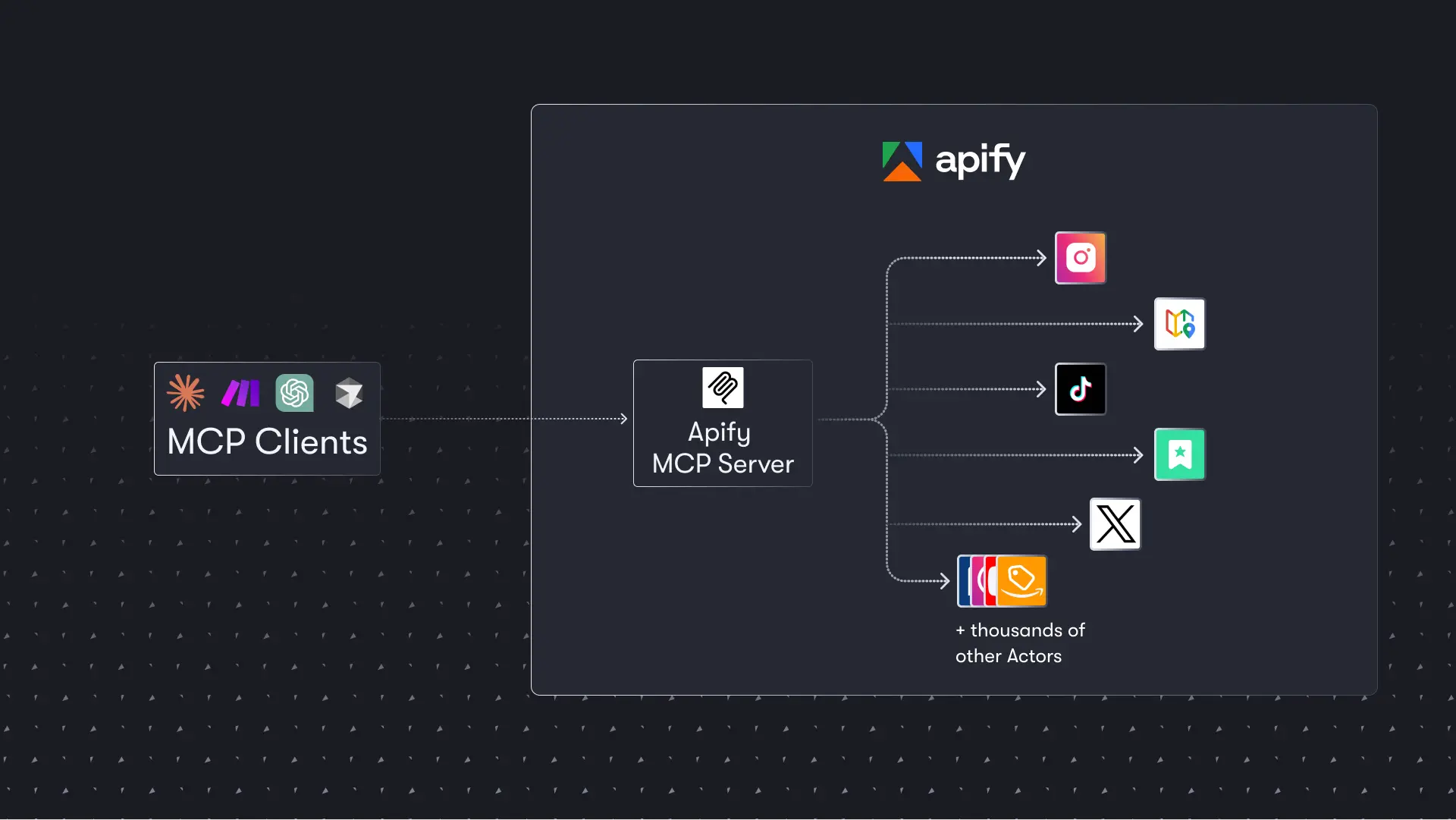
Apify is a general web-scraping and automation platform, and its MCP server opens that whole catalogue to an AI client rather than a fixed set of B2B fields. Lead enrichment is one job among tens of thousands the platform can run, handled through dedicated enrichment Actors.
Key Capabilities:
A hosted server at its own endpoint, connecting Claude, Claude Desktop, Claude Code, ChatGPT, Grok, and Cursor over OAuth or an API token.
Access to more than 64,000 ready-made tools, called Actors, for web scraping, data extraction, and automation, with lead enrichment handled by dedicated enrichment Actors from the Apify Store.
Tool groups for Actor discovery, documentation search, run monitoring, data storage, and reusable tasks, plus the option to preload Actors so an agent runs them without searching first.
Where Apify Shines:
Breadth. More than 64,000 Actors for composing a custom scraping-and-enrichment flow inside your AI client.
Flexibility. Room for developers to tailor the exact pipeline and mix Actors to a specific job.
Where Apify Falls Short:
Scraping-based. Freshness, structure, and compliance are yours to manage, so reliability is something you assemble rather than inherit, and any cross-source waterfall is one you build across Actors yourself.
Not B2B-native. A general automation platform rather than a verified contact source, so contact accuracy depends on the Actors you choose.
Cost: Pay-per-run across Actors, so cost depends on which enrichment Actors you call and how often, rather than a single flat rate.
Best for. Developers building custom, scraping-based enrichment flows they are willing to maintain.
6. Pipe0
Pipe0 is a search-and-enrich platform built around waterfall email enrichment, with a server designed for agents that need guardrails before they spend. It is narrower than the all-in-one options by design, and pairs that focus with scheduling and dry-run validation.
Key Capabilities:
A server that connects Claude, ChatGPT, Claude Code, Cursor, Cowork, and custom agents over OAuth with dynamic client registration, where API keys work for the REST API rather than the MCP server.
Tool groups for discovery, account resources, validation, running searches and enrichments, sheets, and schedules.
Dry-run validation so an agent can check a payload before spending credits, plus a confirmation step on any tool that spends credits or mutates data.
Scheduled runs for recurring workflows.
Where Pipe0 Shines:
Email waterfall. Clean email enrichment and search-then-enrich flows for programmatic work.
Agent guardrails. Validate-before-spend, confirm-on-mutate, and scheduled recurring runs suit unattended agents.
Where Pipe0 Falls Short:
Narrow scope. Email and search centric rather than a full company-and-contact source, with the source mix left to you.
Coverage. Smaller and newer than incumbent providers, so breadth is a consideration.
Cost: Billed like regular API requests, with dry-run validation so an agent can price a payload before it spends.
Best for. Programmatic, email-first enrichment and scheduled agent runs.
7. Bright Data
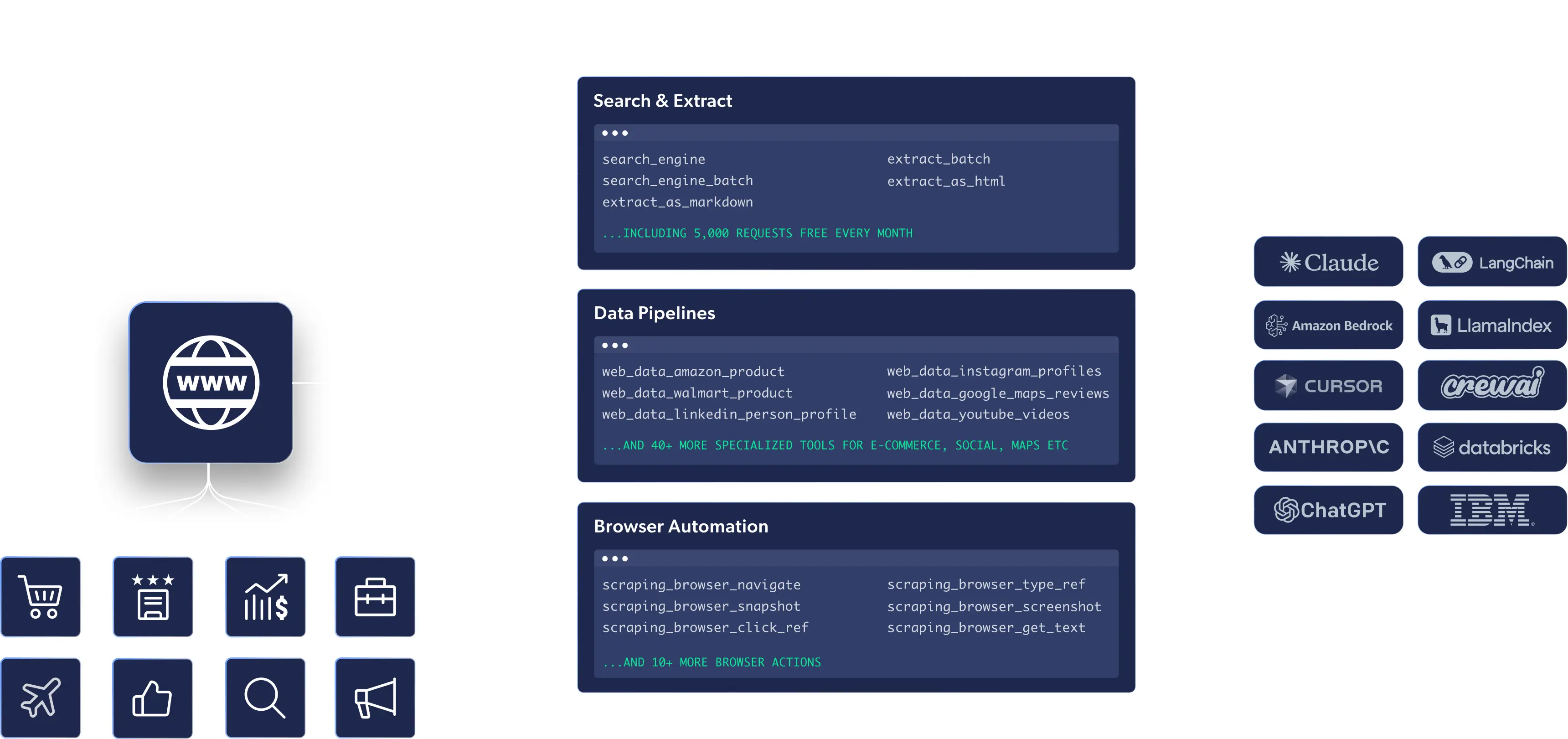
Bright Data's Web MCP is web-access infrastructure. It connects an AI client to the open web for search, extraction, and navigation, rather than to a curated B2B database, so it fits the moment your enrichment need is really a research need.
Key Capabilities:
A server that lets agents search major engines in real time, crawl and extract full websites in LLM-ready formats, reach public web content past geo-restrictions and CAPTCHAs, and drive remote browser sessions on interactive sites.
An enterprise posture with SOC, ISO, and GDPR coverage and a large customer base.
Where Bright Data Shines:
Web reach. Unmatched breadth of live web data for filling gaps from company sites, news, and listings.
Anti-block. Reliable at getting past blocks, CAPTCHAs, and JavaScript rendering at scale.
Where Bright Data Falls Short:
Not a contact graph. Web-access infrastructure rather than verified B2B records, so structuring and verifying person-level data falls to you, with no B2B waterfall behind it to backfill a miss.
Build-your-own. It supplies reach rather than ready contact records, so the enrichment logic sits on you.
Cost: 5,000 free requests a month, then pay-as-you-go from about $1.50 per 1,000 results and $8 per GB, with a spend cap you set in the control panel.
Best for. Teams that need broad live web data and will handle B2B structure and verification themselves.
Quick Comparison
Read the sections above before the grid, since grounding is the axis that decides outcomes and a table flattens it. This summarises how the seven MCP servers for lead enrichment sit side by side.
Tool | Data foundation | Hosted server and auth | Best for |
ZoomInfo | Verified first-party data, up to 95% accuracy, plus waterfall across 25+ sources | First-party, per-user OAuth, entitlement-aware, read-only | Grounded enrichment with intent and relationship context |
Clay | Orchestration and validation across 150+ providers | First-party, OAuth, write-back to CRM and sequencer | Custom, governed multi-provider logic |
Apollo | Crowd-contributed self-service database | First-party, OAuth, permission-scoped | High-volume SMB outbound and sequencing |
Explorium | Broad firmographic and signal aggregation | First-party, agent-focused | Company-level signal for agents |
Apify | Web scraping across 64,000+ Actors | First-party, OAuth or token | Developer-built custom flows |
Pipe0 | Waterfall email sources | First-party, OAuth, scheduled runs | Email-first programmatic enrichment |
Bright Data | Web-access and scraping infrastructure | First-party, OAuth | Broad live web data reach |
How to Choose the Right Enrichment MCP
Every server here can hand an AI client a lead record. What separates them is whether that record holds up when you act on it, and which job you are hiring the server to do.
Match the server to the job:
Engineer your own governed data flow. Clay is built for it.
Run an all-in-one outbound motion from a chat. Apollo covers outbound prospecting through sequencing.
Research accounts with an agent. Explorium suits agent-first work.
Schedule email enrichment. Pipe0 fits recurring programmatic runs.
Build on raw web reach. Apify and Bright Data give developers the widest surface.
The common thread across the field is that each one leans on a source you assemble, govern, or verify yourself.
When the accuracy of every record decides your connect rates and your pipeline, the source behind the server becomes the whole game, and that is where a grounded option pulls ahead. ZoomInfo runs its enrichment on verified first-party data with waterfall fallback, per-user entitlements, and a credit model that avoids charging twice, reachable from the same AI clients as the rest. For a revenue team, that is the difference between an answer that looks right and one you can route on without a second thought.
Ready to give your AI client a grounded enrichment source? Get free access to ZoomInfo's MCP server and GTM tools and connect it to Claude, ChatGPT, or your own agent in minutes.
Frequently Asked Questions
What Is an MCP for Lead Enrichment?
It is a server that gives an AI client tools to find, verify, and complete lead records through the Model Context Protocol. Rather than configuring API calls, you describe the outcome and the model calls the right enrichment tools to reach it.
What Is the Best MCP for Lead Enrichment?
The answer depends on your criteria, which is why this guide scores against seven of them. If verified accuracy and coverage matter most, a grounded source like ZoomInfo leads. If you are assembling custom multi-provider logic, Clay fits, and for email-only programmatic work, Pipe0 does the narrower job well.
Is There a Free MCP for Lead Enrichment?
Several community connectors are free to install, though the data behind them usually is not, so a free wrapper on a paid or limited source still carries a cost. ZoomInfo's server is free to start with consumption credits based on usage, and its search, lookup, and find-similar tools consume no credits at all.
Can I Connect a Lead Enrichment MCP to Claude or ChatGPT?
Yes. A hosted server like ZoomInfo's is listed in the Claude and ChatGPT connector marketplaces and connects over OAuth, and it also works with Claude Code, Cursor, Microsoft Copilot, and any MCP-compatible client through the same endpoint.
How Is an Enrichment MCP Different From an Enrichment API?
An MCP server fits a person asking a question inside an AI tool, where the model chooses the tools. An enrichment API fits application code and batch pipelines, where you control the calls. Many teams run both against the same data and credit pool, using each where it is stronger.
Does Lead Enrichment Through MCP Cost Credits?
It depends on the tool. With ZoomInfo, search and discovery tools are free, enrichment draws on bulk data credits at one credit per new record, and a record already enriched in the past twelve months is not charged again across surfaces.
