

Every AI-drafted email your team sends gets read twice. Once by the agent that wrote it, once by the rep checking whether any of it is true. That second read is where the time saving goes.
ZoomInfo's survey of 50 senior GTM leaders at US enterprises found 50% can't trust their AI's outputs. The models are fine. The data underneath them is stale, duplicated, and scattered across systems the agent can't reach, so it writes a fluent email citing a call that never happened.
AI grounding is what closes that gap, and it's the difference between AI sales agents that create pipeline and agents that create cleanup. This guide covers:
What grounded AI means for a sales team
Why AI sales agents hallucinate
The six types of context a grounded agent needs
Where grounding breaks in an agentic sales workflow
How to ground your stack, starting with a single deal
What Grounded AI Means for Sales Teams
Grounded AI connects a model's reasoning to verified, current data at the moment of the query. For a sales agent, that means working from what's true about the account today, from a source you can trace back. An ungrounded agent works from its training data plus whatever it happened to find in your CRM, and it has no way to tell you which parts it invented.
The gap between those two is not academic. Three things have to hold for an agent to count as grounded:
Live access. The agent pulls data at query time rather than working from a snapshot. B2B records go stale fast, and contact data decays continuously as people change jobs and companies restructure.
Verifiable sources. Any claim in the output traces to a record you can inspect. If you can't audit it, you can't trust it.
Relevant context. The agent gets the context data the task actually requires. More context isn't better. The right context is.
Miss one and the agent looks grounded while quietly filling gaps with plausible fiction.
Live access is the condition teams underestimate. It's why grounded agents reach data through a B2B data API or an MCP server rather than a static export. Anything exported is already out of date by the time the agent reads it.
Most teams already discovered this the hard way when they pointed a general-purpose model at their CRM and asked it to do sales work. The results underwhelmed because CRM data isn't ready for AI. It's a static system of record that humans update when they remember to, and poor data quality compounds every time an agent reads from it.
That's the difference between an AI feature and GTM AI that a rep can actually rely on.
Why AI Sales Agents Hallucinate
Sales agents hallucinate because the data layer they read from is fragmented, stale, or duplicated, and the model has no way to know that.
Take the most common version. A contact has three duplicate records in Salesforce. An agent asked to research the account reads a call transcript attached to the wrong one, then writes an email citing a conversation the prospect never had. The model did its job. The layer underneath handed it the wrong facts.
The failure is rarely dramatic. It's an agent that's almost right. Almost right still gets reviewed, review cycles stretch, and the promised productivity gain quietly disappears. Reps don't abandon AI tools because the output is obviously bad. They abandon them because checking the output costs more than doing the task.
Underneath that sit four data conditions that break grounding:
Condition | What the agent does with it |
Duplicate records | Pulls context from the wrong version of the same person |
Stale firmographics | Segments and scores against a company that no longer looks like that |
Missing signals | Reaches out with no idea the account just hired a new VP |
Disconnected systems | Reads the CRM, misses the call transcript, drafts from half the story |
Fixing these is unglamorous work. Dirty data costs revenue quietly, data deduplication never makes it into a board deck, and CRM hygiene is the first thing cut when a quarter gets tight. It's also the thing that decides whether your agents work.
The pattern holds across the market. Our survey on how sales teams are using AI and the broader state of AI in sales and marketing both land in the same place: teams want AI to work, and the blocker sits below the model. Better data quality in the CRM does more for agent output than a bigger model does.
Capability stopped being the bottleneck a while ago. Trust is what's left, and trust comes from the data layer.
The Six Types of Context a Grounded Sales Agent Needs
A grounded sales agent needs six kinds of context, and it needs them together. Each one alone produces a confident agent working from a partial picture.
Firmographic. Who the account is. Industry, headcount, revenue, corporate hierarchy. Firmographic data is what segmentation and ICP matching run on.
Conversational. What they've actually said. Call transcripts, objections, competitor mentions. This is where conversation intelligence earns its keep, and it's the context most agents never see.
Technographic. What they run. Technographic data tells an agent whether the account is a fit before a rep spends an hour finding out.
Product usage. How they engage with your product, or a competitor's.
News and scoops. Funding rounds, leadership changes, hiring surges. Deal intelligence scoops and job change alerts are the difference between timely outreach and a cold open.
Intent. What they're researching right now. Intent data tells the agent which accounts are in market this week.
Why one signal is never enough
A single signal justifies nothing. Someone changed jobs. Someone liked a post. On its own, that's noise dressed as insight, and an agent acting on it produces the outreach every buyer deletes.
The move that works is combining first-party and third-party context. A job change on its own means little. A job change at an account that already shows habitual product usage, cross-referenced against an intent surge, is a reason to pick up the phone. Understanding first-party versus third-party data is what turns buying signals into a prioritized list rather than a firehose.
This is also why context engineering has become a real discipline. Handing an agent everything you have degrades the output. Handing it the right slice, resolved to the right entity, is the whole job. A 360-degree customer view is the target, and org charts are how an agent knows who else in the buying committee matters.
Where Grounding Breaks in a Sales Workflow
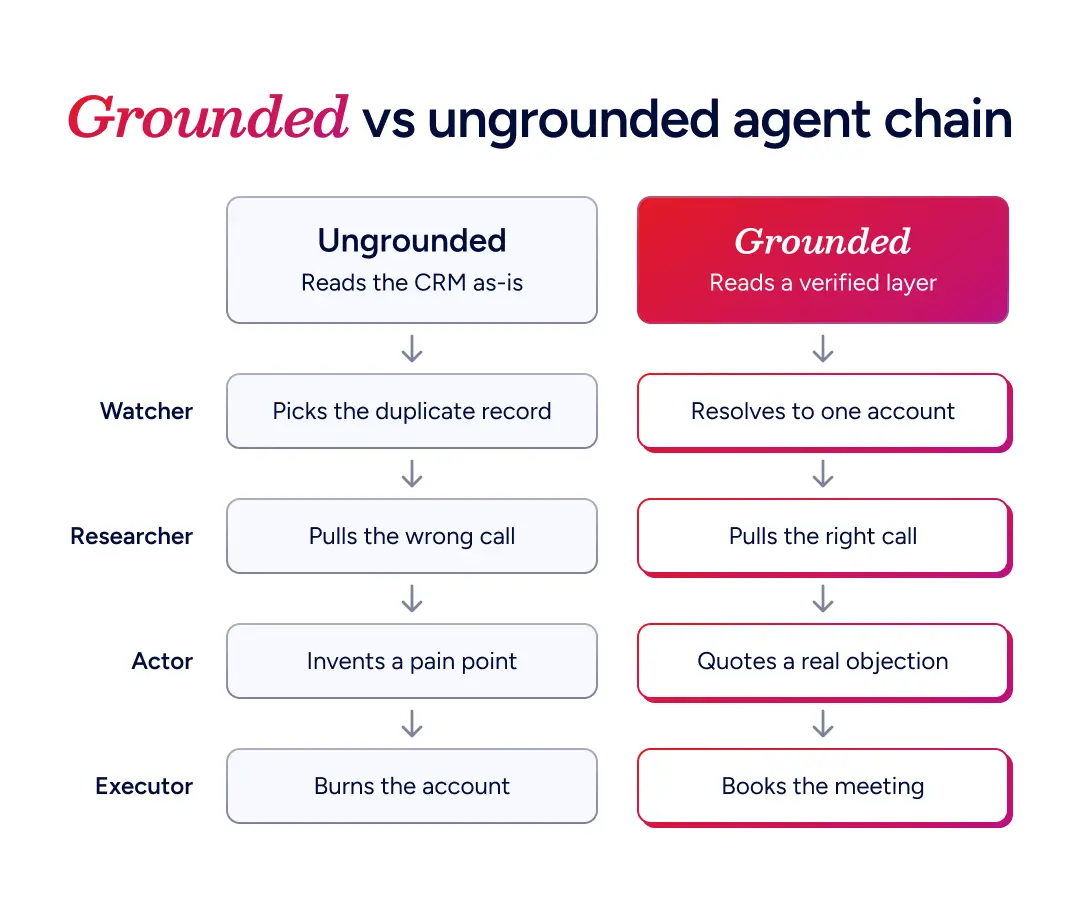
Grounding breaks at the handoff. Most agentic sales workflows chain four roles together, and each depends on the one before it.
Watcher. Detects the trigger. An intent spike, a form fill, a website visit resolved to a known company.
Researcher. Pulls the context. Account history, call transcripts, past objections, open opportunities. This is where prospect research either produces something a rep can use or produces filler.
Actor. Drafts the outreach. Every AI sales email generator on the market lives at this step, and every one of them is only as good as step two.
Executor. Pushes it into the sales engagement platform, updates the CRM, routes the follow-up.
If identity isn't resolved at step one, everything downstream is confidently wrong. The Watcher flags the account. The Researcher pulls the wrong contact's transcript. The Actor writes a fluent, personalized, incorrect email. The Executor sends it at scale.
ZoomInfo's research with those same 50 GTM leaders found 60% say their AI agents can't reason across systems. That's the structural version of the same failure. The data exists somewhere in the stack, and the agent can't reach it. It's now one of the defining constraints for any GTM leader planning an AI roadmap.
Three things cause this:
Data silos. Intent lives in one tool, conversations in another, product usage in a third. Breaking down data silos is a prerequisite for any agent that needs to reason across them.
No integration layer. Without B2B data integration, each tool holds a fragment and no agent holds the whole.
Stack sprawl. Sales tech stack problems compound with every tool added. A bloated GTM tech stack gives agents more places to look and fewer answers.
The durable fix sits underneath the tools. Build the intelligence once in a context layer for AI agents and deploy it everywhere the team already works. Anything built narrowly inside one application ages out the moment the stack changes, which is the argument for going beyond the CRM as the foundation for AI agents.
How to Ground Your Sales AI Stack
Start with one deal, not a platform migration.
Run a lost deal trace
Take a single deal that stalled or was lost. Walk it backwards. Find the one missing connection that would have changed the outcome, the signal that existed somewhere in your stack and never reached the person who needed it. That gap is your first build.
This works because it's specific. It gives you a named integration to fix rather than a vague mandate to improve data quality. Pair it with a proper win/loss analysis and the pattern usually repeats across several deals.
Fix identity before you add agents
An agent chain built on unresolved identity fails at the first handoff. Before you add capability, resolve records across systems. That means CRM data enrichment as a continuous process rather than a one-time cleanup, and waterfall enrichment so a missing field gets filled from the best available source instead of left blank.
For teams building programmatically, a data enrichment API puts verification into the pipeline rather than a weekly cleanup job.
Name an owner
Grounding work dies without a single owner. When it's shared across RevOps, data, marketing, and sales, accountability collapses into everyone pointing at everyone else. This is one of the reasons GTM engineering exists as a role, and why revenue operations teams increasingly own the grounding layer outright.
Consolidate plays before you scale them
Teams that build hundreds of AI plays overwhelm themselves and maintain none of them. Cutting down to five or six well-owned plays usually improves output immediately. That's the practical shape of a data foundation for agentic AI, and it's what separates GTM AI execution from a pilot that never ships.
The infrastructure question underneath all of this is whether you have gen AI data infrastructure at all, or a set of tools that each hold a fragment. Answering it is what a real go-to-market data strategy is for.
How ZoomInfo Grounds AI Sales Agents
ZoomInfo grounds sales agents through the GTM Context Graph, which fuses verified B2B data with a customer's own CRM, conversation, and engagement history into one connected view of every account.
The part that matters for sales agents is causality. A CRM records that a deal moved to closed-lost. It has no record of why. The context engine captures which signals preceded which deal movements and which buying committees formed around which accounts, which is the context an agent needs to reason rather than summarize.
That intelligence reaches sellers in three ways:
GTM Workspace gives reps a unified view across the CRM, ZoomInfo data, conversation history, and live signals, with agents that research accounts, draft outreach, and update records.
GTM Studio gives marketing and RevOps the same grounding for audience building and scoring.
API and MCP carry it into whatever agent your team already runs. ZoomInfo's MCP server works inside Claude and inside ChatGPT, so the grounding layer isn't locked inside one application.
Chorus feeds the conversational context into the graph, and Copilot surfaces the next action on top of it. If you're evaluating the underlying data itself, our page on what ZoomInfo is covers the foundation, and our guide to choosing a B2B data provider covers what to look for generally.
The results show up in pipeline. Seismic attributes 39% of its pipeline to ZoomInfo signals, alongside a 54% increase in sales productivity, according to CBO Toby Carrington. Broader results across the customer base are in our 2025 Customer Impact Report.
Start Grounding Your Sales Agents
Grounding is the thing that decides whether an AI sales agent creates pipeline or creates cleanup. Upgrading the model won't close the gap, because the gap sits below the model.
Pick one deal you lost, trace it backwards, and fix the connection that broke. Then connect your agents to data that's verified, current, and resolved to the right account. Start a free trial and see what a grounded agent does with a real account.
Grounded AI FAQ
What is a grounded AI sales agent?
A grounded AI sales agent is an agent whose outputs are tied to verified, current data about the account it's working, rather than to its training data. It knows who's at the company today, what they said on the last call, and what they're researching now, and every claim it makes traces back to a record you can check.
Why do AI sales agents hallucinate?
Because the data underneath them is duplicated, stale, or scattered across systems the agent can't reach. The model generates fluent text from whatever context it receives. If that context is a duplicate record or a two-year-old firmographic, the output is confidently wrong. This is a data problem wearing a model problem's clothes. Better AI sales intelligence tools help only when the layer beneath them is clean.
How is grounded AI different from an AI sales tool?
Grounded AI describes the data foundation. An AI sales tool is one application built on top of it. Most AI tools for sales assume the grounding is already in place, which is why two teams can run the same tool and get very different results.
Can I ground a sales agent using Salesforce alone?
Only partially. Your CRM grounds the agent in what your team remembered to log. It doesn't ground the agent in what's true about the account outside your funnel, which is most of what matters. Connecting a Salesforce MCP or HubSpot MCP server to an agent gives it reach into the CRM. Pairing that with verified external data and live signals is what makes the reasoning reliable.
How long does it take to ground a sales AI stack?
Longer than buying a model, shorter than rebuilding your GTM system from scratch. Identity resolution, integration, and continuous enrichment are measured in months. Starting with one workflow and one owner gets you a working grounded agent far faster than a full platform program does.
